
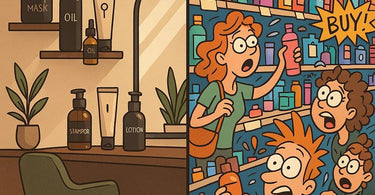
Your clients expect this quality daily, and they're suddenly asking you about a "great dupe" they found online. Welcome to the modern beauty professional's dilemma. As a salon or spa business owner, you're not just selling a service; you're the guardian of results, safety, and trust. The conversation around "dupes"—affordable products designed to mimic high-end ones—is everywhere, fueled by social media and a desire for accessible beauty. But when a client brings a drugstore find into your professional space, it's more than a budget hack; it's a question that cuts to the core of your expertise, your liability, and the very value of the professional beauty industry. Let's unpack this from behind the chair, where the stakes are real and the implications go far beyond a viral TikTok video.
The first crucial distinction we must make as professionals is between a "dupe" and a counterfeit. A dupe, short for duplicate, is a product that imitates the style, function, or aesthetic of a high-end item but is sold under a different brand name and does not try to pass itself off as the original. Think of a chain store selling a contour stick that performs similarly to a luxury brand's but in completely different packaging. These often exist in a legal gray area, mimicking effects without directly infringing on trademarks. A counterfeit, however, is an illegal replica designed to deceive. It uses stolen logos, brand names, and packaging to trick consumers into believing they're buying the genuine article. These are the dangerous fakes that flood online marketplaces, often with subpar, unregulated ingredients. For us, the line is clear: counterfeits have no place in a professional setting, ever. But the dupe conversation is where things get ethically and professionally complicated.
Why Your Clients Are Dupe-Hunting (And It's Not Just About Money)
To navigate this, we need empathy. The appeal of dupes isn't mysterious. For many clients, especially younger ones shaped by social media, dupes represent accessibility. When a luxury gel polish or a celebrity-lauded serum costs a small fortune, a $10 alternative feels like a smart, even rebellious, choice. Influencers and entire communities on platforms like TikTok and Instagram are built around finding and reviewing these "steals," normalizing dupe culture as the savvy way to participate in beauty trends. For some clients, it's a financial necessity; for others, it's the thrill of the hunt. They aren't trying to undermine your authority—they're trying to participate in a beauty narrative that often feels exclusionary. Understanding this "why" is the first step in having a constructive, non-judgmental conversation.
The Professional's Reality: What's Really in the Bottle?
This is where our training and duty of care take center stage. When a client sits in your chair, you are responsible for the integrity of their skin, hair, and nails. This is the fundamental difference between a DIY approach and a professional service. Salon and professional-grade products, like those from Tuel Skincare or ItalWax, are formulated with higher concentrations of active ingredients and are designed to deliver predictable, clinical results. Their formulations are balanced for efficacy and safety under professional use.
Drugstore dupes, while affordable, often achieve their lower price point through compromise. To cut costs, manufacturers may use lower-grade ingredients, more fillers, or less stable formulations. The long-term impact can be a waxy buildup on hair, compromised skin barriers, or color that fades unpredictably. Furthermore, the sourcing and production ethics of some dupe brands can be murky, with less transparency than established professional lines. When you use a professional hydrodermabrasion solution or a specific bleach and lightener, you know its pH, its processing time, and how it will interact with other products in your system. With a dupe, you're gambling with your client's results and your reputation.
The Liability Loophole: Who's Responsible When Things Go Wrong?
Let's talk about the elephant in the treatment room: liability. Imagine a client brings you a tube of a viral "filler-dupe" lip plumper and asks you to use it during their facial. Or they want you to apply a drugstore longwear polish over your professional prep. What happens if they have a severe allergic reaction? What if the product damages their hair during a perm or color service? Your professional insurance is built on the use of products with known formulations, safety data, and manufacturer support. Introducing an unknown, non-professional product into your service chain creates a massive liability loophole. If something goes wrong, you, the licensed professional, will be held accountable. The dupe brand won't be there to support you or your client. This isn't fear-mongering; it's risk management 101 for any serious business owner.
Your Ethical Compass: Supporting Innovation or Enabling Copycats?
Beyond safety and liability, there's an ethical dimension to consider. The professional beauty industry thrives on innovation. Brands invest heavily in research and development to create the next generation of RF machines, more comfortable hard waxes, or breakthrough skincare acids. This innovation is what allows us to offer new, better services to our clients. Widespread dupe culture can undermine this creative ecosystem by siphoning revenue from the original creators, potentially stifling future innovation. As professionals, we are partners with these brands. Choosing to stock and use authentic CND or OPI products, for example, supports the very research that brings better, safer nail technologies to your table.
The Smart Professional's Strategy: Education Over Confrontation
So, how do you handle the dupe dilemma with clients? The answer is confident, compassionate education, not confrontation. Your role is to be the expert guide.
- Start with a Question: "Tell me what you love about that product!" This opens a dialogue instead of shutting it down.
- Explain the "Professional Difference": Use simple analogies. Compare it to a chef using farm-fresh ingredients versus pre-packaged mixes. The result might look similar in a photo, but the quality, consistency, and experience are worlds apart. Highlight how professional products are more concentrated, so a little goes a long way, offering better value over time.
- Focus on Outcomes and Safety: "My goal is to give you the longest-lasting, healthiest result possible. I use this specific wax because I know it adheres to the hair, not the skin, minimizing irritation. I can't guarantee that result or your safety with a formula I haven't trained on."
- Offer a Curated, Accessible Alternative: Have a tiered retail selection. Alongside your premium lines, offer professional-grade brands that provide excellent value. Show them the wax strips or nail treatments you trust that fit a more modest budget. You become their solution, not an obstacle.
Fortify Your Business with True Professional Quality
The best defense against the dupe dilemma is a strong offense built on unwavering quality. Your salon or spa is a sanctuary of expertise. Every element, from the massage table to the towel steamer to the cuticle oil, should scream professional integrity. This is where partnering with a trusted distributor like Pure Spa Direct becomes your strategic advantage. We aggregate the world's best professional brands—from Lycon for waxing to Biotone for massage—giving you access to authentic, safe, and effective products without the markup of going directly to dozens of manufacturers.
Invest in the tools that make your services irreplaceable. A professional Facial Steamer or a microdermabrasion machine delivers results no dupe product can match. Stock your retail wall with products that are extensions of your services, like post-waxing treatments or signature sugar scrubs. When your entire business model is built on demonstrable superior quality, the dupe conversation shifts. It's no longer about denying a client a cheap alternative; it's about inviting them into an experience and a standard of care that has inherent, tangible value they can't replicate at home.
The Bottom Line: You Are The Asset
In the end, the most powerful answer to "Why shouldn't I just use the dupe?" is you. Your knowledge, your skilled hands, your professional judgment, and your commitment to safety are what clients pay for. The products are the tools, but you are the master craftsperson. By standing firm on professional-grade products, you protect your clients, your business, and the standards of our entire industry. You reaffirm that some things—expertise, safety, and guaranteed results—are simply worth the investment. So the next time the dupe dilemma walks into your spa, smile, lean on your expertise, and show them the real meaning of professional value. Your clients, and your bottom line, will thank you for it.
%20Take%20on%20Salon%20vs.%20Drugstore.)