
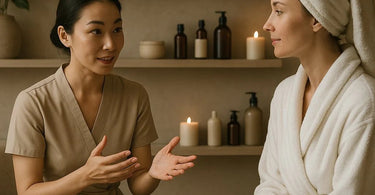
Your journey to excellence starts now... with what your clients aren’t saying. Imagine this: a new client walks into your spa, filled with anticipation for their treatment, but they communicate differently. Maybe they’re non-verbal, have selective mutism, or simply process information better visually. The traditional consultation – that rapid-fire Q&A we all know – suddenly falls flat. But here’s the beautiful truth: the most profound conversations in our industry often happen without a single word. Mastering the art of the non-verbal consultation isn’t just about accessibility; it’s about elevating your service for every single person who walks through your door. It’s time to listen with your eyes, speak with your tools, and create an experience that truly connects.
Think about your own communication for a second. When you’re getting a service, how much do you rely on pointing, nodding, or making a face when the pressure is just right? Now amplify that by 100. For non-speaking clients, these non-verbal cues are the primary language of the appointment. The good news? You’re already halfway there. Every time you’ve used a color chart for a brow tint or a pressure scale for a massage, you’ve been practicing non-verbal communication. We’re just going to build you a bigger, better, and frankly, more fun toolbox.
Beyond the Clipboard: Rethinking the Intake Form
Let’s be real, the standard intake form can be intimidating. For a non-speaking client or someone with communication differences, it can be a barrier before the service even begins. The solution? Visual intake forms. These are game-changers. Instead of lines of text, use icons and images. A picture of a face with areas highlighted for “areas of concern,” emoji-style pain scales (because who doesn’t understand a crying face versus a smiling one?), and visual product selectors can make the process collaborative and stress-free. This isn’t about dumbing things down; it’s about smartening up your process. You can even use tablets with interactive forms for a modern touch that feels more engaging than a piece of paper.
Your New Best Friends: Communication Boards & Visual Aids
If you’ve ever pointed at a menu because you couldn’t pronounce ‘quinoa,’ you get the concept. Communication boards for spas and salons are simply specialized menus for comfort, pressure, and needs. Create laminated boards with clear, large images and simple text. Think: “More Pressure” / “Less Pressure,” “Too Hot” / “Too Cold,” “Check Forehead” / “Check Nose.” For waxing services, a body map where clients can point to the areas they want treated is incredibly effective. For facials, a skin diagram can help them indicate concerns like dryness, oiliness, or sensitivity. Stock up on Spa Tools & Implements that are visually intuitive, making the process smoother for everyone.
The Power of Pre-Visit Planning
One of the most powerful tools in your arsenal happens before the client even arrives. Offer a pre-visit consultation via email or a secure messaging platform. This allows clients or their caregivers to detail preferences, concerns, and goals in a comfortable, non-time-pressured environment. They can send photos of hairstyles they like, describe past positive or negative experiences, and outline any specific sensory sensitivities (e.g., to strong smells from certain Aromatherapy Supplies or the sound of a specific tool). This prep work means you can walk into the appointment feeling prepared and confident, ready to deliver a personalized experience from the first moment.
Speaking Through Touch: The Tactile Consultation
Sometimes, the consultation *is* the service. This is where your technical skill becomes your voice. For massage therapists, this is your superpower. Before even applying oil, use firm, intentional touch to assess muscle tension. As you work, pay hyper-attention to the client’s physical responses – a flinch, a relaxation of the muscles, a slight shift away or towards your pressure. This real-time feedback loop is a conversation in itself. Using high-quality Massage Oils, Lotions, and Creams can also communicate care and quality through texture and subtle scent. The same principle applies during a facial; gently pressing on different areas of the face can help you identify tension and congestion without a single question.
Setting the Stage for Silent Success
The environment you create speaks volumes before you do. A calm, predictable, and non-overwhelming space is key. This means managing noise levels, avoiding harsh lighting, and having a dedicated, clutter-free space. Something as simple as a comfortable Massage Table with cozy Salon & Spa Bedding can say “you are safe here” more effectively than any greeting. For clients who may be overwhelmed, having a quiet corner or a weighted blanket available can make all the difference. Your Luxury Spa Furniture isn’t just for looks—it’s a core part of your non-verbal communication strategy.
Tech to the Rescue: Digital Tools for Better Communication
Embrace technology! Tablets can be loaded with apps that facilitate communication, or simply used to type back and forth. You can show clients before-and-after photos of services, short video clips demonstrating a technique (like the gentle application of ItalWax - Wax), or images of the Nail Art Rhinestones you have available. This visual confirmation eliminates guesswork and ensures you’re both on the same, gorgeous page.
Training Your Team to “Listen” Differently
This shift starts with your staff. Role-play scenarios where team members practice consultations without speaking. Debrief afterwards: What cues did you pick up on? What was challenging? What tools would have helped? This builds empathy and muscle memory. Ensure everyone is familiar with any specialized tools, like the consistent temperature of a Towel Steamer or the gentle exfoliation of a Sugar Scrub, so they can confidently explain them non-verbally. Investing in this training isn’t a cost; it’s an investment in making your business a welcoming place for a wider clientele.
The Universal Benefits: Why This Makes You a Better Pro
Here’s the secret they don’t tell you: refining your skills for non-speaking clients makes you a better technician for *everyone*. You become more observant, more intuitive, and more creative in your communication. That client who’s too relaxed to talk during their massage? You’ve got it covered. The international client who doesn’t share a language with you? No problem. You’re no longer relying solely on words that can be misunderstood or forgotten. You’re building a practice based on undeniable feeling and clear, visual understanding. It makes using tools like a Facial Steamer or selecting a Professional Gel Polish color a seamless, collaborative experience.
Building a Truly Inclusive Clientele
By publicly offering non-verbal consultation options, you send a powerful message to your community: “Everyone is welcome here.” This isn’t just good ethics; it’s good business. You tap into a market of loyal clients and their families who are often overlooked by traditional beauty and wellness spaces. They will not only return, but they will become your most passionate advocates. Whether it’s a precise brow shape with Brow Lamination Supplies or a relaxing manicure with our Cuticle Oil, the service becomes about more than the result—it’s about the respectful and connected journey to get there.
So, take a look around your spa or salon. What does your space say? What does your process say? By embracing the non-verbal consultation, you’re not just learning a new skill—you’re learning a new language of care. And that’s a language that every client, regardless of how they communicate, understands perfectly.
