
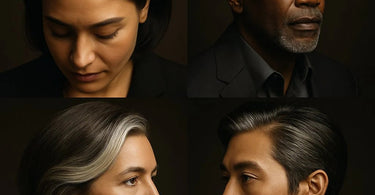
Work smarter, not harder... especially when dealing with the fascinating world of gray hair regrowth patterns. If you've ever looked at two clients with '50% gray' and thought, "Why does one look distinguished while the other looks like they lost a fight with a skunk?" you've encountered the mysterious regrowth pattern. Gray hair doesn't follow a uniform playbook—it's more like a rebellious teenager who shows up wherever it wants, whenever it wants. Understanding these patterns isn't just salon trivia; it's the key to transforming your color services from good to "how did you do that?" magnificent.
As professionals, we know that gray hair isn't a monolith. It's a personal signature written in silver, white, and sometimes unfortunate yellow tones. Some clients get that sophisticated George Clooney crown concentration, others rock the "badger stripe" at the temples, and a lucky few get random silver streaks that look intentionally expensive. Then there are those whose gray comes in like a Jackson Pollock painting—completely unpredictable and occasionally stressful to look at. The pattern dictates everything: your color formulation, application technique, and maintenance schedule.
The Crown Concentrator: When Silver Gathers at the Summit
Meet the "Crown Concentrator"—the client whose gray hair decided that the top of their head is prime real estate. This pattern typically starts at the crown and spreads outward, creating what we affectionately call the "monk's spot" or "reverse halo." From a color perspective, this pattern requires strategic blending because that concentrated gray area can process differently and appear brighter than the rest of the hair.
For these clients, consider using a professional hair color with slightly different formulas for the crown versus the rest of the head. The crown might need a formula with more base color to counteract the density of gray, while the sides and back could use a lighter formula. This is where your color brushes and sectioning skills really shine. Don't forget to stock up on mixing bowls for creating custom formulations on the fly.
The Temple Streaker: Distinguished Sideburns or Rogue Accents
The "Temple Streaker" client sports those sophisticated silver streaks at the temples—the pattern that makes men look distinguished and women contemplate cutting a dramatic fringe. This pattern can be the easiest or most challenging to work with, depending on the client's desired look. Some want to camouflage those streaks entirely, while others want to enhance them for a natural highlight effect.
For full coverage, you'll need a color with excellent gray coverage—consider formulas specifically designed for resistant gray hair. For enhancement, techniques like balayage or foilayage can blend the natural grays with artificial highlights seamlessly. This is where having quality color foils and highlighting caps becomes essential. The temple area also tends to be more sensitive, so having barrier cream on hand protects skin during the coloring process.
The Random Sprinkler: When Gray Plays Hide and Seek
Then there's the "Random Sprinkler"—the client whose gray hairs appear to have been applied by a confetti cannon. This salt-and-pepper pattern distributes gray hairs evenly throughout, creating overall lightness without distinct patterns. While this might seem easier to color, it actually requires meticulous application to ensure every gray hair gets saturated.
For sprinkler patterns, consider using a applicator bottle with a fine tip for precise application or a color comb to work the formula through the hair thoroughly. These clients are perfect candidates for demipermanent colors that blend rather than completely cover, creating a more natural grow-out. The random nature of this pattern means the regrowth is less noticeable, allowing for longer intervals between touch-ups—something your busy clients will appreciate.
The Frontal Bandit: When Gray Claims the Hairline
The "Frontal Bandit" pattern concentrates gray along the front hairline and face-framing sections. This pattern can be particularly aging for clients because it draws attention to fine lines around the eyes and mouth. However, it's also one of the most rewarding patterns to transform because changes in this area have the biggest impact on a client's overall appearance.
For frontal grays, consider slightly lighter or warmer tones around the face to create a softening effect. This is where techniques like face-framing highlights or the use of color glosses can make a dramatic difference. Since this area is highly visible, precision tools like angled brushes and tint bowls with secure grips are essential for clean application along the hairline.
Pattern-Based Formulation Strategies
Different regrowth patterns require different color approaches. For dense crown grays, you might need a higher volume developer and longer processing time. For fine temple grays, a lower volume developer prevents over-processing of both the gray hairs and the more delicate hair in that area.
Your color chart becomes your best friend when customizing formulas for pattern-based coloring. Consider keeping a client journal that notes not just their formula but their specific gray pattern—this allows you to anticipate how their color will grow out and plan accordingly. Stocking a range of professional hair color brands ensures you have the right tools for every pattern that walks through your door.
The Consultation Conversation: Talking Patterns with Clients
During consultations, instead of just asking "how much gray do you have?" try asking "where does your gray like to hang out?" This more visual approach helps clients describe their pattern more accurately. Use a magnifying mirror or magnifying light to examine the pattern together—this not only ensures you're on the same page but demonstrates your expertise and attention to detail.
Explain how their specific pattern will affect the coloring process, maintenance schedule, and final result. The crown concentrator might need more frequent touch-ups, while the random sprinkler can stretch appointments longer. Setting realistic expectations based on their pattern builds trust and reduces post-service disappointments.
Tools of the Trade for Pattern-Perfect Color
Dealing with diverse gray patterns requires an arsenal of specialized tools. Beyond standard coloring supplies, consider adding detail applicators for precision work on temple streaks, sectioning clips that hold firmly without denting, and color removers for those inevitable pattern miscalculations.
Your backbar should include products for every pattern scenario: color-depositing shampoos for maintaining tone between services, root concealers for emergency pattern coverage, and purple shampoos for preventing brassiness in gray and white hairs. Don't forget the processing caps and heat accelerators for stubborn gray patterns that need extra persuasion.
Turning Pattern Knowledge into Profit
Understanding regrowth patterns allows you to create customized service packages. Offer "Pattern-Perfect Color" sessions that include pattern analysis, custom formulation, and precision application. Develop maintenance packages based on pattern type—the crown concentrator might need a mini touch-up between full services, while the frontal bandit might benefit from a color gloss refresh.
Use your pattern expertise during retail recommendations too. The temple streaker might love a root powder for quick touch-ups, while the random sprinkler might appreciate a color-enhancing conditioner to maintain vibrancy. Your deep understanding of their specific pattern makes you indispensable—and that's how you turn one-time clients into lifelong loyalists.
Ultimately, recognizing that gray hair is as unique as a fingerprint transforms your approach to color services. Instead of fighting against nature's design, work with it to create results that look fabulous from the first day to the last. Your clients will appreciate the personalized approach, and you'll enjoy the creative challenge of turning every regrowth pattern into a work of art. Now go forth and conquer those crowns, tame those temples, and make peace with the sprinklers—your color game is about to get pattern-perfect!
%20%26%20What%20It%20Means%20for%20Your%20Color%20Services)