
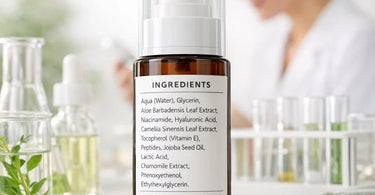
Your journey to better results starts here... and sometimes it begins with a little alphabet soup. If you've ever squinted at the back of a serum bottle, felt your eyes glaze over at 'Tocopherol,' or wondered if 'Aqua' is somehow fancier than the water from your tap, you're not alone. Welcome to the world of INCI lists, the universal language of cosmetic ingredients. For spa and salon professionals, this isn't just about satisfying curiosity—it's a critical business tool. Decoding these labels builds trust with clients, informs better treatment choices, and elevates your expertise from 'service provider' to 'trusted advisor.' It turns the confusing fine print on your Premium Skincare products into a clear roadmap for client success. So, let's grab our linguistic decoder rings and translate this professional must-know.
INCI 101: What in the World is This Universal Language?
INCI stands for International Nomenclature of Cosmetic Ingredient. Born in 1973, this system was created to solve a massive industry headache: imagine if every country, brand, and supplier used different names for the same ingredient. Chaos! The INCI system provides a single, standardized name for each cosmetic ingredient used across the globe, from the United States and the European Union to China and Japan. It's managed by the Personal Care Products Council (PCPC), which publishes the official International Cosmetic Ingredient Dictionary and Handbook.
Think of it this way: just as 'H2O' means water to a scientist in Paris or Tokyo, 'Aqua' (or 'Water') in an INCI list means the same thing to an esthetician in Florida or a chemist in Germany. This universal language helps everyone—from the dermatologist tracking an allergic reaction to the regulator ensuring safety—speak the same tongue. For you, the professional, it means the Tuel Skincare moisturizer you love and the Murad treatment serum you recommend both list their ingredients in a way you can consistently understand and compare.
The Golden Rules of Reading an INCI List: It's All About Order!
Okay, you've found the list. Now, how do you read it? The two most important rules are about nomenclature and order. First, the ingredients must be listed using their standardized INCI names. Second, and this is the golden rule for decoding potency, ingredients are listed in descending order of concentration (by weight) down to the 1% mark. The ingredient present in the greatest amount is first, the second-greatest is second, and so on.
Ingredients at concentrations of 1% or less can be listed in any order after that point. This is why you'll often see exciting 'hero' ingredients or preservatives clustered at the end. For example, if 'Water (Aqua)' is first and 'Glycerin' is second, you know that product contains more water than glycerin. This hierarchy is your secret weapon. When a client brings in a drugstore cream that claims to be 'packed with vitamin C,' but 'Ascorbic Acid' (the INCI name for pure vitamin C) is listed dead last after the preservatives, you can gently explain why your professional-grade Advanced Facial Treatment product, with its actives higher on the list, might be a more effective investment for their goals.
Decoding the Vocabulary: Latin, Science, and Common Sense
An INCI list is a fascinating mix of scientific, Latin, and common English names. Here's your quick translation guide:
- Botanical Ingredients: These use the plant's Latin botanical name, often followed by the plant part and the form. For example, soothing Aloe Vera becomes 'Aloe Barbadensis Leaf Juice'. Luxurious Jojoba Oil is 'Simmondsia Chinensis (Jojoba) Seed Oil'.
- Common Chemical Ingredients: Many familiar ingredients keep their common names. Glycerin stays 'Glycerin,' Beeswax can be listed as 'Beeswax' or 'Cera Alba,' and Vitamin E is typically 'Tocopherol'.
- Fragrances and Colors: Added scent is usually grouped under 'Fragrance (Parfum)'. Color additives may use Colour Index (CI) numbers, like 'CI 77891' for Titanium Dioxide (a white pigment).
This system helps you verify claims. That 'Rose-Infused' toner should have 'Rosa Damascena Flower Water' on its INCI list. If it just has 'Fragrance (Parfum),' you know the rose is likely a synthetic scent. This knowledge is power when selecting authentic products for your Serenity Essentials collection or Aromatherapy treatments.
What INCI Lists Can (and Can't) Tell You: Managing Expectations
INCI lists are incredibly informative, but they have limits. It's crucial to know what they can and cannot do.
What They CAN Do:
- Identify Allergens & Irritants: Clients with sensitivities can avoid known triggers like certain essential oils or preservatives.
- Confirm Active Ingredients: You can verify if a 'Retinol' cream contains 'Retinol' or a different retinoid derivative.
- Show Relative Concentration: As discussed, the order reveals what the product is mostly made of.
- Expose "Greenwashing": A product marketed as 'natural' but filled with synthetic polymers high on the list might not meet your salon's standards.
What They CANNOT Do:
- Guarantee Safety or Approval: An ingredient having an INCI name does NOT mean it's been approved or deemed safe by any regulatory body. That evaluation is the manufacturer's responsibility.
- Reveal Exact Percentages: Except for active ingredients in drugs (like SPF in sunscreen), you don't know the exact percentage of each component.
- Detail Ingredient Quality or Origin: 'Glycerin' could be derived from plants or synthetically produced. 'Prunus Amygdalus Dulcis (Sweet Almond) Oil' could be cold-pressed or refined. The INCI name is the same.
- Explain Proprietary Blends: A trade name like "Matrixyl 3000" must be resolved to its INCI components (e.g., Glycerin, Aqua, Palmitoyl Tripeptide-1), but the exact blend ratio is often a trade secret.
Putting It Into Practice: INCI in Your Daily Spa & Salon Routine
So, how does this translate from textbook to treatment room? Let's walk through some real-world applications that will make you an ingredient superstar.
1. The Curious Client Consultation: A client asks why you use a certain Professional Gel Polish brand. Instead of a vague "it's good," you can point out its ingredient list: "I choose this brand because it uses 'Butyl Acetate' and 'Ethyl Acetate' as its primary solvents, which is a common and effective formulation, and it avoids [ingredient you prefer to avoid]. Its top ingredients indicate a formulation designed for durability and shine." Boom. Instant credibility.
2. The Sensitive Skin Savior: A client with reactive skin is nervous about a Hydrodermabrasion treatment. You can show them the post-treatment calming gel's INCI list: "See, the second ingredient here is 'Aloe Barbadensis Leaf Juice,' known for soothing, and we have 'Bisabolol' (from chamomile) further down, which is fantastic for reducing redness." You've addressed their fear with facts.
3. The Product Selection Pro: When choosing a new ItalWax formula or a Post-Waxing serum, don't just look at the marketing. Compare INCI lists. Is the pre-wax oil mostly silicones or lightweight plant oils? Does the post-wax lotion have calming ingredients like 'Hamamelis Virginiana (Witch Hazel) Water' high on the list? This informed selection leads to better client results and fewer comebacks.
4. The Retail Sales Boost: A client loves their facial and wants to take the magic home. When recommending a Spa Retail Product, highlight key ingredients: "Your skin loved the hydration during the treatment. This moisturizer has 'Sodium Hyaluronate' (a form of hyaluronic acid) as a key active, which is why it plumped your skin so beautifully." You're not just selling a jar of cream; you're selling a specific, demonstrable benefit.
Red Flags & How to Spot a Shady INCI List
Not all ingredient lists are created equal. As a pro, you should be able to spot warning signs of an incorrect or misleading list. If you see these, consider it a red flag about the brand's attention to detail:
- Use of Common Names Only: A list that says "Vitamin E" instead of "Tocopherol" or "Rose Oil" instead of the proper Latin name lacks precision.
- Trade Names in the Main List: You should never see marketing names like "Pro-Retinol Complex 5" in the official list. These must be broken down into their INCI components.
- Marketing Fluff in the List: Words like "organic," "wild-harvested," or "infused with" don't belong in the INCI list itself. Those claims should be separate.
- Implausible Order: If a water-soluble ingredient like "Hyaluronic Acid" appears before "Water (Aqua)," the list is almost certainly wrong.
- The "Too Good to Be True" List: A list containing only lovely plant extracts and oils, with no preservatives, emulsifiers, or solvents, is incomplete. Every stable formula needs these supporting ingredients.
Stick with professional brands from trusted distributors like Pure Spa Direct, where accuracy and compliance are a given. Explore reputable brands in our full Brands Directory.
Become Your Clients' Ingredient Guru
Mastering INCI lists is more than a party trick for beauty nerds (though it is a great one). It's a foundational skill that separates the hobbyist from the professional. It empowers you to make smarter choices for your Spa Essentials inventory, provide rationales for your treatment plans, and build unshakeable trust with your clientele. They come to you for expertise. Speaking confidently about what's actually in the products you use—from Massage Lotions to Lash & Brow tints—is the ultimate demonstration of that expertise.
So next time you unbox a new Facial Steamer or sample a new Sugar Scrub, take a moment to read the label. Play a game: find the water, identify the top three ingredients, look for a fun active you know. Turn it into a team training exercise. This knowledge is now part of your professional toolkit—use it to curate exceptional experiences, one decoded ingredient at a time.
