
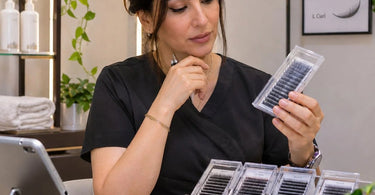
Efficiency that makes a difference... that is the secret to running a small lash studio where every square inch of storage space and every dollar of inventory counts. Offering clients beautiful, customized lash extensions is exciting, but stocking every curl imaginable can turn your perfectly organized lash station into a miniature warehouse of mysterious little trays. Before you start collecting C, CC, D, L, M, and every other curl in the lash alphabet, it pays to understand which options actually support your services, your clientele, and your bottom line. With the right approach to professional lash extensions and supplies, you can deliver impressive variety without burying your workstation beneath enough lash trays to open a second studio.
For independent lash artists, boutique salons, and small beauty studios, the goal is not necessarily to carry the largest inventory. It is to maintain a thoughtfully selected assortment that makes professional lash application easier, supports personalized results, and minimizes unnecessary purchases. Understanding how different lash curl types work is the first step toward building that assortment.
Why Lash Curl Variety Matters in a Small Studio
Every client arrives with a different combination of natural lash direction, eyelid anatomy, eye shape, and desired appearance. One client wants a barely-there enhancement, while another wants a dramatic, wide-eyed result that practically announces her arrival before she enters the room.
Professional lash extensions allow technicians to customize the appearance of the lash line through curl, length, diameter, placement, and styling techniques. Curl selection is particularly important because it influences the direction and visible lift of the finished set.
However, more curl options do not automatically produce better results. A lash artist who understands three curl types exceptionally well may provide more consistent services than someone who stocks ten different curls without a clear application strategy.
Before expanding your inventory, evaluate which curl profiles complement the techniques you already offer and which additional options would solve genuine styling challenges.
Understanding the Most Common Lash Curl Types
Although individual manufacturers may use slightly different curl profiles, several familiar categories appear throughout the professional lash extension industry. Understanding these general characteristics helps technicians make more informed stocking decisions.
J Curl: The Understated Natural Look
J curl extensions have a relatively straight profile with a subtle upward curve. They can be useful when creating delicate enhancements for clients who prefer a natural appearance.
Because J curls create relatively little additional lift, they may not be the best choice for every downward-growing natural lash. Their suitability depends on the client's lash direction and the attachment area available.
For studios specializing in subtle classic extensions, keeping a limited selection of J curl lashes may be worthwhile. Studios whose clients overwhelmingly request more noticeable lift may find that J curl trays move slowly.
B Curl: Soft Definition Without Excessive Lift
B curl extensions provide a gentle curve that falls between the subtle J curl and the more pronounced C curl.
They may work well for clients who want soft definition or whose natural lashes already have some upward curvature. The finished appearance can be polished without looking overly dramatic.
However, if your studio primarily creates lifted, glamorous sets, B curl may become an occasional specialty item rather than an everyday essential.
C Curl: The Versatile Studio Staple
C curl is a practical starting point for many lash extension inventories because it provides noticeable curvature without automatically creating an extremely dramatic effect.
It can support natural-looking enhancements, classic extensions, and a range of textured or volume styles when combined with appropriate lengths and diameters.
For a small studio building its first organized assortment, C curl often deserves consideration as a core inventory option.
That does not mean C curl belongs on every client. Natural lash health, growth direction, eye anatomy, and the desired appearance should always guide professional selection.
CC Curl: A Little More Lift
CC curl generally sits between C and D in terms of visible curvature, although the exact profile varies among manufacturers.
It can be a useful option when a client wants more lift than a standard C curl provides without moving directly to a stronger D curl.
For studios with clients who regularly request defined, lifted lash sets, CC curl may be a valuable addition.
Before stocking both C and CC across every available diameter and length, however, compare the actual profiles from your preferred supplier. Some brands produce curls that are surprisingly similar. Your storage drawer does not need two versions of practically the same thing just because the packaging uses different letters.
D Curl: Bold, Noticeable Curvature
D curl extensions generally create a stronger upward curve and can be useful for dramatic styling when the client's natural lashes and attachment conditions allow it.
They are popular options for certain open-eye, glamorous, and high-lift looks.
However, stronger curvature is not automatically better. A dramatic curl that does not align appropriately with the natural lash may reduce the usable bonding area or create an undesirable direction.
Professional evaluation matters more than simply choosing the curliest option in the tray.
L and M Curls: Specialty Profiles for Custom Styling
L and M curl families differ from traditional rounded curls because their shapes generally incorporate a straighter base or a distinctive transition into visible lift.
Depending on the exact manufacturer profile, these styles may be useful for certain straight-growing lashes, hooded eyelids, or customized styling techniques.
They can give experienced technicians additional design options, but they also require familiarity with attachment angles, natural lash direction, and proper placement.
If your studio frequently serves clients who benefit from these profiles, stocking a small assortment may make sense. If requests are rare, start with a limited selection rather than investing in an entire specialty collection.
Start With Your Actual Clientele, Not Social Media Trends
Online lash inspiration changes quickly. One week everyone wants a soft natural set, and the next week your feed is overflowing with dramatic lifted lashes that seem capable of producing their own breeze.
Trends can inspire service development, but they should not control your purchasing decisions.
Review your recent appointments and identify the styles clients actually request. Consider the following questions:
- How many clients prefer classic or natural-looking extensions?
- How many regularly request dramatic lift or volume?
- Which natural lash directions do you encounter most often?
- Are there clients whose styling needs are difficult to accommodate with your current curls?
- Which extension trays do you reorder frequently?
- Which products remain mostly untouched between appointments?
Even a simple review of your last 30 to 50 lash appointments can provide useful information about demand.
For example, if approximately 70 percent of your clients receive sets primarily using C curl, there may be little reason to devote equal storage space and purchasing dollars to six other profiles.
Stock according to actual service demand, then expand when your appointment history supports the investment.
Remember That Curl Is Only One Part of Your Inventory
One of the biggest mistakes small studios make is treating lash curl selection as a standalone purchasing decision.
Every additional curl can introduce multiple possible combinations of length, diameter, finish, and product format.
Suppose you carry four curl types, three diameters, and ten individual lengths. That represents 120 possible combinations before considering different materials, finishes, or extension styles.
Suddenly, your cute little lash cabinet has developed the inventory requirements of a department store.
The solution is to simplify your product assortment through intentional combinations rather than purchasing every variation.
Choose Mixed-Length Trays Whenever Practical
For small studios, mixed-length lash extension trays can be a useful way to offer styling flexibility without maintaining excessive quantities of separate single-length packages.
Mixed trays allow artists to work with several lengths from one package, making them particularly convenient when experimenting with a new curl profile or serving clients who require different lash mapping patterns.
However, mixed trays are not automatically the most economical choice for every service.
If you consistently use certain lengths faster than others, repeatedly purchasing mixed trays may leave you with an accumulation of rarely used strips.
A practical approach is to use mixed-length trays for secondary curls and specialty styling while considering individual-length trays for your highest-volume combinations.
This balances flexibility with more predictable inventory consumption.
Match Lash Diameter to the Services You Actually Perform
Diameter is another important consideration because it affects extension weight, appearance, and suitability for different application techniques.
Classic extension services generally use different diameter selections from many volume or mega-volume techniques.
For example, some artists work with diameters around 0.12 mm or 0.15 mm for suitable classic applications and finer options such as 0.05 mm or 0.07 mm for certain volume techniques. These are examples of common product categories, not universal recommendations.
The appropriate diameter depends on the natural lash condition, extension length, number of extensions used, product characteristics, and the technician's training.
Before expanding your curl inventory, determine whether your studio needs each curl in classic diameters, volume diameters, or both.
A technician who primarily offers classic services may not need a comprehensive volume assortment. Likewise, a studio specializing in volume work should prioritize the curl and diameter combinations used in those appointments.
Shop classic lash extensions and volume lash extensions based on your actual service menu rather than the temptation to stock everything available.
Consider How Different Curls Affect Lash Mapping
Professional lash mapping determines how extension lengths, curls, and placement work together to create a particular visual result.
A studio offering natural, open-eye, cat-eye, and customized styling may benefit from having more than one curl profile available.
However, the same curl can produce very different results depending on where it is positioned and how its length is distributed across the lash line.
For example, a dramatic curl placed throughout the entire lash line does not necessarily produce a more flattering result than thoughtfully combining compatible curls across different zones.
Similarly, adding more length to the outer corner does not automatically create a lifted appearance. On some eye shapes, an overly long outer section can visually emphasize downward movement.
Before purchasing specialty curls, make sure you understand how they fit into your lash mapping techniques.
Maintain clear client records showing curl, diameter, length, placement, styling preferences, and relevant observations. These records make future appointments more consistent and help identify which products deserve permanent inventory space.
Compare Curl Profiles Between Manufacturers
One detail that catches even experienced technicians by surprise is that curl labels are not perfectly standardized across brands.
A C curl from one manufacturer may look more pronounced than a C curl from another. Differences can also appear in the base shape, overall curvature, taper, and flexibility of the extensions.
Before placing a large wholesale order, compare samples from the specific product lines you plan to use.
Look at the lashes from the side, evaluate their consistency, and consider how the profile works with your preferred professional techniques.
Consistency is especially important when transitioning between suppliers. Mixing noticeably different curl profiles without planning can make it harder to reproduce established client maps.
For a small studio, maintaining a dependable primary extension line can simplify purchasing, training, and inventory organization.
Calculate the Real Cost of Carrying Extra Lash Trays
Wholesale pricing is important, but the cost of an inventory decision goes beyond the price printed on a package.
Every additional lash tray ties up money that could be used for frequently consumed essentials such as lash extension adhesive, lash extension tweezers, under-eye gel pads, and other everyday service supplies.
Consider a hypothetical studio that purchases twelve additional specialty trays at $15 each. That represents $180 in inventory before any other purchasing costs.
If those trays are used frequently, the investment may be justified. If they sit unopened for months, the money might have been better spent replenishing products essential to existing appointments.
Also consider storage requirements, product handling, potential damage, and the administrative time required to track each variation.
The best inventory purchase is not necessarily the one with the largest quantity discount. It is the purchase that supports reliable service delivery without creating unnecessary stock.
Create a Simple Minimum and Maximum Inventory System
Small studios do not need complicated inventory software to maintain control over their lash supplies.
A basic spreadsheet can provide an effective starting point.
Record each product's curl type, diameter, length assortment, supplier, purchase date, current quantity, and approximate consumption rate.
Then establish a minimum stock level for your most frequently used products.
For example, if your studio typically consumes two trays of a particular curl and diameter combination each month, you might maintain enough inventory to cover expected appointments and supplier delivery time, plus a reasonable buffer.
Less frequently used specialty curls may require only a small reserve or a planned ordering schedule.
Review consumption regularly and adjust minimum quantities when client demand changes.
This system helps prevent both last-minute shortages and those mysterious inventory discoveries where you find seven nearly identical trays hiding behind the lash cleanser.
Organize Your Lash Station for Fast Access
Inventory organization is especially important when working in a compact studio where treatment space and storage space overlap.
Keep frequently used curl types within easy reach while storing less common specialty profiles in clearly labeled containers.
Separate inventory by curl, diameter, and length assortment to reduce mistakes during appointments.
Helpful organizational practices include labeling drawers, maintaining consistent tray positions, recording opened packages, and periodically checking your stock against your inventory records.
Consider using dedicated lash extension storage accessories to keep supplies protected and organized.
Store products according to the manufacturer's instructions, in clean conditions that help protect them from contamination and physical damage.
For adhesive products and other chemical supplies, follow their specific storage, opening, and replacement recommendations. Their handling requirements should not be assumed to be identical to those of extension trays.
An organized station makes appointments smoother while creating a more polished professional environment.
Do Not Sacrifice Application Quality for Styling Variety
Offering multiple curl types should never come at the expense of appropriate lash selection or safe professional application.
Natural lashes vary in strength, density, growth direction, and condition. Extension choices should respect those characteristics rather than forcing a predetermined look.
A curl that appears beautiful in a product photograph may not provide an appropriate attachment area on every natural lash.
Clients requesting dramatic results may need adjustments to length, diameter, density, or styling to create an attractive outcome within the limitations of their natural lashes.
Technicians should follow their professional training, product instructions, and applicable licensing and sanitation requirements.
Proper isolation, suitable adhesive use, attention to client sensitivities, and careful placement remain essential regardless of how many curl types are available.
If a client experiences significant irritation, pain, or an unusual reaction, cosmetic application should not continue without appropriate assessment.
A well-stocked studio supports professional judgment. It does not replace it.
Introduce New Curls Gradually Instead of Buying Everything at Once
If you are interested in expanding your styling options, consider treating each new curl as a small business experiment.
Begin with one additional profile that addresses a recurring client request or a specific styling challenge.
Purchase a limited assortment, study the manufacturer's guidance, practice the application techniques, and evaluate the results within your professional scope.
Track how frequently the new curl is used, which lengths are consumed, and whether clients return requesting similar styling.
After several weeks or a suitable number of appointments, determine whether the product deserves a permanent place in your inventory.
If demand remains low, there is no need to expand into every available diameter and length.
This approach makes product experimentation manageable without turning your entire purchasing budget into a gamble.
Build a Practical Starter Assortment for a Small Lash Studio
There is no universal inventory formula that works for every lash business, but a compact assortment can begin with a few carefully chosen curl families.
For a studio offering both natural and defined lash extension styles, a possible starting framework might include:
- Primary curl: C curl in the lengths and appropriate diameters most frequently used in your core services.
- Additional lift option: CC or D curl, selected according to client demand and professional styling requirements.
- Soft styling option: B or J curl if natural-looking enhancements are a meaningful part of your service menu.
- Specialty option: A limited L or M curl assortment if your clientele and training support its use.
- Flexible backup: Mixed-length trays for less frequently requested combinations.
This is an inventory planning example, not a prescription for which curls should be applied to particular clients.
A studio specializing in highly dramatic volume sets may require a different mix from one focused on subtle classic extensions.
The important principle is to build around the services you actually provide and expand based on real demand.
Know When It Is Time to Expand Your Lash Curl Selection
Adding another curl type makes the most sense when it solves a recognizable problem.
Perhaps multiple clients are requesting a look you cannot consistently achieve with your current assortment. Maybe your technicians have completed additional professional training and are ready to offer a new styling service.
Or perhaps your existing specialty tray has become a regular part of appointments and needs a more dependable replenishment plan.
Those are meaningful reasons to expand.
Less compelling reasons include a temporary social media trend, an attractive product display, or the irresistible urge to purchase something because the packaging looks adorable.
Before ordering, ask whether the new curl will improve styling flexibility, support a profitable service, or address recurring client needs.
If the answer is unclear, begin with a smaller trial purchase.
Think About the Complete Lash Service Setup
Successful lash appointments depend on more than extensions alone.
Reliable supplies, comfortable treatment arrangements, appropriate lighting, hygienic practices, and efficient organization all influence the experience of both the technician and the client.
As you plan your inventory, evaluate the complete selection of lash and brow service supplies needed to support your appointments.
Useful categories may include professional adhesives, tweezers, lash cleansing products, disposable applicators, eye pads, and other accessories selected for the specific services performed.
Review your professional cleaning and disinfecting supplies as well, ensuring that reusable tools and treatment surfaces are handled according to the appropriate product directions and applicable regulations.
A carefully maintained assortment of essential products often contributes more to daily efficiency than an oversized collection of specialty curls.
How Pure Spa Direct Helps Professionals Stock Smarter
Pure Spa Direct supplies professional beauty and spa businesses with products for a wide range of salon services. As a distributor rather than a manufacturer, Pure Spa Direct helps professionals shop across relevant supply categories when planning their treatment rooms and purchasing routines.
For lash artists, exploring lash and brow enhancement services for professionals can provide a useful starting point for evaluating products that support a growing service menu.
Studios can also browse lash extension products and professional supplies when comparing options for their individual needs.
Rather than purchasing every available item, focus on selecting compatible products, maintaining dependable supplies, and choosing quantities that reflect actual client demand.
Final Thoughts: More Curl Options Should Mean More Possibilities, Not More Clutter
Stocking multiple lash curl types can be an excellent way to expand creative flexibility and provide more personalized services in a small studio. But variety works best when it is supported by professional knowledge, organized purchasing, and a clear understanding of client preferences.
Start with the curls that support your most popular services. Introduce specialty options gradually, track how often they are used, and avoid purchasing unnecessary combinations simply because they exist.
Pay attention to differences between manufacturers, evaluate the relationship between curl, diameter, and length, and make application quality a priority in every appointment.
Most importantly, remember that successful lash artistry is about selecting the right products for the right client, not collecting every letter of the alphabet.
With thoughtful inventory management and dependable professional lash and brow supplies, even the smallest studio can deliver beautifully customized results while keeping its shelves organized, its purchasing budget under control, and its lash artists focused on what they do best.
