
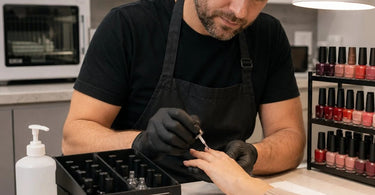
Because quality is non-negotiable, especially when your clients' 10 fingers are your walking billboards. Let's face it, we've all been there: you reach for your trusty base coat, and it's thicker than a client who just found out you're double-booked. Or worse, your top coat has gone from glass-like shine to a dull, cloudy mess. Meanwhile, that neon pink 'Electric Unicorn' color polish you bought because your clients are obsessed with it? It's sitting there, completely fine. It's not you—it's the chemistry, babe. The unsung heroes of the nail world, base and top coats, are the drama queens of the salon. They demand a different vibe, a different energy, and a whole different storage habit than their colorful counterparts. Sticking them all in the same drawer is like putting a diva lead actress in the same dressing room as the chorus line. It just doesn't work. The science behind these products is as distinct as their jobs: one is the ultimate sticky note that grabs onto the natural nail and says, 'Let's do this,' while the other is the tough-as-nails security guard protecting your masterpiece from the evils of chipping. Pigments in color polish can fade in light, but the very resins and polymers that make base and top coats work their magic are far more sensitive to environmental factors. If you've ever had a manicure lift, peel, or cloud over for no apparent reason, it's time to look at your storage station, because your products are trying to tell you something.
If you run a busy salon, you know the struggle of making product supplies last. Every ounce matters to your bottom line. But throwing your base and top coats in with the color polishes is a recipe for disaster and a fast track to throwing money in the trash. The chemistry that makes a base coat bond and a top coat harden is delicate. It's like a toddler with a peanut butter sandwich: once it gets too hot or too cold, it becomes a sticky, unusable mess. And unlike the color polishes that are typically full of pigments and dyes, base and top coats are almost like clear, clean slates. Those pigments in color polishes actually help stabilize the formula, making them more forgiving to slight temperature changes. Your clear coats, however, have nothing to hide behind. So, when you're looking to Professional Nail Care Collections, remember that you're not just buying a product; you're buying a performance, and performance requires optimal conditions.
The Real Scoop: Why Your Base and Top Coats Are Such High-Maintenance Products
Let's get scientific for a hot second, but don't worry, there won't be a quiz. Color polishes are basically a pigment party in a solvent solution. They're robust. The pigment particles are happy to just hang out and look pretty. Base coats, however, are formulated with adhesive resins designed to bind to the keratin in the nail plate, creating a sticky foundation for the layers to come. Top coats are made from tougher polymers and film-formers that cure to a hard, glossy shell. These specific, performance-driven ingredients are significantly more susceptible to temperature fluctuations. Heat, cold, and light are their kryptonite. When you subject them to the same environment as your color polishes, you're essentially asking a prima ballerina to perform on a rocky boat.
Research confirms that the sweet spot for storing these performance-heavy products is between 18 to 24 degrees Celsius (65-75 degrees Fahrenheit) . That's a pretty narrow range! When your salon heats up on a busy Saturday or you leave your kit in a freezing car overnight, you're pushing these products out of their comfort zone. This leads to thickening, separation, and an overall loss of those magical properties that make them work so well . So, before you reach for that base coat or top coat, give a thought to where it's been living, because it's definitely not as chill as your favorite shade of nude.
The Heat is On: Why Your Salon Temperature is Secretly Sabotaging You
Think of your base and top coats as Goldilocks; they don't like it too hot, and they don't like it too cold. They need it just right. If your salon is a little too toasty, the solvents in your top and base coats start to evaporate faster, causing the product to thicken up and become stringy and difficult to apply . You know that dreaded moment when your base coat drags instead of gliding on? That's the heat talking. It compromises the adhesion, leading to premature chipping or entire nails popping off like a champagne cork.
And let's not even talk about the cold. Ever tried to apply a top coat that's a little chilly from being stored near a drafty window? It's like trying to paint with cold molasses. It goes on thick, doesn't level out, and often cures with a dull, hazy finish. This happens because the polymers in the product contract in the cold, making them dense and hard to manipulate . It's a guaranteed way to ruin a perfectly good manicure and waste precious time. So, think twice before you stash your Professional Salon Equipment near a heater or an air conditioning vent; your nail products are far more sensitive than your clients' desire for the perfect Instagram shot.
It's Not Just About Temperature: The Light and Air Factor
Listen, I know you want your salon to be bright and inviting. But your base and top coats? They're vampires. They hate light. While your color polishes might fade over time from direct sunlight, the damage to base and top coats is far more immediate and structural. Many of these products are UV or LED-cured, which means they are sensitive to light sources—especially the UV rays in natural sunlight . Storing them on a bright, sunny shelf could cause them to partially cure right inside the bottle. You'll notice this as a weird, cloudy color, a thickened consistency, or even tiny, lumpy bits that form in the liquid. It's a slow-motion catastrophe.
And then there's air. You know how you're supposed to put the cap back on the peanut butter so it doesn't get hard? It's the same principle here. The oxygen in the air can start to cure or break down the formula if the bottles aren't sealed tight. When you close a bottle, always ensure the neck is clean of excess product, because a crusty rim means the lid can't close properly. This allows air to sneak in, degrading the product and causing it to thicken over time . For products like Professional Gel Polish and their accompanying top and base coats, maintaining an air-tight seal is the difference between a flawless service and a frustrated tech.
Survival of the Fittest: The Disciplined Shelf Life
One of the biggest professional tell-tale signs is the aroma of your products. A healthy base or top coat should have a fresh, chemical smell (think nail salon, not rotten eggs). If you open a bottle and get a whiff of something sour, rancid, or just plain 'off,' that's your warning sign. The product has started to degrade, and using it on a client is a major no-no . That smell is the chemical structure breaking down, and with it, its ability to adhere and protect.
And while some color polishes can be revived with a thinner, never, ever add thinner to your base or top coats. It compromises the formula, ruining the shine and protective qualities . Generally, while an unopened bottle can last a few years, the clock starts ticking the moment you open it. For base and top coats, the general rule of thumb is to replace them after six to twelve months of use . It's not about trying to sell you more product; it's about the integrity of your service. If you're consistently having Professional Nail Care Collections in your rotation, you'll notice a huge difference in performance when you cycle fresh products in and out. Don't be that tech holding onto a bottle for a decade because 'it still has some left in it.' Trust me, your clients can tell.
Creating a Spa Sanctuary for Your Star Players
So, how do we create the ultimate VIP lounge for our base and top coats? It's simpler than you think. First, ditch the idea that every bottle can be stored in the same basket. Dedicate a cool, dark corner of your workspace for these essentials. A drawer that's away from direct sunlight and heat sources is ideal . An opaque container or organizer is even better, as it blocks out light entirely. Think of it as a little blackout room for your most sensitive and hard-working bottles.
When you're in the middle of a service, always recap your bottles immediately after dispensing a product . Don't just leave it open on the table while you're meticulously painting that perfect smile line; every second it's open, it's exposed to air and light. Also, be vigilant about wiping the bottle neck clean after every use. This keeps the threads clear of sticky residue so you can get a perfect seal, preventing air from getting in and gluing your cap shut . It's a tiny habit that will save you from a world of frustration and wasted product. This level of care ensures you're always set up for success with your Stylish and Functional Nail Salon Furniture Essentials creating an environment that works for you, not against you.
Conclusion: Treat Your Base and Top Coats Like the Royalty They Are
Let's be clear, your color polishes are like your favorite pair of shoes: they take some wear and tear but they're relatively tough. But your base and top coats are the foundation and the roofing of your house. If that foundation cracks or the roof leaks, the whole house—the entire manicure—falls apart. They do the heavy lifting, ensuring a long-lasting, flawless finish that brings clients back through your doors again and again. So, give them the respect they deserve.
By simply adjusting your storage habits—keeping them cool, dark, airtight, and replacing them more frequently—you will see a night-and-day difference in the quality of your services and your sanity. You'll stop wasting money on products that fail prematurely and stop having to explain to a client why their polish chipped after two days. It's not a magic trick; it's science. And good science leads to good business, which leads to happy clients and a bank account that's looking pretty good too. Next time you're stocking up, treat your base and top coats like the VIPs they are, and they'll pay you back in flawless, Instagram-worthy results and a reputation as a pro who knows their stuff. Now, go forth and organize—the world needs less sticky, chunky base coats and more high-shine, perfect finishes. And maybe a glass of wine after a long day of filing and painting. You've earned it.
)