
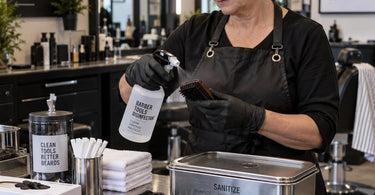
Clients notice the difference quality makes. They notice the sharp line of a fresh fade, the softness of a well-conditioned beard, the shine of healthy hair. But here is what they notice even more than a flawless beard trim: whether or not you just pulled a comb out of a jar of mystery liquid that looks like it has been sitting there since 2019. Beard brushes and combs are not just grooming tools. They are porous, bacteria-loving little sponges that touch every single client who sits in your chair. And if you are not cleaning them properly, you are essentially playing hot potato with other people's skin cells. Gross, right? Let's fix it.
State boards across the country are cracking down on sanitation procedures, and for good reason. A beard brush that is not properly cleaned between clients can harbor bacteria, fungi, and even viruses that cause skin infections, folliculitis, and yes, things far worse than an itchy chin. Whether you run a bustling barber shop, a luxury salon with a men's grooming menu, or a spa that offers beard facials, understanding the why behind beard brush and comb sanitation is not just about passing inspection. It is about protecting your reputation, your clients, and your business.
The Uncomfortable Truth About Your Beard Brush
Let's get real for a second. A beard brush or comb is basically a petri dish with handle. It picks up dead skin cells, natural oils, product residue, and whatever environmental funk your client walked in with. If that client has a skin condition like impetigo, ringworm, or folliculitis, those pathogens can linger on the bristles or teeth of your tool. The next client who sits down gets a little more than a beard trim. They get a potential infection.
According to health guidelines for hairdressers and barbers, equipment that comes into contact with the scalp, face, and neck can spread bacterial infections like impetigo and fungal infections such as tinea and ringworm when instruments are not cleaned between clients . And here is the kicker: you cannot always see the contamination. A brush can look perfectly clean and still be crawling with microscopic troublemakers that are ready to set up shop on your next client's jawline.
Natural bristle brushes are especially problematic. Many state regulations classify natural bristle brushes as porous implements, which means they cannot be properly disinfected for reuse. In Ohio, for example, all porous implements including brushes with natural bristles must be discarded after each use and shall not be cleaned or disinfected for reuse . Yes, you read that correctly. If your beard brush has natural boar bristles, the health department may consider it a single-use item in certain jurisdictions.
What the Rules Actually Say About Comb and Brush Sanitation
Sanitation requirements for barbering tools vary by state, but the core principles are consistent. Tools that contact a client's skin must be cleaned and disinfected between every single use. No exceptions, no shortcuts, no "I sprayed it with some stuff and called it a day."
Minnesota regulations require that razors, shears, combs, clipper blades, hairbrushes, and all other instruments that contact the head, neck, or face must be thoroughly cleaned and sanitized by submersion for a minimum of two minutes after use on each patron . Virginia law goes even further, requiring full immersion in a wet disinfectant solution for a minimum of ten minutes for multiuse implements including combs .
Pennsylvania breaks it down into a clear four-step process: cleanse, disinfect, rinse and dry, then store in a clean closed container . Every single time. For every single client.
The message from regulators is unmistakable: beard brushes and combs are not exempt from sanitation requirements just because they do not have a blade. If it touches a client, it needs to be clean.
Why This Matters for Your Barber Shop or Salon
Beyond the legal requirements, there is a practical business reason to nail your sanitation procedures. Clients talk. They tell their friends about the barber who gave them the best beard trim of their life, and they also tell their friends about the shop where the combs looked questionable. In the age of online reviews and social media, one hygiene complaint can do more damage than a hundred five-star ratings.
There is also the liability factor. If a client develops a skin infection after visiting your shop, and it can be traced back to improperly sanitized tools, you are looking at potential legal trouble, health department fines, and a reputation nightmare. The cost of implementing proper sanitation procedures is nothing compared to the cost of dealing with a health code violation or a lawsuit.
And let's not forget the simple fact that clean tools perform better. A beard brush clogged with product residue and dead skin cells does not glide through a beard the way it should. A comb with buildup between the teeth tugs at tangles instead of smoothing them. Proper cleaning extends the life of your tools and keeps them working the way they were designed to work.
How to Build a Beard Brush and Comb Sanitation Routine
Creating a sanitation routine does not have to be complicated, but it does need to be consistent. Here is a straightforward approach that works for barber shops, salons, and spas that offer beard grooming services.
Step One: Clean After Every Use
After each client, remove all visible debris from your beard brush or comb. A stiff-bristled cleaning brush designed for tool maintenance works well for this. For combs, a toothpick or the pointed end of a tail comb can help dislodge buildup between the teeth. For brushes, you may need to use a fine-tooth comb to rake through the bristles and remove trapped hair and product residue.
Once the visible debris is gone, wash the tool with warm water and a mild detergent or soap. Work the soap into the bristles or between the comb teeth, then rinse thoroughly. Do not skip this step. Disinfectants are inactivated when they come into contact with organic matter, so a dirty tool cannot be properly disinfected .
Step Two: Disinfect Properly
After cleaning, the tool needs to be disinfected. For combs made of hard, nonporous materials like plastic or metal, full immersion in an EPA-registered disinfectant is the standard. Follow the manufacturer's contact time, which is typically ten minutes for most salon-grade disinfectants. Virginia regulations specify a minimum of ten minutes immersion for multiuse implements . Minnesota requires a minimum of two minutes for submersion sanitization .
For beard brushes, the situation is trickier. If your brush has natural bristles, check your state regulations before attempting to disinfect and reuse it. As noted, some states prohibit the reuse of porous implements entirely . For synthetic bristle brushes, which are considered nonporous in many jurisdictions, cleaning followed by disinfection is generally acceptable.
Step Three: Rinse and Dry
After the disinfectant contact time has been met, rinse the tool thoroughly with clean water to remove any residual chemicals. This is especially important for tools that will come into contact with a client's skin, because disinfectant residue can cause irritation. Dry the tool completely with a clean paper towel or let it air dry on a clean surface. Moisture is a breeding ground for bacteria, so do not put a damp brush or comb away in a closed container.
Step Four: Store Properly
Store clean, dry tools in a clean, covered container that is designated for disinfected implements only. Pennsylvania regulations require storage in a clean, dry, and closed container clearly marked as such . Never store clean tools in the same container as dirty ones. That defeats the entire purpose of your sanitation routine.
Choosing the Right Tools for Easier Sanitation
The easiest way to maintain proper sanitation is to choose tools that are designed for professional use and easy cleaning. When stocking your barber shop or salon, look for beard brushes and combs that are made from materials that can withstand regular cleaning and disinfection.
For combs, hard plastic or metal combs are your best bet. They are nonporous, durable, and can be fully immersed in disinfectant without damage. Carbon fiber combs and stainless steel combs are excellent choices for professionals who take sanitation seriously.
For beard brushes, synthetic bristle options are generally easier to clean and disinfect than natural boar bristle brushes. If you prefer the feel of natural bristles, consider keeping a stock of them and treating them as single-use items, or check your state regulations to see if reuse is permitted after proper cleaning.
You will also want to have the right sanitation supplies on hand. A Professional Cleaners and Disinfectants for Salons and Spas collection is a good place to start. You need an EPA-registered disinfectant that is effective against bacteria, viruses, and fungi, and you need enough of it to fully submerge your tools. A Mixing Bowls can work as a soaking container in a pinch, but a dedicated disinfection jar or tray with a lid is more professional and easier to manage.
For barber shops specifically, having a Professional Hair Brushes and Combs for Stylists collection to pull from makes it easy to rotate clean tools throughout the day. Buy enough combs and brushes so that you always have a clean, dry set ready to go while the previous set is being cleaned or soaking.
The Role of Staff Training in Sanitation Success
Even the best sanitation procedures will fail if your team does not follow them. Every barber, stylist, or esthetician who uses beard brushes and combs needs to understand not just what to do, but why it matters. Regular training on sanitation protocols should be part of your shop culture, not an afterthought that only happens when the health inspector is due.
Make it easy for your team to do the right thing. Keep cleaning supplies within arm's reach of every station. Have clearly labeled containers for dirty tools and clean tools. Post a simple sanitation checklist at each station as a visual reminder. And lead by example. If the owner or manager skips steps, the staff will too.
Consider designating one person per shift to be responsible for checking that all sanitation procedures have been followed. This does not have to be a formal role, but having someone who is accountable for the final check can catch problems before they become violations.
Common Sanitation Mistakes to Avoid
Even well-intentioned professionals make mistakes. Here are some of the most common ones to watch out for.
Mistake One: Relying on UV Light Boxes
UV light boxes are prohibited as a method of sterilization in some states, including Iowa . They give a false sense of security and do not reliably kill all pathogens. Stick with chemical disinfection methods that are EPA-registered and proven effective.
Mistake Two: Using the Same Disinfectant Solution All Day
Disinfectant solutions become diluted and contaminated with organic matter throughout the day. Minnesota regulations require that chemical solutions be changed daily or more often as needed . If the solution looks dirty, it is dirty. Change it.
Mistake Three: Skipping the Cleaning Step
Disinfectant does not work on dirty tools. You cannot just drop a beard brush covered in hair and product into a jar of Barbicide and call it a day. The organic matter inactivates the disinfectant, and you end up with a tool that is wet but not clean. Always clean first, then disinfect.
Mistake Four: Storing Clean Tools in the Disinfectant
Disinfectant is not a storage solution. Once the contact time has been met, tools should be rinsed, dried, and stored in a clean, dry environment. Leaving combs and brushes sitting in disinfectant overnight can damage the materials and is not a substitute for proper storage.
Mistake Five: Forgetting About the Container
Your disinfection container needs to be cleaned too. If you are using a jar or tray for soaking tools, wash it out regularly with hot soapy water and let it dry. A dirty container contaminates the clean tools you put into it.
Building a Culture of Clean
Sanitation is not just a set of rules to follow. It is a mindset that should permeate every part of your business. When clients see you pulling a fresh, clean comb out of a covered container, they feel taken care of. When they see you cleaning your tools between clients without being asked, they trust you more. Cleanliness is a form of customer service.
For spa and salon professionals who offer beard grooming services as part of a larger menu, integrating beard brush and comb sanitation into your existing protocols is a natural extension. You already have systems in place for cleaning your Facial Steamers, your High Frequency Machines, and your other professional equipment. Your grooming tools deserve the same level of attention.
If you offer beard facials or men's grooming treatments, you may already be using tools like Spa Tools & Implements for Professionals that require specific cleaning protocols. Make sure your beard brushes and combs are part of that routine. They are just as important as any other tool that touches a client's skin.
And if you are looking to elevate your men's grooming offerings, consider adding retail beard care products to your shelf. Clients who appreciate a clean, professional beard trim are often interested in maintaining that look at home. A Must-Have Spa Retail Products for Enhanced Client Experience collection can give you ideas for products that complement your services and boost your retail revenue.
Final Thoughts: Clean Tools, Happy Clients, Healthy Business
Beard brushes and combs are small tools, but they carry big responsibility. Every time you pick one up, you are putting your client's skin, health, and trust in your hands. Clear sanitation procedures protect your clients, your staff, and your business. They keep you compliant with state regulations. And they demonstrate that you take your craft seriously enough to do the unglamorous work of keeping things clean.
The next time you reach for that beard brush, ask yourself: would I want this used on my face? If the answer is anything less than an enthusiastic yes, it is time to step up your sanitation game. Your clients will notice. And so will the health inspector.
)