
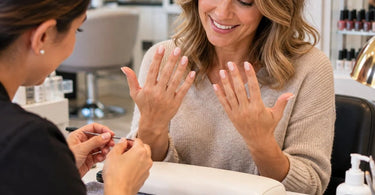
Maximize your potential with the right tools, a trained eye, and a little understanding of what goes through a client's mind during a manicure. You know the moment: one hand is nearly finished, the other is still a work in progress, and suddenly your client lifts both hands into the air like she is conducting a tiny orchestra. She tilts them left, turns them right, lines up her fingertips, and gives you that thoughtful expression usually reserved for choosing a wedding dress. Before you assume she has spotted a problem, consider this: comparing both hands before a nail service is finished is often a perfectly normal part of how clients evaluate symmetry, consistency, and whether their expectations are being met.
For professional nail technicians, understanding this behavior can make appointments smoother, improve communication, and prevent minor concerns from becoming last-minute corrections. The secret is not convincing clients to stop comparing. It is learning what they are actually looking for and building those checkpoints into your service.
Why Clients Compare Both Hands Before the Service Is Finished
Human beings are remarkably good at noticing differences between similar objects, especially when those objects are sitting directly in front of them. Our hands are a particularly interesting example because we see them throughout the day, use them constantly, and associate their appearance with grooming and personal style.
During a manicure, clients naturally begin checking whether the finished result matches the picture they imagined. Looking at both hands together provides more information than examining individual nails. They can compare length, shape, color, shine, and the overall balance of the set.
Think of it as a visual quality check. One beautifully shaped almond nail looks wonderful on its own. Place it next to a slightly rounder almond nail on the opposite hand, however, and suddenly the difference becomes noticeable.
That does not automatically mean either nail was shaped incorrectly. It means the client is evaluating the complete result rather than ten separate pieces.
There is also an important timing factor. Clients frequently compare their hands before the service is finished because they recognize that certain adjustments may be easier to make earlier. A length correction before polish, for example, is usually simpler than a major reshaping request after every nail has received its final finish.
The Mirror Effect: Why Matching Fingers Matter
Many clients instinctively compare corresponding fingers. Thumb against thumb. Index finger against index finger. Pinky against pinky. It is practically a miniature nail inspection committee, and everyone has been invited.
This comparison helps clients assess whether their manicure feels visually balanced.
For nail professionals, several details influence that impression:
- Free-edge length: Whether corresponding nails extend a similar distance beyond the fingertips.
- Nail shape: Whether round, square, oval, almond, or coffin shapes appear consistent.
- Sidewall appearance: Whether the sides look balanced and appropriately tapered.
- Color coverage: Whether pigmentation and opacity appear similar across the set.
- Surface finish: Whether shine, texture, and product application look consistent.
- Design placement: Whether French tips, accent details, and decorative elements create the intended visual relationship.
However, naturally occurring differences between hands are completely normal. Nail beds vary in width, curvature, orientation, and growth pattern. Corresponding fingers may not have identical dimensions.
A professional manicure should aim for a harmonious appearance, not necessarily mathematically identical measurements on every finger.
This distinction matters because forcing identical dimensions onto different natural nail structures can sometimes create an awkward result. A skilled technician evaluates the complete visual effect while respecting the individual anatomy of each nail.
Clients Are Often Comparing Expectations, Not Just Nails
Sometimes the client who repeatedly checks both hands is not worried about a technical mistake at all.
She may be comparing the emerging manicure against the inspiration photo she showed at the beginning of the appointment.
Perhaps the reference featured delicate almond tips, but the current result appears slightly broader. Maybe the nude polish looks warmer under the salon lighting than it did on her phone. Or perhaps she requested short nails and is wondering whether the finished length will still work comfortably when typing.
These are questions about expectations, and they are best addressed through communication rather than guesswork.
A short consultation can establish whether the client prioritizes shape, length, practicality, color accuracy, or decorative details. Ask which elements of her reference image matter most instead of assuming every detail carries equal importance.
For technicians working with extensions, Professional Gel Polish, or Acrylic Nail Supplies, confirming shape and length before the finishing stages can prevent unnecessary rework.
A client who understands the plan is generally better equipped to recognize normal progress during the appointment.
Why the First Finished Hand Can Create Confusion
Picture this familiar salon situation. The technician completes filing and shaping on one hand while the other remains untouched. The client immediately places both hands side by side and notices a dramatic difference.
Of course she does. One hand has been transformed, and the other is still wearing yesterday's agenda.
The issue is that she may be comparing two different stages of the service rather than two completed results.
The same situation occurs during polish application, extension building, and nail art. A hand with finished top coat will naturally look different from one that has only received its base color.
Professionals can minimize confusion by explaining the sequence of the service.
Try a simple statement such as, "I am finishing the shape on this hand first. Once both hands reach the same stage, we will compare the overall length and balance together."
This reassures the client without dismissing her interest in the finished result.
It also creates an appropriate opportunity for feedback before moving into stages that may be more difficult to reverse.
Build a Two-Hand Symmetry Check Into Every Manicure
Instead of waiting for clients to initiate comparisons, make the evaluation part of your professional workflow.
A consistent checkpoint can reduce misunderstandings, support better quality control, and demonstrate attention to detail.
Step 1: Confirm the desired appearance. Discuss shape, length, color, lifestyle considerations, and design preferences before beginning. Use photographs when helpful, but explain that individual nail anatomy influences the final interpretation.
Step 2: Establish a reference nail. After shaping an early nail, invite the client to confirm that the length and shape meet her expectations. This is particularly useful for first-time clients or significant style changes.
Step 3: Shape both hands before the final finish. When the service permits, compare corresponding nails after the initial shaping stage. This provides a better opportunity to assess balance before applying finishing products.
Step 4: Check from multiple viewing angles. Examine the nails from above, from the front, and along the side profile as appropriate. A nail that looks balanced from one angle may reveal a different contour from another.
Step 5: Invite specific feedback. Ask whether the overall length and shape feel right before proceeding. Specific questions are more helpful than a vague request for approval.
Step 6: Perform a final comparison. Once both hands are complete and sufficiently cured or dried, review color, finish, shape, and design placement together.
This process is not about encouraging clients to scrutinize every microscopic detail. It is about making professional quality checks visible and collaborative.
The Tools That Make Nail Symmetry Easier
Technique and experience remain essential, but using consistent professional supplies can make precision work more manageable.
For shaping, reliable Nail Files & Buffers help technicians refine free edges, smooth transitions, and adjust contours according to the service and nail structure.
Appropriate grit selection matters. Different products and natural nail conditions require different approaches, and aggressive filing should never be used simply to force visual symmetry.
Precision Nail Brushes & Tools support controlled application, especially when working near the cuticle area, creating French tips, or positioning intricate designs.
For technicians who frequently perform structured manicures or extensions, useful supplies may include Nail Forms, Nail Tips, and Nail Art Brushes, depending on the service offered.
Lighting is another frequently overlooked factor. A well-positioned professional task light helps reveal surface irregularities, inconsistencies in coverage, and details that may be difficult to see under uneven illumination.
Explore LED Bright Lamps for salon workstations where clear visibility is a priority.
Equipment does not replace trained judgment, but the right setup gives technicians a better opportunity to apply that judgment consistently.
Lighting Can Make Two Matching Hands Look Different
Here is a surprisingly common source of unnecessary concern: the hands may look different because the light hitting them is different.
One hand might sit directly beneath a task lamp while the other rests closer to the edge of the table. The resulting change in brightness can alter the apparent depth, shine, or warmth of a polish color.
Shimmer, chrome, pearl, and reflective finishes are particularly sensitive to lighting direction. A product can appear brighter on one hand simply because its reflective particles are catching the light differently.
Before assuming an application inconsistency, position both hands under similar lighting and examine them from comparable angles.
If the difference remains visible, investigate the application itself. Uneven coverage, inconsistent layer thickness, or differing surface preparation may require attention.
The goal is to distinguish a genuine service issue from an optical effect before making unnecessary changes.
What About French Tips and Nail Art?
Clients can become especially observant when the manicure includes designs that are intended to match across both hands.
French manicures are a classic example. The client may compare smile-line depth, curvature, and the amount of exposed base color on corresponding fingers.
With nail art, attention often shifts toward placement, spacing, and proportions.
A tiny flower positioned near the cuticle on one ring finger may look unbalanced if its counterpart sits much closer to the tip. Similarly, decorative accents that are intended to mirror each other can appear inconsistent when viewed together.
Professional Nail Art Supplies and Nail Art Rhinestones give technicians creative options, but planning remains important.
Before applying a repeating design, decide whether the two hands should be true visual mirrors, identical arrangements, or intentionally different compositions.
These approaches are not interchangeable. A client who expects matching accent nails may be surprised by a design that uses asymmetry as an artistic feature.
For complex sets, a brief layout discussion can save valuable appointment time.
How to Respond When a Client Spots a Difference
Few phrases make a busy nail technician more alert than, "Can I ask you something about this nail?"
But a question is not automatically a complaint.
Start by identifying the specific concern. Is the client noticing length, shape, color, thickness, or design placement?
Then examine both hands together instead of immediately defending the work or promising a correction.
A useful response might be, "Absolutely. Show me which detail looks different to you, and we can check it together."
This gives the technician an opportunity to determine whether an adjustment is appropriate.
If the concern reflects natural nail anatomy, explain the limitation clearly and offer realistic options. If a genuine inconsistency is present, acknowledge it and determine the safest correction for the service stage.
Avoid overfiling, excessive product removal, or repeatedly adding material simply to make two nails look identical. The integrity of the natural nail and the correct application of professional products must remain priorities.
Never interpret client feedback as permission to compromise product instructions, proper curing, hygiene, or structural safety.
Most importantly, keep the conversation collaborative. The objective is a result the client understands and feels comfortable wearing.
Why Some Clients Compare More Than Others
Not every client approaches a manicure with the same level of visual attention.
First-time clients may inspect their hands carefully because they are unfamiliar with the technician's process. Clients preparing for weddings, vacations, professional events, or important photographs may focus more closely on consistency.
Someone who has experienced a disappointing manicure in the past may also request additional reassurance.
Other clients simply enjoy watching their nails take shape. Their repeated comparisons may reflect excitement rather than anxiety.
A client who checks every finger is not necessarily difficult. She may be engaged, curious, or trying to communicate a preference that she does not yet know how to describe.
Experienced technicians can recognize these different motivations without labeling clients or assuming that careful observation signals dissatisfaction.
When appropriate, explain what you are checking during the service. A small amount of professional education often helps clients appreciate the technical decisions involved.
Make the Nail Station Work for Better Consultations
The physical workstation also affects how easily clients and technicians can evaluate results together.
A clean, organized manicure table creates room to position both hands comfortably for comparison. Good lighting improves visibility, while accessible tools make minor adjustments more efficient.
Browse Nail Tables and Manicure Stations for professional workstation options, along with Manicure Essentials that support daily nail services.
Organized supplies can help maintain a consistent workflow, particularly in busy salons where technicians move between natural manicures, gel services, extensions, and detailed nail art.
Routine cleaning and disinfection remain equally important. Use appropriate Professional Cleaners & Disinfectants for Salons and Spas according to product labeling and applicable salon regulations.
A thoughtfully arranged workstation does not guarantee a perfect manicure, but it supports professional habits that make consistent results easier to achieve.
Turn the Comparison Moment Into a Better Client Experience
The moment when a client places both hands together is an opportunity to demonstrate professionalism.
Instead of interpreting the comparison as a challenge, use it as a natural checkpoint.
Ask whether she is happy with the shape and overall balance. Explain any intentional differences caused by nail anatomy or design placement. Confirm that she understands what the finished result will look like.
For clients who frequently request the same service, documenting preferences can also be useful. Record the desired length, preferred shape, color selections, and any specific concerns according to the salon's normal client-record practices.
This information can make future appointments more efficient and reduce the need to rediscover preferences every time.
When appropriate, finish the service with care recommendations and a discussion of maintenance. Products such as Cuticle Oil and other suitable Nail Treatments may fit naturally into an individualized aftercare conversation.
Recommend products based on the actual service and client needs rather than assuming every manicure requires the same retail routine.
What Salon Owners Can Learn From This Behavior
For salon owners and managers, repeated two-hand comparisons can reveal valuable opportunities to improve service consistency.
If clients frequently request similar adjustments, examine when those concerns arise.
Are technicians confirming length before applying color? Is lighting consistent across workstations? Are nail shape expectations documented clearly? Do appointment schedules allow adequate time for quality checks?
These operational questions are more useful than simply assuming clients are becoming overly particular.
Consider developing a practical manicure checklist that includes an initial consultation, a shape confirmation, a two-hand comparison, and a final review.
Training technicians to explain these steps can help establish a consistent service standard without requiring every professional to work in exactly the same way.
Owners can also evaluate whether their inventory of Professional Nail Care Collections supports the services their teams perform most frequently.
Reliable access to appropriate products, functional equipment, and well-maintained tools helps reduce avoidable interruptions during appointments.
And because small concerns are often easier to address early, these checkpoints may help protect appointment schedules from preventable end-of-service corrections.
The Bottom Line: Clients Want Two Hands That Feel Like One Beautiful Set
So, why do clients compare both hands before the service is finished? Because they are trying to understand the complete result. They want their manicure to feel cohesive, flattering, and consistent with what they requested.
Sometimes they are checking actual symmetry. Sometimes they are comparing color or length. Sometimes they are simply admiring the transformation and cannot resist a little fingertip inspection.
For nail professionals, the smartest approach is to make comparison part of the process rather than treating it as an interruption. Confirm expectations early, evaluate corresponding nails at appropriate stages, use reliable professional tools, and invite specific feedback before the final finish.
Pure Spa Direct supplies professional nail technicians and salon businesses with a wide selection of tools, nail care products, equipment, and workstation essentials from established industry brands. Whether you are refining your manicure setup or replenishing everyday supplies, explore the Manicure Essentials and Professional Nail Care Collections to support your services.
After all, a client holding both hands up for inspection does not have to be a dramatic salon moment. With thoughtful technique and communication, it can become the moment she realizes that every finger has received the attention it deserves. And that is a much nicer ending than ten minutes of unexpected filing while your next appointment is already walking through the door.
