
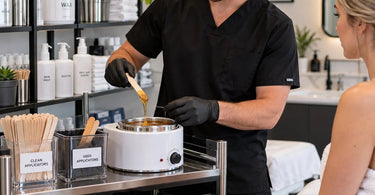
Efficiency meets quality with this choice... and in professional waxing, that choice starts with how your station is organized before the first client even walks through the door. Every esthetician knows the golden rule: never return a used applicator to a shared wax pot. Yet preventing double-dipping consistently takes more than a reminder taped to the wall and a stern look from the salon manager. The real secret is building a service workflow where fresh applicators are always within reach, used tools have an obvious destination, and good hygiene feels as natural as reaching for your favorite professional waxing supplies.
Think about it. Your appointment book is full, your client is chatting about her weekend, and you are halfway through a Brazilian wax when you realize the applicator container is inconveniently positioned behind the warmer. Suddenly, a basic hygiene rule is competing with speed, convenience, and an awkward reach across the treatment table. That is exactly why double-dipping prevention depends on workflow, not just rules.
A thoughtfully arranged waxing station helps protect clients, supports consistent service standards, and makes the workday smoother for everyone. Better yet, it does not require turning your treatment room into a laboratory. A few practical changes to supplies, station layout, training, and daily routines can make a remarkable difference.
What Is Double-Dipping in Professional Waxing?
Double-dipping happens when an applicator that has already touched a client's skin is placed back into a shared container of wax. The applicator may carry skin cells, hair, microorganisms, or other contaminants into the remaining product.
Professional wax is heated to a temperature suitable for application, not maintained as a validated sterilization process. A warm wax pot should never be treated as a magical germ-destroying cauldron, no matter how impressive the temperature display looks.
For a standard shared-pot application workflow, the safe practice is straightforward: use a fresh, clean applicator for each dip and application, then discard it immediately after contact with the client's skin. Do not turn a used wooden stick around and dip its other end into the shared pot. That is still a contaminated applicator.
Some jurisdictions permit specifically controlled single-client wax portions or other dispensing methods, but requirements vary. Salon owners should follow applicable state and local regulations, licensing-board requirements, and product manufacturer instructions rather than assuming one method is acceptable everywhere.
The hygiene principle remains consistent: prevent materials that have contacted a client from contaminating the shared wax supply.
Why a Written No-Double-Dipping Rule Is Not Enough
Most waxing professionals do not need another lecture about the importance of sanitation. They need workstations that make proper procedures easy to perform during a busy service.
Imagine a salon with a beautifully printed hygiene policy, a spotless reception area, and a treatment room where clean applicators are stored in a drawer across the room. The technician may understand the policy perfectly, but the physical setup creates unnecessary interruptions.
Now imagine the same room with fresh applicators beside the warmer, a conveniently positioned discard container, and enough supplies prepared for the entire appointment. The correct action becomes the simplest action.
That is the difference between a rule and a reliable workflow.
Rules explain what professionals must do. Workflow determines whether the required actions are practical, repeatable, and easy to maintain throughout the day. Strong waxing operations need both.
Build Your Waxing Station Around the One-Dip Process
One of the most effective ways to prevent double-dipping is to organize the treatment station around the natural sequence of a waxing service.
The ideal sequence is simple: take a clean applicator, collect wax, apply it to the client, and immediately discard the used applicator. Then repeat with a fresh applicator.
Each step should have an obvious physical location.
Keep Clean Applicators Close to the Wax Warmer
Place a sufficient supply of Professional Wax Spatulas and Applicators for Salons & Spas within comfortable reach of the warmer. Choose a clean, protected dispensing arrangement that prevents used gloves, contaminated tools, or other treatment materials from touching the remaining applicators.
Consider organizing applicators by service type. Narrow sticks may be useful for detailed facial waxing, while larger spatulas can accommodate broader application areas.
The important detail is not simply having a mountain of wooden sticks nearby. It is ensuring that every fresh applicator is accessible without reaching across contaminated surfaces.
Give Used Applicators an Immediate Destination
Position an appropriate lined waste container where used sticks can be discarded promptly without crossing over the clean supply area.
Do not allow used applicators to accumulate beside the warmer, rest on a treatment cart, or migrate into the mysterious pile of things that someone promises to clean later.
A used stick should have one destination: the appropriate waste container.
Keeping that destination obvious reduces accidental handling and helps maintain separation between clean supplies and items that have contacted the client.
Separate Clean, Active, and Discard Areas
A practical waxing station can be divided into three functional zones. The clean zone contains protected applicators, unused strips, and other prepared supplies. The active zone includes the wax warmer and products being used during the treatment. The discard zone contains used single-use items and designated waste containers.
These zones do not require three separate pieces of furniture. Even a compact treatment cart can support a logical arrangement when supplies are positioned intentionally.
The objective is to minimize unnecessary movement and prevent clean materials from coming into contact with used tools or contaminated surfaces.
Choose Supplies That Support Hygienic Habits
Good organization works best when the tools themselves fit the service. Selecting appropriate waxing supplies can reduce awkward movements, repeated searching, and mid-treatment interruptions.
Start with applicators. Having the correct sizes available is more useful than relying on one oversized stick for every imaginable treatment area. Use a fresh applicator for every dip into shared wax, regardless of its size.
Next, evaluate your Professional Wax Warmers for Salons & Spas. A stable warmer with an accessible pot, appropriate temperature controls, and a layout that permits convenient cleaning makes the workstation easier to manage.
For salons offering strip waxing, organize Quality Wax Strips & Rolls for Effective Hair Removal alongside clean applicators so the technician can move through the service without repeatedly opening cabinets.
Professionals offering stripless treatments can evaluate Professional Stripless Hard Wax and select products appropriate for the service area, technique, and manufacturer instructions.
Other useful station essentials include Pre & Post-Waxing Products, disposable table protection, gloves when appropriate, and properly selected surface cleaning and disinfection products.
Each item should have a designated location that supports the order in which it is used.
Prepare Enough Applicators Before Every Appointment
Running out of clean sticks halfway through a service is not a character-building exercise. It is a preventable supply problem.
Before each appointment, estimate the number of applicators needed based on the treatment area, application technique, and typical service usage. Keep an adequate clean supply available, along with a reasonable backup.
A facial waxing appointment may require a different mix of applicator sizes than a full-leg or Brazilian service. Standardizing preparation by appointment type helps reduce guesswork.
For example, a waxing team might establish separate preparation checklists for eyebrow waxing, underarm waxing, leg waxing, and Brazilian waxing. Each checklist can identify the appropriate applicator styles, strips where needed, pre-service products, protective supplies, and waste-management materials.
The goal is not to impose a rigid number of sticks on every technician. It is to ensure that no professional feels pressured to compromise hygiene because the necessary supplies are missing.
Salons with substantial appointment volume may also benefit from purchasing frequently used consumables through Bulk Wax Deals and maintaining clearly defined reorder points.
Prevent Cross-Contamination Beyond the Wax Pot
Double-dipping prevention is an important part of waxing hygiene, but it is not the entire picture.
Consider the gloves used during treatment. If a technician touches the client's skin, a used strip, or another potentially contaminated surface, those gloves should not automatically be considered clean simply because they are still being worn.
Hand hygiene and glove changes should follow the service activity, applicable infection-control requirements, and the possibility of contamination. Gloves do not replace proper hand hygiene.
Organize Protective Gloves & Masks for Salon and Spa Professionals so replacements are accessible without unnecessary handling of clean supplies.
Similarly, avoid contaminating bottles, jars, or dispensers containing pre-wax cleansers and post-wax products. Use dispensing methods that protect the unused product, and never return product removed for a client to its original container.
Reusable treatment surfaces and equipment also require appropriate cleaning and disinfection between clients. Keep suitable Professional Cleaners & Disinfectants for Salons and Spas available and follow product label instructions, including required contact times and surface compatibility.
Hygiene works as a complete system. A fresh applicator cannot compensate for a contaminated workstation.
Make Hygiene Practical During Back-to-Back Bookings
Busy appointment schedules can reveal weaknesses in an otherwise organized salon.
When one client leaves and another arrives shortly afterward, staff may feel pressure to complete turnover tasks quickly. This is precisely why the reset process should be planned instead of improvised.
Build realistic sanitation and station preparation time into appointment scheduling. During turnover, staff should discard used single-use materials, clean and disinfect appropriate surfaces, replace protective coverings, replenish supplies, and prepare the station for the next client.
Products such as Hygienic Table Paper for Waxing, Spa & Massage Tables can support a practical turnover routine when used in accordance with appropriate sanitation procedures.
A well-designed reset checklist can also help ensure that essential steps do not disappear when the schedule gets hectic.
Efficiency should come from better preparation, not from skipping infection-control practices. A professional treatment room can operate smoothly while still allowing the time needed to maintain proper hygiene.
Train the Entire Team on the Same Workflow
A hygiene policy is only as consistent as the team implementing it.
New employees may arrive with different training backgrounds, service techniques, or habits developed in previous workplaces. Even experienced estheticians can benefit from a shared understanding of the salon's procedures.
Training should demonstrate exactly how the workstation is arranged, where clean applicators belong, how used sticks are discarded, and what to do when contamination is suspected.
Rather than simply instructing employees not to double-dip, have them practice the complete service sequence at a properly prepared station.
Managers can also observe routine services and offer constructive feedback on workstation organization, applicator handling, glove use, and turnover procedures.
These observations should focus on consistent procedures rather than embarrassing employees. Nobody performs better sanitation work because someone dramatically announces a wooden-stick emergency in the middle of a treatment.
Regular refreshers help keep procedures consistent as team members change, products are introduced, and service menus expand.
What Should You Do If Double-Dipping Happens?
Even with thoughtful preparation, an applicator-handling mistake can occur. The salon should have a clear response procedure rather than expecting individual technicians to improvise.
If a used applicator is returned to a shared wax pot, stop using the potentially contaminated wax. Do not assume reheating it will make the product safe.
Follow applicable licensing-board requirements and manufacturer directions for disposing of contaminated wax and cleaning and disinfecting the affected equipment. Regulations in many jurisdictions require contaminated wax to be discarded and the pot to be emptied and disinfected before reuse.
Report and document the incident according to salon policy, and follow any applicable notification or reporting requirements. Resume services only after the station and equipment have been properly addressed.
Managers should also investigate why the incident occurred. Were applicators unavailable? Was the discard container poorly positioned? Did the technician misunderstand the process? Was the treatment setup unnecessarily complicated?
Correcting the underlying workflow problem is more valuable than issuing a reminder and hoping the same situation never happens again.
How Better Workflow Can Reduce Waste Without Sacrificing Safety
Salon owners sometimes worry that using a fresh applicator for every dip will increase supply consumption. Single-use applicators are indeed a recurring operating expense, but reducing their use by double-dipping is not an appropriate cost-saving strategy.
Instead, focus on avoiding preventable waste elsewhere in the service.
Choose applicator sizes that match the treatment, manage wax portions thoughtfully, maintain appropriate warmer temperatures, and prepare quantities of supplies that reflect typical appointment needs.
Track consumption by service category so purchasing decisions reflect actual demand rather than rough estimates.
For example, a salon might compare applicator usage across similar appointments and identify whether differences are caused by service technique, product consistency, treatment size, or inefficient station arrangements.
The purpose of that review should be better planning, not pressuring technicians to reuse disposable tools.
Purchasing appropriate Complete Waxing Kits for Salons & Spas or maintaining a standardized inventory of commonly used supplies can also simplify preparation for new technicians and busy treatment rooms.
Protecting hygiene standards and operating efficiently are complementary goals when the workflow is designed properly.
Can Single-Client Wax Portions Change the Process?
Some professional waxing systems use a measured portion of wax transferred into a separate container dedicated to one client. Depending on local rules, this can provide an alternative to repeatedly taking wax from a shared pot with fresh applicators.
However, a single-client portion is not an automatic exemption from sanitation requirements.
The portion must be dispensed without contaminating the original supply. Applicator handling must comply with the rules governing that method, and the container and any leftover wax must be discarded as required after the service. Used wax must never be returned to the shared pot.
Because regulations differ by jurisdiction, salons should verify whether their local licensing board permits the particular method before incorporating it into standard procedures.
Even when permitted, single-client portions require thoughtful organization, suitable dispensing containers, and proper disposal procedures.
The broader lesson remains unchanged: hygiene depends on how products and tools move through the service.
Use a Simple Waxing Station Checklist
A practical checklist makes double-dipping prevention easier to maintain across multiple technicians, treatment rooms, and shifts.
Before the appointment: Confirm that the wax warmer is clean and ready for use according to manufacturer instructions. Set out sufficient clean applicators, prepare appropriate products, ensure protective supplies are available, and position the waste container within comfortable reach.
During the service: Use a fresh applicator for every dip into a shared wax supply. Discard applicators immediately after use. Maintain clean and used supply separation, perform hand hygiene and change gloves as required, and avoid touching uncontaminated products with soiled tools or gloves.
After the appointment: Dispose of used single-use items, remove used table protection, clean and disinfect required surfaces and equipment, inspect the workstation for contamination, and restock necessary supplies.
At closing: Complete equipment care and sanitation procedures, inspect supplies, record shortages, and ensure the station is ready for the next operating day.
This process can be adapted for eyebrow waxing, facial waxing, body waxing, and other services while preserving the same essential hygiene standards.
Turn Good Hygiene Into a Better Client Experience
Clients may not notice every organizational decision behind a waxing appointment, but they can often recognize when a technician works confidently and maintains a clean treatment environment.
Fresh applicators, organized supplies, and deliberate disposal habits help communicate professionalism without requiring a long speech about salon sanitation.
That confidence matters especially during intimate waxing services, when clients may already feel nervous or vulnerable.
Professionals can explain their hygiene practices naturally when clients have questions. A simple statement that a fresh applicator is used for every dip into shared wax is clear, reassuring, and easy to understand.
There is no need to transform the appointment into a full infection-control seminar. Your client booked a wax, not a surprise science exam.
Ultimately, thoughtful hygiene procedures contribute to a more comfortable service experience and demonstrate respect for client well-being.
Frequently Asked Questions About Double-Dipping Prevention
Is double-dipping acceptable if the same client is receiving the entire service?
Returning a used applicator to a shared wax pot can contaminate the wax regardless of whether another client is present. Use fresh applicators for each dip into shared wax. A separately dispensed single-client portion may be treated differently under certain regulations, but salons must verify and follow their applicable requirements.
Does hot wax kill germs introduced by a used applicator?
No reliable assumption of sterilization should be made. Professional waxing temperatures are selected for product performance and safe application, not for sterilizing contaminated wax.
Can you reuse a wooden applicator by flipping it over?
No. Once an applicator has contacted the client's skin, reversing it does not make it suitable for another dip into a shared pot. Many sanitation regulations expressly prohibit reusing the opposite end.
How can a busy salon make single-use applicators more convenient?
Keep fresh applicators within easy reach, use suitable sizes for each service, place the discard container nearby, maintain dependable inventory levels, and standardize treatment-room preparation.
What happens if wax becomes contaminated?
Stop using the affected wax and follow applicable requirements for disposal and equipment cleaning and disinfection. Do not try to rescue contaminated wax by simply heating it longer.
How often should waxing station procedures be reviewed?
Review procedures during new-employee training, when introducing new products or equipment, after observed errors, and periodically as part of routine quality checks. Confirm that written procedures remain consistent with current local regulations and manufacturer instructions.
The Bottom Line: Make the Hygienic Choice the Easy Choice
Double-dipping prevention succeeds when sanitation rules are supported by the way a professional waxing service actually operates. Fresh applicators, convenient disposal, organized treatment zones, reliable inventory, clear training, and consistent station resets all work together to protect the shared wax supply.
For spa owners and waxing professionals, the most useful question is not simply whether employees know the rule. It is whether the treatment room makes following that rule easy during every appointment, including the busiest moments of the day.
Review your station setup, identify unnecessary movements, and make sure the right tools are available exactly where they are needed. Explore Waxing Supplies for Professionals, Professional Wax Spatulas and Applicators, and Waxing Accessories & Removers for Professional Use when planning an efficient, well-equipped treatment space.
Because the best sanitation routine is not the one everyone promises to remember. It is the one your station is designed to support, one fresh applicator at a time.
