
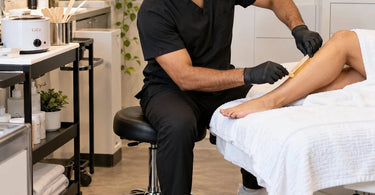
Deliver excellence, every time... even if that means scooting your stool around the waxing room like you are participating in a very glamorous office chair Olympics. If you have ever wondered why estheticians keep repositioning their stool during a wax, the answer involves much more than finding a comfortable place to sit. Those seemingly endless little adjustments can improve access to the treatment area, support better waxing technique, reduce unnecessary physical strain, and help create a smoother experience for everyone involved. In professional waxing, where precision and control matter, your position can be almost as important as the products in your wax warmer.
Experienced estheticians understand that a waxing appointment is rarely a stationary activity. Different treatment areas require different angles, clients have different body shapes and positioning needs, and the esthetician must maintain control while applying wax, supporting the skin, and removing hair. A properly positioned stool helps make those movements more manageable. However, there is a difference between purposeful repositioning and constantly chasing a stool that never seems to be in the right place. Understanding that difference can help waxing professionals improve their daily workflow.
Why Stool Position Matters More Than You Think
Waxing involves a surprising combination of precision, movement, balance, and repetitive physical effort. An esthetician must control the applicator, follow appropriate application and removal techniques, maintain skin tension, and see the treatment area clearly. Trying to accomplish all of that from an awkward seated position can create unnecessary challenges.
Imagine attempting to wax the lower leg while sitting too far away from the treatment table. Your shoulders creep forward, your back rounds, and your arm stretches across the client. Suddenly, what should be a controlled application becomes an enthusiastic game of human origami.
Moving the stool closer to the area being treated can allow the esthetician to work with a more comfortable arm position. Repositioning around the table can also reduce excessive twisting and help keep the treatment area within easy reach.
The goal is not to remain perfectly motionless. It is to avoid unnecessary reaching, bending, and twisting while maintaining safe control of the waxing process.
Different Waxing Areas Require Different Working Angles
One reason estheticians reposition their stools so frequently is that the ideal working angle changes throughout an appointment. A position that works beautifully for one area might be completely impractical for another.
Facial waxing: Eyebrows, the upper lip, chin, and other facial areas require detailed visibility and controlled movements. A stool positioned near the head of the treatment table may allow more precise access without excessive forward leaning.
Leg waxing: Working from the thighs toward the ankles involves a much larger treatment area. Moving along the table often makes more sense than attempting to reach the entire leg from one spot.
Underarm waxing: The angle of the client's arm, the direction of hair growth, and the curvature of the underarm can influence where the esthetician should sit or stand.
Bikini and Brazilian waxing: These services may require several carefully managed working positions. Proper client positioning, clear communication, appropriate draping, and controlled access are especially important. The esthetician may need to move to a different location around the treatment table rather than repeatedly twisting or reaching from one side.
Professional service areas should determine the esthetician's working position, not the other way around. A little stool movement is often the practical solution.
The Ergonomics Behind the Constant Scooting
Estheticians can spend hours performing repetitive hand and arm movements while leaning toward treatment tables. Over time, awkward postures and prolonged static positions may contribute to fatigue and musculoskeletal discomfort.
Ergonomics focuses on adapting the working environment to the person performing the task. For waxing professionals, this can include adjusting treatment table height, selecting appropriate seating, arranging supplies, improving lighting, and changing working positions throughout an appointment.
A properly positioned stool should help the esthetician maintain reasonably relaxed shoulders, a comfortable back position, and controlled arm movements. The feet should have stable support, either on the floor or an appropriate footrest. The worker should not have to balance on the edge of the seat simply to reach the client.
It is also important to understand that sitting does not automatically make a task ergonomic. An esthetician who remains seated while twisting repeatedly across the table may experience more discomfort than one who changes position or stands for certain treatment areas.
Alternating between comfortable sitting and standing positions can be useful when the service and workstation allow it. Short movement breaks between appointments can also help prevent prolonged static positioning.
Basically, your body should not have to submit a formal complaint to management after every Brazilian wax.
Why the Height of Your Stool Changes Everything
Stool height can influence the esthetician's working posture, visibility, and ability to control an applicator. If the stool is too low relative to the treatment surface, the esthetician may compensate by raising the shoulders or stretching upward. If it is too high, the working position may encourage uncomfortable bending or place the feet without adequate support.
An adjustable esthetician stool allows professionals to change their seated height according to their body proportions and the treatment being performed.
However, stool height should never be considered separately from the treatment table. A stool that works perfectly with one table may feel awkward with another.
When setting up the workstation, consider these practical questions:
- Can the esthetician reach the treatment area without excessive forward bending?
- Are the shoulders reasonably relaxed during application?
- Can both feet remain securely supported?
- Is there enough space to move the stool without contacting equipment?
- Can the esthetician maintain controlled hand and wrist positions?
- Would adjusting the treatment table create a more comfortable working height?
For professionals furnishing a new treatment room, exploring Top-Quality Equipment & Furniture for Spas & Salons can help identify furniture categories that support a practical workstation layout.
A Rolling Stool Can Improve Workflow, but Only When the Room Cooperates
Rolling stools are popular in many spa and treatment environments because they allow technicians to make small positional adjustments without repeatedly standing up and moving a chair. For waxing services, this mobility can be especially useful when transitioning between nearby treatment areas.
A rolling stool is not automatically the best option for every room, however. Its usefulness depends on stability, caster design, floor conditions, available space, and the type of service being performed.
Professionals comparing rolling spa stools should consider several practical features.
Adjustable height: A suitable height range helps accommodate different technicians and workstation arrangements.
Stable base: The stool should remain steady while the esthetician performs controlled movements. Mobility should not come at the expense of stability.
Appropriate casters: Wheels should be compatible with the flooring and move predictably. A stool that rolls unexpectedly during a wax removal is not the kind of excitement anyone ordered.
Cleanable upholstery: Waxing environments require surfaces that can be cleaned and disinfected according to applicable procedures and manufacturer instructions.
Suitable seat design: Cushioning, seat shape, and support should allow the technician to work comfortably without encouraging excessive slouching or awkward positioning.
Practical dimensions: The stool must fit between equipment and furniture without obstructing movement or creating a tripping hazard.
The best stool is not necessarily the one with the most elaborate appearance. It is the one that supports the actual movements required during professional services.
Why Estheticians Move Their Stool Instead of Just Moving Their Arms
Repositioning the stool changes more than the distance between the esthetician and the client. It can also change the angle of the working arm, the visibility of the treatment area, and the amount of torso rotation required.
Consider a leg waxing service. An esthetician who remains seated near the client's knee may have a comfortable working angle for one section but need to reach significantly farther for the ankle. Sliding the stool along the table can bring the next section within a more natural working range.
The same principle applies to facial waxing, where a small change in seated position can provide a clearer view of the treatment area.
Moving closer can also help prevent unnecessary reaching toward the wax warmer, applicators, and other supplies, provided these items are arranged safely.
Importantly, repositioning does not replace proper waxing technique. The esthetician must still follow the wax manufacturer's instructions, observe suitable application and removal practices, maintain appropriate skin support, and work within professional training and licensing requirements.
The stool is simply one component of a well-organized professional technique.
Sometimes the Stool Is Not the Real Problem
If an esthetician constantly adjusts a stool but never finds a comfortable position, the underlying issue may involve the treatment room rather than the seating itself.
For example, a treatment table positioned too close to a wall can restrict access to one side of the client. A wax warmer placed across the room can create excessive reaching or repeated standing. Poor lighting may encourage the technician to lean forward to inspect the treatment area.
Even a cluttered supply cart can interrupt the workflow when frequently used applicators, strips, and preparation products are difficult to access.
Before replacing the stool, evaluate the entire room arrangement. Look at the space around the table, the location of frequently used supplies, the working height, and the movement required during a typical appointment.
A layout adjustment may solve problems that no amount of expensive stool cushioning can fix.
How to Set Up a Waxing Room for Easier Movement
A thoughtfully arranged treatment room allows an esthetician to move deliberately rather than continually improvising around obstacles.
1. Create access around the treatment table. Leave practical clearance around the sides and ends of the table used during services. The amount of space required depends on the room layout, equipment, accessibility needs, and treatment type.
2. Select an appropriate treatment table. An adjustable facial treatment bed or other suitable treatment table can help accommodate different working heights and client positions. Consider stability, safe load capacity, cleanability, and appropriate positioning features.
3. Keep the wax warmer in a secure location. Professional Wax Warmers for Salons & Spas should be placed on stable surfaces where hot wax and cords will not interfere with movement. Never roll or reach carelessly around exposed hot wax.
4. Organize applicators within practical reach. Keep clean supplies accessible using an appropriate setup for Professional Wax Spatulas and Applicators for Salons & Spas. Follow hygienic dispensing practices and avoid contaminating clean supplies.
5. Establish a consistent supply arrangement. Place preparation products, clean materials, waste containers, and other frequently used items in designated locations. A consistent arrangement reduces unnecessary movement and helps technicians focus on the client.
6. Improve visibility. Well-positioned task lighting can reduce the temptation to lean forward excessively. Explore LED Bright Lamps where additional illumination is appropriate.
7. Keep travel paths clear. Maintain uncluttered flooring, manage electrical cords, and make sure the stool moves safely around the treatment table.
The objective is a treatment room where necessary movement feels natural and unnecessary movement is minimized.
How Client Positioning Affects Stool Movement
Sometimes the smartest way to improve an esthetician's working angle is to reposition the client rather than the stool.
During leg waxing, for example, asking the client to rotate a leg slightly or adjust its position may improve access to a particular area. During underarm waxing, an appropriate change in arm position may create a more workable treatment surface.
These adjustments should always be explained clearly and performed with client comfort, mobility, privacy, and safety in mind.
Clients should never be pushed into uncomfortable positions simply to accommodate an inconvenient workstation.
Proper support accessories, including suitable Massage Bolsters, may be useful for certain treatment arrangements when consistent with the service, equipment instructions, and client needs.
Good communication also matters. A simple explanation such as "I am going to adjust your leg slightly so I can reach this area comfortably" helps clients understand why changes are necessary.
A confident professional can make these transitions feel effortless rather than like an unexpected furniture-moving demonstration.
Does Better Positioning Help With Wax Application and Removal?
Comfortable positioning can support more controlled application and removal movements. When the treatment area is accessible, the esthetician may find it easier to maintain appropriate wrist alignment, observe hair growth patterns, and perform the technique required for the selected wax.
During strip waxing, good positioning can help the technician manage the strip and support the surrounding skin while using the appropriate removal motion. During hard wax services, clear access can help with controlled application, edge management, and removal according to product directions.
Whether using Soft Strip Wax for Effective Salon Hair Removal or Professional Stripless Hard Wax, movement should support correct technique rather than compensate for poor technique.
Professionals should always select wax appropriate for the treatment area and follow manufacturer guidance regarding temperature, application, removal, contraindications, and skin preparation.
Moving a stool does not make an unsuitable wax suitable, and it cannot eliminate every cause of discomfort or skin irritation.
Why Some Estheticians Prefer Standing for Certain Waxing Services
Despite the popularity of spa stools, sitting is not always the most practical position for every waxing procedure.
Standing may provide better access during treatments involving a larger surface area or a working angle that is difficult to achieve from a seated position. For some estheticians, standing also makes it easier to move around the table between sections.
Other technicians prefer sitting for detailed facial work or smaller areas where precise movements can be performed from a comfortable seated height.
The decision should depend on the task, the practitioner's physical needs, the available equipment, and the ability to maintain a safe working posture.
Alternating between positions may be more practical than attempting to perform every service in exactly the same way.
The professional goal is consistency in technique and client care, not consistency in whether your backside happens to occupy a stool.
Professional Waxing Supplies That Support a More Organized Station
Efficient stool movement works best when the surrounding supplies are organized. A technician who has to cross the room for every applicator or preparation product will still experience an interrupted workflow, regardless of how comfortable the seating feels.
For professional waxing rooms, several supply categories deserve attention.
Waxing essentials: The Waxing Supplies for Professionals collection provides a starting point for organizing the materials needed for regular services.
Wax options: Professionals comparing formulations can explore collections such as ItalWax - Wax and select products according to their service menu and manufacturer instructions.
Wax removal supplies: Suitable Quality Wax Strips & Rolls for Effective Hair Removal should be organized so clean materials are available without unnecessary reaching.
Pre- and post-service care: Keep appropriate Pre & Post-Waxing Products in designated locations that support a consistent treatment sequence.
Protective supplies: Maintain access to suitable Protective Gloves & Masks for Salon and Spa Professionals in accordance with applicable infection-control procedures and service requirements.
Treatment surface protection: Organize supplies such as Hygienic Table Paper for Waxing, Spa & Massage Tables so the room can be prepared efficiently between clients.
Cleaning and disinfection: Keep approved Professional Cleaners & Disinfectants for Salons and Spas available and use them according to product labels, surface compatibility, and applicable regulations.
Pure Spa Direct supplies professional products and equipment from established manufacturers, helping spa and salon businesses shop for the components of an organized waxing station without implying that every treatment room needs the same equipment.
Common Stool Positioning Mistakes to Avoid
Repositioning is useful, but certain habits can make the process less effective or even introduce safety concerns.
Rolling while holding hot wax: Whenever possible, establish a stable working position before handling an applicator containing hot wax. Avoid sudden rolling movements that could cause spills or accidental contact.
Using the stool to reach everything: A rolling stool is not a replacement for proper room organization. If the warmer, supplies, and treatment table are too far apart, reconsider the layout.
Keeping the same height for every service: A setting that works for eyebrow waxing may not be appropriate for leg waxing. Reassess seating and table height as needed.
Twisting instead of moving: Rotating the upper body repeatedly while the stool remains stationary can create unnecessary strain. Reposition the entire working posture when practical.
Ignoring foot support: Sitting too high with unsupported feet can reduce stability and contribute to discomfort. Use seating and foot support appropriate for the technician.
Choosing appearance over function: A beautiful stool that does not fit the workstation, cannot be cleaned appropriately, or moves unpredictably is a poor choice for demanding professional services.
Neglecting maintenance: Inspect casters, adjustment mechanisms, upholstery, and the stool base according to manufacturer instructions. Remove damaged or unstable seating from service until properly repaired or replaced.
A Quick Waxing Room Ergonomics Check
Before your next appointment, spend a moment evaluating the setup from the position where you actually perform the service.
- Adjust the treatment table and stool to a comfortable, stable working height.
- Confirm that the client can be positioned and supported appropriately.
- Check that the treatment area is clearly visible without excessive bending.
- Position your stool so frequently used working areas are within comfortable reach.
- Make sure your feet have stable support.
- Keep clean applicators and supplies organized and accessible.
- Verify that the wax warmer and electrical cords are safely placed.
- Clear the floor of unnecessary equipment and obstacles.
- Plan where you will move as the service progresses.
- Change your posture or take suitable movement breaks between appointments when practical.
This quick evaluation can reveal small problems that become much more noticeable during a fully booked day.
When Is It Time to Replace Your Esthetician Stool?
Frequent repositioning is normal. Constant discomfort, poor stability, or malfunctioning adjustment mechanisms are not.
If a stool no longer maintains its selected height, rolls unpredictably, has damaged upholstery that cannot be cleaned effectively, or feels unstable during normal use, it may be time for repair or replacement.
Professional buyers should evaluate the intended task, height-adjustment range, seat dimensions, weight capacity, flooring compatibility, cleanability, and manufacturer recommendations.
Businesses should also consider whether one stool model realistically accommodates all technicians sharing a treatment room. Differences in height, working preferences, and physical needs may make adjustable equipment particularly valuable.
For new spa rooms, expansions, or furniture upgrades, browsing Luxury Spa Furniture alongside targeted esthetician stool search results can help buyers compare their available equipment options.
The Bottom Line: That Little Stool Dance Has a Purpose
So, why do estheticians keep repositioning their stool during a wax? Because waxing is a dynamic, hands-on service that requires adjustments in angle, distance, visibility, and body positioning. Moving the stool can help keep the treatment area accessible, support more controlled movements, and reduce unnecessary physical strain.
The secret is knowing when movement improves the service and when repeated movement points to an inconvenient workstation. A comfortable stool, appropriate treatment table, organized supplies, and thoughtfully arranged room can work together to make appointments more efficient and manageable.
For spa owners, waxing specialists, and salon managers, investing attention in ergonomics is part of investing in a sustainable professional workflow. Explore Spa Essentials for Professionals and professional equipment options from Pure Spa Direct when planning improvements to your treatment space.
And the next time someone notices you rolling three inches to the left, then two inches to the right, remember that it is not necessarily indecision. It might just be the difference between reaching comfortably and spending the rest of your afternoon wondering why your shoulder is auditioning for a heating pad commercial.
