
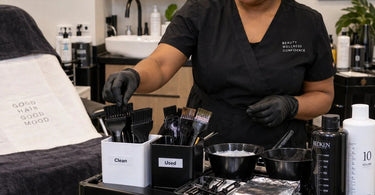
Deliver luxury clients crave every time, and you will build a salon reputation that practically markets itself. But here is the unglamorous truth nobody Instagrams: the difference between a luxury experience and a liability lawsuit often comes down to where you park your dirty tint brush. Yes, that humble, color-stained workhorse sitting on your Professional Hair Color cart right now. If it is cuddling up next to your clean brushes like a couple of teenagers at a movie theater, you have got a problem. A big, bacteria-breeding, state-board-fine-triggering, client-trust-eroding problem. And friend, we need to talk about it.
Now before you roll your eyes and mutter something about how you have been doing this for fifteen years and nobody has ever complained, hear me out. This is not about shame. This is about strategy. Because a clean and used brush separation system on your hair color cart is not just about staying on the right side of your state board inspector (though, spoiler alert, it absolutely is). It is about workflow, efficiency, and the kind of quiet professionalism that makes a client sink into her chair and think, "Okay, this place has its act together."
The Horror Story That Happens Every Single Day
Let me paint you a picture. It is a busy Saturday. You have got a balayage in foils, a root touch-up processing, and a walk-in color correction waiting. Your Hair Color Cart is loaded with everything you need. You reach for a tint brush. Is it clean? You think so. You used it on the last client, wiped it on a towel, and set it back on the cart next to the others. It looks fine. It smells like color, but everything smells like color. So you dip it into a fresh bowl of Professional Hair Color and go to town.
Here is what you just did. That "clean enough" brush might have residual color molecules, sure, but more importantly it has microscopic debris from your last client's scalp. Skin cells. Hair product buildup. Possibly bacteria. Now you have just introduced that little cocktail into a fresh bowl of color and applied it to a new client's head. Best case scenario? Nothing happens. Worst case scenario? Your client develops an irritation, a reaction, or an infection. And suddenly that fifteen-year track record does not matter one bit.
According to cosmetology regulations across multiple states, brushes must be cleaned and disinfected prior to each use, and clean implements must be stored separately from soiled ones . Ohio's administrative code is blunt about it: used and unclean equipment shall be stored separate and apart from clean items . This is not a suggestion. It is a rule. And it exists because the scenario I just described is not hypothetical. It is Tuesday.
What Exactly Is a Brush Separation System (And Why Does Your Cart Need One)?
A clean and used brush separation system is exactly what it sounds like. It is a deliberate, physical separation between the brushes you have already cleaned and disinfected and the brushes that have been used on a client and are awaiting their turn in the wash station. No mixing. No guessing. No "well, this one looks okay."
On a traditional Hair Color Cart, tools tend to live wherever there is space. A brush gets used, gets a quick wipe, and gets tossed back into the same drawer or bin as the clean ones. It is not malicious. It is just busy. But it is also a cross-contamination trap waiting to spring.
The solution is structural. Your cart should have clearly designated zones. One area for clean, disinfected tools. Another for used tools that need processing. And never the twain shall meet. This is the same principle behind the Sanitary Maintenance Area (SMA) concept taught in cosmetology schools, where clean and soiled implements are kept on opposite sides of a defined workspace .
California's Board of Barbering and Cosmetology actually calls this out as one of the most common violations cited during inspections: soiled non-electrical items must be stored in a container labeled "Dirty," "Soiled," or "Contaminated," while disinfected items go in a clean covered place labeled "Clean" . If your hair color cart does not have this setup, you are essentially inviting a citation to come sit on your shoulder like a very unwelcome parrot.
The Psychology of the Clean Brush (Or, Why Your Brain Is Lying to You)
Here is the thing about human beings: we are terrible at judging cleanliness by sight. A brush that looks clean might be teeming with microscopic friends. A brush that looks stained might actually be fully disinfected. But our brains take shortcuts. We see a brush that is not obviously coated in goop and we think, "Good enough."
This is why systems beat willpower every single time. When you have a designated clean zone and a designated dirty zone on your Hair Color Cart, you do not have to make a judgment call in the middle of a busy service. You do not have to rely on your exhausted brain at 4 PM on a Saturday. The system makes the decision for you. Clean brushes go here. Used brushes go there. End of story.
It is the same logic behind keeping your Mixing Bowls organized at your backbar. You would not use a bowl that still has yesterday's developer crusted in the bottom, would you? Of course not. The same standard applies to your brushes.
The Legal and Financial Argument (Because Nobody Wants a Fine)
Let us get practical for a moment. State boards do not mess around with sanitation. Florida's cosmetology rules explicitly state that using a brush, comb, or other article on more than one patron without being disinfected is prohibited, and salons are required to have sufficient implements to allow for adequate disinfecting practices . Translation: you need enough clean brushes that you are never tempted to reuse a dirty one.
Michigan's rules are equally clear: clean tools and supplies must be stored in covered containers and separate from used tools and supplies . Montana requires that soiled implements be stored separately from those that have been sanitized and disinfected . This is a consistent, nationwide expectation.
Now think about the financial side. A single citation from a state board inspection can cost you hundreds of dollars in fines, not to mention the damage to your reputation if clients find out. And if a client develops an infection or reaction because you used a contaminated brush? That is a potential lawsuit. That is a Yelp review that starts with "I wanted to love this place, but..." That is the kind of thing that keeps salon owners awake at night.
Compare that to the cost of a simple separation system on your cart. A few extra brushes. A couple of small bins or dividers. Maybe a dedicated container for dirty tools. That is it. The math is not complicated.
How to Set Up Your Hair Color Cart for Success
Okay, so you are convinced. You want a separation system. But how do you actually do it without turning your cart into a chaotic mess of containers and labels?
Start by assessing your current cart setup. Where do your brushes live right now? If the answer is "wherever they fit," you have your work cut out for you. But it is easier than you think.
Zone One: The Clean Zone. This is where your freshly disinfected brushes live. They should be stored in a covered container, a drawer, or a designated section of your cart that is protected from dust and debris. If your cart has a drawer, consider using a small organizer inside it to keep clean brushes upright and separated. Some stylists use a simple plastic bin with a lid. Others prefer a dedicated brush holder. Whatever you choose, the key is that this zone is clearly and consistently the home for clean tools only.
Zone Two: The Dirty Zone. This is where used brushes go immediately after they come off a client's head. Not after you finish the service. Not after you wipe them down. Immediately. The longer a used brush sits around without going to its designated dirty zone, the higher the chance it ends up back in the clean pile by accident. A small, labeled bin on the cart works perfectly. Some stylists use a mesh bag or a bucket that can be carried to the wash station at the end of the service.
Zone Three: The In-Use Zone. This is optional but helpful for busy colorists. A small tray or dish where the brush you are actively using sits during the service. Once you are done with it, it goes to the dirty zone. Not the clean zone. Never the clean zone.
The labels matter. California regulations specifically require that soiled items be stored in containers labeled "Dirty," "Soiled," or "Contaminated," and clean items in containers labeled "Clean" or "Disinfected" . You can buy pre-made labels or make your own. The point is clarity. Anyone walking up to your cart should know exactly which zone is which.
The Brush Cleaning Routine That Actually Works
A separation system only works if the dirty brushes actually get cleaned. This sounds obvious, but you would be surprised how many carts have a dirty zone that turns into a permanent storage facility for brushes that never quite make it to the sink.
Your brush cleaning routine should be as automatic as washing your hands between clients. For hair color brushes, the process is straightforward. Remove all visible color and debris. Wash with soap or detergent and warm water. Rinse thoroughly. Then disinfect according to your product's instructions. Michigan's rules specify that brushes must be immersed in a wet sanitizer for at least ten minutes or the period recommended by the disinfectant manufacturer .
Synthetic bristle brushes, which are standard for professional hair color work, are non-porous and clean up beautifully. They do not absorb color, which means they do not harbor bacteria the way natural bristles might. This is one more reason to invest in quality tools from brands you trust.
Once your brushes are clean and fully dry, they go back to Zone One. Clean. Ready. Waiting for their next client. And because you have a system, you never have to wonder whether the brush in your hand is actually clean. You know.
Why This Matters More Than You Think for Client Retention
Let us zoom out for a second. Your clients come to you for beautiful hair, yes. But they also come to you for an experience. They want to feel pampered. They want to feel safe. They want to trust that you know what you are doing and that you are not cutting corners when they are not looking.
A clean and used brush separation system is a visible signal of that trustworthiness. When a client sees labeled containers on your cart, when she notices that you never reach for a dirty brush, when she watches you move a used tool to a designated spot without even thinking about it, she absorbs a message: this person is a professional. This person cares. This person is not going to give me a scalp infection because she was too busy to clean a brush.
That is the kind of detail that turns a first-time client into a regular. That is the kind of detail that makes her tell her friends, "You have to try my colorist, she is so thorough." That is the kind of detail that builds a business.
And honestly? It is not that hard. It is just a matter of deciding that clean and dirty brushes do not belong in the same place. Ever. Once you make that decision, the rest is just logistics.
The Tools That Make It Easy
If your current hair color cart was not designed with separation in mind, do not worry. You can retrofit almost any cart with a few simple additions. Small plastic bins with lids. Adhesive labels. A brush holder that mounts to the side of the cart. A mesh bag for dirty tools that hangs from a hook.
If you are in the market for a new cart or want to upgrade your current setup, look for carts with drawers or compartments that can be dedicated to clean tools. Some carts even come with built-in dividers that make separation intuitive. And if you are really serious about hygiene, consider adding a UV Sterilizer to your backbar for additional peace of mind. (Though note that UV sterilizers are for storage after cleaning and disinfection, not as a replacement for proper cleaning .)
Pair your new system with high-quality Professional Hair Color and reliable Mixing Bowls, and you have got a color station that is as functional as it is professional.
The Bottom Line (And the Part Where I Tell You to Just Do It)
Look, I know you are busy. I know you have got clients to please, colors to mix, foils to fold, and about a thousand other things competing for your attention. The last thing you want is one more system to maintain. But here is the thing: a clean and used brush separation system is not one more thing. It is the thing that makes all the other things easier. It eliminates the mental load of wondering whether a brush is clean. It eliminates the risk of cross-contamination. It eliminates the frantic scramble when a state board inspector walks in.
It also, and this is the part nobody talks about enough, just feels better. There is a certain peace of mind that comes from knowing your station is organized, your tools are clean, and your clients are safe. That peace of mind lets you focus on what you actually love: making people look and feel amazing.
So go look at your hair color cart right now. Are your clean brushes mingling with your dirty ones? Are you relying on memory and hope to keep things straight? If so, today is the day. Get a couple of bins. Make some labels. Draw the line between clean and dirty. Your clients will never know the difference, but they will feel it. And your state board inspector? She will smile and move on to the next salon.
Now go forth and separate those brushes. Your future self (and your future clients) will thank you.
)