
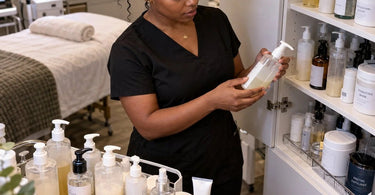
Success is in the details... and sometimes those details are hiding behind 14 half-empty bottles of lotion in the back of your spa cabinet. You know the ones. Three different massage oils, two facial cleansers that everyone swears are still being used, a mysterious toner without a label, and one lonely bottle of something nobody remembers ordering. Somehow, despite having enough partially used products to stock a small beauty convention, your team is convinced you are completely out of everything. Sound familiar? Half-empty bottles are one of the sneakiest inventory problems in professional spas and salons, quietly consuming cabinet space, tying up money, and creating unnecessary confusion. The good news? Understanding why these bottles multiply can help you build a smarter, cleaner, and more profitable product management system.
Why Do Half-Empty Bottles Keep Appearing in Spa Cabinets?
Half-empty bottles rarely accumulate because professionals intentionally waste products. Most of the time, they are the result of everyday operational habits that make perfect sense in the moment but create problems over time.
A massage therapist opens a fresh bottle because the existing one is nearly empty. An esthetician places an unfinished cleanser in the cabinet while preparing for the next appointment. A new employee cannot find the treatment oil they need, so they open another container. Meanwhile, an older bottle quietly moves farther toward the back of the shelf, where it begins its new career as a permanent cabinet resident.
Multiply these situations across several treatment rooms, employees, and months, and suddenly your storage cabinets resemble a retirement community for unfinished beauty products.
The real problem is not necessarily how much product your business purchases. It is how products move through your operation after they arrive.
Everyone Opens a New Bottle Before Finishing the Old One
One of the most common causes of half-empty inventory is the simple absence of an agreed-upon product rotation system.
Imagine a busy massage department using professional Massage Oils, Lotions, and Creams for Therapists. Each therapist has favorite products, preferred consistencies, and established routines. Without clearly assigned stock locations, several therapists may open separate bottles of the same lotion.
The result is five partially used bottles instead of one actively used container and four properly stored backups.
Develop a simple first-expiring, first-out system. Products with the earliest applicable expiration or use-by dates should generally receive priority, provided they remain suitable for professional use and manufacturer directions are followed. When dates are equivalent, older stock can usually be used first.
Clearly separate unopened inventory from products already in service. A designated active-product area helps employees recognize which containers should be used before opening additional stock.
One practical rule can make an enormous difference: Before opening a new bottle, check whether an appropriate, safe, usable bottle is already available.
When Every Treatment Room Has Its Own Secret Stash
Professional spa employees need reliable access to treatment products. Nobody wants an esthetician leaving a client mid-facial to search three rooms for cleanser.
Unfortunately, convenience sometimes evolves into accidental product hoarding.
Each treatment room develops its own collection of backup lotions, masks, serums, cleansers, and finishing products. Some are regularly used. Others sit untouched because employees assume another room has the newer inventory.
This becomes especially noticeable with Premium Skincare Products for Spas and Salons, where numerous formulas may serve different treatment protocols and skin concerns.
The solution is not to remove essential supplies from treatment rooms. Instead, establish reasonable par levels, meaning the target quantity of each product that a room should keep available.
For example, a facial room might maintain one active bottle of its standard cleanser and a designated replacement when appropriate. Less frequently used specialty products can remain in controlled central inventory until needed.
Par levels should reflect actual appointment volume, product consumption, and how quickly replacement stock can be obtained. A fully booked facial room has different requirements than a room used for occasional specialty services.
The Almost Empty Bottle Nobody Wants to Deal With
There is a peculiar stage in a spa product's life when it becomes too empty to feel convenient but too full to justify throwing away.
It is the bottle with just enough lotion for half a massage. The cleanser pump that requires an Olympic-level upper-body workout. The moisturizer that only releases product after being turned upside down and given a motivational speech.
Employees may avoid these containers because they cannot confidently estimate whether enough product remains to complete a treatment.
This is understandable. Running short during a service is inconvenient, especially when the client is comfortably positioned and the appointment schedule is tight.
Rather than expecting professionals to gamble on product quantities, establish practical procedures for managing low-volume containers.
Keep appropriate backups available and create a clearly marked area for containers that are approaching replacement. Where manufacturer instructions and sanitation requirements permit, eligible products can be used until they are finished without interrupting services.
Never combine leftover cosmetic products from different containers merely to reduce waste unless the manufacturer specifically authorizes that practice. Topping off containers, introducing unclean tools, or transferring products improperly can create contamination and traceability problems.
Saving a few ounces should never compromise product safety.
Too Many Similar Products Create Too Many Open Bottles
Professional spas thrive on variety. Customized treatments are part of what makes the industry exciting.
However, offering multiple products with almost identical functions can complicate inventory control.
Consider a treatment room containing four lavender massage lotions, three unscented body creams, two nearly identical facial cleansers, and several exfoliating scrubs that serve overlapping purposes.
Each product may have a legitimate place in your business, but unnecessary duplication can encourage employees to open whichever bottle happens to catch their eye.
A thoughtful product assortment review can help identify opportunities to simplify.
Evaluate your Spa Body Treatments, skincare products, and massage supplies based on client demand, treatment protocols, ingredient requirements, employee preferences, and purchasing history.
Determine which items are essential, which offer meaningful differences, and which may be creating unnecessary overlap.
Standardizing frequently used products does not mean eliminating professional flexibility. It means ensuring every product has a clear purpose.
Sometimes the best way to create more storage space is not buying another cabinet. It is deciding whether your business truly needs seven variations of essentially the same thing.
Product Packaging Can Contribute to the Problem
Not every half-empty bottle is the result of poor organization. Sometimes the packaging itself makes efficient dispensing difficult.
Thick creams may cling to the interior walls of containers. Pump mechanisms can struggle to reach remaining product. Narrow openings may make it difficult to dispense a viscous formula consistently.
For busy professionals, this can make an otherwise usable container feel finished long before it is actually empty.
When evaluating product packaging, consider whether bottles dispense reliably, remain stable on treatment carts, and allow practical use of their contents.
Professional Bottles & Jars may help organize products when dispensing or decanting is expressly permitted by the manufacturer and performed using appropriate hygienic procedures.
Any authorized secondary container should retain necessary product identification, dilution information where applicable, relevant warnings, and traceability details. Follow applicable workplace, product labeling, and sanitation requirements.
Do not assume that every original formula is suitable for repackaging. Some products require their original containers to preserve stability, sanitation, and safe dispensing.
Why Half-Empty Bottles Are More Expensive Than They Look
A partially used bottle is not automatically wasted product. It becomes a financial problem when businesses repeatedly purchase replacements while usable inventory remains overlooked.
Consider a spa with eight treatment rooms. Suppose each room contains three partially used products that are no longer being actively rotated into services. That creates 24 containers holding inventory that may eventually be forgotten, expire, deteriorate, or be discarded.
If each container represents an average of $12 in remaining product value, the business has $288 tied up in those overlooked contents. That is an illustrative example, not a universal cost estimate, but it demonstrates how small inefficiencies accumulate.
There are additional indirect costs: employees spend time searching for supplies, managers reorder products unnecessarily, shelves become cluttered, and expired inventory can require disposal.
More importantly, unnecessary product purchases reduce the money available for supplies that actually need replenishment.
Smart inventory management is not about squeezing every possible drop from every bottle. It is about buying intentionally, using products safely, and maintaining visibility into what the business already owns.
Expiration Dates and Product Safety Change Everything
One of the biggest mistakes a spa can make is assuming that a half-empty product remains usable simply because there is still liquid inside.
Professional cosmetics and treatment products may have specific expiration dates, periods after opening, storage requirements, or manufacturer recommendations.
Heat, moisture, air exposure, repeated handling, and contamination can affect product condition. Some formulas can separate, change consistency, develop unusual odors, or lose their intended performance characteristics.
A cabinet full of aging, partially used products may therefore represent more than a storage inconvenience.
Train employees to inspect labels, follow manufacturer guidance, and document opening dates when appropriate. Products that have expired, show signs of deterioration, have been contaminated, or cannot be confidently identified should not be used on clients.
Pay particular attention to sensitive treatment categories, including eye-area products, professional peels, lash and brow products, and formulas that require specific handling conditions.
Never extend product life by adding water, mixing incompatible formulas, or disregarding storage instructions. Also remember that products classified as drugs, such as certain sunscreens or acne treatments, may carry requirements different from those for ordinary cosmetics.
The most expensive bottle in the cabinet is not necessarily the one you throw away. It may be the one that creates a preventable client safety problem.
A Simple Cabinet Audit Can Reveal the Real Problem
You do not need complicated software to discover why your half-empty bottles keep multiplying. Start with a focused cabinet audit.
Choose one treatment room or storage cabinet and review every product inside. Record its name, approximate remaining quantity, opening date if known, expiration information, storage requirements, and whether the product is still part of an active treatment protocol.
Separate products into practical categories: active and suitable for use, unopened backup stock, items requiring further verification, and products that must be removed from service.
Look for patterns. Are multiple containers of the same cleanser open? Do several treatment rooms maintain excessive backup supplies? Are specialty masks being ordered faster than they are used?
Ask employees why they open new bottles. Their answers may reveal inconvenient storage locations, unreliable dispensers, unclear labeling, or insufficient access to replacement stock.
Importantly, avoid turning the audit into a blame session. Employees often develop duplicate inventories because the existing workflow makes doing so easier than following the intended process.
The goal is to fix the system, not identify who last opened another bottle of eucalyptus lotion.
Create a Two-Zone Storage System
One practical strategy is to divide inventory into two clearly defined areas.
Zone One: Active Products. This area contains the approved products currently being used for services. Items should be accessible, properly labeled, stored according to manufacturer instructions, and organized by treatment category.
Zone Two: Unopened Backup Inventory. This area contains replacement stock that remains sealed until needed. Keep it organized by product name and applicable expiration or rotation dates.
A third clearly identified quarantine location can be useful for damaged, questionable, recalled, or unidentified products awaiting review or disposal. These items should never be available for routine treatment use.
Within active storage, consider organizing shelves by service type, such as facial treatments, massage therapy, body treatments, and waxing.
For example, maintain a designated area for Pre & Post-Waxing Products rather than allowing pre-wax cleansers and finishing lotions to migrate throughout unrelated treatment rooms.
Clear storage locations make it easier to check existing supplies before opening replacements.
Make Product Rotation Part of the Daily Routine
An inventory system is only effective when it fits the way employees actually work.
Fortunately, meaningful improvements do not require a lengthy morning meeting or a clipboard the size of a treatment table.
At opening, employees can confirm that each room has sufficient approved products for scheduled services. During restocking, they can check for existing active containers and prioritize appropriate older inventory.
At closing, a quick inspection can identify low-stock products, containers requiring replacement, and items that have been placed in the wrong storage area.
Assign responsibility for maintaining central inventory so employees know who can authorize opening new bulk containers or requesting additional stock.
Keep the process simple enough that the team can follow it consistently, even on a busy Saturday when the appointment book looks like an airport departure board.
Bulk Buying Only Saves Money When Products Get Used
Purchasing professional supplies in larger quantities can offer meaningful advantages for high-volume spas and salons.
However, buying more inventory than a business can realistically use before its applicable expiration or use period may cancel out those savings.
Before placing bulk orders, consider average weekly consumption, seasonal appointment patterns, storage capacity, supplier lead times, and product shelf life.
For commonly used Spa Essentials for Professionals, larger quantities may make sense when demand is predictable and products can be stored correctly.
Specialty serums, seasonal fragrances, and rarely requested treatment products may be better suited to smaller orders.
Think of bulk purchasing as a tool rather than an automatic bargain. A generous discount means very little if half the inventory expires while waiting for its moment to shine.
Give Employees a Say in Product Organization
Managers often design inventory systems around what looks organized on paper. Treatment professionals, meanwhile, have to make those systems work between appointments.
Ask massage therapists, estheticians, nail technicians, and other service providers which products they use most frequently and where they need those items stored.
A cleanser that belongs in a central supply cabinet according to the spreadsheet may need to remain immediately accessible inside a facial room. A massage lotion that is used throughout the day may require a dedicated dispenser at each station.
When employees help develop storage procedures, the system is more likely to match real service demands.
Encourage staff to report dispensing difficulties, duplicate containers, inconsistent stock availability, and confusing labels.
These small observations can help managers correct issues before they become expensive habits.
Track Product Usage Instead of Guessing
Once your cabinets are organized, basic usage tracking can keep the clutter from returning.
Start with your highest-volume products rather than attempting to document every cotton pad and decorative nail accessory in the building.
Record how many bottles are opened during a typical week, how quickly they are consumed, and how many treatments those products support.
For instance, if a massage department uses approximately one bottle of a specific lotion for every 15 treatments, that information can help estimate future purchasing requirements.
Actual consumption will vary by treatment duration, application technique, product consistency, and service protocols, so use real observations rather than assuming a universal amount per appointment.
Track products that routinely remain unfinished. They may indicate excessive purchasing, inconvenient packaging, overlapping formulas, or a service that is no longer popular.
Even a simple spreadsheet can turn vague inventory concerns into useful purchasing information.
Organized Cabinets Make Professional Services Run More Smoothly
Inventory organization affects much more than the appearance of a storage room.
When employees know exactly where products belong, they spend less time searching and more time focusing on clients.
Proper rotation reduces avoidable product deterioration and helps managers identify genuine replenishment needs. Clearly identified containers also support consistent treatment protocols and responsible professional handling.
Organized storage can make sanitation procedures easier to maintain because surfaces are less cluttered and questionable products are easier to identify.
For multi-room operations, standardized organization can also simplify onboarding. New employees can locate essential products without asking three coworkers where the facial cleanser disappeared.
And yes, a neatly organized cabinet is deeply satisfying. There is something wonderful about opening a spa cupboard and seeing orderly supplies instead of what appears to be a lotion-based archaeological excavation.
How Pure Spa Direct Helps You Build a Smarter Supply System
Maintaining organized inventory begins with choosing professional supplies that suit your actual services and purchasing needs.
Pure Spa Direct is a wholesale distributor serving spa, salon, massage, waxing, nail, beauty, and wellness professionals. With an extensive selection of professional products and supplies, businesses can source items for multiple service categories while evaluating options that fit their treatment protocols and inventory requirements.
Explore Must-Have Supplies for Salon & Spa Business Success for everyday operational essentials, or browse Professional Cotton, Sponges, and Wipes for Salons & Spas for frequently replenished service supplies.
For treatment-specific purchasing, take advantage of professional product categories rather than ordering extra inventory simply because existing products are difficult to locate.
Better purchasing decisions start with knowing what is already on your shelves, what your professionals actually use, and how quickly those products move through the business.
The Bottom Line: Stop Letting Half-Empty Bottles Run Your Spa
Half-empty bottles multiply because small workflow problems compound over time. Employees open replacements before locating active products. Treatment rooms accumulate duplicate supplies. Packaging makes products difficult to finish. Purchases are based on assumptions instead of actual consumption.
None of these problems requires a dramatic operational overhaul.
Begin with one cabinet. Identify duplicate containers, verify which products are safe to use, establish clear storage zones, and create a realistic rotation system. Then expand those improvements throughout your treatment rooms.
Review purchasing habits regularly, communicate expectations with your team, and make sure inventory procedures support efficient professional services rather than interfere with them.
A well-managed cabinet should contain products with a purpose, not an ever-growing collection of unfinished bottles waiting for someone to remember they exist.
After all, your spa cabinets should be working for your business, not secretly operating a halfway house for abandoned moisturizers.
