
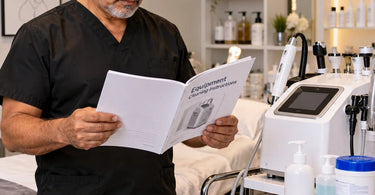
Start today, succeed tomorrow... especially when the equipment you purchase today does not become tomorrow's expensive cleaning nightmare! That gorgeous new treatment chair, high-tech facial machine, or luxurious pedicure station might look like the perfect addition to your spa or salon, but have you checked what it actually takes to clean it? Manufacturer cleaning instructions deserve a starring role in every professional equipment purchasing decision because they affect sanitation, staff efficiency, operating expenses, equipment longevity, and the client experience. A beautiful piece of equipment is only a smart investment if your team can keep it clean, maintain it correctly, and prepare it safely for the next appointment.
For busy spa, salon, nail, massage, waxing, and beauty professionals, cleaning is not an occasional housekeeping project. It is part of the service workflow, happening between appointments, throughout the day, and during closing procedures. Understanding manufacturer cleaning requirements before purchasing equipment can save your business from frustrating surprises, unnecessary maintenance expenses, and preventable scheduling headaches.
At Pure Spa Direct, we understand that professional equipment needs to do more than look impressive in your treatment room. As a distributor serving beauty and wellness professionals, we help businesses explore equipment and supplies that support practical, productive operations. Let's look at why the cleaning instructions should be one of the first things you read before approving your next equipment purchase.
The Purchase Price Is Only the Beginning
Picture two attractive treatment chairs. Both offer comfortable positioning, modern styling, and the features your estheticians need. One costs slightly less, but its upholstery requires a specialized cleaning product, certain disinfectants are prohibited, and cleaning around its mechanical components takes extra time. The other costs a little more but has accessible surfaces and documented compatibility with products already used in your facility.
Which chair is actually the better investment?
The answer depends on its total cost of ownership, not simply the number on the price tag. Cleaning procedures influence recurring expenses in several ways:
- Approved cleaning agents and disinfectants may carry different costs.
- Specialized cleaning tools or replacement components may be necessary.
- Longer cleaning procedures can increase the time between appointments.
- Improper cleaning can damage finishes, seals, upholstery, and electrical components.
- Additional staff training may be required for complicated equipment.
- Preventive maintenance and professional servicing may affect annual operating expenses.
Before investing in Top-Quality Equipment & Furniture for Spas & Salons, consider what ownership will look like after the excitement of delivery day has faded. Your equipment will spend years being used, wiped down, maintained, and prepared for clients. That daily reality matters.
Cleaning and Disinfection Are Not the Same Thing
One of the most important details in equipment instructions is the distinction between cleaning and disinfecting. These terms are often used interchangeably in casual conversation, but they describe different processes.
Cleaning removes visible soil, product residue, oils, debris, and other contaminants from a surface. Disinfection uses an appropriate product or process to inactivate specified microorganisms under defined conditions. In many situations, equipment must be cleaned before it is disinfected because accumulated residue can interfere with disinfectant performance.
For professional facilities, the correct procedure depends on the equipment, its intended use, applicable state board requirements, and the disinfectant's labeled directions. Equipment that contacts intact skin may have different reprocessing requirements from implements or devices that contact nonintact skin or present other infection risks.
This is why purchasing equipment with vague instructions such as wipe clean as needed should raise questions. That phrase does not necessarily tell you whether the surface can tolerate a required disinfectant, how long a product must remain wet, or which components require additional attention.
Explore Professional Cleaners & Disinfectants for Salons and Spas while reviewing the specific equipment manufacturer's compatibility guidance and the disinfectant's EPA-registered label. Both sets of directions matter.
Disinfectant Compatibility Can Make or Break a Purchase
Not every disinfectant is compatible with every piece of salon or spa equipment. Some materials can deteriorate when repeatedly exposed to certain chemicals, while other surfaces may require specific concentrations, application methods, or rinsing procedures.
Potential compatibility concerns include discoloration of upholstery, deterioration of protective coatings, corrosion of metal components, damage to rubber seals, and degradation of certain plastics or adhesives. The extent of these problems depends on the material, the chemical, its concentration, contact duration, and frequency of exposure.
Imagine purchasing a luxurious treatment bed only to discover that your facility's established disinfectant is not approved for its upholstery. Your options might include changing cleaning products, consulting the manufacturer about compatible alternatives, or reconsidering the purchase entirely.
Before ordering, ask the manufacturer or supplier these questions:
- Which cleaning products are approved for routine use?
- Which disinfectant types and specific formulations are compatible?
- Are any chemicals, concentrations, or application methods prohibited?
- Must the surface be rinsed after cleaning or disinfection?
- Are there specific contact-time or drying considerations?
- Will using an unapproved product affect warranty coverage?
- Are the instructions compatible with applicable sanitation requirements for your services?
Do not assume that a product labeled safe for many hard surfaces is appropriate for every type of equipment. A disinfectant's labeled use sites and directions must also cover the intended application. When the equipment manufacturer's instructions and the sanitation method your business needs cannot be reconciled, resolve that conflict before purchasing.
Cleaning Time Directly Affects Appointment Scheduling
Every salon and spa owner knows that the space between appointments can disappear faster than a freshly folded stack of clean towels. Client checkout, room preparation, product restocking, and sanitation must all fit into a realistic schedule.
Now imagine discovering that a new machine requires several removable components to be cleaned individually, a lengthy disinfection procedure, careful drying, and occasional internal maintenance. Those tasks might be entirely manageable, but only if they are included in your operational plan.
Consider a hypothetical treatment room that handles eight appointments per day. If a new piece of equipment adds five minutes of active cleaning work after each service, that represents 40 additional minutes of labor daily. Across 22 operating days, the total becomes approximately 14.7 hours per month.
That is not an estimate for any particular machine. It simply demonstrates how small differences in cleaning procedures can accumulate in a busy business.
Remember that disinfectant contact time and staff labor time are not always the same. A surface may need to remain visibly wet for the disinfectant's full labeled contact time, even if the employee can perform other permitted tasks during part of that period. Equipment should not return to service until all required cleaning, disinfection, rinsing, and drying steps are complete.
When comparing equipment, evaluate both active cleaning labor and total time before the station can safely be used again. The easier an approved procedure is to complete consistently, the easier it may be to keep the appointment schedule running smoothly.
Pedicure Equipment Deserves Extra Attention
Pedicure equipment is a perfect example of why cleaning instructions should influence purchasing decisions. Foot spa systems may include basins, removable screens, jets, plumbing, filters, or other components that require specific maintenance and disinfection procedures.
A pedicure station can look beautifully polished from the outside while having internal components that demand additional attention. Depending on the design, the manufacturer may specify procedures for removing debris, circulating cleaning solutions, flushing internal pathways, and performing routine maintenance.
Before choosing from Pedicure Chairs/Spas, examine the complete cleaning and disinfection instructions. Find out whether the system uses removable liners, pipeless technology, circulating water pathways, or another design, and determine exactly what those features mean for sanitation.
Important purchasing questions include whether components are accessible without specialized tools, how the manufacturer defines routine versus periodic cleaning, and whether replacement parts remain readily available.
Also confirm that the required procedures can satisfy your state board's rules. Some jurisdictions impose specific requirements for pedicure equipment, including cleaning logs, disinfection steps, or maintenance schedules. Manufacturer instructions are essential, but they do not replace applicable regulations.
A thoughtfully selected pedicure station should support a comfortable client experience without turning the closing routine into a plumbing adventure nobody volunteered for.
Facial Machines Can Have Surprising Maintenance Needs
Professional facial equipment frequently combines electrical components, water reservoirs, removable attachments, tubing, and surfaces that encounter skincare products. Each feature can create its own cleaning requirements.
Consider Facial Steamers. Depending on the model, instructions may address the type of water permitted, reservoir cleaning frequency, mineral deposit removal, drainage, and safe handling of heated components.
A model with a water reservoir that is easy to access and maintain may be more convenient for a busy treatment room than a design requiring complicated disassembly. However, the appropriate choice depends on the actual manufacturer's specifications, not assumptions based on appearance.
Other devices, including Hydrodermabrasion equipment, may require detailed cleaning of solution containers, handpieces, tips, and fluid pathways. Some components may be disposable, while others require validated cleaning or disinfection procedures.
When considering Advanced Spa Equipment for Professional Use, request the complete user manual before making a final decision. Look for cleaning requirements by component, instructions for reusable accessories, preventive maintenance intervals, and any restrictions concerning liquids or disinfectants near electrical connections.
Never assume that a spray bottle and a quick wipe are sufficient for a complicated treatment device. Follow the device-specific instructions for use and its intended professional application.
Wax Warmers and Product Buildup Require a Practical Plan
Waxing professionals know that sticky residue has a remarkable talent for appearing in places nobody remembers touching. This makes cleanability an important consideration when purchasing warming equipment and accessories.
When comparing Professional Wax Warmers for Salons & Spas, inspect the design of the heating chamber, outer housing, temperature controls, removable inserts, and surrounding surfaces.
Ask whether the manufacturer permits specific wax residue removers, how the unit must be cooled or disconnected before cleaning, and whether removable containers can be cleaned separately. Confirm that cleaning products will not damage temperature markings, control panels, or protective finishes.
A warmer with accessible surfaces and straightforward maintenance instructions may make everyday operations easier, especially in a high-volume waxing studio.
Explore Waxing Accessories & Removers for Professional Use when developing a compatible cleaning supply plan. Remember that removing wax residue is not automatically equivalent to disinfecting the relevant surface. The correct steps depend on manufacturer guidance, surface type, and the professional sanitation requirements involved.
Upholstery Can Be Beautiful and High Maintenance
Massage tables, treatment beds, salon chairs, and other upholstered furnishings deserve careful evaluation because their surfaces experience frequent contact with clients, linens, oils, lotions, and cleaning agents.
Attractive upholstery does not automatically mean durable upholstery. Some finishes tolerate repeated cleaning better than others, and manufacturer-approved chemical options can vary significantly.
Before buying from Top Quality Massage Tables Chairs for Relaxation & Wellness, review upholstery care instructions alongside comfort, weight capacity, adjustability, and overall construction.
Important considerations include whether the surface can be cleaned and disinfected as required, how massage oils should be removed, which chemicals are prohibited, and whether upholstery repairs or replacement components are available.
For practitioners using Massage Oils, Lotions, and Creams for Therapists, product buildup deserves particular attention. Residual oils can affect cleaning performance and may contribute to upholstery deterioration when not removed according to the manufacturer's directions.
Protective coverings and Salon & Spa Bedding can support a comfortable and organized treatment environment, but they do not eliminate the need to maintain the equipment underneath.
Replacement Parts and Consumables Matter Too
Some equipment purchases involve recurring expenses beyond cleaning chemicals. Filters, disposable liners, replacement tubing, seals, specialized attachments, and other components may require periodic replacement.
Those details should be included in your purchasing comparison. A lower-cost machine with expensive proprietary consumables may ultimately require more investment than a competing model with readily available components.
Before purchasing, ask how frequently parts typically require replacement under the manufacturer's recommended maintenance schedule. Find out whether routine replacements can be completed by trained staff or require authorized service.
Availability matters as well. If an essential replacement component becomes difficult to obtain, equipment downtime can affect appointments and client satisfaction.
Browse Bulbs & Replacement Parts for Spa and Salon Equipment as part of your overall equipment planning, while confirming the exact part numbers and compatibility requirements for your selected model.
The goal is not to avoid equipment that requires maintenance. Professional equipment often needs regular care. The goal is to understand those responsibilities before your business depends on the machine.
Cleaning Requirements Can Affect Warranty Protection
Manufacturer warranties commonly include terms addressing acceptable use, maintenance, and damage caused by improper care. The precise coverage varies by product and manufacturer.
Using prohibited cleaning chemicals, exposing electrical components to moisture, ignoring required maintenance, or attempting unauthorized repairs may create problems when requesting warranty service.
Before purchasing, review the warranty document rather than relying on general expectations. Determine whether the manufacturer requires specific maintenance records, approved replacement parts, authorized technicians, or proof that cleaning procedures were followed.
Save a copy of the equipment manual, warranty terms, proof of purchase, and applicable service records in an accessible business folder. If cleaning instructions change or the manufacturer issues updated guidance, ensure staff members are using the appropriate version.
A little documentation today can prevent a major paperwork scavenger hunt later.
Choose Equipment Your Team Can Clean Consistently
Even an effective sanitation procedure becomes less reliable when it is confusing, difficult to perform, or poorly understood by the people responsible for completing it.
Consider how equipment cleaning fits into your actual staffing model. Does the equipment require special disassembly? Can employees access the relevant surfaces safely? Are the cleaning steps clearly illustrated? Is personal protective equipment required? Does the manufacturer recommend specialized training?
For busy businesses with multiple shifts or several treatment providers, consistency is especially important. Ideally, every trained employee should be able to follow the same documented procedure and understand when the equipment is ready for its next use.
After purchasing new equipment, create a cleaning checklist based on the manufacturer's instructions and applicable sanitation rules. Include the correct cleaning agents, disinfection procedures, contact times, rinsing or drying requirements, and maintenance intervals where relevant.
Keep supplies organized and accessible. Stocking appropriate Protective Gloves & Masks for Salon and Spa Professionals and approved cleaning products can help staff follow established procedures without searching through supply cabinets during a busy workday.
Make sure employees understand that stronger chemical concentrations, longer soaking, or improvised cleaning methods are not automatically safer. Follow the labeled disinfectant directions and the equipment manufacturer's instructions instead.
How to Compare Equipment Before You Buy
Adding cleaning requirements to your purchasing process does not have to be complicated. A simple comparison worksheet can reveal meaningful differences between equipment options.
For each model, document the purchase price, intended services, approved cleaning agents, disinfection compatibility, routine cleaning time, periodic maintenance, required consumables, replacement part availability, warranty conditions, and anticipated staff training.
Consider giving special attention to four categories:
- Sanitation suitability: Can the equipment be cleaned and disinfected appropriately for its intended professional use and applicable requirements?
- Daily convenience: How much active effort and overall turnaround time does routine cleaning require?
- Long-term costs: What recurring supplies, parts, labor, and service expenses should be anticipated?
- Operational reliability: Are instructions clear, components accessible, and maintenance support available?
Sanitation suitability should be a minimum requirement rather than something traded away for convenience. Once an option meets the necessary safety and compliance standards, the other categories can help determine which product offers the best overall value.
For example, consider two hypothetical facial machines with similar treatment capabilities. Machine A costs $1,800 and requires an estimated $25 per month in maintenance consumables. Machine B costs $2,050 and requires approximately $10 monthly. Over three years, the simplified purchase-plus-consumables totals would be $2,700 for Machine A and $2,410 for Machine B.
These are illustrative figures, not actual product prices or maintenance claims. They exclude labor, electricity, repairs, taxes, and other operating expenses. Their purpose is to show why examining recurring costs can change the apparent value of a purchase.
The same approach applies to Professional Salon Equipment for Top Stylists and Barbers, nail furniture, massage tables, waxing equipment, and advanced skincare devices.
Questions to Ask Before Finalizing an Equipment Order
Before placing an order, take a few minutes to collect the answers that can protect your investment and support smoother operations.
- Can I obtain the complete manufacturer cleaning and maintenance instructions before purchasing?
- Which components must be cleaned, disinfected, removed, or replaced?
- Are the manufacturer's approved methods compatible with my state's professional sanitation requirements?
- Will my current cleaning and disinfection products work with the equipment?
- How long does the complete between-client procedure require?
- Does periodic maintenance involve additional labor or service appointments?
- Are special cleaning tools, proprietary products, or consumables needed?
- What chemicals or procedures can damage the equipment or affect warranty coverage?
- Are replacement parts readily available for the specific model?
- Can my team realistically follow the required procedures during normal business hours?
If essential information is missing, contact the manufacturer or distributor before ordering. A clear answer before checkout is usually much more convenient than discovering an incompatibility after installation.
Better Cleaning Planning Creates a Better Client Experience
Clients may not see the maintenance manual, but they certainly notice the results of a well-run professional environment. A clean, organized treatment room, equipment in good condition, and predictable appointment timing all contribute to confidence and comfort.
Equipment that supports practical cleaning procedures can also make employees' jobs easier. Instead of improvising around inaccessible surfaces or searching for approved supplies, staff can follow a consistent process and concentrate on delivering excellent services.
That consistency becomes especially valuable as a business grows. Additional treatment rooms, new employees, expanded services, and higher appointment volume all place greater demands on sanitation systems.
Choosing equipment with clear, workable cleaning instructions helps build operational standards that can scale alongside your business.
Make Cleaning Instructions Part of Every Smart Equipment Investment
The next time a stunning new salon chair, sophisticated facial machine, or deluxe pedicure station catches your eye, enjoy the exciting features, the sleek design, and the possibilities for your services. Then ask the less glamorous but equally important question: How exactly are we going to clean this thing?
Manufacturer cleaning instructions reveal far more than which cloth to use. They help determine whether equipment fits your sanitation procedures, staffing schedule, maintenance budget, and long-term business goals. Taking those requirements seriously before purchasing can protect your investment and prevent unnecessary operational complications.
Explore Must-Have Supplies for Salon & Spa Business Success and professional equipment selections at Pure Spa Direct as you plan your next upgrade. Compare features, request the relevant manufacturer's documentation, and choose products that make sense for the way your business actually operates.
After all, the best equipment purchase is not simply the one that looks fabulous on delivery day. It is the one that continues working beautifully, fits your cleaning routine, and earns its place in your business long after the unboxing excitement is over.
