
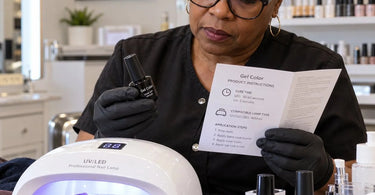
Clients love this must-have item... until their gorgeous gel manicure starts lifting, peeling, or behaving like it has somewhere better to be. A professional UV/LED nail lamp is one of the hardest-working pieces of equipment at a nail station, but choosing the right one involves much more than grabbing the model with the biggest wattage printed on the box. That impressive number might look fabulous in a product listing, yet it cannot tell you whether the lamp will properly cure the gel products your salon actually uses. For professional nail technicians, understanding lamp compatibility, manufacturer curing instructions, and proper application techniques can make a meaningful difference in service consistency, client comfort, and product performance.
The good news? You do not need an advanced chemistry degree or a mysterious laboratory hidden behind your manicure station. You simply need to understand what nail lamp specifications actually mean, which instructions matter most, and why the relationship between your lamp and gel formula deserves more attention than an enormous wattage claim.
Why Nail Lamp Wattage Is Not the Whole Story
Imagine shopping for two nail lamps. One advertises 48 watts, while another proudly displays 120 watts. Which one will cure your favorite professional gel polish correctly?
If you immediately picked the 120-watt model, congratulations! You have fallen for one of the nail equipment industry's most tempting marketing shortcuts. Bigger numbers are appealing, especially when you are trying to keep a busy appointment schedule moving. Unfortunately, electrical wattage does not provide enough information to determine whether a lamp is compatible with a particular gel formula.
Wattage generally describes electrical power consumption. It does not directly measure the intensity of useful curing light reaching the nail surface, nor does it identify the wavelengths produced by the lamp.
Two lamps with similar wattage ratings can deliver different curing performance because of differences in their LED components, optical design, light distribution, operating modes, and construction.
A higher advertised wattage does not automatically mean faster curing, deeper curing, or greater product compatibility.
For professional buyers comparing professional nail lamps, wattage belongs on the specification checklist, but it should never be the only item on that checklist.
How UV and LED Nail Lamps Actually Cure Gel Products
To understand why product instructions matter, it helps to know what happens underneath that pretty glossy surface.
Professional gel products contain ingredients called photoinitiators. When these ingredients receive suitable light energy, they help initiate a chemical reaction known as polymerization. This reaction transforms the gel formulation into a hardened coating or enhancement.
However, the process depends on several important variables working together:
- Wavelength: The type of light energy emitted by the lamp must be appropriate for the photoinitiators in the gel formula.
- Light intensity: Sufficient curing energy must reach the product.
- Exposure time: The gel must remain under the appropriate light for the duration specified by the product manufacturer.
- Application thickness: The amount and density of product influence how effectively light reaches the material.
- Positioning: Nails must receive adequate illumination throughout the curing process.
Think of it as following a baking recipe. Setting the oven to an impressively high temperature does not guarantee perfect results. You still need the correct temperature, timing, and preparation. Nobody wants a beautiful cake with an uncooked center, and nobody wants an apparently hardened manicure with inadequately cured material underneath.
The manufacturer develops curing instructions around the characteristics of its formula and compatible curing equipment. Those directions are therefore much more meaningful than a generic promise that a lamp cures everything.
Why Wavelength Compatibility Matters More Than a Big Wattage Number
Wavelength is measured in nanometers, commonly abbreviated as nm. Many modern professional UV/LED nail lamps advertise wavelengths around 365 nm and 405 nm.
These wavelengths are relevant because different gel formulations use photoinitiators that respond to different portions of the ultraviolet or near-visible light spectrum.
A lamp designed to emit light at both 365 nm and 405 nm may support a broader selection of gel systems than certain older or single-wavelength designs. However, that does not mean every dual-wavelength lamp is automatically compatible with every gel product.
Even when the advertised wavelengths match, differences in light intensity and distribution can affect the curing process.
For nail salon owners, the practical lesson is straightforward: Check the gel manufacturer's recommended lamp and curing requirements before assuming compatibility.
If a manufacturer specifies a particular lamp model, wavelength range, or validated curing system, that information deserves priority over a competing lamp's general wattage claims.
Why Following Gel Polish Manufacturer Instructions Is So Important
Professional gel polish is not one universal formula packaged in different colors. Manufacturers use different combinations of resins, pigments, photoinitiators, and other ingredients to create their products.
That means one gel color may have different curing requirements from a builder gel, sculpting gel, rubber base, or top coat.
Product instructions may specify:
- The recommended curing lamp or approved lamp family.
- Whether the formula is intended for UV, LED, or compatible UV/LED curing equipment.
- The curing time for each application layer.
- Recommended application thickness.
- Special instructions for builder gels or thicker applications.
- Whether a particular curing mode is required.
- Additional instructions for darker, highly pigmented, or specialty formulas.
For example, a manufacturer might specify a particular curing duration using its designated LED lamp. That does not mean every other lamp labeled LED can achieve equivalent curing in the same amount of time.
Likewise, changing the curing time without manufacturer guidance is not a reliable way to compensate for incompatible equipment.
The best professional habit is to review product instructions before introducing a new gel formula into your service menu.
Can an Incorrect Nail Lamp Cause Gel Polish to Undercure?
Yes. Using a lamp that does not provide suitable wavelengths, intensity, or exposure conditions can result in incomplete polymerization.
Undercuring is especially concerning because the surface of a gel coating may appear firm even when the material beneath has not reached the intended degree of cure.
Potential consequences include compromised adhesion, premature service breakdown, peeling, and increased exposure to incompletely reacted ingredients.
Repeated skin exposure to certain uncured gel ingredients, including some acrylates and methacrylates, can contribute to allergic sensitization. This makes proper product handling and curing an important professional safety consideration, not simply a question of how long a manicure lasts.
Technicians should also avoid allowing uncured gel to contact surrounding skin. Follow product safety instructions, use appropriate application techniques, and remove accidental skin contact before curing according to manufacturer guidance.
One particularly important detail: A tacky inhibition layer does not automatically mean a gel is undercured. Certain gel products are intentionally formulated to leave a surface layer that requires a specific finishing procedure.
Likewise, a hard or glossy surface is not proof that the entire coating has cured adequately.
If product performance raises concerns, review compatibility and manufacturer guidance rather than relying on appearance alone.
Does a Higher Wattage Nail Lamp Cure Gel Faster?
Not necessarily, and this is where marketing and practical salon operations sometimes have a dramatic disagreement.
A higher-wattage lamp may consume more electrical power, but curing speed depends on whether sufficient light at the appropriate wavelengths reaches the gel formulation.
Consider two hypothetical lamps:
- Lamp A: A 48-watt model that the gel manufacturer has evaluated and recommends for its products.
- Lamp B: A 120-watt model with impressive marketing claims but no confirmed compatibility with those same products.
Lamp A would be the more defensible professional choice for that gel system, even though Lamp B displays a much larger number.
This does not mean high-wattage equipment is inherently unsuitable. It simply means that the number on the label cannot substitute for compatibility information.
For busy salons, selecting a validated lamp and product combination can also make service timing more predictable. That is far more useful than discovering halfway through a fully booked Saturday that your newest lamp is not behaving as expected.
What Nail Technicians Should Check Before Buying a UV/LED Lamp
Shopping for UV/LED gel nail lamps becomes easier when you start with the products already used at your manicure stations.
Before purchasing new equipment, consider the following questions.
1. Which Gel Systems Will the Lamp Need to Cure?
Make a list of your salon's frequently used base coats, color gels, top coats, builder gels, and enhancement products.
Review their curing requirements individually. A lamp compatible with one product family should not automatically be assumed suitable for every formula in your inventory.
2. Does the Gel Manufacturer Recommend This Lamp?
Look for explicit recommendations, approved lamp models, or written compatibility information.
If the instructions are unclear, contact the product manufacturer for guidance rather than guessing.
3. What Wavelengths Does the Lamp Produce?
Check whether the lamp manufacturer publishes its wavelength specifications and whether those specifications are appropriate for your gel products.
A dual-wavelength claim can be useful information, but it is not a universal compatibility guarantee.
4. Does the Lamp Illuminate the Entire Nail?
Consider lamp size, diode placement, reflective surfaces, and whether clients can comfortably position all fingers and thumbs where the manufacturer intends.
Uneven positioning may leave some nails receiving less curing light than others.
5. Are Replacement Parts and Maintenance Instructions Available?
Professional equipment should be evaluated for ongoing serviceability, cleaning procedures, and manufacturer-recommended maintenance.
Explore Bulbs & Replacement Parts for Spa and Salon Equipment when maintaining equipment that uses replaceable components.
6. Does the Lamp Suit the Salon's Workflow?
Consider hand placement, comfortable access, timer settings, available space, and the types of services offered.
For dedicated nail stations, pairing suitable curing equipment with functional Nail Tables and Manicure Stations can help create an organized professional workspace.
Why Builder Gel and Thick Applications Need Special Attention
Builder gels and enhancement products deserve extra care because thicker applications can affect how curing light travels through the material.
With thicker or highly pigmented products, the light reaching deeper layers may be reduced. That makes proper application thickness and manufacturer-specified curing procedures especially important.
Some professional gel systems include instructions for controlled application layers, particular curing modes, or specific lamp models.
Do not assume that adding an extra-thick layer saves time simply because the lamp has a high wattage rating.
It might look efficient until the enhancement begins demonstrating its own interpretation of structural integrity.
For salons offering sculpted enhancements or overlays, review the curing instructions for each product in the service, including base materials, builders, color products, and finishing gels.
Explore builder gels and Nail Brushes & Tools while planning a professional enhancement station.
What About Low Heat Mode on Professional Nail Lamps?
Some professional lamps offer low heat, gradual power, or specialized curing modes intended to manage the rate at which a product cures.
These features can be relevant because polymerization releases heat. Certain gel formulas, especially when applied in larger amounts, can create an uncomfortable heat sensation during curing.
However, low heat mode is not an automatic solution for every product.
Reducing or gradually increasing lamp output changes the exposure conditions, so technicians should follow the gel manufacturer's instructions about whether and how to use these settings.
If a client experiences excessive heat or discomfort, stop the exposure and follow the relevant product and lamp safety guidance. Do not simply ask the client to tolerate the sensation.
Client comfort matters, and a professional curing procedure should never become an endurance competition.
How to Spot Possible Nail Lamp Compatibility Problems
A recurring service issue does not automatically prove that your lamp is responsible. Preparation, application thickness, product condition, maintenance, and client habits can all influence results.
Still, certain patterns deserve closer investigation:
- Repeated lifting or peeling across multiple clients.
- Unexpectedly soft or unstable gel after curing.
- Inconsistent results between different fingers.
- Changes in performance after switching lamp models.
- Problems appearing after introducing a new gel formula.
- Unusual curing behavior after equipment ages or becomes dirty.
When troubleshooting, begin with the product instructions.
Confirm the recommended lamp, curing duration, application thickness, hand positioning, and equipment maintenance requirements.
Inspect the lamp for dirt, damage, malfunctioning components, or other conditions identified in its maintenance instructions.
If concerns continue, contact the relevant manufacturer before using the product and lamp combination for additional client services.
Do not repeatedly add arbitrary curing cycles and assume the problem has been solved.
Should Nail Salons Use One Lamp Brand for Every Gel Product?
There is no universal answer because gel product lines and manufacturer recommendations differ.
Some professional brands develop their formulas and lamps as coordinated systems. Using their recommended equipment helps technicians follow the application procedure established for those products.
Other manufacturers may provide compatibility instructions covering multiple lamp models.
For salon owners carrying products from several professional nail brands, the important task is confirming which lamp and product combinations are supported.
Brands such as CND, OPI, and Gelish offer professional nail product ranges worth exploring when building a coordinated service menu. Always consult the instructions for the specific gel and curing equipment selected rather than assuming that every item within a brand or across brands shares identical requirements.
Standardization can be particularly helpful for salons with multiple technicians or locations. Choosing supported product and lamp combinations makes it easier to train staff and maintain consistent procedures.
Why Nail Lamp Maintenance Matters Just as Much as Initial Selection
Even a properly matched lamp needs routine attention.
Dust, product residue, contaminated surfaces, aging components, or damaged equipment may interfere with normal operation.
Follow the lamp manufacturer's instructions for cleaning, inspection, replacement parts, and service life.
Important maintenance practices include:
- Inspecting curing equipment regularly.
- Cleaning approved surfaces according to the manufacturer's directions.
- Keeping light-emitting components free from obstructing debris.
- Checking timers and operating modes.
- Following the specified replacement schedule for serviceable bulbs or components.
- Removing malfunctioning equipment from service until the issue is resolved.
Never spray cleaning liquids directly into electrical components unless the manufacturer specifically permits that procedure.
Keep appropriate Professional Cleaners & Disinfectants for Salons and Spas available for relevant workspace cleaning and disinfection tasks, following both product labels and equipment instructions.
A shiny new lamp deserves attention, but so does the dependable equipment that has survived countless manicures, seasonal color trends, and approximately a million requests for just one more tiny rhinestone.
Creating a Simple Gel Curing Reference Guide for Your Nail Team
One of the easiest ways to improve consistency is to create a curing reference sheet for every nail station.
Instead of expecting technicians to memorize instructions for dozens of products, organize the information in a straightforward format.
For each gel product, record:
- Product name and manufacturer.
- Recommended or approved lamp model.
- Applicable curing wavelength or compatibility information, when provided.
- Manufacturer-specified curing time.
- Application thickness or layer instructions.
- Required curing mode or special directions.
- Date instructions were last verified.
Keep the information accessible and update it whenever product formulations, equipment, or manufacturer directions change.
For multi-location businesses, a shared reference guide can help different teams follow the same documented procedures.
This is especially useful when technicians regularly introduce seasonal shades or switch between gel manicure and enhancement services.
The goal is not to create more paperwork. It is to make the correct procedure easy to follow during a busy appointment schedule.
How Smart Nail Lamp Purchasing Protects Your Salon Budget
For professional buyers, the purchase price of a lamp is only one part of its value.
A low-cost lamp that cannot be confirmed as compatible with your products may require replacement or limit which services your technicians can perform.
Likewise, paying extra for a dramatic wattage claim provides little benefit if the lamp does not meet the requirements of your gel systems.
Evaluate your purchase around practical business questions:
- Will the lamp work with the gel products used most often?
- Does the manufacturer provide clear specifications and operating instructions?
- Can all technicians follow a consistent curing procedure?
- Is the lamp suitable for the physical layout of the nail station?
- What maintenance and replacement costs should be expected?
- Does the equipment support the services the business plans to offer?
Building your purchasing plan around confirmed compatibility can help reduce unnecessary equipment changes and avoid poorly matched inventory decisions.
For a complete station setup, explore Professional Nail Care Collections, Manicure Essentials, and Nail Salon Furniture Essentials.
Frequently Asked Questions About Nail Lamp Wattage and Gel Curing
Is a 48-watt nail lamp strong enough for professional gel polish?
A 48-watt lamp may be suitable for certain professional gel products, but wattage alone cannot establish compatibility. Check whether the gel manufacturer recommends that lamp or provides appropriate curing specifications for it.
Can a 120-watt nail lamp cure every gel polish?
No. A high wattage rating does not guarantee suitable wavelengths, light intensity at the nail, or compatibility with every gel formulation.
Are all UV/LED nail lamps interchangeable?
No. Lamps can differ in wavelength output, intensity, optical design, operating modes, and validated product compatibility. Always follow the relevant manufacturer directions.
Can I simply cure gel longer if my lamp is not recommended?
Not as a general rule. Increasing exposure time does not reliably correct incompatible wavelengths or inadequate light delivery. Obtain manufacturer guidance rather than guessing.
Why does my gel polish feel sticky after curing?
Some formulas intentionally retain a tacky inhibition layer. This can be normal and does not independently confirm undercuring. Review the product's finishing instructions, especially if the behavior differs from expectations.
Do dark gel polish colors need longer curing times?
Highly pigmented formulations can affect light penetration, but the correct curing procedure depends on the specific product. Follow the manufacturer's instructions rather than automatically extending curing time.
Should I buy the nail lamp recommended by my gel polish manufacturer?
Using the manufacturer's recommended or approved curing system is generally the most straightforward approach. If considering another lamp, request confirmation of compatibility from the gel manufacturer.
The Bottom Line: Choose Nail Lamp Compatibility Over Marketing Hype
A successful professional gel service depends on more than finding a lamp with a dazzling wattage claim. Appropriate wavelengths, sufficient curing light, correct application thickness, proper positioning, and manufacturer-specified exposure times all contribute to the intended curing process.
For nail technicians and salon owners, the smartest approach is to start with the products being used, review their instructions, and select compatible equipment accordingly.
That practical habit supports more consistent services, better equipment decisions, and a more professional approach to gel application.
At Pure Spa Direct, we understand that professional nail businesses need dependable supplies, sensible purchasing options, and equipment that fits their actual service menus. As a wholesale distributor serving beauty professionals, we offer access to a broad selection of nail care products, equipment, and salon essentials from established suppliers.
Explore our Professional Gel Polish, browse UV/LED Nail Lamps, and discover complementary Nail Treatments and Cuticle Oils for your manicure service menu.
Because a beautifully finished manicure should turn heads for the right reasons, not leave everyone wondering whether the lamp with the biggest number actually understood the assignment.
