
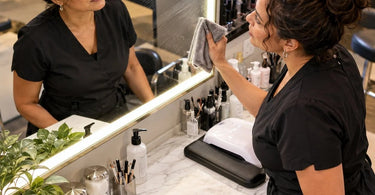
Efficiency meets quality with this choice... especially when your spa or salon mirrors look absolutely flawless from straight ahead, then suddenly reveal a mysterious collection of streaks the moment you take two steps to the left. It can feel like the mirror is personally waiting for the worst possible lighting angle to expose your housekeeping secrets. The good news is that there is a practical reason mirror cleaning streaks behave this way, and understanding it can help your team get consistently clearer results without repeatedly spraying, wiping, inspecting, sighing, and starting over.
In professional beauty spaces, mirrors are everywhere. Styling stations, waxing rooms, esthetic treatment rooms, nail salons, barber stations, makeup areas, bathrooms, reception displays, and retail zones all rely on reflective surfaces to create a bright, polished appearance. Unlike a countertop that can look clean from almost any viewpoint, a mirror interacts with light in ways that make even an extremely thin layer of residue suddenly obvious.
Why Mirrors Reveal Cleaning Streaks Only From Certain Angles
The short answer is light. A cleaning streak is usually a very thin film of dried cleaner, redistributed soil, minerals, oils, or other residue sitting on the glass. Viewed straight on under soft, even illumination, that film may be nearly invisible. Change the viewing angle or allow a concentrated light source to strike the mirror from the side, however, and the residue can scatter or reflect light differently than the clean glass surrounding it.
That is why the same mirror can look pristine at 9:00 in the morning and mysteriously streaky later in the day when sunlight enters the room differently. Directional salon lighting can create the same effect. LED fixtures, vanity bulbs, windows, ring lights, and task lighting may illuminate a thin residue from an angle that makes it practically wave hello.
This phenomenon is especially noticeable on large styling mirrors. The larger the reflective surface, the more opportunities there are for changing light angles to reveal imperfections. A tiny streak that disappears into the background on a small mirror can turn into a surprisingly noticeable ribbon across a full styling station.
The Streak Is Usually Residue, Not Dirt
One of the most useful housekeeping lessons for a professional salon or spa is that adding more cleaner does not automatically produce cleaner glass. In fact, excess solution can create the exact problem you are trying to eliminate. If cleaner is applied heavily enough that it cannot be completely removed before drying, a microscopic film may remain behind.
That film can contain cleaning ingredients plus whatever was already on the mirror. In a busy salon, that might include hairspray mist, styling product overspray, fingerprints, cosmetic powder, hair color residue, skin oils, dust, or humidity-related deposits. In treatment rooms, product mist and moisture can contribute additional buildup.
Instead of automatically reaching for another five enthusiastic sprays, professionals can often get better results by using less product and a clean wiping surface. A dedicated professional formula such as CleanPak RTU Glass Cleaner can simplify the routine because it is ready to use and designed for glass and mirrored surfaces. Pure Spa Direct distributes professional supplies rather than manufacturing them, so teams can choose products that fit their individual facility protocols.
Your Cloth Can Quietly Become the Problem
There comes a moment in every cleaning cloth's career when it stops removing residue and starts relocating it. Unfortunately, it does not submit a resignation letter first.
Once a cloth becomes loaded with cleaner, dust, oil, or styling-product residue, continuing to wipe can simply spread that material across a larger area. The mirror may initially appear clean because the surface is still damp. After evaporation, the transferred film becomes visible under angled light.
Fresh, lint-free cloths are therefore an important part of a reliable mirror routine. Keeping an adequate supply of microfiber cloths available at cleaning stations makes it easier for staff to switch to a fresh cloth instead of attempting to conquer an entire salon with one increasingly exhausted square of fabric.
Professional facilities may also want to maintain dedicated cloths for mirrors and glass rather than moving the same cloth between countertops, equipment, sinks, and reflective surfaces. A simple separation system can reduce the chance of transferring oily or chemical residue onto glass.
Why Salon Mirrors Can Be Particularly Challenging
A salon mirror lives an adventurous life. Hair spray travels farther than anyone expects. Finishing sprays float through the air. Color services can create tiny splashes. Clients touch mirrors. Styling products settle gradually onto surfaces. Add dust and normal airborne particles, and the result can be an extremely thin film that does not necessarily look dirty until it is disturbed during cleaning.
This is one reason maintaining mirrors is not always a simple spray-and-wipe job. If the underlying film is oily or sticky, one quick pass may loosen it without completely removing it. The partially dissolved residue then dries into elongated marks that become obvious from certain angles.
Facilities stocking Professional Cleaners & Disinfectants for Salons and Spas can create more organized housekeeping protocols by keeping appropriate products accessible and clearly assigned to their intended surfaces. Always follow the product label and the mirror manufacturer's care recommendations, particularly for specialty, framed, antiqued, coated, or decorative mirrors.
Humidity Makes the Situation More Interesting
Spa environments often combine mirrors with steam, warm towels, facial treatments, showers, and other moisture-producing services. That can make residue more noticeable and housekeeping routines a little more demanding.
Humidity may cause moisture to condense on a mirror and interact with material already sitting on the glass. When that moisture evaporates, previously subtle residue can become visible again. If you have ever cleaned a mirror beautifully only to discover streaks after the room gets steamy, you are not imagining things.
Areas using Facial Steamers or Towel Steamers may benefit from paying particular attention to nearby reflective surfaces as part of routine room resets. This does not mean mirrors need to be attacked with cleaner after every hint of humidity. It simply means environmental conditions should be considered when developing the cleaning schedule.
Use the Two-Cloth Strategy
A practical approach for professional mirror maintenance is to separate cleaning from final buffing. Use one clean cloth for the actual cleaning pass and another completely dry cloth for the finishing pass. The second cloth helps pick up the remaining moisture and microscopic residue before it dries on the surface.
This can be more effective than repeatedly wiping with the same damp cloth. Once a cloth is wet enough, it may leave a tiny amount of solution behind with every pass. You wipe the left side, move right, then unknowingly bring some of the left side's residue along for the ride. Congratulations: your streak has just received complimentary transportation.
Work methodically across the mirror rather than randomly chasing individual marks. A consistent top-to-bottom or side-to-side pattern makes it easier to see which areas have been cleaned and reduces unnecessary repeat passes.
Do Not Automatically Drench the Mirror
More liquid can mean more residue, more dripping, and more work. For routine cleaning, a controlled application is generally easier to manage than saturating the entire mirror.
Depending on the cleaning product instructions and mirror construction, applying a modest amount of cleaner to the cloth can offer greater control and help prevent liquid from running excessively toward mirror edges, frames, counters, floors, electrical fixtures, or products displayed underneath. Always defer to the directions for the cleaner and the care instructions supplied with the mirror.
Keeping appropriate Professional Cotton, Sponges, and Wipes for Salons & Spas available also helps teams select the right disposable or reusable material for different housekeeping tasks rather than improvising with whatever happens to be nearby.
The Angle Check Is Your Secret Weapon
If streaks only reveal themselves from certain angles, use that behavior to your advantage. After cleaning and drying a mirror, inspect it from more than one position. Step slightly left and right. Look from standing and seated client height. Check it with normal task lighting operating.
This is particularly useful for styling stations because the employee's usual viewpoint may be completely different from the client's. A stylist can clean a mirror while standing close to it and see perfection, while a seated client several feet away catches a streak illuminated by an overhead fixture.
You do not need to conduct a forensic investigation worthy of a television crime lab after every haircut. A quick angle check is usually enough. Ten extra seconds of inspection can prevent staff from discovering the streak only after a client is already sitting directly in front of it.
Build Mirror Care Into the Salon Workflow
Consistency matters more than frantic polishing right before a client arrives. Mirrors that receive light, regular maintenance are generally easier to keep presentable than surfaces allowed to accumulate layers of hairspray, fingerprints, dust, and product residue.
Consider assigning mirror checks to natural transition points in the day. Styling stations can be inspected during opening procedures, between service blocks, and at closing. Treatment rooms can include mirror inspection in standard room-reset procedures. Reception and retail mirrors can be checked when employees tidy displays.
For busy businesses, grouping essentials with other Must-Have Supplies for Salon & Spa Business Success can help prevent the classic housekeeping mystery in which everyone agrees the mirror needs cleaning but nobody can locate the glass cleaner.
Watch What Happens Around the Mirror
The easiest streak to remove is the one that never forms. Pay attention to where sprays are being used, where products are mixed, and how close service activity occurs to large reflective surfaces.
For example, salon teams working with Professional Hair Salon & Barber Shop Supplies may be able to reduce overspray by adjusting where finishing products are applied. Esthetic rooms can position frequently used products so accidental splashes are less likely to reach mirrors. Small operational choices can reduce how much residue needs to be removed later.
Mirror maintenance is therefore partly a cleaning issue and partly a workflow issue. If one mirror develops the same hazy film every day while others stay clear, investigate what is happening nearby instead of simply increasing the amount of cleaner.
A Flawless Reflection Is Mostly About Technique
Those strange streaks that appear only when you move across the room are not evidence that your mirror has developed a mischievous personality. They are usually thin films that become visible when directional light interacts with them from the right angle.
For spa and salon professionals, the solution is refreshingly practical: minimize unnecessary product, use clean lint-free cloths, remove residue rather than redistributing it, finish with a dry buff, and inspect the surface from the angles your clients actually see. Keep professional cleaning supplies organized and replace saturated cloths before they become streak-distribution devices.
A beautifully maintained mirror reinforces the polished atmosphere clients expect from a professional beauty business. And once your team learns the angle check, those surprise streaks have far fewer opportunities to make their dramatic comeback five minutes before the next appointment.
