
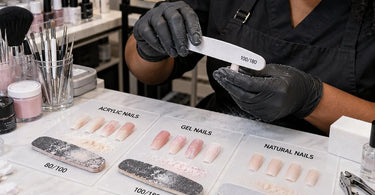
Clients return for this every time... beautifully shaped nails, smooth edges, and a flawless finish that makes every manicure look like it belongs in a magazine. But behind those gorgeous results is a hardworking little tool that rarely gets the appreciation it deserves: the humble nail file. If you have ever noticed that one file seems to survive an entire acrylic shaping session while another feels worn out halfway through a gel service, you are not imagining things. Nail files really do behave differently depending on the material they encounter, and understanding why can make a noticeable difference in your salon's efficiency, service quality, and supply costs. That inexpensive little rectangle has a surprisingly complicated relationship with acrylic, gel, and natural nails!
For professional nail technicians, nail files are more than basic shaping tools. They are precision instruments that influence how quickly you work, how smoothly enhancements are finished, and how comfortably clients experience their services. Different nail materials create different types of friction, debris, and resistance, all of which influence how abrasives perform over time. Understanding these differences helps nail professionals select the appropriate grit, recognize signs of wear, and avoid wasting time wrestling with files that have already given up on life.
Why Nail Files Wear Differently on Acrylic, Gel, and Natural Nails
The secret begins with the material being filed. Acrylic enhancements, cured gel products, and natural nails have different physical properties, including hardness, flexibility, density, and the way they release particles during abrasion. A nail file removes material through countless tiny abrasive particles attached to its working surface. As those particles contact the nail, they gradually lose cutting efficiency through wear, damage, and accumulation of filing debris.
Acrylic enhancements often require significant product reduction and reshaping. Certain cured gels behave differently under pressure and may produce finer or more adhesive debris. Natural nails require much gentler abrasion because their keratin structure is considerably more delicate than that of artificial enhancements.
The result? A file that works beautifully for one service may feel inefficient, overly aggressive, or completely inappropriate for another. Understanding these differences is essential when choosing supplies from a professional nail care collection.
How Acrylic Nails Put Abrasive Files to Work
Acrylic enhancements are formed when liquid monomer and polymer powder react to produce a hardened artificial nail material. Once properly cured, acrylic provides a relatively rigid structure that can withstand substantial shaping. That durability is wonderful for clients who love long sculpted nails, but it also means nail technicians must remove a considerable amount of material during filing.
When filing acrylic, abrasive particles repeatedly contact a firm surface. The mechanical resistance involved in reducing bulk, refining sidewalls, and establishing the apex gradually wears down the file's abrasive coating. Heavy pressure and extended filing can accelerate that wear, particularly when using a file that is too fine for the initial shaping stage.
Acrylic filing also creates significant amounts of powdery dust. Some particles settle into spaces between the abrasive grains, reducing how effectively the file cuts. A file may feel dull because its abrasive surface is clogged, because the particles have worn down, or because both conditions are occurring.
For substantial acrylic reduction, many professionals begin with a coarse file around 100 to 150 grit, depending on the enhancement and the amount of material requiring removal. They then transition to approximately 180 grit or finer for controlled refinement. Extremely coarse files should remain reserved for appropriate artificial enhancement work and never be used directly on the natural nail plate.
Stocking dependable acrylic nail supplies alongside several file grits helps technicians work efficiently without expecting one file to perform every task.
Why Gel Nails Can Make Files Feel Dull So Quickly
Gel enhancements introduce another fascinating variable: formulation. Hard builder gels, soak-off builder products, flexible strengthening gels, and traditional gel polish do not all respond to filing in the same way. Their cured hardness, flexibility, and particle characteristics can vary considerably.
Some hard gels produce fine, relatively dry filing dust and resist abrasion in ways that resemble other rigid enhancements. Softer or more flexible gels may generate debris that packs into the abrasive surface. In these cases, the file can seem to lose its cutting ability before its abrasive particles are completely worn away.
This distinction matters because technicians sometimes respond to reduced filing performance by pressing harder. Unfortunately, greater pressure does not necessarily solve a clogged abrasive surface. It can create unnecessary friction, reduce control, and make a routine service more tiring.
Choosing a file suited to the specific cured gel is more effective. Hard gel bulk reduction may require a coarser abrasive, while gentle refinement or work over thinner gel layers typically calls for a finer option. Many technicians use approximately 180 grit for controlled enhancement shaping, followed by finer finishing abrasives when appropriate.
For technicians working with professional gel polish, it is important to distinguish surface refinement from complete product removal. Thin gel polish coatings should not be aggressively filed down to the natural nail. Always follow the product manufacturer's removal directions, especially for soak-off systems.
Natural Nails Require a Completely Different Filing Approach
Natural nails are made primarily of keratin, a structural protein arranged in layers. Unlike artificial enhancement materials, the natural nail plate is living tissue's protective, nonliving keratin covering, and its thickness and resilience vary considerably among clients.
Natural nails are also flexible and moisture-sensitive. A client with thin, peeling, or brittle nails may respond very differently to filing than someone with naturally strong, dense nail plates. This makes aggressive abrasion particularly risky.
For shaping natural nail free edges, technicians commonly select 180 to 240 grit files, with finer options often preferred for fragile nails. The surface of the natural nail plate should receive even more conservative treatment. Where preparation requires removing surface shine, use only the gentle abrasive and technique specified by the product manufacturer, and avoid unnecessary thinning.
One interesting difference is that natural nail filing often involves much less material removal than acrylic shaping. Consequently, the abrasive may experience less mechanical wear during a typical natural manicure. However, reduced wear does not automatically mean the same file should be reused across clients.
Hygiene requirements and the tool's construction determine whether reuse is appropriate. Many traditional emery boards and foam files are porous and intended for single-client use. Even a perfectly sharp file should be discarded when it cannot be properly cleaned and disinfected according to applicable requirements.
Pairing suitable files with professional manicure essentials helps protect natural nails while delivering smooth, polished results.
Understanding Nail File Grit Without the Guesswork
Grit describes the relative coarseness of an abrasive surface. Lower grit numbers represent larger, more aggressive abrasive particles, while higher numbers indicate finer particles designed for gentler shaping and finishing.
Although individual products vary, the following ranges provide a useful starting point for professional nail services.
80 to 100 grit: Very coarse abrasion suited to selected artificial enhancement reduction tasks. These files remove material quickly and require careful control. Never use them on natural nail plates.
100 to 150 grit: Commonly used for reducing and shaping thicker acrylic or hard gel enhancements. These abrasives can remove bulk efficiently before refinement.
180 grit: A versatile medium abrasive for enhancement refinement and careful shaping of natural nail free edges. It remains too aggressive for unnecessary filing across the natural nail surface.
220 to 240 grit: Useful for gentle natural nail edge shaping, smoothing, and finishing selected enhancement surfaces.
400 grit and finer: Typically used for progressive smoothing, finishing, or specialized buffing tasks, depending on the product and desired result.
These ranges are general guidelines rather than universal rules. Abrasive construction, manufacturer recommendations, nail condition, and service technique all influence the best choice.
A well-organized assortment of professional nail files allows technicians to match the abrasive to the task instead of relying on one increasingly exhausted file for every appointment.
Is Your Nail File Actually Worn Out or Just Clogged?
This is where things get interesting. Not every file that feels dull has permanently lost its abrasive capability. Sometimes, accumulated filing debris is covering the abrasive particles, making the tool appear less effective.
Abrasive wear occurs when the grains gradually become rounded, fractured, or detached from the backing. A file with substantial abrasive wear loses cutting efficiency even when its surface is free of debris.
Clogging occurs when particles of acrylic, gel, natural nail keratin, or other residue collect between abrasive grains. This buildup reduces direct contact between the working abrasive and the nail material.
Backing deterioration is another potential issue. Foam cushions can compress, adhesives can weaken, and file edges can separate. Even when some abrasive remains, a damaged file may no longer provide consistent control.
A technician may notice uneven cutting, increased resistance, slipping, frayed edges, exposed backing, or the need for additional strokes. These are good reasons to stop using the file and evaluate whether replacement is necessary.
For single-use files, visible clogging or reduced performance means it is time for a fresh tool. For properly designed reusable implements, cleaning and disinfection must follow the manufacturer's instructions and applicable salon regulations. Attempting to extend the life of a disposable abrasive through improvised cleaning methods is not worth compromising professional hygiene.
Why Filing Pressure Changes How Long Files Last
Pressure is one of the most overlooked factors in abrasive performance. It is tempting to push harder when shaping stubborn enhancements, particularly during a packed appointment schedule. Unfortunately, excessive force can create more problems than it solves.
Heavy pressure increases friction between the abrasive particles and nail material. Depending on the file construction, this may accelerate grain wear, damage the backing, or make the abrasive surface behave less predictably.
On natural nails, excessive pressure can also lead to unwanted thinning, rough edges, or damage to surrounding skin. On enhancements, it can make controlling the final shape more difficult.
Professional filing should emphasize deliberate strokes, stable hand positioning, and appropriate grit selection. If removing material requires excessive force, consider whether the abrasive is too fine, the file is worn, or a different filing method is better suited to the product.
Remember, your nail file is supposed to do the work. Your wrist does not need to audition for a competitive weightlifting team.
How Filing Dust Influences Performance and Salon Cleanliness
Different nail materials generate different amounts and types of dust. Acrylic shaping commonly produces substantial dry particulate matter, while cured gel filing can create dust ranging from fine powder to particles that collect within an abrasive surface.
These particles affect visibility, tool performance, workstation cleanliness, and occupational exposure. Technicians should use appropriate source-capture ventilation or dust extraction and follow applicable workplace safety practices. Personal protective equipment should be selected according to the task, product guidance, and exposure conditions.
A suitable nail dust collector can help capture airborne particles near the filing area. Proper workstation arrangement also helps minimize scattered debris and keeps tools accessible.
Consider how filing dust moves around a busy manicure station. It can settle on supplies, collect around equipment, and interfere with keeping the workspace orderly. Maintaining organized nail tables and manicure stations supports efficient cleanup between appointments.
Dust management does not prevent all abrasive wear, but it improves working conditions and makes it easier to monitor the progress of shaping services.
Do Different Nail File Materials Wear Differently?
Absolutely. Two files with identical grit numbers can perform differently because their abrasive materials, backing construction, bonding systems, and overall quality may vary.
Traditional emery boards use abrasive-coated flexible backing materials. They are widely used for shaping and are typically treated as disposable when their construction prevents proper disinfection.
Foam-backed files offer some cushioning and flexibility, making them convenient for certain contouring and finishing tasks. However, their compressible construction can change how pressure reaches the abrasive surface.
Rigid professional files provide firmer support, which can be useful for maintaining consistent shaping angles on enhancements. Their durability depends on the abrasive coating and backing construction.
Glass nail files feature an abrasive texture formed in the glass surface. Quality glass files can offer consistent fine shaping of natural nail edges, although they are not the appropriate choice for every bulk enhancement reduction task. Reusable glass files must be suitable for the required cleaning and disinfection procedures.
Replaceable abrasive systems combine a reusable holder with disposable filing surfaces. When approved for professional use and maintained correctly, these systems can offer consistent fresh abrasives while allowing the underlying holder to be cleaned and disinfected as directed.
Choosing tools involves balancing abrasive performance, client comfort, hygiene, service requirements, and cost per appointment rather than focusing exclusively on the purchase price.
How to Prevent Nail Files From Wearing Out Prematurely
The best strategy is not simply purchasing the toughest file available. It is matching the right tool to the right task and avoiding habits that reduce its useful performance.
Start with an appropriate grit. Using an excessively fine file for heavy acrylic reduction forces the abrasive to work longer than necessary. A staged approach allows coarse tools to handle bulk removal and finer tools to finish the surface.
Avoid excessive pressure. Apply controlled pressure and let the abrasive do its job. If filing becomes unusually difficult, assess the file before continuing.
Use fresh abrasives when needed. A file that no longer cuts efficiently wastes appointment time and encourages unnecessary force.
Keep files suited to their assigned purpose. Maintain clearly identified supplies for enhancement shaping and natural nail services so technicians can select appropriate grits quickly.
Store supplies correctly. Keep unused files clean, dry, and protected from contamination or crushing. Excess moisture can compromise certain backing materials and adhesives.
Follow hygiene protocols. Discard single-use files after the intended use. Clean and disinfect reusable tools only according to their approved instructions and applicable state regulations.
These practical habits can improve consistency while reducing unnecessary interruptions during busy nail appointments.
Why File Durability Matters to Salon Profitability
At first glance, nail files might seem like one of the least expensive items on a salon's supply list. But a high-volume nail business can use a substantial number of files over weeks and months, making them an important consumable to manage.
Purchase price is only part of the equation. A file that loses cutting efficiency quickly may increase service time, require additional strokes, or need replacement before a task is complete. Meanwhile, a file that performs well but is unsuitable for the intended service may create avoidable problems.
Imagine a technician performs ten appointments in a day. If poor file selection adds just two minutes to each service, that represents twenty minutes of unnecessary filing time. Across a busy week, small inefficiencies add up.
Of course, durability must never override hygiene. A disposable file should not be stretched across multiple clients to save a few cents. The smarter approach is selecting appropriate professional supplies, planning consumable inventory, and maintaining consistent replacement practices.
Purchasing regularly used items through a professional wholesale distributor such as Pure Spa Direct helps salon owners organize supply replenishment. Browse Nail Files & Buffers along with other nail essentials to build a practical inventory suited to your service menu.
Building a Smart Nail Filing Station for Every Service
A well-equipped station should support the full range of services a technician performs, from natural manicures to acrylic fills and structured gel enhancements.
Keep appropriate coarse enhancement files available for substantial product reduction, medium files for shaping, and finer files or buffers for delicate finishing. Separate fresh supplies from used implements and organize disposable items so they can be retrieved without interrupting the service.
Include nail brushes and tools for appropriate product application and dust removal, along with the additional materials required for preparation and finishing.
Where suitable, keep cuticle oil available for the concluding stage of compatible nail services. A beautiful enhancement deserves a polished presentation, and healthy-looking surrounding skin helps complete the effect.
Salon managers can also establish simple supply standards for their teams. Identifying preferred file types and grits for each service makes inventory easier to monitor and helps technicians maintain consistent procedures.
Common Nail Filing Mistakes That Waste Time and Supplies
Even experienced professionals can fall into habits that reduce filing efficiency. One common mistake is using an overly fine file for extensive enhancement reduction. This increases the number of strokes required and may create the impression that the file is wearing out exceptionally quickly.
Another is continuing to use an abrasive after its cutting performance has noticeably declined. The extra pressure and repetition may cost more time than replacing the file.
Using a coarse enhancement file near an exposed natural nail is especially problematic. The transition between artificial product and natural nail requires care, precise positioning, and appropriate abrasives.
Technicians should also avoid assuming all gels behave identically. A rigid hard gel and a flexible soak-off builder product may require different filing approaches despite both carrying the gel label.
Finally, do not confuse a visually clean file with a properly disinfected one. Filing debris can contain biological material, and porous tools cannot automatically be made reusable simply by brushing away visible dust.
What Professional Nail Technicians Should Remember
The reason nail files wear differently on acrylic, gel, and natural nails is ultimately a combination of material properties, abrasive design, filing technique, and the type of debris produced.
Acrylic enhancements often demand aggressive material reduction, putting substantial mechanical stress on abrasive grains. Gel products vary by formulation, with some producing debris that contributes to clogging and others requiring controlled abrasion of firm cured structures. Natural nails typically require less aggressive filing but demand greater attention to protecting the delicate nail plate.
Understanding these differences allows technicians to choose appropriate grits, recognize worn or clogged abrasives, maintain better filing control, and improve the overall consistency of professional services.
At Pure Spa Direct, we know that exceptional nail services depend on more than gorgeous colors and beautiful designs. The everyday tools behind the scenes matter just as much. As a professional distributor serving spas, salons, and beauty businesses, Pure Spa Direct offers access to nail care products and essential supplies that support an efficient, well-equipped workstation.
Explore our Professional Nail Care Collections to find tools for acrylic enhancements, gel services, natural manicures, and everything in between. Because the right file should help you create beautiful nails, not leave you wondering whether your next appointment requires a fresh manicure or a new wrist!
