
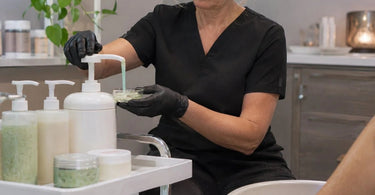
Build better results today... one perfectly measured scoop of pedicure scrub at a time! If your nail salon has five technicians and five different ideas about how much lotion, scrub, or foot soak belongs in a pedicure, your product costs might be doing a little dance behind your back. One technician uses a modest dollop, another believes every client deserves enough massage cream to moisturize a small elephant, and suddenly your inventory numbers make absolutely no sense. Standardizing pedicure product dispensing brings consistency to your services, helps protect product hygiene, reduces unnecessary waste, and makes your supply budget much easier to manage. Best of all, you can accomplish these improvements without making your pedicures feel rushed, restrictive, or anything less than fabulous.
For busy nail salons, consistent dispensing is a practical operational improvement that affects nearly every part of the pedicure experience. From selecting the right professional pedicure supplies to training technicians on portion sizes, small adjustments can make a meaningful difference over hundreds of appointments. The goal is not to use the least amount of product possible. It is to use the appropriate amount every time, following manufacturer instructions while delivering the service quality your clients expect.
What Does Standardized Pedicure Product Dispensing Actually Mean?
Standardized dispensing means establishing a consistent, documented method for measuring, transferring, and applying the products used during pedicure services. Rather than allowing each technician to estimate every portion independently, the salon creates practical guidelines for its most frequently used products.
These guidelines might specify how much foot soak to measure for a particular basin and water volume, how much exfoliating scrub to prepare for a standard service, or how many pump strokes of lotion typically provide the desired coverage.
A successful dispensing system generally includes several elements:
- Defined portions: Establish a practical starting quantity for each service step based on product instructions and actual treatment requirements.
- Consistent dispensing equipment: Use appropriate pumps, measured containers, scoops, or single-service packaging.
- Clear product identification: Keep original labels available and properly identify any permitted secondary containers.
- Hygienic handling: Transfer products without contaminating the remaining supply.
- Staff training: Teach technicians the same process while allowing reasonable adjustments for individual client needs.
- Inventory tracking: Compare actual consumption with expected usage to identify opportunities for improvement.
Think of it as creating a reliable pedicure recipe. Your technicians still provide the personalized service, but everyone starts with the same thoughtfully planned ingredients.
Reason #1: Stop Paying for Products That Never Improve the Pedicure
Professional pedicure products are business investments, not unlimited supplies from a magical beauty pantry. Every unnecessary scoop of scrub, oversized portion of mask, or generous squeeze of lotion has a cost.
Individual portions may seem insignificant, but repeated over dozens of appointments every day, inconsistent dispensing can contribute to substantial product consumption.
Consider a hypothetical salon using a professional foot scrub that costs $40 for a 64-ounce container. That works out to $0.625 per fluid ounce when measured by volume. If technicians routinely use 1.5 fluid ounces when a properly tested, manufacturer-compatible 1-ounce portion would be sufficient, the extra half-ounce costs approximately $0.31 per pedicure.
At 30 pedicures per day over 26 operating days, that is approximately $244 in additional scrub expense each month, or about $2,925 annually. And that calculation covers just one product.
The example is illustrative, not a universal portion recommendation. Scrubs can be sold and measured by weight or volume, and the correct quantity depends on their formulation, consistency, and intended application.
Now consider similar overuse across foot soaks, masks, callus treatments, and massage lotions. A salon that controls unnecessary dispensing has an opportunity to improve its product cost per service without automatically increasing menu prices.
The objective is intelligent product usage, never compromising treatment effectiveness or client comfort to save pennies.
Reason #2: Make Every Pedicure Feel Like the Same Premium Service
Consistency is one of the quiet ingredients behind a strong salon reputation. Clients appreciate knowing that their favorite pedicure will provide a comparable experience regardless of which qualified technician performs the service.
Imagine one client receives a generous, well-executed exfoliation, while another gets such a tiny amount of scrub that the technician spends more time looking for product than exfoliating. Even if both appointments follow the same service menu, the experiences can feel noticeably different.
Standardized dispensing helps create an established baseline for:
- Foot soak preparation and concentration.
- Exfoliating scrub application.
- Foot mask coverage and treatment time.
- Massage lotion or cream application.
- Finishing products and cuticle oil application.
Portion guidelines work best alongside training on technique, timing, communication, and appropriate customization. A client with particularly dry skin may need a different approach than someone booking a quick maintenance pedicure.
Standardization establishes consistency without eliminating professional judgment. Your team can still deliver personalized treatments while maintaining predictable product use.
Reason #3: Help Protect Product Hygiene and Prevent Cross-Contamination
One of the strongest reasons to standardize dispensing is that the way technicians access products matters just as much as the amount they use.
Repeatedly dipping fingers, used spatulas, or service tools into shared product containers can contaminate the unused supply. Products should be stored and dispensed according to manufacturer instructions and applicable state cosmetology regulations.
For many creams, scrubs, masks, and similar preparations, a sensible approach is to transfer the required portion into a clean, appropriate service container before application. Use a clean, permitted dispensing method and prevent used applicators from contacting the bulk supply.
Professional bottles and jars, mixing bowls, and applicators and spatulas can help organize this process when selected appropriately for the products involved.
Establish these hygiene rules across the salon:
- Keep bulk product containers properly closed when not dispensing.
- Never return unused product from a client service to the original container.
- Avoid double-dipping or reintroducing contaminated applicators into shared supplies.
- Use disposable applicators where required and clean and disinfect reusable implements according to applicable requirements.
- Follow manufacturer directions for cleaning reusable dispensing containers and pumps.
- Label secondary containers appropriately and maintain required product safety information.
- Discard prepared product that has become contaminated or cannot be safely retained under applicable instructions.
Remember that standardized cosmetic product dispensing does not replace mandatory cleaning and disinfection of footbaths, pedicure equipment, and reusable implements. Disinfectants must be selected, diluted, applied, and used for their full required contact time according to their labels and applicable regulations. Never treat a measured cosmetic product portion as a substitute for infection-control procedures.
Reason #4: Make Pedicure Stations Faster and Easier to Manage
Picture a fully booked Saturday afternoon. The appointment calendar is packed, the front desk phone is ringing, and someone has relocated the foot scrub to a mysterious location known only to the salon universe.
This is exactly when a standardized station setup becomes valuable.
Organizing each pedicure station with consistent dispensing supplies allows technicians to prepare services without repeatedly searching for products or guessing quantities.
Depending on the salon layout and product requirements, an effective station might include appropriately labeled pump dispensers, clean service bowls, designated single-use applicators, and a clearly organized treatment cart.
Many salons can improve their workflow by reviewing how products are positioned around their pedicure chairs and spas. Frequently used items should be accessible without interfering with sanitation procedures or creating clutter.
Instead of preparing oversized quantities just in case, technicians can begin with the standard portion and add more product hygienically when the service genuinely requires it.
The result can be fewer unnecessary interruptions, cleaner-looking stations, and a more organized treatment experience.
Reason #5: Improve Inventory Forecasting and Reduce Surprise Shortages
If your salon regularly runs out of one product while another sits untouched for months, inconsistent usage may be part of the problem.
Without an established dispensing standard, forecasting supplies becomes difficult because product consumption changes depending on who happens to be working.
Standardization gives managers a reliable starting point for estimating demand.
For example, suppose a salon uses an average of 0.75 fluid ounce of massage lotion per standard pedicure, and a 64-fluid-ounce container is usable in its entirety. The theoretical number of services per container is approximately 85.
If the salon expects 500 standard pedicures next month, its baseline demand would be approximately 5.86 containers, rounded up to six. Managers can then account for actual dispensing losses, premium treatment upgrades, remaining inventory, and purchasing lead times.
This does not mean every client receives an identical amount of lotion. It means the salon has a reasonable planning figure that can be refined using real consumption data.
Better forecasting supports more intentional ordering, reduces unnecessary emergency purchases, and helps managers identify when consumption changes unexpectedly.
Browse professional nail care collections and keep the products used most frequently in your services organized around documented demand rather than guesswork.
Reason #6: Make Staff Training More Consistent
Experienced nail technicians develop preferences and techniques over time. Those individual skills can be valuable, but a salon still needs documented service expectations.
Without clear dispensing guidelines, newly hired technicians may learn five different procedures from five different coworkers. That is not an onboarding program. That is a game of pedicure telephone.
Create a simple dispensing reference for each service category. Include the product name, portion measurement, preparation method, required handling precautions, and circumstances that justify additional product.
For example, a service reference might identify the standard quantity of exfoliating scrub, the appropriate scoop or pump, and the expected application area. It should also indicate that actual use must follow product directions and may vary with the selected treatment.
Use training demonstrations to confirm that technicians can measure and transfer products accurately. Having each technician demonstrate the procedure is more useful than assuming everyone interprets a phrase like small scoop the same way.
A written dispensing procedure also makes it easier to introduce new treatments or products without disrupting established salon operations.
Choosing the Right Dispensing Method for Each Pedicure Product
Not every product belongs in the same type of dispenser. A thick sugar scrub behaves differently from a thin lotion, and a concentrated foot soak may have very specific dilution instructions.
The ideal dispensing method depends on product consistency, packaging, manufacturer instructions, sanitation considerations, and service volume.
Pump Dispensers for Compatible Lotions and Creams
Appropriate pump dispensers can simplify portioning for products that are compatible with that delivery system. They are especially convenient when technicians use the same lotion or cream repeatedly throughout the day.
Before standardizing the number of pumps, measure actual output. Two pumps that look identical can deliver different quantities, especially when product viscosity changes.
Use dispensers approved or suitable for the formulation, and avoid transferring products when the manufacturer prohibits repackaging or when required labeling, shelf-life, or hygiene controls cannot be maintained.
Measured Scoops for Scrubs and Masks
Professional sugar scrubs and salt scrubs may work well with appropriately sized scoops when their formulations and instructions permit that method.
Remember that a scoop measures volume rather than weight. Different products can have substantially different densities, so a scoop holding one ounce by volume does not necessarily contain one ounce by weight.
For products with significant settling or separation, follow the manufacturer instructions before measuring. Never assume one scoop size is appropriate for every scrub in the salon.
Transfer portions hygienically into suitable service bowls. Avoid storing a used scoop inside a bulk container.
Measured Doses for Foot Soaks and Concentrates
Concentrated foot soaks require particular attention because the correct amount often depends on the water volume and manufacturer dilution instructions.
Measure these products using a suitable measuring device rather than estimating by eye. Train technicians to distinguish between a product intended for direct use and one requiring dilution.
Never improvise concentration ratios. Too much product may create unnecessary expense or increase the potential for irritation, while too little may fail to deliver the intended performance.
Disinfectant concentrates require their own separate procedures. They must be handled strictly according to their registered labels and should never be treated as interchangeable with cosmetic foot soaks.
Single-Service Packaging for Predictable Portions
Preportioned professional pedicure products can be especially useful for salons seeking predictable treatment kits and reduced handling of shared containers.
Single-service packaging may simplify preparation and support consistent usage, provided technicians follow the instructions and use each package as intended.
Brands available through Pure Spa Direct, including Voesh, Avry Beauty, and La Palm, are useful collections to explore when comparing professional pedicure product formats.
Compare individual product specifications rather than assuming every item from a brand is a single-service kit or suitable for every dispensing approach.
How to Calculate Your Salon's Product Cost Per Pedicure
A dispensing standard becomes much more valuable when it is connected to actual service costs.
Start by calculating the cost per usable unit of each product. Then multiply that figure by the quantity consumed during a standard service.
Product cost per service = Usable quantity dispensed per service x Cost per matching unit.
For example, imagine the following hypothetical product costs for a standard pedicure:
- Foot soak: $0.18 per service.
- Exfoliating scrub: $0.45 per service.
- Foot mask: $0.65 per service.
- Massage lotion: $0.35 per service.
- Finishing oil: $0.12 per service.
Combined, these products cost approximately $1.75 per appointment. If unnecessary dispensing raises actual usage by 20%, the cost becomes approximately $2.10, creating an extra $0.35 in product expense per service.
At 1,000 pedicures per month, that difference equals approximately $350 in monthly product spending or $4,200 over twelve months.
Actual savings depend on product pricing, service volume, baseline overuse, required application quantities, and achievable reductions. These figures are examples, not guaranteed results.
Also remember that product cost is only one component of profitability. Labor, utilities, equipment maintenance, cleaning supplies, disposable items, and overhead still matter. The purpose of product dispensing standards is to make one important category of expenses more predictable.
How to Introduce Standardized Dispensing Without Annoying Your Technicians
Nobody wants a new operational policy delivered as a surprise lecture about lotion. The best dispensing systems are built with technician input rather than simply handed down from the manager's desk.
Step 1: Observe existing product usage. Review several typical pedicure appointments and record how much of each product is used. Include different technicians and service categories. Avoid interrupting normal services or compromising client care.
Step 2: Review manufacturer instructions. Identify any required quantities, dilution ratios, application methods, restrictions, and recommended treatment times. These requirements take precedence over internally developed targets.
Step 3: Establish practical baseline portions. Test measured quantities during appropriate staff demonstrations. Confirm that the amount provides the intended coverage and service quality.
Step 4: Choose the dispensing equipment. Select pumps, measuring devices, hygienic applicators, or individual treatment packages suitable for the specific products. Check compatibility and labeling requirements before transferring anything into another container.
Step 5: Create a short visual reference. Place clear instructions in the staff preparation area. Include product identification, typical portion, dispensing method, and any important exceptions.
Step 6: Train and collect feedback. Ask technicians whether the process is practical during busy appointments. Adjust the workflow when legitimate service needs reveal a better approach.
Step 7: Monitor results. Compare inventory usage, treatment quality, and product spending over several weeks. Look for improvements without creating pressure to underapply products.
Start with the three products your salon uses most frequently. Once that process works, expand to other items rather than redesigning every pedicure service overnight.
Do Not Confuse Standardization With Using Less Product at Any Cost
There is an important difference between efficiency and cutting corners.
A foot mask should provide appropriate coverage. Massage lotion should support a comfortable treatment. Foot soak concentrates should be measured according to their directions. Professional treatments should never be weakened simply to reach an arbitrary cost target.
Clients are paying for the service described on your menu, and technicians need enough product to perform that service correctly.
Some treatments genuinely require more product because of the treatment area, product formulation, or service upgrade. Your system should permit documented, reasonable adjustments.
It is also important to distinguish cosmetic products from products with specific safety requirements. Callus removers, chemical exfoliants, and disinfectants may involve precise application instructions, exposure limits, protective equipment, or other restrictions. Never substitute a generic pump-count guideline for manufacturer directions.
The most effective dispensing system makes proper usage easier, rather than rewarding technicians for using the smallest possible amount.
What Supplies Help Build a More Organized Pedicure Station?
Standardized dispensing works best when technicians have reliable products and suitable accessories within easy reach.
Depending on your menu, a professional pedicure station may benefit from these categories:
- Pedicure Supplies for professional foot care services and treatment preparation.
- Bottles and Jars for suitable product storage and dispensing applications.
- Mixing Bowls for hygienic preparation of appropriate service portions.
- Applicators and Spatulas for controlled product transfer and application.
- Professional Cotton, Sponges, and Wipes for suitable single-use treatment tasks.
- High-Quality Towels for professional service presentation.
- Protective Gloves and Masks when required by the service, product instructions, or applicable safety procedures.
- Professional Cleaners and Disinfectants for appropriate equipment and surface cleaning and disinfection protocols.
Pure Spa Direct is a professional beauty supply distributor, not the manufacturer of every product it carries. That distinction is especially important when selecting dispensing systems: always evaluate the instructions provided by the actual product manufacturer, along with applicable salon regulations.
Five Common Pedicure Dispensing Mistakes to Avoid
1. Using the same portion for every product. Different formulations have different densities, coverage requirements, and recommended application quantities. A universal scoop is convenient but not necessarily accurate.
2. Assuming every pump dispenses the same amount. Pump output varies by dispenser design, product viscosity, and condition. Test the actual dispensing volume instead of guessing.
3. Transferring products into unlabeled containers. Secondary containers may need specific labels and other controls. Keep required product identity, directions, hazard information, and safety documentation accessible.
4. Returning leftover product to the bulk container. Once product is portioned for a client, do not reintroduce leftovers into the original supply. Prepare reasonable initial portions and follow proper disposal procedures.
5. Ignoring staff feedback. A process that looks wonderful on a spreadsheet but creates unnecessary delays at the pedicure station may need refinement. Practical systems support the people performing the services.
How to Tell Whether Your New Dispensing System Is Working
After implementing standardized dispensing, review results using a few simple measurements.
Product cost per pedicure: Divide actual product expense for a defined period by the number and mix of applicable services performed. Account for opening and closing inventory rather than relying only on purchasing totals.
Services per container: Compare the number of services completed with the amount of product consumed. Large differences from expected usage may indicate portion variation, spills, product loss, or forecasting errors.
Inventory availability: Monitor whether essential pedicure products are consistently available without frequent emergency orders.
Technician compliance: Observe whether employees can follow the documented process comfortably and hygienically. Use additional training when needed instead of turning every measurement into a disciplinary issue.
Service quality: Review client feedback, technician observations, and treatment consistency to make sure the standard still delivers the promised experience.
Track these measures over enough appointments to account for variations in service mix and busy periods. A single unusually hectic Saturday should not determine your entire inventory policy.
Should Small Nail Salons Standardize Dispensing Too?
Absolutely. You do not need twenty technicians or a spreadsheet-loving operations manager to benefit from consistent product usage.
Even a salon with two technicians can experience meaningful differences in supply consumption. Small businesses may actually find dispensing standards easier to introduce because there are fewer people to train and fewer stations to organize.
Begin with a short written guide and a few inexpensive, suitable measuring tools. Record expected usage for your most popular pedicure and compare it with actual consumption.
As your salon grows, those habits become the foundation for consistent onboarding, better purchasing decisions, and reliable service delivery.
The same approach can be adapted to manicure essentials, spa body treatments, and other services where professional products are portioned repeatedly throughout the day.
Better Dispensing Creates a Better Business, One Pedicure at a Time
Standardizing pedicure product dispensing is not about turning talented nail technicians into measuring machines. It is about creating a thoughtful system that supports hygiene, service consistency, inventory accuracy, and responsible product spending.
When every technician understands how much product to prepare, how to dispense it safely, and when a treatment requires an adjustment, salon operations become easier to manage. Clients receive more dependable services, employees have clearer expectations, and owners gain better visibility into their actual costs.
Whether you are updating your pedicure menu, opening another location, or simply wondering why the foot scrub keeps disappearing faster than your appointment book fills, a well-designed dispensing process is a smart place to begin.
Explore professional pedicure products and supplies, compare suitable dispensing accessories, and build a station setup that works for your team. Pure Spa Direct offers a broad selection of professional beauty and salon supplies to support your purchasing and treatment preparation needs.
Because a fantastic pedicure should leave clients feeling pampered, technicians feeling prepared, and salon owners feeling confident about their numbers. The only thing that should be overflowing is your appointment calendar!
