
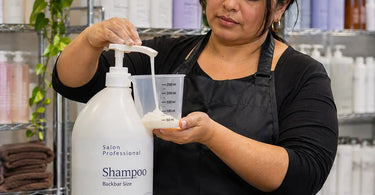
Elevate treatments with this top pick... a smarter approach to salon shampoo purchasing that starts with one surprisingly important detail: how much product comes out of the backbar pump. That innocent little pump sitting beside the shampoo bowl may be making more purchasing decisions than your salon manager realizes. Every press delivers a measurable amount of shampoo, and those amounts add up across clients, stylists, stations, and busy service weeks. If your shampoo orders are based entirely on bottle size, previous purchases, or the familiar panic of discovering an empty container during a Saturday rush, it may be time to give your backbar dispensing system a little attention.
Professional shampoo purchasing should account for actual consumption, not simply the number of bottles sitting on a shelf. Two salons using the same shampoo can experience dramatically different product costs because their pumps deliver different amounts, their service protocols require different quantities, and their teams have different dispensing habits. Understanding those differences helps salon owners establish realistic purchasing budgets, minimize unnecessary waste, and maintain consistent service standards without asking stylists to perform miracles with a teaspoon of shampoo.
Why Backbar Pump Output Matters More Than You Think
Backbar shampoo pumps are convenient because they make professional hair washing faster, cleaner, and easier to manage. Instead of tipping large bottles over a wet shampoo bowl, stylists can dispense product with one hand and continue working comfortably.
However, pumps are not automatically standardized. Different dispensing mechanisms can deliver different amounts of product per complete stroke. Bottle design, pump specifications, product viscosity, and whether the pump is fully depressed can all affect the amount released.
Imagine two shampoo stations using identical professional shampoo. One pump delivers 3 milliliters per stroke, while the other delivers 5 milliliters. If each stylist uses three full pumps per shampoo service, one station dispenses 9 milliliters while the other dispenses 15 milliliters.
That is a substantial difference before accounting for additional cleansing passes, longer hair, or individual client needs. Neither stylist necessarily realizes how much more product one station consumes.
For salon owners purchasing Premium Hair Care Products for Salons & Barber Shops, pump output provides an important piece of information for estimating how quickly inventory will disappear.
One Pump Does Not Always Equal One Pump
Here is where backbar purchasing gets interesting. Salon teams frequently discuss shampoo quantities in pumps rather than milliliters. A stylist might say that a particular cleansing service requires two pumps, while another routinely uses four.
Unfortunately, the word pump describes an action, not a fixed measurement.
A dispenser delivering 2 milliliters per stroke requires five complete strokes to dispense 10 milliliters. A dispenser delivering 5 milliliters reaches that same quantity in only two strokes.
This means that instructions such as use three pumps can produce inconsistent results when salons have different dispensers installed across their shampoo bowls.
Even matching bottles do not necessarily guarantee matching output if pumps have been replaced with different models.
Before purchasing another case of shampoo, determine what your actual dispensing equipment delivers. It is a small operational detail with the potential to improve several purchasing decisions.
How to Measure Your Salon Shampoo Pump Output
Measuring pump output is relatively simple and does not require expensive equipment. A graduated measuring container or an accurate digital scale can help establish an average dispensing amount.
Begin with the shampoo and pump combination your salon currently uses. Prime the pump according to its instructions so the mechanism is dispensing normally.
Dispense ten complete strokes into a clean measuring container. Record the total volume and divide by ten to estimate the average amount delivered per stroke.
For example, if ten strokes produce 40 milliliters, the average pump output is 4 milliliters.
Repeat the test several times to check consistency. If using a digital scale, remember that grams and milliliters are not necessarily interchangeable because shampoo density can differ from water. Use a volume measurement or the product's verified density when converting between mass and volume.
Record the result alongside the product name, bottle size, pump model, and date tested.
Repeat this process whenever the salon changes its shampoo, replaces a dispenser, or introduces a new bottle format. Testing the actual shampoo is preferable to relying on a pump rating measured with a different liquid.
For facilities maintaining multiple dispensing containers, explore Bottles & Jars and shampoo pump options that suit the intended product and professional workflow.
Calculate Shampoo Consumption Per Client
Once you know how much shampoo each pump releases, the next step is connecting that measurement to actual salon services.
The basic calculation is straightforward:
Milliliters per pump x pumps per service = shampoo used per service.
Suppose your salon uses a pump delivering 4 milliliters per stroke. A standard shampoo service requiring three strokes consumes approximately 12 milliliters.
If your team performs 500 comparable shampoo services per month, estimated monthly shampoo consumption would be 6,000 milliliters, or 6 liters.
Now consider a different pump delivering 6 milliliters per stroke. With the same three-stroke routine and 500 monthly services, consumption increases to 9 liters.
That is a difference of 3 liters per month without changing the shampoo brand, service menu, or number of clients.
These figures are illustrative rather than recommended shampoo doses. Actual product requirements depend on the formula, hair characteristics, cleansing protocol, and manufacturer guidance.
The lesson is not to select the smallest pump available. It is to understand how much product your salon actually needs and choose a dispensing system that supports consistent, appropriate use.
Build a Purchasing Forecast Around Real Shampoo Services
Salon shampoo purchasing becomes considerably more predictable when service volume and dispensing measurements are evaluated together.
Start by reviewing the number of shampoo services performed during a representative month. Separate the services into meaningful categories when they use different cleansing quantities.
For example, your salon might distinguish routine shampoo and blowout appointments, shampoo services associated with haircuts, color service cleansing, and specialty treatments.
Next, estimate the average shampoo used for each service category. Multiply the quantity by the number of services expected during the purchasing period.
Consider a hypothetical salon with the following monthly workload:
Standard shampoo services: 300 appointments using 12 milliliters each, totaling 3,600 milliliters.
Double-cleanse services: 150 appointments using 20 milliliters each, totaling 3,000 milliliters.
Specialty cleansing services: 50 appointments using 16 milliliters each, totaling 800 milliliters.
Combined estimated consumption is 7,400 milliliters, or 7.4 liters per month.
That number provides a much more useful purchasing baseline than simply ordering whatever quantity arrived last month.
To determine how much to purchase, subtract usable inventory already on hand, account for expected deliveries, and add an appropriate safety buffer based on delivery lead times and service demand.
A salon with reliable consumption records can adjust purchasing quantities as appointment volume changes rather than repeatedly overstocking products that are already sitting in storage.
Why Shampoo Bottle Size Can Be Misleading
Large professional shampoo bottles often look economical because they contain more product and can reduce the frequency of individual bottle purchases.
However, bottle size tells you how much shampoo you are purchasing, not how many services that shampoo will support.
Consider a 1,000-milliliter professional shampoo bottle.
At 10 milliliters per service, the bottle theoretically supports 100 services. At 20 milliliters per service, that same bottle supports only 50 services.
These are theoretical yields before accounting for priming, residual product, spills, or other losses.
When comparing wholesale shampoo options, calculate approximate services per container as well as cost per milliliter.
Container volume divided by average milliliters per service = estimated services per container.
This approach helps evaluate whether a larger container, different dispensing format, or alternative formula offers better value for your particular salon.
It also prevents the classic backbar mystery: how did that enormous bottle disappear before anyone remembered opening it?
Calculate the True Shampoo Cost Per Service
Salon owners often evaluate shampoo purchases using total container price. That information matters, but cost per service provides a clearer picture of how shampoo affects profitability.
First, divide the purchase price by the product volume to determine cost per milliliter.
Then multiply the cost per milliliter by the quantity typically used during an appointment.
Suppose a salon purchases 1,000 milliliters of shampoo for $30.
Its product cost is $0.03 per milliliter.
A service using 12 milliliters costs approximately $0.36 in shampoo. A service using 20 milliliters costs approximately $0.60.
Across 600 shampoo services, the difference is $144.
That amount may seem modest compared with major salon expenses, but recurring product costs deserve attention, particularly when a business operates several shampoo stations or locations.
Actual landed cost should also account for applicable shipping, discounts, and other purchasing expenses. Salon owners should track shampoo separately from conditioner, masks, and other treatment products to understand the complete service cost.
Pure Spa Direct offers access to Professional Hair Salon & Barber Shop Supplies for businesses evaluating the products used throughout their daily service routines.
Does a Higher-Output Shampoo Pump Always Mean More Waste?
Not necessarily. A pump that delivers a larger amount per stroke can be perfectly appropriate when the product and service require that quantity.
For example, a high-output dispenser may make sense for a frequently used professional shampoo in a busy wash area, particularly when the salon's standard application quantity matches the pump output.
A smaller-output pump may offer better control for concentrated formulas or applications where precision matters.
The problem occurs when the dispensing amount and service requirements do not match.
If a stylist needs approximately 10 milliliters but the pump delivers 8 milliliters per stroke, two full pumps may dispense substantially more than the intended amount. A different pump or application method could help provide more appropriate portions.
Conversely, a very small pump may require repeated presses, creating inconvenience and encouraging inconsistent dispensing habits.
Choose pumps based on actual service requirements, dispenser compatibility, and operational convenience rather than assuming that lower output is always better.
Hair Length, Density, and Service Type Change Shampoo Demand
Backbar consumption cannot be accurately predicted from pump output alone. Salon professionals work with clients whose hair and service requirements vary considerably.
Hair density, length, texture, styling product buildup, and the type of cleansing service can influence how much shampoo is appropriate.
A short haircut appointment may require a different amount than a service involving exceptionally long or dense hair. Some professional protocols call for multiple cleansing applications, while others require specific specialty formulas.
The goal is to establish realistic ranges instead of forcing every client into one dispensing quantity.
Consider recording average consumption for routine cleansing, double cleansing, and specialty services separately.
Follow the shampoo manufacturer's directions and professional service standards. Do not automatically reduce the amount of product used simply to lower costs if doing so compromises cleansing performance.
Consistent results and client satisfaction remain essential parts of successful salon operations.
Standardizing Pumps Across Shampoo Stations
When different shampoo stations use different pumps, purchasing estimates can become unnecessarily complicated.
One stylist may work with a dispenser that releases a small amount, while another uses a noticeably higher-output model. Staff members may believe they follow the same shampoo routine even though actual consumption differs.
Standardizing compatible dispensers across stations can reduce that variation.
Begin by identifying the shampoo products used most frequently. Determine which pumps are compatible with each container and formula, then test dispensing performance.
Where practical, use consistent pump models for the same shampoo across comparable stations.
Clearly label shampoo and conditioner containers, particularly when products have similar packaging. Avoid assuming that a pump designed for one formula will perform identically with another.
For salon owners evaluating additional wash-area equipment and station essentials, the Professional Salon Equipment for Top Stylists and Barbers collection offers a useful starting point.
Train Stylists Without Making Shampoo Portioning Awkward
There is a fine line between helpful inventory management and making stylists feel like someone is monitoring every bubble at the shampoo bowl.
Successful portion control works best when presented as a professional consistency initiative rather than a competition to use the least product.
Explain how dispensing measurements support purchasing accuracy, help prevent unexpected shortages, and maintain reliable product availability.
Provide a simple reference for commonly performed services and demonstrate how the selected pump works.
Encourage stylists to adjust quantities according to actual client needs and manufacturer guidance, while avoiding unnecessary repeated dispensing.
Ask the team for feedback. Experienced professionals may identify situations where the standard dispensing quantity is insufficient or where a particular pump makes product application difficult.
When employees participate in developing practical procedures, they are more likely to follow them consistently.
Keep Shampoo Inventory Separate From Retail Stock
Backbar purchasing becomes less reliable when professional-use inventory and retail inventory are mixed together.
A bottle intended for sale should not quietly migrate to the shampoo bowl without being recorded. Likewise, backbar products should not disappear from inventory because they were transferred between stations or locations.
Maintain separate records for professional-use shampoo, retail products, and any products reserved for specialty services.
Track incoming purchases, containers opened for service, remaining stock, and significant product transfers.
If a salon also sells take-home shampoo and conditioner, record those transactions separately from products used during appointments.
This distinction makes it easier to recognize whether a shampoo shortage reflects unusually high service consumption, stronger retail sales, ordering delays, or inventory-recording errors.
Organized inventory practices also make it easier to evaluate other recurring expenses, including High-Quality Towels, Professional Hair Brushes & Combs for Stylists, and other consumables or supplies that support daily salon operations.
Do Not Overlook Product Loss From Pumps and Refill Practices
Dispensing quantity is only one part of shampoo consumption. Damaged pumps, leaks, spills, and improper refill practices can also create losses.
Inspect pumps regularly for dripping, damaged components, or inconsistent dispensing. Replace malfunctioning equipment with compatible parts rather than allowing product to collect around the bottle.
Follow manufacturer instructions for storage, refilling, and dispenser maintenance. Do not top off reusable containers or transfer products in ways that conflict with product labeling, hygiene requirements, or applicable salon regulations.
Where refilling is permitted, use appropriate cleaning procedures and clearly identify the contents. Never mix different shampoo formulas simply to empty leftover bottles.
Store products according to their labels and monitor inventory rotation so older stock is used appropriately before newer stock.
Good dispensing habits support both predictable purchasing and a clean, professional backbar environment.
Use Reorder Points Instead of Waiting for Empty Bottles
Once average shampoo consumption is established, salons can create more dependable reorder schedules.
Begin with the average quantity consumed per day or week. Then consider how long it normally takes to receive new inventory after placing an order.
For example, suppose a salon uses approximately 2 liters of shampoo each week and typically requires two weeks to replenish stock.
The salon would expect to consume approximately 4 liters during that lead time.
A reorder point should account for that expected usage plus a reasonable safety reserve based on demand fluctuations and supplier reliability.
If the salon selects a 1-liter safety reserve, a hypothetical reorder point would be approximately 5 liters of usable inventory.
This is a planning example, not a universal inventory recommendation. Actual purchasing thresholds should reflect the salon's demand patterns, available storage, vendor requirements, and delivery schedules.
Reevaluate reorder points during holiday periods, seasonal promotions, staffing changes, and other times when appointment volume may increase.
Comparing Professional Shampoo Options Beyond the Price Tag
Wholesale shampoo comparisons should consider more than the lowest price per bottle.
Product performance, suitable hair types, cleansing requirements, container size, pump compatibility, and actual product usage all influence value.
A shampoo with a lower purchase price is not automatically the most economical if it requires substantially more product per service.
Similarly, a more concentrated formula may offer a competitive cost per application, but its actual yield should be verified through product directions and normal professional use rather than assumptions.
When evaluating new products, record the purchase price, volume, average dispensing amount, and observed number of applications.
For salons exploring established professional hair care lines, Pure Spa Direct carries collections including Wella, Rusk, and Clairol Professional.
Product availability, specific formulations, and package formats should be checked individually when making purchasing decisions. The right option is the one that fits the salon's services, professional preferences, and operating budget.
Create a Simple Monthly Backbar Shampoo Review
You do not need complicated inventory software to improve shampoo purchasing accuracy. A straightforward monthly worksheet can reveal useful trends.
Record the following information for each major shampoo used in the salon:
Product and container size: Identify the shampoo and the quantity supplied.
Average pump output: Record the measured milliliters per complete stroke.
Average service usage: Estimate the quantity required for each relevant appointment category.
Service volume: Track how many applicable appointments were completed.
Expected consumption: Multiply the average quantity per service by the corresponding number of services.
Actual consumption: Compare beginning inventory plus receipts with ending inventory, adjusting for documented transfers and other inventory movements.
Purchasing costs: Monitor the product cost per service and total amount spent.
Reorder requirements: Estimate upcoming demand, delivery lead time, and appropriate safety stock.
Review differences between expected and actual consumption without immediately assuming staff waste. Changes in service mix, incomplete records, damaged dispensers, and special client needs can all explain variations.
Over time, these records help build realistic purchasing forecasts and identify opportunities for operational improvements.
Common Mistakes Salon Owners Should Avoid
Assuming every pump delivers the same amount. Measure output rather than relying on stroke counts alone.
Ordering shampoo based exclusively on last month's purchases. Previous orders may reflect overstocking, shortages, or unusual demand rather than normal consumption.
Ignoring differences between service categories. A specialty cleansing service may require a different product quantity than a standard shampoo appointment.
Choosing low-output pumps without testing them. Smaller portions are not automatically more efficient if they create inconvenience or prevent appropriate application.
Mixing retail and backbar inventory. Separate inventory records provide a clearer picture of actual professional-use consumption.
Skipping staff input. Stylists understand the practical demands of shampoo services and can help establish realistic product-use standards.
Forgetting to account for delivery schedules. Accurate consumption estimates are most useful when paired with dependable reorder planning.
Frequently Asked Questions About Salon Shampoo Pump Output
How much shampoo does one backbar pump dispense?
There is no universal quantity. Output depends on the dispenser design, product, and operating conditions. Measure several complete strokes using the actual shampoo to establish a reliable average.
How do I calculate the number of shampoo services per bottle?
Divide the container volume in milliliters by the average quantity used per service. For example, a 1,000-milliliter bottle used at 12 milliliters per appointment theoretically supports approximately 83 services before accounting for losses.
Should salons use the same shampoo pump at every station?
Consistent pumps can help standardize dispensing for the same product, provided they are compatible with the shampoo and meet the practical needs of the service.
Can changing shampoo pumps reduce product expenses?
Potentially. If existing pumps regularly dispense more product than necessary, a compatible alternative may improve portion control. Any savings should be evaluated against actual product requirements and service quality.
How frequently should salons review shampoo consumption?
A monthly review is a useful starting point. Recheck measurements after changing products or dispensers, and update purchasing forecasts when service volume changes significantly.
Does buying shampoo in bulk always save money?
Not always. Bulk purchasing should be evaluated using landed cost, actual consumption, storage capacity, product shelf life, and cash flow. Larger quantities are most helpful when the salon can use them appropriately within a reasonable period.
Make Every Backbar Pump Part of a Smarter Purchasing Strategy
Salon shampoo purchasing should not be a guessing game played between empty bottles and emergency supply orders. Knowing how much product each pump dispenses allows owners and managers to connect daily services with actual inventory needs.
Once pump output, service volume, and cost per application are measured, purchasing decisions become more consistent and easier to explain. The salon can reduce avoidable waste, plan replenishment more accurately, and keep professional shampoo available for the clients who need it.
Pure Spa Direct is a professional wholesale distributor, not a shampoo manufacturer, offering access to hair care products, salon equipment, and everyday supplies for beauty businesses. Explore professional salon hair care products, backbar shampoo options, and Must-Have Supplies for Salon & Spa Business Success when planning your next supply order.
Because the best shampoo inventory strategy is one that keeps the bowls busy, the shelves stocked, and the purchasing budget from needing its own deep-conditioning treatment.
