
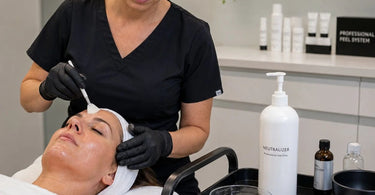
Boost sales effortlessly with the knowledge that turns a good esthetician into a legendary one. Let's talk about the unsung hero of the chemical peel world. You've got your acids, your timing down, and the perfect playlist for your client. But if you've ever had a peel go just a little... too far, you know the sinking feeling. That's where the neutralizer comes in. Not just any neutralizer, but understanding exactly why neutralizer placement matters during professional peels is the difference between a client who glows and a client who has a story to tell (and not the kind you want circulating). Today, we're diving deep into the art and science of stopping the action, ensuring your clients get that radiant, even skin tone without any unwanted drama. And don't worry, we'll keep it fun, because even serious science deserves a little personality.
Imagine this: You're in the zone. The glycolic acid is applied, the timer is set, and you're watching for that perfect, even frosting. But then, you accidentally miss a spot with your Neutralizer Solution. Suddenly, you're not a master esthetician; you're a chemist who forgot the final ingredient. That's the reality of why neutralizer placement matters during professional peels. It’s the moment you take back control from the acid and restore your client's skin to its happy, balanced state. This isn't just a step; it's the step that ensures your artistry doesn't turn into a science experiment gone wrong. Let's make sure every spot is covered, literally.
The Great Peel Off: Why Stopping is Just as Important as Starting
Think of a chemical peel like a highly motivated cleaning crew for the skin. They come in, they break down the old, dead cells, and they reveal the fresh, glowing layer underneath. But what happens if you don't tell the crew to stop? They keep cleaning, and pretty soon, they've scrubbed through the good stuff, leaving you with irritation, redness, and a whole lot of regret. That's where the neutralizer steps in, acting as the kind but firm security guard that says, "Okay, folks, show's over. Time to clock out." The principle is simple chemistry: acids work by lowering the skin's pH . A neutralizer is a base that raises the pH back to its normal, comfortable level (around 4.5-5.5), immediately halting the exfoliation process . This isn't just a suggestion; for many peels, it's an absolute necessity to prevent over-exfoliation, which can lead to chemical burns, post-inflammatory hyperpigmentation, and a very unhappy client .
Let's face it: we've all heard the stories (or maybe lived them) of a peel that went on a little too long. Maybe the timer was off, or the client's skin was more reactive than expected. But with a thorough understanding of neutralization, you're not just hoping for the best; you're controlling the outcome . When you apply a neutralizer like the Matrixpeel Neutralizer, you're telling the acid, "Your work here is done." This precise control is what allows you to achieve consistent, predictable results and ensures every peel is a success. This is why many professional peel systems come with a dedicated Professional Peel System that includes the matching neutralizer. It’s a carefully calibrated dance, and you're the choreographer.
How to Use Neutralizer: A Guide for Flawless Application
Okay, you're convinced. Neutralizer is essential. But how do you ensure your Neutralizer Placement is on point? Here's the step-by-step playbook that turns the process from a task into an art form. First, your neutralizer should be prepped and ready before you even apply the peel. Time is of the essence. After the peel has been on for the recommended time (usually 3-7 minutes depending on the acid and concentration ), assess the skin. You're looking for signs of endpoint: first signs of redness, patient discomfort, or the appearance of frosting (blanching or whitening of the skin) .
Once you've hit that sweet spot, it's go-time. Using soft cotton, gauze, or a spray, thoroughly saturate the entire treated area with your neutralizing solution . The key word here is thorough. It's not a quick spritz; it's a generous application. You want to see a slight foaming or fizzing reaction—that's the chemical reaction telling you it's working . Some professionals recommend leaving the neutralizer on for a minute or two to ensure complete neutralization . After that, rinse the area with cool water and pat dry. The skin should feel calm and balanced, not tingly or reactive. For example, when using a 20% glycolic acid peel, you'll want to follow the specific instructions for its corresponding neutralizer, ensuring you stop the exfoliation precisely when intended .
A final pro-tip: don't forget the edges! It's easy to focus on the center of the face and miss the hairline, jawline, or the delicate skin around the nose. Incomplete coverage leaves pockets of active acid, which can lead to uneven peeling or irritation. Think of it like applying sunscreen—every millimeter matters. Your goal is a safe, even finish that leaves your client's skin glowing and smooth . This is why your Professional Cleaning Solutions and preparation are just as important as the peel itself. A clean, prepared canvas ensures even acid application and, by extension, even neutralization.
Avoid These Neutralizer Blunders (We've All Had an Oops Moment!)
Even the pros can trip up when it comes to neutralization. But forewarned is forearmed. Here are some common mistakes to avoid, so your reputation as a skin wizard remains untarnished. Mistake #1: Using Water as a Neutralizer. "I'll just rinse it off, that should be fine, right?" Wrong. Water dilutes the acid but does not chemically neutralize it. It can even help spread the acid around, potentially increasing the risk of burns . Always use a proper, formulated neutralizing solution.
Mistake #2: Skimping on the Product. A tiny spritz or a single wipe isn't enough. You need to generously apply the neutralizer to ensure every trace of the acid is deactivated. If you're not seeing that satisfying fizz, you might not have used enough . Mistake #3: Waiting Too Long. If you've let a peel go beyond its recommended time, you're already on the back foot. Neutralizing a peel that has over-penetrated can sometimes be less effective. This is where having a quality Neutralizer Solution from a trusted brand is crucial, as it is formulated to be both effective and gentle on the skin .
And finally, Mistake #4: Forgetting the Aftercare. Once the peel is neutralized, the skin's barrier is temporarily compromised. This is not the time to slather on active ingredients. Think gentle, soothing, and hydrating. A good post-peel protocol is the other half of a successful treatment. This includes recommending a high-quality SPF and calming skincare to your clients. By avoiding these pitfalls, you ensure every peel is a safe, effective, and transformative experience that keeps clients coming back for more. Your Spa Retail Products can play a huge role here, providing the aftercare solutions that extend your professional glow right into their daily routine.
So, the next time you're prepping for a chemical peel, remember that the true magic happens after the acid has done its job. A mastery of why neutralizer placement matters during professional peels is what separates the okay esthetician from the absolutely phenomenal one. It's about confidence, control, and the ultimate respect for your client's skin. Now, go out there and neutralize like a boss—your clients' skin will thank you for it!
)