
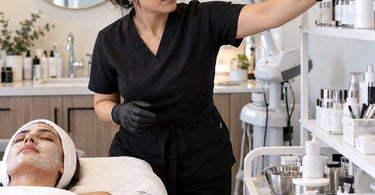
Do the job right the first time... and make sure you are not doing three unnecessary things just to get there! In a busy salon, one tiny extra step can seem completely harmless. Walking across the room for another towel, opening a cabinet for the same product, or searching for a clean applicator might take only a few seconds. But repeat that little inconvenience 30 times a day, and suddenly your salon has an invisible employee whose only job is wasting everybody's time. The sneaky part? Nobody notices because everyone is too busy working!
Salon workflow efficiency is not always about faster appointments, expensive technology, or squeezing another client into an already packed schedule. Sometimes, meaningful improvements come from eliminating small, repetitive actions that quietly interrupt your team's rhythm. For salon owners, spa managers, estheticians, nail technicians, hairstylists, and waxing professionals, understanding how these tiny inefficiencies multiply can reveal opportunities to reduce unnecessary effort, improve service consistency, and create a calmer working environment.
The Math Behind One Tiny Salon Workflow Problem
Imagine an esthetician who needs to walk to a storage cabinet every time she reaches for a frequently used supply. The trip adds approximately 20 seconds to her workflow. Not a big deal, right? She probably spends more time deciding what to order for lunch.
Now multiply that 20-second interruption by 30 repetitions throughout the day.
That equals 600 seconds, or 10 minutes of unnecessary activity every day.
Across a five-day workweek, that becomes 50 minutes. Over 50 working weeks, that one repeated inconvenience adds up to approximately 41.7 hours.
Yes, more than 40 hours spent doing something that might be completely avoidable.
Consider what happens when several professionals experience the same problem. If five employees each lose those 10 minutes daily, the business accumulates 50 minutes of unnecessary activity per working day. Over 250 working days, that represents approximately 208 hours of staff time.
These calculations are illustrations, not guaranteed savings. Actual results depend on service volume, staffing, task frequency, and whether the eliminated movement truly reduces paid labor time. Still, they demonstrate why small operational details deserve attention.
Why Salon Professionals Often Miss Repetitive Inefficiencies
Most beauty professionals develop routines through experience. Once a routine feels familiar, its individual steps become almost automatic.
A hairstylist may reach behind her chair for a comb several times during an appointment. A nail technician may repeatedly open a drawer to retrieve files. A waxing specialist might walk between a treatment bed and a supply shelf for fresh applicators.
None of these actions looks particularly inefficient in isolation.
The problem is repetition.
Staff members often become so accustomed to their surroundings that they stop questioning whether their tools are arranged logically. Something that started as a temporary workaround can eventually become the permanent way everyone works.
And because professionals are skilled at adapting, they often compensate for inconvenient setups without complaining.
That does not mean the setup is efficient. It just means your team has become exceptionally talented at working around it.
The Difference Between Necessary Steps and Unnecessary Steps
Before removing anything from a salon workflow, distinguish between essential professional procedures and avoidable activity.
Handwashing, appropriate glove changes, equipment cleaning, disinfection, consultation, recordkeeping, and manufacturer-required processing steps should never be eliminated simply to save time. Applicable state cosmetology rules, workplace safety requirements, and product instructions remain essential.
For example, proper cleaning and disinfection of reusable implements between clients is a necessary part of professional nail services. Making disinfected implements easier to access can improve workflow, but shortening a required disinfectant contact time is not an acceptable efficiency improvement.
The goal is to remove wasted motion, searching, unnecessary handling, and preventable interruptions without compromising hygiene, technical quality, or client care.
Think of it this way: eliminating the third trip to the supply closet is smart. Eliminating the cleaning procedure is not.
Where the Extra Steps Hide in Everyday Salon Services
Every department has its own version of the missing towel mystery. Understanding where repetitive actions occur is the first step toward improving the workflow.
Hair Salon Stations
Stylists regularly switch between combs, brushes, clips, shears, styling tools, and finishing products. If these items are scattered across drawers, countertops, and neighboring stations, unnecessary reaching and walking can interrupt the service.
A workstation organized around the actual service sequence can reduce repeated searching. Position frequently used Professional Hair Brushes & Combs in consistent locations, arrange styling tools within comfortable reach, and keep clean accessories separated from used items.
For color services, organize color bowls and brushes, protective materials, and other regularly needed products before beginning. Avoid unnecessary trips during processing while maintaining product instructions and safe handling practices.
Nail Tables and Manicure Stations
Manicure services involve many small implements. A technician might repeatedly reach for files, buffers, brushes, wipes, bottles, or other accessories.
A well-planned Nail Table or Manicure Station can improve how supplies are positioned and accessed throughout the appointment.
Keep regularly used Nail Files & Buffers and Manicure Essentials organized according to service needs, with clearly designated locations for clean, used, and disposable materials.
Opening the same drawer 30 times is not necessarily a disaster. But if every opening requires moving four unrelated products first, your drawer may be auditioning for a career as an obstacle course.
Waxing Treatment Rooms
Waxing services provide an especially useful example because technicians frequently need multiple consumable supplies during one appointment.
If spatulas, strips, gloves, pre-wax products, and post-wax products are stored in different corners of the room, preparation and application may involve unnecessary movement.
Organizing Waxing Supplies for Professionals around the technician's working position can create a smoother service experience.
Keep appropriate Wax Spatulas and Applicators, Wax Strips and Rolls, and Pre & Post-Waxing Products accessible while maintaining proper hygiene and preventing cross-contamination.
Supplies should be organized according to the service and infection-control requirements, not simply arranged for the prettiest countertop photograph.
Facial and Esthetic Treatment Rooms
Facial treatments often require a sequence of cleansing, exfoliating, treatment, and finishing products. When professionals must repeatedly turn away from the client to find the next item, the service can feel less fluid.
Organized Facial Treatment Products, conveniently positioned Cotton, Sponges, and Wipes, and properly maintained treatment equipment can support a more consistent sequence.
Where appropriate, a salon trolley can keep frequently used items near the treatment area without overcrowding the work surface.
The Hidden Cost Is More Than Lost Minutes
The direct time calculation is only one part of the picture. Repetitive inefficiencies can also affect concentration, physical comfort, supply control, and the way services feel to clients.
Every time a technician stops a task to search for something, attention shifts away from the procedure. The professional must interrupt the current action, locate the missing item, and return to the previous task.
Although the impact varies, frequent interruptions can make a workday feel more fragmented.
Unnecessary reaching, bending, twisting, and walking may also contribute to physical strain, especially when they occur alongside other repetitive movements. Organizing equipment within comfortable reach and adjusting workstation height can help reduce awkward positioning.
Then there is the client experience.
Imagine enjoying a relaxing facial while your esthetician repeatedly disappears to find supplies. The treatment may still be professionally performed, but the interruptions can make the experience feel less polished.
Clients usually do not evaluate your workstation organization directly. They notice whether the appointment feels smooth, attentive, and comfortable.
How to Identify the 30-Times-a-Day Problem
You do not need an expensive consultant or complicated software to begin identifying repetitive workflow problems. Start by observing one service station during a normal working day.
Choose a recurring task and record how often a professional performs it. Focus on actions such as retrieving products, opening storage, walking to another workstation, searching for implements, or returning supplies to their proper location.
Ask several practical questions:
- Which supplies are retrieved most frequently?
- How many times does the technician leave the immediate work area?
- Which drawers or cabinets are opened repeatedly?
- Are essential products consistently stored in the same location?
- Do employees interrupt services because supplies have run out?
- Could a frequently used item be moved closer without creating a safety or hygiene issue?
- Are clean, used, and contaminated materials clearly separated?
Observe the process without blaming employees. The purpose is to improve the system, not criticize people for following a routine that the business itself may have created.
Even better, ask technicians what causes the most unnecessary movement. The person who uses a workstation every day often knows exactly which cabinet deserves to be launched into the sun.
Use a Simple Time-and-Motion Audit
A practical salon workflow audit can be completed in a few manageable steps.
Step 1: Select one repeated action. For example, walking to retrieve clean towels during service preparation.
Step 2: Measure the actual duration. Time several repetitions rather than relying on memory. Record how long the activity takes, including locating and retrieving the item.
Step 3: Count its frequency. Determine how often it occurs during a normal shift and across different service types.
Step 4: Calculate the cumulative time. Multiply the average duration by the number of daily repetitions.
Step 5: Test one improvement. Rearrange supplies, establish a preparation routine, or introduce appropriate organizational equipment.
Step 6: Measure again. Compare the new process with the original while confirming that safety, hygiene, service quality, and comfort are unchanged or improved.
For example, if an activity takes 15 seconds and happens 30 times daily, it consumes 7.5 minutes per day. Reducing that activity to five seconds saves five minutes daily, assuming the same number of repetitions.
Small improvements become meaningful when they occur consistently across many appointments and working days.
Build Workstations Around the Sequence of Service
One of the simplest ways to reduce wasted movement is to organize a workstation in the order products are actually used.
Instead of grouping everything solely by product category, think about the sequence of the treatment.
A facial workstation might have clearly designated areas for preparation, treatment products, and finishing supplies. A waxing station might position unopened consumables and properly maintained equipment close to the treatment area while keeping used materials separate.
Frequently used items should be easy to reach without excessive bending or twisting. Less frequently used items can occupy secondary storage.
Products should remain in suitable containers and storage conditions, with required labels, appropriate chemical handling, and safe access maintained.
Do not create clutter simply to bring every possible item within arm's reach. The goal is purposeful placement, not constructing a tiny mountain of supplies beside the client.
Depending on the department, useful organizational options may include Bottles & Jars, Mixing Bowls, accessible carts, and appropriately designed Spa and Salon Equipment & Furniture.
Pre-Stage Supplies Instead of Interrupting Every Appointment
Another effective improvement is preparing a standardized supply setup before each service.
For example, a waxing professional may check that the appropriate wax, applicators, strips if needed, protective materials, and finishing products are ready before the client enters the treatment room.
A nail technician can prepare an approved set of clean implements and required single-use supplies according to the booked treatment.
A massage therapist can arrange appropriate Massage Oils, Lotions, and Creams, fresh linens, and necessary Massage Bolsters before beginning.
This reduces the chance of discovering missing items midway through an appointment.
However, preparation must never compromise cleanliness. Fresh linens, properly disinfected reusable tools, and single-use supplies must be handled according to applicable requirements. Products that are intended for one client should not be reused.
The improvement comes from preparing correctly in advance, not skipping necessary procedures.
Why Reordering Systems Are Part of Workflow Efficiency
Some of the most frustrating workflow interruptions happen because nobody realizes a supply is nearly depleted until it is needed.
A technician reaches for a fresh roll of treatment paper. Empty shelf. She checks another cabinet. Nothing. Someone remembers seeing a box in the back room. Cue the salon-wide treasure hunt.
This problem often starts long before the appointment.
Establishing clear reorder points for frequently used consumables helps maintain reliable access. Items such as Salon Towels, Hygienic Table Paper, Protective Gloves and Masks, and Applicators and Spatulas are good candidates for routine inventory checks.
Set minimum stock levels using actual consumption, supplier lead times, expected demand, and a reasonable safety buffer.
For example, if a department uses an average of 10 packages of a particular consumable each week and replenishment takes two weeks, expected lead-time demand is 20 packages. Any additional safety stock should reflect variability in use and delivery rather than an arbitrary guess.
Maintaining appropriate stock does not require filling every storage closet to the ceiling. It requires knowing what gets used, how quickly it gets used, and when to reorder.
Do Not Confuse Faster Work With Better Work
There is an important distinction between improving workflow efficiency and pressuring staff to perform technical services faster.
An esthetician should not rush an application procedure simply because the appointment calendar is full. A nail technician should not compromise precision to meet an unrealistic time target. A stylist should not skip a necessary consultation to gain a few minutes.
Instead, identify tasks that add no professional value and redesign them where practical.
When tools are readily accessible, supplies are prepared, and workstations are logically arranged, professionals may have more uninterrupted time to focus on the actual service.
That is the point of efficient salon operations: reducing friction while protecting quality.
How One Improved Step Can Affect Appointment Scheduling
Saving five or ten minutes per day does not automatically mean a salon can add another client. Appointment durations, staffing coverage, sanitation procedures, and booking demand determine whether saved time creates additional revenue opportunities.
However, reducing unnecessary activity can give teams more breathing room between appointments.
That time might support better station preparation, more consistent schedule transitions, inventory checks, or a less stressful close to the workday.
In salons where repeated inefficiencies contribute to appointment delays, correcting those issues may help improve schedule reliability.
Any financial benefit should be evaluated using actual operating data. Avoid assuming that every minute saved translates directly into billable service time.
Sometimes the biggest win is simply finishing the day without feeling like you have personally walked a marathon between the wax warmer and the towel cabinet.
Make Small Improvements a Team Habit
A single workstation adjustment can help one technician. A repeatable improvement process can benefit the entire business.
Encourage employees to suggest one small workflow improvement each week. Focus on recurring frustrations rather than major renovations.
Suggestions might include moving a supply dispenser, labeling a storage drawer, adjusting a cart position, creating standardized preparation kits, or organizing frequently used products by service type.
Test each suggestion before adopting it across every workstation.
What works for a waxing room may not work for a nail table. Different professionals, service sequences, accessibility needs, and equipment layouts may require different arrangements.
Once an improvement proves helpful, document the process clearly enough that new team members can follow it.
Consistency matters because an organized system works only when employees know where things belong.
When Better Salon Equipment Is Worth Considering
Not every workflow problem requires buying something. Often, rearranging existing supplies is enough.
But sometimes the physical limitations of a workstation create ongoing inefficiency.
A manicure table without practical storage may force frequent trips across the room. A crowded treatment room may need a compact rolling cart. Poorly positioned equipment may require excessive reaching or repeated setup adjustments.
Before purchasing new Professional Salon Equipment, identify the specific problem you want the equipment to solve.
Ask whether it improves access, comfort, organization, cleaning procedures, or service preparation. Check dimensions, required clearances, maintenance needs, and compatibility with the existing workspace.
Pure Spa Direct offers professional salon, spa, nail, waxing, and treatment-room supplies from multiple manufacturers, making it possible to explore different equipment and organizational options for specific services.
The smartest purchasing decision is not necessarily the fanciest station with the most drawers. It is the one that solves a real operational problem without creating three new ones.
A Five-Day Salon Workflow Improvement Challenge
Want to see what small adjustments could accomplish? Try a focused five-day experiment.
Day 1: Observe. Choose one busy workstation and write down recurring interruptions, unnecessary trips, or frequently misplaced supplies.
Day 2: Measure. Count how often the problem occurs and estimate or time its daily impact.
Day 3: Rearrange. Make one low-risk improvement that preserves safe working practices and all required cleaning and disinfection procedures.
Day 4: Test. Have the team use the updated setup during real appointments. Ask whether it improves access, comfort, or service continuity.
Day 5: Compare. Measure the task again and review staff feedback. Keep the change if it produces a useful improvement without introducing new problems.
Document the result. A 10-second improvement might sound tiny, but if it happens repeatedly across a busy schedule, the cumulative effect can become meaningful.
Then choose another problem.
There is no need to transform the entire salon overnight. Incremental improvements are generally easier to evaluate, train, and maintain.
The Real Goal: A Salon That Works With Your Team
The most successful salon workflow is not necessarily the one with the fewest steps. It is the one where each step has a clear purpose and supports professional service delivery.
Necessary hygiene, consultation, technical, and safety procedures protect the client and professional. Unnecessary searching, repeated walking, awkward storage, and preventable supply shortages do not.
By measuring everyday tasks, improving workstation organization, preparing supplies before appointments, and maintaining consistent inventory practices, salon owners can reduce wasted activity without sacrificing service quality.
The next time someone walks across the room for the same item for the thirtieth time, consider whether the problem is the employee or the setup.
Chances are, the employee is doing exactly what the space requires.
Give your team a better system, and those little moments of frustration can turn into smoother appointments, more comfortable workdays, and a business that operates with greater intention.
Because in a professional salon, every second does not need to be rushed. But every unnecessary step deserves a second look.
