
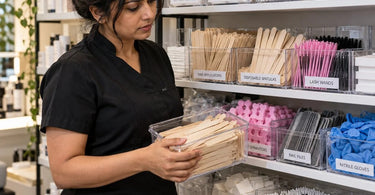
Set yourself up for greatness... but maybe not by ordering another 5,000 cotton rounds just because they were on sale! Every spa and salon professional knows the sinking feeling of reaching for a tiny essential during a busy service and discovering the container is empty. That frustration often inspires a perfectly understandable response: buy more, buy extra, and buy enough to survive a small apocalypse. Unfortunately, salon consumables have a sneaky way of turning from helpful backup supplies into an overflowing collection of boxes, bags, and mysterious little containers. Suddenly, your treatment room has six varieties of disposable applicators, three unopened cases of gloves, and absolutely no idea where the cotton swabs went. Welcome to the surprising world of overstocking, where having too much can create almost as much operational chaos as having too little.
For busy estheticians, nail technicians, massage therapists, waxing specialists, and salon owners, maintaining the right amount of everyday supplies is essential to smooth appointments. Those inexpensive items might seem insignificant individually, but their combined impact on storage space, purchasing budgets, staff efficiency, and treatment room organization can be enormous. The goal is not to keep the smallest possible inventory. It is to maintain enough of the right supplies, in the right locations, without turning every storage cabinet into a game of professional beauty supply Jenga.
The Tiny Consumables That Quietly Take Over Your Salon
Big equipment purchases usually receive plenty of attention. Nobody accidentally orders six massage tables because they forgot there were five in the back room. Tiny consumables, however, are a different story. Their individual prices are relatively low, they are used frequently, and they are easy to toss into an order without much consideration.
Consider the everyday essentials found throughout a professional beauty business:
- Cotton rounds, cotton balls, and disposable wipes: Used for facial treatments, nail services, makeup removal, and countless cleanup tasks.
- Waxing applicators and strips: Essential supplies that can accumulate in multiple sizes, shapes, and package quantities.
- Disposable gloves: Necessary for many services and cleaning procedures, but surprisingly easy to overpurchase in less frequently used sizes.
- Microbrushes and precision applicators: Tiny tools used in brow, lash, and detailed beauty services.
- Nail files, buffers, and disposable accessories: Small products that can multiply rapidly when different technicians favor different styles.
- Sponges, gauze, and facial applicators: Lightweight essentials that occupy more cabinet space than their individual size suggests.
- Disposable spatulas and mixing accessories: Convenient supplies that frequently arrive in large quantities.
Browse categories such as Professional Cotton, Sponges, and Wipes for Salons & Spas, Applicators & Spatulas, and Protective Gloves & Masks, and you will quickly see how many variations of everyday essentials exist. Having choices is wonderful. Having every choice simultaneously stuffed into one drawer? Slightly less wonderful.
Why Overstocking Tiny Consumables Creates Real Business Problems
The trouble with excessive inventory is that its costs extend beyond the purchase price. A box of disposable supplies might be inexpensive, but that does not mean storing, tracking, locating, and eventually using it is free.
Storage space disappears. Treatment rooms and supply closets have limited capacity. When shelves become packed with extra cartons, frequently used supplies get pushed behind products nobody needs today. Staff may start storing overflow in treatment rooms, hallways, or inconvenient cabinets, creating clutter and potentially interfering with safe movement or proper storage practices.
Employees spend more time searching. A technician should not need an archaeological expedition to find the correct waxing strip. When products are scattered across multiple storage locations, even simple supply retrieval becomes frustrating. Those extra minutes add up across appointments and employees.
Duplicate purchases become common. If someone cannot locate the unopened carton of applicators behind the towel stacks, they may assume the salon needs more. The next order arrives, and congratulations, your business now owns enough wooden sticks to build a miniature log cabin.
Cash gets tied up in supplies. Money spent on excessive backup inventory cannot simultaneously support equipment maintenance, employee education, marketing, or other business priorities. Small purchases become meaningful when repeated across dozens of product categories.
Older supplies become harder to manage. Some consumables have expiration dates, manufacturer storage requirements, or packaging that protects them from contamination. Excessive inventory makes stock rotation more difficult and increases the possibility that products will become damaged, outdated, or unsuitable before they are used.
Why Running Out Is Not the Only Inventory Emergency
Running out of essential supplies is obviously disruptive. Imagine preparing for a fully booked waxing afternoon and discovering that the correct disposable applicators are gone. Suddenly, the appointment schedule becomes considerably less relaxing.
But overstocking produces a different kind of disruption. Staff might have plenty of supplies somewhere in the building without having the specific item available at the workstation. Inventory can be technically abundant while remaining operationally inaccessible.
A waxing room might contain hundreds of applicators, but none in the correct size for a particular treatment. A nail station might have stacks of files but not the grit required for the technician's service. A facial room might have an impressive mountain of cotton products but lack the preferred lint-free material.
This reveals an important distinction: inventory quantity is not the same as inventory readiness.
A well-managed salon needs an appropriate supply of usable products that match its current service menu, team preferences, and appointment volume. Simply increasing the total number of items rarely solves an inventory problem when purchasing decisions are disconnected from actual demand.
Bulk Buying Is Helpful Until the Math Stops Working
Wholesale purchasing can offer real advantages for professional beauty businesses. Larger packages may lower the per-unit price, reduce ordering frequency, and help protect against unexpected demand. That makes bulk purchasing attractive, particularly for dependable essentials used every day.
However, a lower unit cost only produces savings if the business can use the inventory efficiently.
Consider a fictional waxing studio that uses approximately 1,000 disposable applicators each month. Purchasing 3,000 applicators might provide a reasonable supply cushion, depending on storage capacity and delivery times. Purchasing 20,000 because the price per applicator is slightly lower could leave the studio holding nearly two years of inventory.
That inventory occupies space, consumes purchasing dollars, and requires ongoing organization. If the studio changes its service menu or preferred applicator sizes, some of those supplies may become less useful.
When evaluating Waxing Supplies for Professionals or other frequently replenished products, compare package pricing with realistic monthly consumption. The best wholesale value is not necessarily the largest carton. It is the purchase quantity that supports your business without creating unnecessary waste or storage pressure.
How to Calculate the Right Amount of Everyday Supplies
Fortunately, managing tiny consumables does not require an elaborate software system or an advanced degree in spreadsheet wizardry. A few practical calculations can dramatically improve purchasing decisions.
Start by determining how much of each essential item your business actually uses. Review a representative period, such as four to eight weeks, while accounting for seasonal fluctuations or unusually busy appointment schedules.
For example, imagine a salon uses approximately 600 cotton rounds per week. Its supplier typically delivers within five business days, and management wants an additional three business days of safety stock.
Assuming the salon operates five days per week, the average daily usage is 120 cotton rounds. Five operating days of demand equals 600 rounds, and three extra operating days add another 360.
The resulting reorder point is approximately 960 cotton rounds.
Reorder point = expected usage during supplier lead time + safety stock.
When available stock approaches that threshold, the purchasing manager knows it is time to reorder. The target quantity after replenishment should also account for how often inventory is reviewed, package sizes, delivery reliability, and upcoming appointments.
This approach can be applied to cotton products, gloves, nail accessories, disposable sponges, waxing strips, and other everyday items. Adjust quantities as the business grows or changes its service offerings.
Give Every Tiny Consumable a Designated Home
One of the simplest ways to prevent supply chaos is to establish consistent storage locations. Every regularly stocked consumable should have an assigned place that employees can identify immediately.
Clear, labeled containers work particularly well for smaller items. Rather than placing three open bags of cotton pads on a shelf, consolidate suitable stock into a clearly identified container while preserving any necessary product identification and protective packaging.
Organize supplies according to service type and frequency of use. Frequently used products should be easily accessible near the appropriate workstation, while sealed backup inventory belongs in a designated central storage area.
For example, a waxing station might contain a manageable working supply of applicators, strips, and gloves. Additional stock can be stored in a labeled cabinet instead of overflowing onto treatment counters.
For related supplies, explore Professional Wax Spatulas and Applicators for Salons & Spas and Quality Wax Strips & Rolls for Effective Hair Removal. Selecting the correct styles and package quantities makes it easier to standardize what belongs at each station.
The objective is not to create a storage closet worthy of a home organization television show. It is to make supplies easy to locate, count, replenish, and use correctly.
Stop Opening New Packages Before Finishing the Old Ones
Few things make a supply room more confusing than discovering four partially used packages of the same item. One technician opens a new box because the old one appears empty. Another opens a different package because the first box was moved. Eventually, the salon has a collection of half-empty cartons that nobody recognizes as available inventory.
Establish a simple rule: finish the existing working supply before opening another package, provided the remaining items are clean, suitable for use, and properly stored.
Maintain one clearly marked active supply location for each item and keep unopened backup packages separate. Where appropriate, label the date an item was received or opened.
Use first-in, first-out rotation for products without differing expiration dates. For dated products, prioritize the earliest expiration date while following the manufacturer's storage and use instructions.
Never consolidate items in a way that compromises sanitation, traceability, or product integrity. Sterile or individually sealed items must remain protected according to their labeling, and disposable single-use products should never be reused to reduce inventory costs.
These practices help prevent forgotten stock, unnecessary package openings, and supplies that become unusable before they reach a treatment room.
Create a Two-Bin System That Makes Reordering Obvious
If staff members consistently struggle to identify when supplies are running low, a two-bin system may be a practical solution.
Divide an appropriate item into two labeled storage sections. The first contains the active working supply. The second contains a predetermined backup quantity sufficient to cover expected demand while replacement inventory arrives.
When the active bin becomes empty, staff begin using the reserve and trigger a reorder. The backup quantity should reflect actual usage and realistic supplier lead times, not an arbitrary guess.
This arrangement can work particularly well for:
- Disposable cotton rounds and wipes.
- Frequently used waxing applicators.
- Standard nail buffers and disposable files.
- Compatible facial sponges.
- Other compact, high-turnover consumables with predictable demand.
For high-volume facilities, separate backup locations may be needed for different departments. Regardless of the arrangement, assign responsibility for replenishment so that multiple employees do not accidentally submit duplicate orders.
The beauty of this system is its simplicity. Employees can recognize a reorder signal without repeatedly counting every individual item. Your team can spend less time wondering whether supplies were ordered and more time delivering excellent services.
Small Products Need Smart Inventory Categories
Not all consumables deserve the same purchasing strategy. Some products move rapidly and support almost every service. Others are specialized and may only be needed for occasional appointments.
Dividing inventory into practical categories helps prevent excessive purchasing.
High-use essentials: These include common cotton products, frequently used gloves, everyday applicators, and other supplies consumed consistently. Maintain enough backup stock to accommodate normal demand and realistic delivery delays.
Service-specific essentials: These items are necessary for particular treatments, such as specialized lash applicators or certain nail files. Maintain quantities based on bookings and the frequency of those services.
Occasional-use supplies: Products associated with infrequent services or specialty treatments usually require smaller quantities. Evaluate upcoming bookings before placing additional orders.
Seasonal consumables: Supplies associated with promotions, holidays, or changing service demand should receive temporary purchasing adjustments rather than permanent increases in inventory.
For example, a salon offering extensive manicures and pedicures might use large quantities of Nail Files & Buffers. A business offering only occasional nail services may need considerably less inventory of the same products.
Similarly, an esthetics practice with a busy facial schedule may consume Compressed Sponges regularly, while a massage-focused business might use them only occasionally.
Order according to your service mix, not according to what another business keeps in its supply closet.
Let Appointment Bookings Influence Purchasing Decisions
Past consumption provides a useful baseline, but upcoming appointments can reveal changes that inventory history alone might miss.
If a spa is introducing additional facial services, hosting a busy promotional weekend, or adding another technician, the expected demand for consumables may increase. Conversely, a temporary reduction in staffing or a seasonal slowdown may justify smaller replenishment orders.
Review appointment bookings alongside inventory counts. Pay particular attention to services with significant disposable supply requirements, including waxing, lash treatments, brow services, nail care, and certain body treatments.
A busy waxing schedule might justify replenishing Pre & Post-Waxing Products and related disposable supplies before the week begins. An increase in lash appointments may require additional compatible items from Lash & Brow Service Supplies.
This does not mean ordering a new case every time the appointment calendar looks full. Instead, compare expected demand with available stock and purchase only what is necessary to maintain the established inventory targets.
The Hidden Cost of Having Supplies in the Wrong Room
Multi-room spas and larger salons face another inventory challenge: uneven distribution.
One facial room may have an overflowing drawer of cotton rounds while the room next door is nearly empty. A waxing specialist may have multiple boxes of applicators, while another technician repeatedly visits the supply closet.
Without clear replenishment procedures, employees may independently stash backup supplies in their favorite locations. This feels convenient until management tries to determine how much inventory the business actually owns.
Establish standardized workstation quantities based on the services performed in each room. Designate one central backup storage location and schedule regular restocking.
Staff should know where supplies belong, who replenishes each station, and how to report a shortage. A simple shared inventory sheet or standardized restocking checklist may be sufficient.
The goal is to make every workstation reliable without allowing each room to become its own miniature warehouse.
Watch Out for the Temptation of Just-in-Case Ordering
Overstocking is often driven by good intentions. Salon professionals want to prevent appointment disruptions, accommodate last-minute bookings, and avoid the stress of emergency orders.
But the phrase just in case can become expensive when applied to every product in the building.
Before adding another bulk package to your order, ask a few practical questions:
- How much of this exact item do we currently have?
- How quickly do we normally use it?
- Is there already an unopened package in another location?
- How long does replenishment usually take?
- Will this purchase fit within our designated storage area?
- Is a smaller package more appropriate for our service volume?
- Are we purchasing because demand increased or simply because the price looks attractive?
These questions help distinguish strategic bulk purchasing from emotional backup buying. There is nothing wrong with taking advantage of a worthwhile wholesale opportunity, but the purchase should make operational sense.
A discount does not automatically become savings when half the order remains unused for a year.
How to Fix an Overstocked Supply Closet Without Wasting Products
If your salon already has more consumables than it needs, do not respond by throwing everything away. Begin with a careful inventory review.
Remove cartons from hiding places and count what is actually available. Check manufacturer expiration dates, storage conditions, package integrity, and suitability for intended professional use.
Organize usable supplies by category and consolidate them into appropriate designated locations. Maintain original labeling or other necessary identification, and keep items in their required protective packaging.
Next, temporarily reduce or suspend orders for products with excessive stock. Use existing supplies before replenishing them, provided they remain safe and appropriate for the service.
Identify duplicate products that perform the same function. For instance, a salon might have accumulated several styles of disposable applicators that are effectively interchangeable for certain approved uses. Standardizing future purchasing can reduce unnecessary variety while preserving the options technicians genuinely need.
For unopened, unexpired products that are no longer required, investigate whether returns, approved transfers between business locations, or appropriate donations are possible. Always consider manufacturer instructions, sanitation requirements, and applicable business policies.
Finally, determine why the overstock developed. Did several employees order independently? Were inventory counts inaccurate? Did the salon continue buying for a service that is no longer popular?
Fixing the underlying purchasing process is more valuable than simply clearing a shelf. Otherwise, the supply mountain will return, possibly wearing a different brand label.
Build a Weekly Inventory Routine That Actually Sticks
An inventory system only works when employees use it consistently. Fortunately, small consumables usually benefit from a straightforward routine rather than complicated administration.
Choose a consistent day to review high-use products. Assign one person to verify quantities, note unusually fast consumption, and prepare purchase recommendations.
A practical weekly routine might include the following steps:
- Check treatment stations: Confirm that each room has its established working quantity of essential supplies.
- Count backup inventory: Include unopened cartons, partially used packages, and stock in all approved storage locations.
- Review incoming orders: Account for products already purchased but not yet delivered to avoid duplicate ordering.
- Compare against reorder points: Identify items that need replenishment based on actual consumption and lead times.
- Inspect older stock: Rotate suitable supplies and check expiration dates, packaging, and storage conditions.
- Place coordinated orders: Consolidate purchasing decisions through the designated inventory manager.
- Update the inventory record: Keep product descriptions, sizes, package quantities, and storage locations consistent.
Even a simple spreadsheet can work well for a smaller salon. Larger businesses may prefer inventory features within their existing business management software.
For particularly fast-moving supplies, conduct brief checks between scheduled inventory reviews. The frequency should reflect the product's importance and rate of consumption.
Choosing Professional Supplies That Fit Your Actual Workflow
Better inventory management starts before products arrive at your door. Choosing the correct format, package size, and product variety makes ongoing organization much easier.
At Pure Spa Direct, professional spa and salon owners can explore a broad selection of wholesale essentials across categories such as Spa Essentials for Professionals, Manicure Essentials, and Must-Have Supplies for Salon & Spa Business Success.
As a professional beauty supply distributor, Pure Spa Direct offers access to products from different manufacturers, making it easier to compare supply options for your particular business.
Before choosing a package, consider how the product will be stored, how frequently staff use it, and whether the quantity matches your purchasing cycle. A compact package may be ideal for an occasional specialty service, while a larger wholesale quantity may make excellent financial sense for a dependable daily essential.
Consistency can also simplify ordering. If your team is satisfied with a particular applicator, wipe, or disposable accessory, standardizing that item may reduce confusion and unnecessary duplicate product variations.
Of course, product selection must always account for service suitability, technician requirements, manufacturer instructions, and hygiene practices. Efficiency should support professional standards, never compromise them.
A More Organized Salon Starts With Smarter Quantities
The most efficient supply closet is not necessarily the fullest one. It is the one where every product has a purpose, every item has a location, and employees know exactly when to replenish it.
Reducing excess inventory can free up valuable storage space, make treatment preparation more predictable, and improve visibility into purchasing expenses. Equally important, maintaining sensible backup quantities protects your business from the disruptions caused by unexpected shortages.
Think of inventory control as finding the comfortable middle ground between panic ordering and supply hoarding. You want enough disposable applicators to confidently handle your appointment schedule, but perhaps not enough to open your own applicator distribution center.
By tracking actual usage, setting practical reorder points, organizing storage areas, and coordinating purchasing decisions, salon and spa professionals can transform their supply management from a recurring frustration into a reliable business routine.
Explore professional consumables and everyday treatment essentials at Pure Spa Direct, choose quantities that match your services, and give those hardworking little supplies a system that makes sense. Because your beauty business deserves well-stocked treatment rooms, organized cabinets, and absolutely no surprise avalanche of cotton rounds when someone opens a drawer.
