
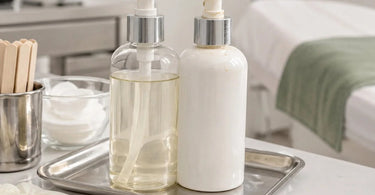
Let your results speak for themselves... but let's be real, they can't speak if they're busy fighting off a microscopic invasion force. We love a good pump bottle. They look sleek on the backbar, they're convenient for dispensing, and they scream "professional." But here's the plot twist that keeps us up at night: that innocent-looking pump dispenser isn't the impenetrable fortress of hygiene we all want it to be. It's more like a charmingly leaky castle with a drawbridge that sometimes gets stuck open. In the world of spas, salons, and waxing centers, understanding why pump bottles are not automatically contamination-proof is the difference between a glowing reputation and a client horror story involving words like "contact dermatitis" and "I'm never coming back." Let's bust the myth that pumps are the ultimate hygiene solution.
Now, before you start eyeing your Bottles & Jars collection with suspicion, let's clarify something. Pump bottles are a significant upgrade from open jars where fingers dig into product like they're mining for gold. However, assuming a pump is a 100% sterile barrier is like assuming a screen door will hold back a hurricane. It'll slow things down, but there are gaps. As a distributor, Pure Spa Direct sees every type of dispensing system imaginable, and we know the ones that work well and the ones that need a little TLC. The problem with pumps isn't the concept, it's the execution. Bacteria and air are sneaky little devils, and they find ways to exploit the mechanical complexities of even the best-looking dispenser.
The Airborne Enemy: How Your Pump Can Suck In Contamination
Ever wonder why that luxurious lotion starts to smell a little funky after a few months? It's not just age; it's oxidation. Many pump systems are designed to create a vacuum to draw the product up the tube. But every time that piston moves up, it has to pull air from somewhere to fill the space left behind. That "somewhere" is usually a vent hole located on the pump mechanism. And that vent doesn't just let in air; it lets in airborne bacteria, mold spores, and other uninvited guests. This is a particular concern when you're using products with active ingredients like Advanced Facial Treatment Products that are sensitive to degradation. A standard pump can actually be a highway for contaminants to travel right back into the pristine product you rely on for results. Research highlights that pump outlets, bottles, and nozzles are a potential source of contamination, particularly due to the contents accumulating around the outlet . The contact between the product and the inlet valve over time is a known risk factor for contamination and degradation .
The Great "Top-Up" Trap: A Recipe for Disaster
Let's talk about one of the biggest sins in salon/spa hygiene: topping up bottles. We all do it, or at least we're tempted to do it. That fancy bottle of Massage Oils, Lotions, and Creams for Therapists is almost empty, and it seems so logical to just combine the dregs with a fresh batch. Wrong. So wrong. When you add new product to an old bottle, you are essentially creating a microbial mixing bowl. That old product has been exposed to air, potentially contaminated by the pump, and is likely harboring bacteria or yeast. When you mix it with fresh product, you contaminate the entire new batch, shortening its shelf life and putting every client who uses it at risk. Official sanitation standards explicitly state that pump or spray bottles should never be topped up . The leftover portion from dispensing should not be returned to the original container and must not be used on other clients .
Critical Areas: The Nozzle, The Dip Tube, The Danger Zone
So, if we can't just rely on the pump to be our barrier, where do we focus our germ-killing energy? The nozzle is the primary offender. Product accumulates around the opening, dries up, and creates a sticky, crusty breeding ground for bacteria. The next time you pump, the fresh product pushes right past that gunk, collecting a souvenir on its way to your client's skin. This is especially problematic when using products for Dermaplaning or Microdermabrasion, where you are working with micro-exfoliated skin that is more susceptible to infection. Even the dip tube, the straw that extends into the bottle, can harbor mold if product is left to stagnate. It's why so many professionals are switching to single-use applicators for creams and lotions, as a clean spatula must be used to remove creams or other products from jars, and sterile cotton or sponges must be used to apply them .
Think You're Safe? Here Are the Specific Contamination Factors
Here's a breakdown of the common hygiene fail points with pump systems and how to address them:
- Ventilation Contamination: If the pump has a vent, you're pulling air into the bottle. In a salon environment, that air is full of hairspray particles, dust, and airborne bacteria. Solution: Consider using Airless Pump systems. They use a piston that rises from the bottom, eliminating the need for a vent and keeping the product completely sealed from air .
- Cross-Contamination From The Spout: The tip of the pump is an unsanitary zone. Solution: Wipe the nozzle with a clean, disinfectant-soaked cloth after each use. Some pumps come with a separate cap to cover the nozzle, which helps, but only if it's kept clean. Also, clean bottles and nozzles in warm water and detergent, rinse them under hot running water, and dry them using a lint-free cloth before refilling .
- Bacterial Growth In The Tube: Moist environments in the dark are paradise for mold and mildew. Solution: For products used infrequently, consider dispensing into smaller, single-use vessels or specific Bottles & Jars. Deep clean your dispensers regularly.
- The "Pump Wipe" Feint: Wiping the nozzle on a towel that just dried the last client's hands? That's a direct transfer of bacteria. Solution: Use single-use paper towels or dedicated, freshly sanitized towels for this task. Think about your Protective Gloves & Masks and treat the pump like the sensitive equipment it is.
- Material Degradation: Ingredients in products can interact with the elastomers and seals inside the pump. This can cause them to degrade, leading to micro-leaks and a loss of sealing capability . This is a slow process, but over time, the integrity of the pump mechanism itself becomes compromised.
Best Practices For A Contamination-Free Dispensing System
Okay, enough with the doom and gloom. Let's talk about how to win this battle. The regulation says "clean spatulas, other clean tools, or clean disposable gloves must be used to remove bulk substances from containers" . That applies to how you treat the contents of your pump bottles too.
- Choose the Right Pump: Not all pumps are created equal. Do your research. For your high-end, active-ingredient products, invest in Airless Pump systems. For other products, a high-quality standard pump is fine, but understand its limitations.
- Implement a "No Top-Up" Policy: Seriously. This is non-negotiable. Train your staff that when a bottle is low, it gets discarded or repurposed for cleaning supplies, but never, ever mixed with new retail or service product.
- Clean the Mechanism: Wipe down the pump nozzle and neck with a Professional Cleaners & Disinfectants for Salons and Spas after every use or at the end of each day. For a deep clean, run warm soapy water through the pump by pumping it, then follow with a disinfectant solution, and then pump clean water through to rinse.
- Label Everything: Label pumps with the date the product was put into service. This prevents product from sitting too long. Lotions, ointments, creams, and powders must be accurately labeled and kept in closed containers . Knowing a product's "born on" date helps manage its lifecycle.
- Consider Alternative Dispensing: For some treatments, like Lash Lift & Perm or sensitive skincare, consider using Disposable Tubes or completely sealed unit-dose packets. They are more expensive per unit, but they are the absolute gold standard for preventing cross-contamination.
Brands That Understand the Assignment
At Pure Spa Direct, we know that the fight against contamination starts with the products you choose. That's why we carry industry-leading brands known for their quality packaging and formulations that resist contamination. Brands like Murad often use advanced packaging, and we offer a range of Spa Essentials that emphasize hygiene. We also supply top-tier products from CND and OPI for nail care, where contamination can ruin a manicure faster than a smudge. And let's not forget the waxing department, where ItalWax and Lycon are staples, requiring immaculate hygiene to prevent the spread of bacteria in the wax pot area. If you're looking for the right dispenser, remember that choosing a pump size matters for hygiene, branding, and cost control . The right pump system on your backbar and retail shelves looks organized, professional, and intentional .
So, the next time you reach for that pump bottle, don't get complacent. Remember: it's a tool, not a magic shield. It requires respect, regular cleaning, and a healthy dose of skepticism to ensure your clients are getting the safe, professional experience they deserve. The moment we stop treating every tool like a potential biohazard is the moment we risk our reputation. Be smart, be clean, and be the professional your clients trust.
