
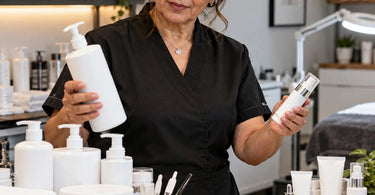
Simplify your work, maximize your results... and make sure everyone behind the retail counter knows exactly what belongs in the treatment room and what belongs in a client's bathroom cabinet. For spa and salon professionals, the distinction between professional versus home use is not a tiny technical detail hiding in the fine print. It affects how products are explained, recommended, handled, sold, and ultimately experienced by clients, which means a well-trained retail team can protect trust while helping clients confidently choose the right spa retail products.
The confusion is understandable. A professional cleanser may look like a cleanser. A wax warmer may look deceptively simple. A peel, tint, exfoliant, massage product, or nail system may come in packaging that does not scream, "Please do not improvise with me while watching television at midnight." Yet products intended for professional services can have different directions, application methods, concentrations, equipment requirements, safety considerations, or training expectations than products created for routine home care.
Professional Use and Home Use Are Different Jobs
The easiest way to train retail staff is to stop thinking of professional and home-use products as "strong" and "weak" versions of the same thing. That oversimplification can create trouble. Instead, think of them as products designed for different environments, users, and purposes.
A professional product may be designed to fit into a structured service performed by someone who understands preparation, application, timing, removal, sanitation, contraindications, and aftercare. Professional treatments can also involve equipment or complementary supplies. A product used with advanced facial treatment products, for example, may make perfect sense in a treatment protocol while being inappropriate for a client to casually experiment with at home.
Home-use retail products have a different mission. They should support what happens between appointments in a way the client can reasonably understand and follow. The goal is not to send the client home with a miniature treatment room. It is to give them a manageable routine.
Why Staff Need an Answer Better Than "It Is Professional"
Imagine a client holding two products and asking, "Why can I buy this one but not that one?" If the answer is merely, "That one is professional," the explanation feels arbitrary. The client may reasonably wonder whether the distinction is meaningful or simply a sales tactic.
Retail staff should be able to explain the practical difference in plain language. Depending on the product, that could involve application technique, concentration, exposure time, required professional assessment, equipment, removal procedure, ventilation, protective measures, or manufacturer directions. Staff do not need to deliver a chemistry lecture beside the reception desk, but they do need enough knowledge to explain why a product belongs where it belongs.
The magic phrase is not "because we said so." The useful phrase is something closer to: "This product is designed for use during a professional service because the application and timing need to be controlled. This other product is designed for you to use safely and conveniently between appointments."
Labels, Directions, and Warnings Matter
Professional beauty products should never be categorized by packaging appearance alone. Staff should pay attention to manufacturer directions, warnings, intended use, available safety information, and any professional-use designation. Products intended for professional environments may have instructions and precautions that assume a trained operator is controlling the service.
This is especially important in categories where technique is central to the outcome. Consider waxing supplies for professionals. Professional waxing involves more than owning wax. Temperature, skin preparation, application direction, removal technique, sanitation, and post-service care all matter. Sending a client home with professional supplies simply because the products are physically available can blur an important line between retail support and professional service.
The same thinking applies throughout beauty and wellness. A bottle, jar, packet, or machine should be used according to its intended purpose and directions. If staff are uncertain, the correct response is to check the product information or ask a knowledgeable manager rather than confidently inventing an answer. Confidence is lovely. Fictional instructions are less lovely.
Retail Training Should Include the "Why"
A retail training sheet can quickly become a graveyard of product names if staff are only asked to memorize what is sellable. Better training explains why each category belongs in professional services, home care, or both.
For every important product category, staff should understand four things: who the intended user is, where the product is designed to be used, what knowledge or technique is required, and what alternative can be recommended when the professional product is not appropriate for home use.
That final point is crucial. Telling a client "no" without giving them a useful next step shuts down the conversation. Instead, staff can redirect the client toward an appropriate retail option. Someone interested in continuing exfoliation between services might be guided toward suitable skincare products rather than a treatment-room product requiring professional application.
Do Not Assume a Client Understands Industry Language
Beauty professionals spend all day around terminology that sounds perfectly ordinary to them. Clients do not. Words such as developer, activator, neutralizer, primer, catalyst, acid, enzyme, hard wax, soft wax, monomer, curing, occlusion, and emulsion can mean very different things depending on the service.
Retail employees should translate industry language into client-friendly explanations without becoming dismissive. A client asking whether they can use a professional product at home is not asking a silly question. In many cases, they are interested, engaged, and trying to maintain their results. That is exactly the kind of client relationship a spa or salon wants to encourage.
The answer should focus on intended use rather than making the professional world sound mysterious. Professional products are not magical potions guarded by an esthetician dragon. They are tools designed for specific purposes, and some require professional knowledge to use correctly.
Waxing Is a Perfect Example
Waxing illustrates why clear distinctions matter. A professional may work with professional stripless hard wax, soft strip wax, specialized applicators, pre-wax products, post-wax products, and controlled heating equipment.
To an untrained shopper, the visible process may appear straightforward: warm wax, apply wax, remove hair. Professionals know that the details are the service. Temperature control, product selection, hair growth direction, skin condition, pressure, application thickness, removal technique, and aftercare can all affect the experience.
Retail staff should therefore understand whether individual products are designed for professional services, appropriate retail use, or both according to their labeling and manufacturer instructions. The answer should never be based solely on whether the container is small enough to fit in a shopping bag.
The Same Problem Appears in Lash and Brow Services
Clients often love the results of professional lash and brow services and naturally ask how they can maintain or recreate them. That makes lash and brow service supplies another category where knowledgeable retail conversations matter.
A professional service may involve multiple components with precise instructions, timing, sequencing, and application requirements. Retail aftercare has a different purpose. Staff should be trained to distinguish between products intended to support the results of a service and supplies intended to perform the service itself.
That distinction is good for everyone. The client gets a clearer routine, the professional protects the integrity of the service, and the business avoids turning a simple retail conversation into an accidental do-it-yourself chemistry class.
Nail Products Need Clear Explanations Too
Nail professionals encounter the same issue. Clients may see products used during appointments and assume every bottle is appropriate for casual home application. Professional nail systems can involve specific preparation, curing, removal, ventilation, application, or compatibility requirements.
Staff discussing professional gel polish, acrylic nail supplies, or other professional systems should understand what the manufacturer intends and avoid presenting professional service products as simple home-care items unless they are specifically suitable for that use.
Meanwhile, retail-friendly nail care can support clients between appointments without asking them to become nail technicians by Tuesday.
Equipment Makes the Distinction Even More Obvious
The professional versus home-use conversation becomes especially important around equipment. Many treatment devices require training, service protocols, maintenance, sanitation procedures, client screening, or other operational knowledge.
A professional shopping for advanced spa equipment for professional use is evaluating tools for a business environment. That is very different from a client asking for an easy product to add to a nightly routine. Staff should never casually imply that professional equipment is interchangeable with consumer home-care devices simply because both categories make similar marketing claims.
When answering questions about equipment, staff should stick closely to product specifications, manufacturer instructions, intended use, and the scope of their own knowledge.
A Simple Staff Script Can Prevent Awkward Conversations
Retail employees do not need to memorize speeches. They do benefit from a repeatable framework. When asked whether something can be used at home, staff can first identify the product's intended use, then explain the main practical reason for the distinction, and finally recommend a suitable alternative if needed.
For example: "That product is designed for the professional treatment because it requires specific application and timing. For home maintenance, this option is easier to use and is intended for regular client care."
Short. Useful. No mysterious eyebrow raise required.
Train Staff to Know When Not to Guess
One of the most valuable retail skills is knowing when to stop talking and verify information. If a staff member does not know whether a particular product is appropriate for client home use, they should check the manufacturer directions, packaging, product information, or internal training resources.
This is particularly important when questions involve sensitivities, contraindications, medical conditions, reactions, or unusual uses. Retail staff should not improvise professional or medical advice simply to avoid saying, "Let me check that for you." That sentence is not a weakness. It is excellent customer service.
Clear Answers Can Improve Retail Sales
Drawing a firm line between professional and home use does not have to reduce retail opportunities. In many cases, it improves them. Clients are more likely to purchase an appropriate product when they understand exactly what it does, where it fits into their routine, and why their professional recommended it.
A strong retail assortment can complement professional treatments with cleansers, moisturizers, exfoliating products, nail care, body care, hair care, brow care, massage and wellness products, and other appropriate maintenance items. Businesses can explore categories such as must-have supplies for salon and spa business success while deliberately separating back-bar needs from products intended for client resale.
That makes the retail shelf feel curated instead of random. Every product has a reason for being there.
Professional Knowledge Is Part of the Client Experience
A beautiful retail display gets attention, but knowledgeable employees turn that attention into trust. Clients remember when someone gives them a clear answer instead of pushing the most expensive bottle toward the register.
Teach staff to explain the intended user, intended setting, key directions, and appropriate retail alternative. Keep professional products in the professional lane when required. Build a home-care assortment that genuinely complements services. And encourage staff to verify information whenever they are unsure.
The result is a retail conversation that feels helpful rather than pushy. Clients understand what they are buying, professionals maintain appropriate control over service products, and the business strengthens its reputation for knowing the difference between "you can buy this" and "you should use this." In beauty retail, that distinction is worth getting right every single time.
