
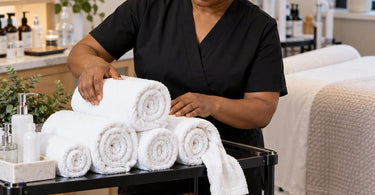
Start strong, stay successful... and keep those beautifully rolled spa towels from staging their own little escape act before your client even enters the room. You know the scene: your treatment room is spotless, your products are arranged perfectly, and your freshly rolled towels look like they belong in a five-star resort. Then you turn around to grab your facial supplies, and suddenly one towel has unraveled across the counter like it has somewhere more important to be. The good news? Rolled towels usually come undone for surprisingly simple reasons, and a few practical changes to your folding technique, towel selection, and storage setup can make your professional presentation much more reliable.
For estheticians, massage therapists, nail technicians, waxing specialists, and salon owners, towels are more than something to wipe up water. They are part of the treatment experience, the visual atmosphere, and the daily choreography that keeps appointments moving smoothly. Understanding why towels refuse to stay rolled can save preparation time, reduce unnecessary handling, and help your treatment space maintain that wonderfully polished appearance clients expect.
Why Do Rolled Towels Unroll on Their Own?
The short answer is that a rolled towel stays together through a combination of fabric friction, compression, overlapping layers, and support from its surroundings. When those factors are out of balance, the outer edge can loosen and the roll gradually opens.
Unlike a ribbon or elastic band, a towel does not have a built-in fastening mechanism. Its layers stay in place because they press against one another. The fibers create friction, while the folds and surrounding towels help resist movement.
Several everyday details can interfere with that arrangement:
- Loose initial rolling: Extra space between layers allows the towel to expand and unravel.
- Incorrect finishing position: An exposed outer edge can lift away from the roll.
- Excessive bulk: Thick towels can resist the curvature needed for a compact roll.
- Uneven folding: Misaligned edges create a lopsided shape that is harder to stabilize.
- Fabric characteristics: Different weaves, finishes, and levels of wear affect how securely layers grip.
- Unstable storage: A smooth shelf, oversized basket, or crowded cart can allow rolls to shift.
- Repeated handling: Moving a towel from shelf to tray to treatment table can gradually loosen it.
Think of your towel roll as a tiny architectural achievement. Without enough structural support, that carefully constructed cylinder can become a fluffy landslide.
The Most Common Mistake: Rolling Without Controlling the Final Edge
One of the biggest reasons rolled towels come apart is surprisingly easy to overlook: the finishing edge is left facing outward or upward.
When the final loose edge sits on top, it has less support from the towel itself. A small movement, brush from another object, or change in position can lift the edge and begin the unraveling process.
The fix: Position the finishing edge underneath the rolled towel whenever possible. The weight of the roll helps hold that edge in place against the shelf, tray, or treatment surface.
For upright rolls, position the loose edge against the inside wall of a basket or against an adjacent towel. This creates a gentle barrier that helps prevent the edge from opening.
It is a tiny adjustment, but one that can make the difference between an orderly display and a towel that looks like it tried to leave work early.
How to Roll Spa Towels So They Actually Stay Rolled
A consistent folding technique is one of the easiest ways to improve towel presentation without purchasing additional equipment. The goal is to create even layers, moderate tension, and a secure finishing edge.
Here is a practical method that works well for many spa hand towels, facial towels, and other rectangular treatment linens.
Step 1: Start with a completely dry, properly laundered towel. Place the towel on a clean, flat surface. Smooth out wrinkles and straighten the corners before beginning.
Step 2: Fold the towel into a uniform rectangle. Depending on the towel dimensions, fold it lengthwise once or twice. Keep both long edges aligned so the finished roll does not taper toward one side.
Step 3: Create a firm starting edge. Fold a small section of one short end inward to establish a compact center. This makes the first rotation easier to control.
Step 4: Roll with steady, even pressure. Use both hands to guide the towel forward. Keep the edges aligned and maintain consistent tension throughout the roll. Aim for snug rather than aggressively compressed.
Step 5: Secure the finishing edge through positioning. Place the completed roll seam-side down on a clean surface, or turn the loose edge toward the wall of its storage basket.
Step 6: Test the roll. Let it rest for a moment and observe whether the outside layer begins lifting. If it does, unroll and adjust the tension rather than repeatedly squeezing the finished cylinder.
The most important part is consistency. Once your team agrees on a reliable method, everyone can create towels that look similar instead of producing an assortment ranging from perfectly polished spa rolls to suspiciously shaped burritos.
Why Thick, Fluffy Towels Can Be Harder to Keep Rolled
There is a delightful little irony in professional spa linens: the plushest towels do not always make the most cooperative rolls.
Thicker towels contain more material within each rotation. As the towel wraps around itself, the layers must bend into a circular shape. Depending on the construction and fabric finish, that extra bulk can make a very compact roll harder to maintain.
A thinner towel may form a neat, narrow cylinder with relatively little effort, while a thick bath towel may naturally create a larger roll that needs more surrounding support.
This does not mean thick towels are unsuitable for professional spa services. It simply means the rolling method should match the towel.
Consider these adjustments:
- Use a slightly wider roll for plush towels instead of forcing them into a tiny cylinder.
- Avoid excessive folding that creates unnecessary bulk in the center.
- Reserve smaller rolls for lightweight facial towels and washcloths.
- Use baskets or storage dividers that support larger rolls without crushing them.
- Choose towel dimensions that match the intended service and storage area.
When evaluating professional salon and spa towels, consider not only softness and absorbency but also how easily the towels fold, roll, stack, and fit your treatment stations.
Does Towel Fabric Affect How Well a Roll Holds Together?
Absolutely. Fabric construction affects how the towel bends, compresses, and interacts with adjacent layers.
Traditional cotton terry towels have small loops that create a textured surface. That texture can help adjacent layers grip one another, although loop length, towel weight, and finishing treatments all influence the result.
Some smoother fabrics may slide more easily against themselves, particularly when the towel has a relatively slick finish. Dense or stiff towels may hold their shape differently from softer, more flexible linens.
There is no single fabric that guarantees a perfect roll. Two towels of identical dimensions can behave differently because of their weave, thickness, laundering history, and overall construction.
For busy spa businesses, a simple test can be more helpful than judging towels by appearance alone. Roll a few clean, dry samples from different towel styles, place them in their intended storage location, and observe which ones remain neat after normal staff handling.
If one towel style requires constant adjustment while another stays organized, that information can guide future purchasing decisions.
How Laundry Habits Can Change Your Towel Rolls
Professional towels experience a demanding schedule. Between repeated laundering, drying, folding, and exposure to treatment products, fabric characteristics can gradually change.
Detergent residue, excessive use of fabric softeners, uneven drying, and changes in towel texture may influence how the layers feel and behave during rolling.
Over time, some towels also become distorted or develop edges that no longer sit evenly. A towel with a stretched hem or noticeably uneven shape may be difficult to roll symmetrically.
To keep linens performing consistently:
- Follow the towel manufacturer's laundering and drying instructions.
- Use detergent amounts appropriate for the machine, load, and soil level.
- Avoid overloading washers, which can interfere with effective washing and rinsing.
- Use fabric softeners only when appropriate for the towel, since residues can affect absorbency and fabric feel.
- Dry reusable towels completely before rolling them for dry storage.
- Inspect hems, edges, and overall fabric condition during folding.
- Remove severely worn or misshapen towels from client-facing presentation areas.
It is also worth separating heavily soiled service towels according to your facility's laundering procedures. Massage oils, waxing products, and other treatment residues can require special handling, and ordinary towel washing instructions may not address every type of contamination.
For professional laundering routines, keeping salon laundry supplies organized can make it easier for staff to maintain consistent procedures.
Why Towels Look Perfect on the Folding Table but Fall Apart in Storage
You finish rolling a beautiful batch of towels. They sit quietly on the folding counter, looking innocent and cooperative. Twenty minutes later, the shelf resembles the aftermath of a very small linen rebellion.
Often, the problem is not the original roll. It is the way the towels are stored.
A rolled towel resting on a wide, smooth shelf has room to shift. If the finishing edge is positioned incorrectly, that movement can loosen the outer layer.
Oversized baskets present a similar challenge. A few towels placed loosely inside a large container can move whenever someone reaches for another towel.
On the other hand, cramming towels tightly together can create problems of its own. Rolls may become misshapen, and staff may pull several towels out while trying to retrieve one.
The ideal arrangement provides enough gentle support to maintain the roll without squeezing the fabric excessively.
Practical storage improvements include:
- Choose baskets that suit the diameter and quantity of the rolls.
- Use shallow trays for attractive single-layer displays.
- Place towels with the finishing edge facing downward or toward a support surface.
- Keep roll sizes consistent within each storage section.
- Use appropriate shelf dividers to prevent towels from migrating across open shelving.
- Avoid stacking heavy products on top of rolled linens.
- Store clean towels away from splashes, chemical products, and other contamination sources.
Professionally organized spa essentials can make everyday setup easier while helping treatment rooms maintain a clean, intentional appearance.
Should Spa Towels Be Stored Horizontally or Vertically?
Both orientations can work well, but each has advantages depending on the towel size and storage container.
Horizontal storage is convenient for shelves, trays, and treatment counters. It allows the towel's weight to help secure the finishing edge when that edge faces downward. Horizontal rolls can also be grouped neatly in shallow baskets.
Vertical storage creates an attractive display in round or rectangular containers. The rolled ends remain visible, making it easy to select individual towels. However, upright towels may need gentle support from the container walls or neighboring rolls to keep their outer edges secure.
For larger bath towels, horizontal positioning may be easier to manage because the rolls are wider and heavier.
For smaller facial towels, vertical positioning can create an orderly presentation while using relatively little counter space.
Try both arrangements using the same towels. The best option is the one that remains stable during actual work, not just the one that photographs beautifully for approximately six seconds.
Humidity Can Make Towel Storage More Complicated
Spas and salons often have changing humidity levels throughout the day. Steamy treatment areas, showers, laundry equipment, and moisture-producing services can all influence the surrounding environment.
Towels naturally exchange moisture with the air, especially when made from absorbent fibers such as cotton. Changes in moisture content can influence fabric feel and flexibility, although humidity alone does not automatically cause a properly rolled towel to unravel.
The more important concern is moisture management. Towels stored before they are completely dry, or kept in persistently damp conditions, can develop unpleasant odors and create hygiene problems.
Keep clean, dry linen storage separate from damp treatment materials. Use appropriate ventilation, avoid placing clean towels directly beside wet sinks or shower areas, and allow sufficient airflow around stored textiles.
A towel that is damp when rolled should not be treated as an ordinary dry-storage towel. Warm, moist towels prepared for immediate services require a different handling procedure from clean linens intended to remain in storage.
Do Towel Steamers and Hot Towel Cabinets Make Towels Unroll?
They certainly can introduce another opportunity for towels to shift, especially when staff load, remove, or rearrange them repeatedly.
Professional towel steamers and warming cabinets are common in facial services, barber treatments, massage sessions, and other professional settings. Depending on the equipment and treatment procedure, towels may be prepared with moisture before warming.
Moisture can temporarily change how the fibers feel and how the layers move against one another. Handling, shelf position, and the spacing between towels can also affect whether the roll stays intact.
If warm towels repeatedly unravel, review the preparation process rather than immediately assuming the equipment is defective.
Useful checks include:
- Confirm that the towel size is suitable for the equipment and intended service.
- Roll each towel evenly before loading.
- Follow the equipment manufacturer's instructions for towel preparation and moisture levels.
- Avoid overfilling compartments or blocking required airflow.
- Arrange towels so their finishing edges are supported where practical.
- Minimize unnecessary handling before service.
- Follow facility procedures for safe towel temperatures, handling, and turnover.
Remember that warming a towel is not the same as sterilizing it. Maintain appropriate laundering and hygiene practices regardless of whether a towel is presented warm or at room temperature.
And please, no improvised rubber bands, decorative ribbons, or mystery fasteners inside warming equipment unless the equipment manufacturer specifically approves their use.
Why Facial Towels Unroll More Easily Than Larger Towels
Smaller facial towels can be particularly frustrating because their lightweight construction may provide less pressure to hold the finishing edge in place.
A tiny roll has less material pressing down on its outer layer, especially when it sits alone on a smooth surface. Depending on its fabric and dimensions, it may also create fewer overlapping rotations than a larger towel.
For facial services, try folding the towel into a narrower rectangle before rolling. This can create a more compact shape with better-aligned edges.
Small towel rolls also benefit from snugly sized trays or containers that prevent excessive movement.
Professionals who prepare numerous facial setups each day may find it helpful to use the same folding procedure for every towel in a particular service category.
Keeping facial towels consistent in size and construction can make the preparation process faster and more predictable.
What About Massage Towels, Waxing Towels, and Pedicure Towels?
Different services place different demands on towel preparation, so a single rolling style may not be ideal for every treatment room.
Massage therapy: Larger towels may be used alongside salon and spa bedding, blankets, and bolsters. A neat horizontal roll can work well for presentation, while folded storage may be more practical for larger linens that are frequently unfolded during treatment.
Facials: Small towels are often prepared in batches. Uniform dimensions and a secure finishing edge can help keep trays and warming equipment organized.
Waxing services: Towels should be stored separately from wax containers and other products that could transfer residue. Pair an organized linen station with properly arranged waxing supplies for professionals to reduce accidental contact during busy appointments.
Pedicure services: Rolled towels can create an attractive display beside pedicure chairs and spas. Use containers and surfaces appropriate for the service environment, keeping clean linens protected from splashes and used instruments.
Barber services: Compact towels are convenient for hot towel treatments. A standardized roll can simplify preparation, but safe warming and handling procedures always come before decorative perfection.
Whether you manage a boutique facial studio or a busy multi-service salon, the best towel routine is the one that supports both presentation and efficient service.
How to Prevent Towels From Unrolling During Treatment Room Setup
Even a securely rolled towel may loosen after several transfers between shelves, carts, counters, and treatment tables.
Every time someone picks up a roll, presses it against another object, or places it down with the finishing edge exposed, there is another chance for the outside layer to move.
One effective solution is to reduce the number of times a towel must be handled.
Instead of individually transferring every towel during room preparation, consider organizing clean, dry rolls in a dedicated tray that can be moved to the treatment area as a unit, provided your facility's hygiene procedures permit it.
Another option is preparing a designated quantity of towels for each service type before appointments begin.
For example, a facial station may require several small towels, while a massage room may need larger towels and additional linens. Having a consistent setup list reduces last-minute searching and unnecessary rearranging.
Use dedicated clean-linen areas within your spa and salon equipment layout so freshly prepared towels are not constantly moved around the room.
The goal is simple: fewer unnecessary movements, fewer unraveling opportunities, and fewer moments spent silently negotiating with a piece of terry cloth.
When Is Folding Better Than Rolling?
Here is something worth remembering: not every towel needs to be rolled.
Rolling is popular because it looks inviting and works beautifully in certain baskets, shelves, and treatment displays. But traditional folding can be more efficient for large towels, tightly packed linen closets, or high-volume back-of-house storage.
Folded towels generally stack predictably on flat shelves, while rolled towels can be easier to organize in containers designed for cylinders.
For facilities with large inventories, a combination of both methods often makes practical sense.
Consider keeping your bulk reserve towels folded in clean storage areas while displaying a smaller quantity of carefully rolled towels at client-facing stations.
This approach can reduce repeated preparation work without sacrificing the elegant presentation that makes a spa environment feel special.
Your linen closet does not need to resemble a luxury hotel photograph from every possible angle. Sometimes practical organization is the real luxury.
How to Train Staff to Roll Towels Consistently
One of the easiest ways to improve towel presentation across a professional team is to standardize the process.
Without a shared method, different employees naturally develop different habits. One person creates tight compact rolls, another prefers loose fluffy rolls, and a third produces something that can only be described as abstract textile sculpture.
A simple towel preparation standard can eliminate much of that variation.
Choose one example towel for each major service category. Demonstrate the preferred folding direction, finished width, rolling tension, and final storage position.
Then let staff practice the method using the actual towels your business stocks.
For a practical training exercise, ask each team member to roll five towels and arrange them in the designated storage container. Check whether the rolls are similarly sized, stable, and easy to retrieve without disturbing their neighbors.
Training should focus on repeatable results rather than achieving a particular rolling speed immediately. Once employees are comfortable with the technique, preparation naturally becomes easier.
It also helps to maintain consistent towel sizes within each designated service area. Mixing several unrelated sizes can make uniform displays more difficult.
Choosing Professional Towels That Make Daily Setup Easier
If you are continually re-rolling the same towels despite correcting your technique and storage, it may be time to evaluate whether the linens suit their intended use.
Professional purchasing decisions should consider more than the initial price or a towel's appearance in a product photograph.
Look at these practical characteristics:
- Dimensions: Does the towel fit the treatment area, storage basket, and equipment?
- Fabric construction: Does the towel feel flexible enough to create the desired roll?
- Thickness: Is it appropriate for the service without creating excessive bulk?
- Absorbency: Does it perform adequately during the treatment?
- Laundering requirements: Can your facility clean and maintain it according to its care instructions?
- Color consistency: Will it blend with your existing linens and treatment room presentation?
- Durability: Does the towel remain functional and presentable through repeated professional laundering?
Pure Spa Direct offers access to professional supplies for spa and salon businesses as a distributor, including high-quality towels, towel steamers, and spa essentials.
Professionals comparing linen options can also explore collections such as Bleachsafe Towels, Turkish Towel Company, and Sposh. Review individual product descriptions, dimensions, materials, and care guidance to determine which options suit your services and laundering practices.
A Five-Minute Towel Roll Troubleshooting Test
If your towel rolls keep coming apart and you cannot identify the cause, try a quick comparison before changing your entire preparation system.
Test 1: Check the finishing edge. Roll two identical clean, dry towels using the same technique. Place one with its finishing edge facing upward and the other with the edge underneath. Observe how each holds its shape.
Test 2: Adjust rolling tension. Prepare another pair using different levels of tension. Look for a firm, even result without unnecessarily crushing the towel.
Test 3: Compare storage support. Place one roll on an open shelf and another in an appropriately sized clean basket. Check whether either one shifts or loosens.
Test 4: Examine towel condition. Compare a newer towel with an older towel of the same style. Look for stretched edges, changes in thickness, or differences in fabric flexibility.
Test 5: Simulate normal handling. Move the rolls through the same steps staff use when preparing a treatment room. Observe whether unraveling begins during storage, movement, or final placement.
Change one factor at a time wherever possible. Otherwise, you may improve the result without knowing what actually solved the problem.
There is no need for an expensive experiment. A few towels, a flat work surface, and a little attention to detail can reveal a surprising amount about your current routine.
The Small Details That Make a Spa Feel Beautifully Organized
Clients may never witness the rolling process or realize how much care goes into preparing a treatment room. They simply encounter a calm, clean, inviting space where everything appears ready for them.
That effortless presentation is built on dozens of small decisions: the position of a treatment tray, the arrangement of clean linens, the organization of supplies, and the consistency of your setup routine.
A beautifully rolled towel is not the most important part of a facial, massage, or pedicure. It is, however, one of those quiet visual details that contributes to a thoughtfully prepared environment.
And when linens stay organized, your team can spend less time correcting displays and more time focusing on services and client comfort.
Frequently Asked Questions About Rolled Spa Towels
Why do my rolled towels loosen even when I roll them tightly?
Tension alone does not guarantee stability. The finishing edge, fabric thickness, fold alignment, and storage surface all affect how securely a towel holds its shape. Try placing the finishing edge underneath and using a container that gently supports the roll.
Should I roll towels immediately after drying?
Roll dry-storage towels only after they have dried completely and are ready for clean storage. Towels that are still damp should finish drying first. Follow the manufacturer's laundering guidance and your facility's hygiene procedures.
Can I use rubber bands to hold spa towels together?
For client-facing towels, a reliable folding technique and supportive storage usually provide a cleaner presentation without additional fasteners. Avoid placing unapproved bands, ribbons, or accessories in towel warming equipment. Any fastening method must also be compatible with your hygiene and treatment procedures.
Are rolled towels more sanitary than folded towels?
Neither shape is automatically more sanitary. Proper laundering, complete drying before dry storage, clean handling, protected storage, and appropriate linen turnover are what matter most.
Why do towels unroll when I remove another towel from the basket?
Adjacent rolls may be providing some of the support that keeps the remaining towels in place. Removing one can change that support and allow neighboring towels to shift. A better-fitting container or divider can help.
What is the best way to roll small hot towels for facials?
Fold each towel into a consistent rectangle, roll evenly, and position the finishing edge so it is supported. Then prepare and warm the towels according to your equipment manufacturer's instructions and your facility's hygiene procedures.
Do expensive towels stay rolled better?
Not necessarily. A towel's price does not determine whether it will hold a roll. Dimensions, fabric construction, thickness, condition, rolling technique, and storage arrangement are usually more useful factors to evaluate.
Final Thoughts: Keep the Towels Rolled and the Treatment Room Ready
Rolled towels unroll for a combination of ordinary reasons: loose layers, unsupported finishing edges, bulky fabric, uneven folding, unstable storage, and unnecessary handling. Fortunately, most of those problems can be corrected with small adjustments rather than major changes to your business.
Start with consistent folding, moderate rolling tension, and seam-side-down placement. Match your storage containers to the towels you actually use, maintain proper laundering procedures, and choose professional linens that suit your services.
For your next treatment room refresh, explore the professional towels, towel steamers, and salon and spa business supplies available through Pure Spa Direct.
Because your towels should be ready to greet your clients looking their absolute best, not sprawled across the counter like they just finished a twelve-hour shift.
