
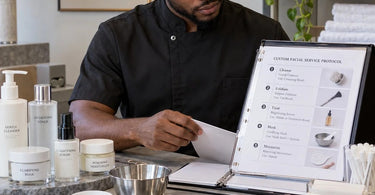
Pros trust this for consistent quality: if your service protocol says "apply cleanser" but doesn't mention the Mixing Bowls or the Facial Steamer you use to prep the skin, you're basically writing a recipe that says "add stuff and hope for the best." You know that moment when a new esthetician grabs the wrong Wax Spatulas during a Brazilian because nobody told them the protocol specifies the narrow ones for precision work? Yeah. That moment. The one where you silently mouth "nooooo" while maintaining a serene spa face. That moment is exactly why your service protocols need to name tools as well as products. It's not about being bossy. It's about being clear, consistent, and saving your sanity one treatment room at a time.
Here at Pure Spa Direct, we talk to spa and salon owners every single day. The ones who run the smoothest operations? They don't just have a protocol taped to the wall. They have protocols that read like a well-choreographed dance routine - every tool, every product, every step accounted for. The ones who spend their evenings fielding frantic texts about "which warmer do I use for the hard wax"? They've got protocols that are vague, outdated, or worse, living entirely in someone's head.
The "Where's the Thing?" Problem (And Why It's Costing You Money)
Picture this. You hire a new esthetician. She's talented, she's eager, she's got that spark. You hand her your service protocol for a signature facial. It says: "Cleanse, exfoliate, steam, extract, mask, moisturize." Great. Super helpful. Except now she's standing in your supply closet staring at three different cleansers, two exfoliants, a Facial Steamer she's never seen before, and a drawer full of tools that look like they belong in a sci-fi movie.
She grabs the wrong cleanser. She forgets to use the High Frequency Machine after extractions because it wasn't mentioned. She skips the Magnifying Light adjustment that would have helped her actually see the blackheads she was supposed to extract. The client leaves. She's happy. But you know that facial could have been twenty percent better with the right tools properly identified in the protocol.
Now multiply that by every new hire, every busy Saturday, every "I'm covering for someone who called in sick" shift. Vague protocols cost you time, money, and the kind of consistency that turns first-time clients into regulars.
Tools Are Products Too (Your Clients Just Don't Know It Yet)
Here's the thing nobody tells you when you're writing SOPs at eleven p.m. with a glass of wine and a growing sense of existential dread: tools and products are not separate categories in your client's mind. They're all part of the experience. When a client feels the smooth glide of a well-maintained Professional Wax Warmer set to the perfect temperature, they don't think "what a nice tool." They think "wow, this place knows what they're doing."
When they feel the gentle suction of a Ultrasonic Skin Scrubber during a facial, they don't ask about the equipment brand. They ask how much it costs to add that to their next appointment. Tools create sensations. Products create results. Together, they create the memory that makes someone rebook before they've even put their shoes back on.
If your protocol only mentions products, you're missing half the story. And your staff is missing half the instructions they need to deliver that story consistently.
The Waxing Example That Will Make You Nod (Or Cringe)
Let's talk about waxing. Because waxing is where vague protocols go to die. It's also where naming tools in your SOPs pays off faster than almost any other service.
Your protocol says: "Apply hard wax to bikini area. Remove. Apply post-wax oil."
Okay. Which hard wax? From which brand? Using which Professional Wax Spatulas and Applicators? At what temperature? With which Professional Wax Warmer? And after removal, do we use ItalWax - Pre/Post or the Pre & Post-Waxing Products from the other line?
Now imagine your protocol says: "Using the Professional Wax Warmer set to 65 degrees, apply a thin layer of ItalWax - Wax using the flat-edge Professional Wax Spatulas and Applicators. Allow to set for thirty seconds, then remove using a firm, parallel motion. Apply ItalWax - Pre/Post to soothe and protect the skin."
Which protocol would you rather hand a new hire? Which one would you rather follow yourself on a chaotic Saturday when your brain has already left for the weekend?
The tool-named version doesn't just tell your esthetician what to do. It tells them how to do it well. It connects the product to the equipment that makes it work. It removes the guesswork that leads to inconsistency, which leads to unhappy clients, which leads to you wondering why you didn't just become a cat groomer instead.
Naming Tools in Protocols Is Actually a Marketing Strategy (Surprise!)
Here's the sneaky part. When your protocols name tools, something magical happens at the front desk. Your staff starts talking about those tools. Not in a nerdy way, but in a "hey, this is what makes our service special" way.
A client asks about their glowing skin after a facial. Your esthetician says, "Oh, we used the Hydrodermabrasion system and finished with the LED Bright Lamps to calm any inflammation." The client doesn't know what half those words mean, but they know it sounds fancy and effective. They feel like they got the premium experience. They tell their friends.
Now compare that to: "We used some products and stuff." Yeah. That's not going to get you a five-star review.
Naming tools in your protocols gives your staff the language to talk about your services with confidence. It transforms "we did a facial" into "we performed a customized treatment using advanced technology designed to deliver results." Same service. Completely different perception.
The Training Benefit Nobody Talks About (But Every Owner Needs)
Training new employees is expensive. It takes time, patience, and a level of emotional fortitude you didn't know you had. And the number one reason training takes longer than it should? Your new hire keeps having to ask where things are and which tools to use.
When your protocol names tools, your training gets faster. A lot faster. Because your new esthetician isn't hunting around the supply closet wondering if the Cuticle Oil goes on before or after the Nail Files & Buffers. She's reading the protocol, seeing exactly what she needs, and executing with confidence.
Pure Spa Direct has everything you need to stock those protocols with the right tools. From Portable Massage Tables for on-location services to Towel Steamers that make every treatment feel more luxurious, we've built our catalog around what professionals actually use in real treatment rooms. Not what looks good in a catalog. What works.
Lash and Brow Protocols: The Precision Problem
Lash and brow services are where tool naming becomes absolutely non-negotiable. You cannot perform a Lash Lift & Perm with the wrong tools. You just can't. The entire service depends on precise instruments, correct products, and a protocol that leaves zero room for improvisation.
If your protocol says "apply lash lift solution," you're asking for trouble. Which solution? From which brand? Using which applicator? How long do you leave it on? What's the removal process?
Now imagine your protocol says: "Using the Lash Lift & Perm system, apply the lifting solution with the small silicone applicator included in the kit. Set the timer for eight minutes. Remove thoroughly with the provided remover solution and a clean Professional Cotton, Sponges, and Wipes pad. Then apply the setting solution using a fresh applicator."
That's not just a protocol. That's a recipe for consistent, beautiful results that keep your lash clients coming back every six weeks like clockwork.
And here's the bonus: when your protocol is that detailed, you can hand it to a newly certified lash artist and trust that she'll deliver the same results as your senior esthetician. That's scalability. That's how you grow a business without losing your mind.
Nail Services: Where Tools Are the Service
In nail services, the tools are so central to the experience that leaving them out of the protocol is almost comical. You can't do a Professional Gel Polish manicure without a Nail Brushes & Tools set. You can't shape a nail without Nail Files & Buffers. You can't create that stunning Nail Art Rhinestones design without the right applicators and curing equipment.
Yet so many nail protocols read like they were written by someone who has never actually done a manicure. "Prep the nail. Apply color. Cure." Thanks, Captain Obvious. That's not a protocol. That's a bumper sticker.
Your nail protocols should read like a love letter to precision. "After shaping with the 180-grit Nail Files & Buffers, push back cuticles using the stainless steel cuticle pusher. Apply Cuticle Oil and massage into the nail bed. Dehydrate the nail plate with the prep solution. Apply base coat using the flat brush from the Nail Brushes & Tools set. Cure under the LED lamp for thirty seconds."
That's a protocol your nail techs will actually use. That's a protocol that protects your investment in quality tools. That's a protocol that ensures every client gets the same beautiful, long-lasting result.
Massage Protocols: Comfort Is a Tool Too
Massage protocols have a unique challenge because the "tools" in a massage room are often things clients never see. The Massage Table Warmers & Toppers for Client Comfort that keep the table cozy. The Massage Bolsters that support the lower back during a prenatal massage. The Hot Stones and Warmers that turn a standard massage into a deeply therapeutic experience.
If your protocol says "perform a hot stone massage," you're leaving out about a dozen critical details. Which stones? At what temperature? In which warmer? How do you transition between stones and hands-on work? What's the cleanup process for the stones and the warmer?
A well-written massage protocol names every tool and explains its role. "Preheat the Hot Stones and Warmers to 130 degrees. Place the Massage Bolsters under the client's knees and ankles. Use the Massage Oils, Lotions, and Creams for Therapists to lubricate the skin before applying the first stone. Maintain contact with the client at all times, using the Massage Table Warmers & Toppers for Client Comfort to keep the client warm between stone applications."
That's not just a protocol. That's a blueprint for a service that clients will describe to their friends as "the most relaxing hour of my life."
Product-Specific Protocols: The Brand Consistency Factor
If you're using professional brands like ItalWax, Berodin, Cirepil, or Satin Smooth, your protocols should name the specific brand and product within that brand. Not just "hard wax," but "Berodin Blue Hard Wax." Not just "post-wax oil," but "ItalWax - Pre/Post Post-Wax Oil."
Why? Because different brands have different formulations, different application techniques, and different temperature requirements. A protocol that says "use hard wax" is useless if your esthetician grabs the wrong brand and applies it at the wrong temperature. The result? A waxing experience that's uncomfortable for the client and frustrating for you.
When your protocol names the brand and the specific product, you're protecting your client experience and your investment in quality supplies. You're also making it easier for your staff to understand why you chose those products in the first place. They're not just following instructions. They're understanding the reasoning behind them.
The Cleaning Protocol Connection (Because Tools Need Love Too)
Here's the part that nobody wants to think about but everybody needs to: cleaning and sanitation protocols also need to name tools. Not just the products you use to clean them, but the tools themselves.
If your protocol says "disinfect implements between clients," you're leaving out critical information. Which implements? With which Professional Cleaners & Disinfectants? For how long? Using which UV Sterilizers or soaking containers?
A proper sanitation protocol names every tool that needs attention. "After each client, remove all single-use items including Applicators & Spatulas and Compressed Sponges. Dispose of them immediately. Wipe down all hard surfaces with Professional Cleaners & Disinfectants. Submerge metal tools in EPA-approved disinfectant for the required contact time. Replace all linens with fresh High-Quality Towels and Salon & Spa Bedding. Replace Hygienic Table Paper for Waxing, Spa & Massage Tables before the next client."
That's not just a cleaning protocol. That's a liability shield. That's a client trust builder. That's the difference between a spa that passes inspection with flying colors and one that gets a surprise visit from the health department and a very uncomfortable conversation.
Making Your Protocols Actually User-Friendly
Here's the hard truth: a protocol that nobody reads is worse than no protocol at all. Because it gives you the illusion of consistency without the reality of it.
So how do you write protocols that your staff will actually use? A few tips from someone who has seen a lot of spa SOPs in her day:
Use bold text for tool names. When your esthetician scans the protocol, the tools jump out. She knows exactly what she needs to grab before she even finishes reading the sentence.
Include photos or diagrams. A picture of the Facial Steamers with a label pointing to the on/off switch and the temperature dial is worth a thousand words of description.
Organize by service flow. Don't just list tools randomly. Group them by the step in the service where they're used. Prep tools. Treatment tools. Finishing tools. Cleaning tools.
Keep it updated. If you switch from one brand of hard wax to another, update the protocol immediately. Don't wait for your staff to figure it out on their own. That's how you end up with a treatment room full of confused estheticians and a wax warmer set to the wrong temperature.
Make it accessible. A protocol that lives in a binder in your office is useless. Put it where your staff can see it. Laminate it. Hang it on the wall of the treatment room. Turn it into a digital checklist they can access on their phones.
The Bottom Line: Tools Are Part of the Story
Your service protocols are the story of how your spa or salon delivers results. They're the roadmap that takes a client from "I booked an appointment" to "I can't wait to come back." And every good story needs details. It needs specifics. It needs the names of the characters, the settings, and the props that make the whole thing come alive.
In your service protocols, your tools are the props. They're not interchangeable. They're not optional. They're essential to the experience you're creating. When you name them in your protocols, you're not just being thorough. You're giving your staff the tools they need to succeed. Literally.
So go through your protocols this week. Look at every service you offer. Ask yourself: does this tell my staff which tools to use, or does it just assume they'll figure it out? If it's the latter, it's time for an update.
Your staff will thank you. Your clients will notice the difference. And you'll finally stop getting those eleven p.m. texts asking which wax warmer to use for the hard wax. (It's the Professional Wax Warmers for Salons & Spas, by the way. The one with the temperature dial. Not the crockpot.)
At Pure Spa Direct, we're here to help you stock your treatment rooms with the tools that make your protocols shine. From Complete Waxing Kits for Salons & Spas to Advanced Spa Equipment for Professional Use, we've got what you need to deliver the services your clients love and the consistency your business depends on. Because when your protocols name the tools, your staff delivers the results. And that's a story worth telling.
)