
Get ahead with this smart buy. Let me guess: you bought that fancy wax warmer because it was on sale, or that facial steamer because it matched your treatment room aesthetic, and now it sits in the corner collecting dust while you wrestle with a unit that can't keep up with your Tuesday afternoon rush. Here's the thing nobody tells you when you're scrolling through equipment listings at 2 AM: your service volume should dictate your equipment capacity, not the other way around. It's like buying a two-seater sports car when you've got four kids and a golden retriever, technically functional, practically a nightmare. Let's fix that.
The math is simpler than you think. If you're booking eight ItalWax services a day, you don't need the same wax warmer as the salon down the street doing forty. If your facial room turns over every sixty minutes, a steamer with a thirty-minute heat-up time is basically a very expensive paperweight. Capacity planning isn't sexy, but neither is explaining to a client why they've been waiting twenty minutes for their brow wax because your single-well warmer is still melting. Let's break down how to match your equipment to your actual volume, so you stop bleeding money on gear that doesn't pull its weight.
Start With Your Booked Hours, Not Your Wishlist
Before you even think about clicking 'add to cart,' you need to know your real numbers. How many treatment rooms are you actually running? How many hours per day are those rooms occupied? A single treatment room operating eight hours with sixty-minute services can theoretically handle eight clients per day . That's your ceiling. Now look at your current bookings. If you're averaging five waxing appointments daily and each takes thirty minutes, you need a warmer that can handle back-to-back application without a meltdown, literally.
Here's where it gets practical. A double wax warmer like the Dermwax Premium Professional Double Wax Warmer lets you run two wax types simultaneously, so you're not stopping mid-service to swap out wells . If your volume is creeping toward fifteen waxing services daily, this isn't a luxury, it's basic math. You physically cannot maintain service flow with a single unit that needs to cool down and reheat between clients.
The Facial Steamer Trap (Or: Why Your 30-Minute Heat-Up Is Killing Your Schedule)
Facial steamers are notorious for this. You buy a beautiful unit that looks like it belongs in a magazine spread, then discover it takes thirty minutes to produce usable steam. Meanwhile your client is lying on the table wondering if you forgot about them. If you're running four facials a day, that's two hours of your life gone to waiting for steam. Two. Hours.
Look for steamers with quick heat-up times and sufficient runtime for back-to-back services . If your facial room turns over every forty-five minutes, your steamer needs to be ready in under ten and run for at least forty-five without refilling. A unit like the Spa Masters Professional Facial Steamer with Ozone is designed for exactly this rhythm, quick recovery, consistent output, no mid-service panic .
And please, for the love of all things holy, don't put your steamer next to your wax warmer. Steam softens wax. You will have a bad time .
Towels: The Silent Capacity Killer
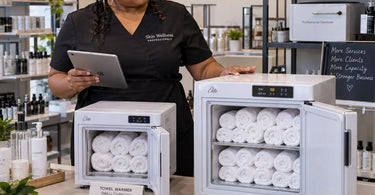
Nobody thinks about towels until they're out of towels. A Towel Steamer with a small capacity is fine if you're doing three massages a day. It's an absolute liability if you're running a full schedule of body treatments, facials, and pedicures, each one requiring hot towels at multiple points.
Do the math. One massage might use three to four towels. One facial might use two. A pedicure might use one or two. Multiply that by your daily service count and you'll see why a 180-towel capacity unit like the HANS Equipment Stainless Towel Steamer exists . It's not overkill, it's appropriate for a salon with real volume. A compact unit that holds twenty towels is perfect for a solo esthetician doing four facials a day. Match the unit to the load.
Room Turnover: The Number That Changes Everything
Your treatment room turnover time is the single most important metric for equipment planning. If you have forty-five minutes between clients to clean, reset, and prepare, your equipment needs to support that rhythm. If you have fifteen minutes, you need equipment that's already hot and ready before the next client walks in.
This is why Professional Wax Warmers with digital temperature control and quick recovery matter for high-volume waxing. Analog warmers that take forever to reach temperature and fluctuate wildly are fine for low-volume boutique settings. They're a disaster for a waxing studio booking every thirty minutes.
The same logic applies to High Frequency Machines, Microdermabrasion units, and anything else with a warm-up or cycle time. If the equipment's natural rhythm doesn't match your room turnover, you're fighting your own tools all day.
When Volume Justifies the Upgrade (And When It Absolutely Does Not)
Let's be brutally honest for a second. If you're doing three waxing services a day, you do not need a double wax warmer with digital precision and auto-stirring technology. That's like buying a commercial espresso machine to make one latte every morning. You'll hate cleaning it and it'll take up counter space you don't have.
But if you're at eight services and climbing? If you're turning away bookings because you can't physically fit them in? That's your signal. That's when a double warmer or a second unit becomes an investment, not an expense. The math is simple: every appointment you lose to slow equipment is money you're literally watching walk out the door.
For treatment tables, the same principle applies. A massage table with manual adjustments is perfectly fine for low-volume settings. But if you're doing six or more body treatments daily and your therapists are constantly cranking levers and repositioning clients manually, an electric table like the Aelita 5-Motor Electric Facial Table pays for itself in therapist sanity and saved time . Five motors mean you can adjust height, backrest, footrest, seat tilt, and overall tilt independently, which means faster setups, less physical strain, and happier staff.
The Hidden Cost of Undersized Equipment
Here's what nobody puts on the spec sheet: the emotional tax of working with equipment that can't keep up. The stress of explaining delays to clients. The physical exhaustion of manual adjustments. The mental load of constantly worrying about whether your warmer will die mid-service. That's real, and it compounds daily.
Equipment that's appropriately sized for your volume doesn't just perform better, it makes your entire operation feel smoother. Your staff moves faster. Your clients feel the difference. Your reviews improve because nobody's writing 'great service but had to wait twenty minutes for the steamer to heat up.'
And honestly? A salon that runs like a well-oiled machine is a salon that makes more money. Not because you're charging more, but because you're seeing more clients, losing fewer appointments to scheduling chaos, and keeping your team happy enough to stay.
How to Actually Do the Math (Without a Spreadsheet Headache)
Grab a pen. Write down your three busiest services by volume. For each one, answer: How many do I do per day on average? What's the equipment's warm-up time? How long can it run before needing a reset or refill? How long does it take to reset between clients?
Now multiply your daily service count by the equipment's cycle time. If that number exceeds the hours you're open, you have a capacity problem. For example, if you're doing ten waxing services daily and your warmer takes fifteen minutes to reach temperature and twenty minutes to recover between wax types, you're losing hours to waiting. A double warmer that eliminates the swap time fixes that .
A high-capacity towel steamer means you're not constantly refilling and reheating . A facial steamer with extended runtime means you're not pausing treatments to wait for the next round of steam .
The point isn't to buy the biggest, fanciest equipment. It's to buy equipment that disappears into your workflow because it just works, every time, without you thinking about it.
Your Equipment Should Be Invisible (In a Good Way)
The best equipment in your salon is the stuff you never think about. It's hot when you need it. It holds enough towels for the day. It doesn't require mid-service adjustments or apologies to clients. It just does its job, quietly and consistently.
That only happens when capacity matches volume. Not when you buy based on aesthetics, or price, or what some influencer said was 'the best.' When you buy based on what your actual bookings demand.
So before your next equipment purchase, do yourself a favor. Look at your calendar. Count your services. Do the simple math. Your future self, the one who isn't stressed out and apologizing to clients, will thank you.
And if you're not sure where to start, browse our Top-Quality Equipment & Furniture for Spas & Salons collection. We've got options for every volume level, from boutique solo artists to full-scale spas that never stop moving. Because the right equipment isn't about having the most, it's about having the right capacity for the work you actually do.
Now go book those appointments with confidence. Your warmer is ready.
)