
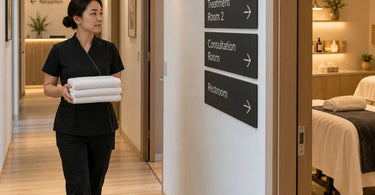
Upgrade client experiences now... starting with the spaces between your treatment rooms! Spa hallway signage might seem like a tiny detail compared with luxurious treatment beds, beautiful lighting, and perfectly folded towels, but those little signs can make a surprisingly big difference in how clients experience your business. A guest who cannot find the restroom, wanders toward the wrong treatment room, or accidentally walks into a staff-only area is not exactly having the relaxing spa day they imagined. And while a confused client might laugh it off, nobody really wants their facial appointment to include an unscheduled tour of the laundry closet.
For spa owners, salon managers, massage therapists, estheticians, and wellness professionals, hallway signage is much more than decoration. It is part of the client journey, a practical communication tool, and an often-overlooked element of professional facility management. Thoughtfully designed signs help guests move confidently through your space while allowing your team to focus on providing exceptional services instead of repeatedly answering the question, "Which way is the bathroom?"
Whether you operate a boutique day spa, a busy salon, a multiroom waxing studio, or a full-service wellness center, the right hallway signage can make your entire business feel more organized, welcoming, and polished.
Your Spa Experience Does Not Stop at the Treatment Room Door
Think about everything your clients encounter between checking in and receiving their treatments. They may walk from reception to a consultation room, change in a locker area, visit the restroom, or follow a hallway toward their appointment. Every transition creates an opportunity to reinforce the professional atmosphere you have worked so hard to establish.
A beautifully decorated treatment room cannot completely compensate for a confusing journey to reach it. Imagine a first-time guest receiving directions to the relaxation lounge, only to discover three identical doors and a hallway that branches in two directions. Suddenly, the relaxing music is competing with the internal panic of wondering whether they are about to interrupt somebody else's massage.
Clear signs eliminate much of that uncertainty. They communicate that your business has considered the guest experience beyond the actual treatment.
This same attention to detail should extend to your reception furniture, waiting areas, and treatment spaces. The entire environment should feel connected, intentional, and easy to navigate.
Why Clients Feel More Comfortable When They Know Where to Go
One of the most important functions of spa hallway signage is reducing the small moments of uncertainty that interrupt relaxation. Clients may be visiting your facility for the first time, preparing for an unfamiliar service, or simply trying to navigate while wearing a robe and slippers.
Even confident clients can feel awkward asking for directions multiple times. Some may hesitate to interrupt a busy receptionist or approach a treatment provider who appears occupied.
Simple, visible directional signs allow guests to locate important areas independently. Consider clear identification for restrooms, changing rooms, lockers, relaxation lounges, consultation rooms, and treatment areas.
For example, a sign indicating that the relaxation lounge is straight ahead can reassure clients that they are moving in the correct direction. A clearly marked restroom prevents unnecessary wandering. A treatment room number displayed consistently helps guests and staff confirm the correct location.
The goal is not to fill every hallway with instructions. It is to provide useful information exactly where someone needs it.
Good Hallway Signage Makes Your Staff More Efficient
Have you ever noticed how many times employees answer the same directional questions during a busy day? Where is the restroom? Which room is mine? Is this the changing area? Where should I wait?
Every question seems minor, but repeated interruptions can disrupt the flow of appointments, particularly in facilities with multiple treatment rooms or several service categories.
Strategically placed spa signage can help reduce unnecessary interruptions and support smoother movement throughout the building.
Imagine a busy afternoon when your esthetician is preparing a facial, your massage therapist is resetting a room, and your receptionist is checking in two clients. If guests can independently identify the restroom and relaxation area, employees have fewer routine directions to provide.
That leaves more attention available for preparing services, maintaining sanitation, answering treatment questions, and creating meaningful client interactions.
Of course, signs never replace friendly personal assistance. They simply reduce the need for staff members to act as human GPS systems throughout the day.
The Most Important Signs Every Spa Should Consider
Not every facility needs the same signage system. A compact waxing studio may require only a few strategically positioned signs, while a large spa with multiple wings may need a more extensive wayfinding plan.
However, several categories are especially useful for professional beauty and wellness environments.
Restroom signs: Make restrooms easy to locate from reception, treatment corridors, and relaxation areas. Clients should not need to open random doors to find them.
Treatment room identification: Use clear room numbers or names so guests and service providers can identify the correct spaces without confusion.
Changing room and locker signs: Properly identify changing areas and locker facilities to help clients move confidently through their appointments.
Relaxation lounge directions: Guide guests to waiting and relaxation spaces, especially when the lounge is located beyond the main reception area.
Staff-only signs: Clearly identify private workrooms, supply storage, laundry areas, and other spaces not intended for client access.
Quiet-zone reminders: Tasteful reminders can help maintain a peaceful environment near massage rooms, facial suites, and meditation areas.
Emergency and exit signage: Maintain all legally required exit identification, emergency information, and safety signage according to applicable regulations.
The most effective approach is to identify the decisions clients must make as they move through your facility and provide clear guidance at those points.
Make Your Signs Match the Atmosphere of Your Spa
Professional signage does not have to look like it was borrowed from an office building. In fact, hallway signs should complement the visual identity of your spa rather than interrupt it.
A minimalist wellness studio might favor matte finishes, understated lettering, and simple geometric shapes. A luxury day spa could incorporate brushed metal, soft neutrals, or elegant wall-mounted plaques. A bright modern salon may use bolder typography and carefully coordinated accent colors.
Whatever the style, readability must come before decoration. A beautiful sign that nobody can read is essentially expensive wall art.
Choose fonts that are clear at a glance. Maintain strong contrast between text and background. Avoid overly reflective surfaces that create glare under hallway lighting. Keep wording short and recognizable.
Consistency is equally important. If one treatment room has a sophisticated engraved plaque and the next has a handwritten label attached with tape, the experience can feel unfinished.
Coordinating signs with your luxury spa furniture, wall colors, and general interior design helps create a cohesive environment.
Accessibility Is More Important Than Aesthetic Preferences
One of the biggest mistakes spa operators can make is choosing signage based entirely on appearance without considering accessibility.
Clients have different visual, mobility, and communication needs. Effective signs should help as many people as possible navigate your facility comfortably and independently.
In the United States, applicable accessibility standards distinguish between signs identifying permanent rooms and spaces and signs providing directions or general information. Signs identifying permanent rooms, such as restrooms and numbered treatment rooms, generally require specific tactile and visual features, including raised characters and braille. Directional signs have different requirements and generally do not require tactile lettering.
Placement, character size, contrast, glare, and mounting location also matter. For applicable tactile signs, ADA standards establish a mounting range based on character baselines, rather than simply specifying a convenient eye-level position.
Business owners should review applicable federal, state, and local accessibility requirements before purchasing or installing permanent signs. A professional signage supplier familiar with accessibility standards can help identify appropriate specifications.
Remember that an elegant sign should never come at the expense of someone being able to use it.
Where You Place a Sign Matters Just as Much as What It Says
A sign can be beautifully designed, easy to read, and completely useless if it is installed where nobody notices it.
Consider the hallway from your client's perspective. Where do they naturally look when leaving reception? What happens when they reach an intersection? Can they see the restroom sign before passing the restroom?
Signs should appear before or at important decision points rather than after clients have already taken a wrong turn.
Directional signs are particularly useful at hallway intersections, entrances to different service areas, and transitions between public and private spaces.
Door identification should remain consistent throughout the facility. Avoid hiding signs behind open doors, decorative plants, storage carts, or other obstacles. Required accessibility signs must also follow applicable placement rules.
Lighting deserves attention, too. Soft spa lighting creates atmosphere, but extremely dim corridors can make signs difficult to read.
Review your LED lighting options and existing fixtures to maintain an inviting environment with sufficient visibility.
A practical test is to walk through the building as though you are visiting for the first time. If you have to stop and think about where to go, the signage may need improvement.
Protect Client Privacy With Thoughtful Room Labels
Spa environments involve personal services, private conversations, and areas where guests may be changing clothes or receiving treatments. Hallway signage can help maintain appropriate boundaries.
Clearly marked staff-only areas discourage accidental entry into preparation rooms, storage spaces, and employee facilities. Treatment room identification can reduce the likelihood of guests opening an occupied room while searching for their appointment.
Where appropriate, understated occupied indicators or staff-controlled room status systems can provide another layer of practical communication.
However, avoid placing sensitive client information, treatment details, or identifying appointment information on public hallway signs.
For example, a simple room number provides useful navigation without revealing who is inside or what treatment they are receiving.
These precautions are especially valuable in waxing studios, massage facilities, and other businesses where personal privacy is particularly important.
Professional treatment room organization should reinforce these boundaries. Properly arranged spa essentials, clean linens, and organized supplies help employees maintain orderly spaces behind the doors clients are directed toward.
Quiet-Zone Signs Can Reinforce a Peaceful Environment
Sound travels surprisingly well through spa hallways. A cheerful conversation outside a massage room can become the unexpected soundtrack to somebody else's relaxation session.
Thoughtful reminders can encourage softer voices without making guests feel reprimanded.
Instead of aggressive notices, consider warm language such as "Quiet Zone - Relaxation in Progress" or "Please Enjoy Our Peaceful Space."
The wording should reflect your spa's personality while communicating the expected behavior clearly.
These signs work particularly well near massage rooms, meditation areas, relaxation lounges, and other locations where maintaining a quiet atmosphere supports the service experience.
Pair signage with appropriate operational choices, including minimizing hallway conversations, managing equipment noise, and organizing the movement of treatment supplies.
Products such as salon and spa bedding and aromatherapy supplies can complement a comfortable treatment environment when used appropriately. Neither, however, replaces effective sound management or clear communication.
Signs Should Support a Smooth Workflow, Not Create Visual Clutter
More signage does not automatically mean better organization. If a hallway contains fifteen arrows, six decorative sayings, four promotional posters, and three different restroom symbols, clients may have trouble identifying the information they actually need.
Too much visual information creates unnecessary competition for attention.
Instead, prioritize a clear hierarchy. Essential navigation should be easiest to notice. Secondary information should remain visually quieter. Promotional displays should never obscure required safety signs or important directions.
Keep messages concise and avoid placing several unrelated instructions on the same sign.
A hallway intersection may need only a simple arrow directing guests toward treatment rooms and restrooms. Detailed service menus, retail promotions, and appointment information generally belong elsewhere.
Think of effective spa signage as a polite, discreet employee who always knows where everything is and never interrupts a facial to explain it.
How to Audit Your Existing Spa Hallway Signage
You do not necessarily need an expensive renovation to improve your facility's wayfinding. A simple walkthrough can reveal overlooked problems.
Step 1: Start at the entrance. Follow the route a new client would take from reception to each major service area. Notice where directions become unclear.
Step 2: Identify decision points. Look for hallway intersections, groups of identical doors, stairways, and areas where guests commonly stop to ask for directions.
Step 3: Review existing signs. Check whether labels are accurate, readable, consistently designed, securely installed, and appropriately located.
Step 4: Check accessibility and safety. Review applicable signage requirements, including tactile room identification, visual readability, required safety signs, and unobstructed routes.
Step 5: Ask your staff. Receptionists, massage therapists, estheticians, nail technicians, and other employees often know exactly where guests become confused.
Step 6: Observe recurring questions. Track which directions your staff members repeat most frequently. Those questions may reveal where a new sign would be most helpful.
Step 7: Make improvements and test again. Install or update signs, then walk the same routes to see whether navigation has become more intuitive.
Even small improvements, such as consistent room numbers or a properly positioned restroom sign, can create noticeable operational benefits.
Do Not Forget Maintenance and Future Changes
Signage should be included in routine facility inspections rather than treated as a one-time decorating project.
Check for peeling labels, loose mounting hardware, faded lettering, scratched finishes, and outdated directions. Clean signs using methods appropriate for their materials, particularly in spaces where fingerprints and product residue may accumulate.
Coordinate regular cleaning with your existing inventory of professional cleaners and disinfectants, following manufacturer instructions and ensuring compatibility with sign surfaces.
Any change in room function should trigger a signage review. If a consultation room becomes a treatment suite or a storage area becomes a staff lounge, update the identifying signs accordingly.
Temporary signs may be necessary during renovations, but they should not create confusion or interfere with required permanent signage.
And please, retire the curling paper arrow taped to the wall six months ago. It served its purpose. It deserves a peaceful retirement.
Small Signage Improvements Can Support a More Professional Business
For spa owners managing tight schedules, staffing needs, and operating expenses, hallway signs may not appear near the top of the priority list. Yet the cost of overlooking navigation can show up through repeated staff interruptions, awkward guest experiences, and an environment that feels less organized than it should.
Better signage does not guarantee more bookings or higher revenue. What it can do is remove unnecessary friction from the client journey and demonstrate attention to details that guests may notice even when they cannot explain exactly why a space feels comfortable.
A thoughtful facility improvement plan should consider the full environment, from hallway navigation to professional spa equipment and furniture, treatment preparation areas, and reception organization.
At Pure Spa Direct, we understand that professional spa and salon operations depend on countless small details working together. As a distributor of professional beauty, spa, salon, and wellness supplies, we help businesses source the equipment, furnishings, treatment essentials, and operational products that support well-organized service environments.
Frequently Asked Questions About Spa Hallway Signage
Why is hallway signage important in a spa?
Hallway signage helps clients find treatment rooms, restrooms, changing areas, and relaxation spaces. It can reduce confusion, support efficient staff workflows, reinforce privacy boundaries, and contribute to a more professional client experience.
What signs should a small spa have?
Needs vary by layout, but commonly useful signs include restroom identification, treatment room labels, changing room directions, staff-only notices, and appropriate safety signage. Required accessibility and emergency signs must also be addressed.
Should spa hallway signs match the interior design?
Yes. Coordinating signage materials, typography, and colors with the surrounding decor can create a cohesive appearance. Readability, accessibility, and clear communication should always take priority over purely decorative choices.
Do spa treatment room signs need braille?
In the United States, signs identifying permanent rooms and spaces generally must satisfy applicable accessibility requirements, which include tactile features such as raised characters and braille. Specific requirements depend on the sign's purpose and applicable regulations. Consult a qualified signage professional when determining compliance.
Where should directional signs be placed?
Place signs where guests must make navigation decisions, including hallway intersections and entrances to distinct service areas. They should be visible before clients pass the location or turn they need.
How often should spa signage be updated?
Review signs during regular facility inspections and whenever room functions, layouts, or traffic patterns change. Replace damaged, unclear, or outdated signs promptly.
Give Every Client a Clear Path to Relaxation
Beautiful treatments deserve a beautiful experience from beginning to end. That includes the moments when clients are walking through your hallways, searching for their next destination, or quietly finding their way back to reception.
Clear, attractive, accessible spa hallway signage helps transform those transitions into a seamless part of the visit. It supports client confidence, encourages privacy, makes staff communication more efficient, and reinforces the professional atmosphere you want guests to remember.
The next time you review your spa environment, look beyond your treatment beds and retail displays. Walk your hallways with fresh eyes. Your next meaningful client experience improvement might be a small sign that has been missing all along.
And for the professional products, furnishings, treatment supplies, and everyday essentials that help keep your spa or salon running beautifully, explore the extensive selection of Must-Have Supplies for Salon & Spa Business Success available through Pure Spa Direct.
Because relaxation should begin the moment clients walk through your doors, not after they finally figure out which door to open.
