
Clients notice the upgrade. They notice the fluffy robe, the crisp sheet, and the overall vibe of cleanliness. But what happens when that white, fluffy cloud of a robe comes back from the laundry, looking a little worse for wear? It's not just about tossing it back on the rack. There is a critical step that separates a good spa from a great one: a separate inspection before that robe ever touches a client's skin. While the rush of a busy day might tempt you to skip this, treating every returned spa robe like a potential biohazard is not paranoia; it is the hallmark of professionalism. Think of it as a spa's version of airport security. You wouldn't let someone board a plane without a ticket, so why would you let a robe touch a client without a thorough look-over? Let us unpack why this is the most important 60 seconds of your robe's life cycle.
First things first: why are we even talking about this? Imagine you are a client. You have just had an incredible Massage and you are feeling like a piece of human pudding. You slip on a robe, and it smells faintly of, well, not laundry. Or worse, it has a mysterious stain from a previous client. Your experience just went from five-star to zero-star faster than you can say 'refund.' A separate inspection is the first line of defense against this nightmare scenario. It is about ensuring that what you are handing over is as perfect as the service you just provided. It is about protecting the client's experience, but it is also about protecting your professional reputation.
The Hidden Horrors Lurking in the Linen Pile
Okay, maybe 'horrors' is a bit dramatic. But let us be real, the daily grind is tough on spa linens. From massage oils and lotions to waxing residue and chemical peels, your robes see it all. We are talking about a war zone of beauty products. Just like you need to maintain a high standard of cleanliness, your linens need that same level of scrutiny. The guest who wore that robe before might have had a thick layer of self-tanner, a potent essential oil, or a stubborn wax treatment that just didn't come out in the wash. If you send that robe back out, you are not just sending a dirty garment; you are potentially exposing the next client to skin irritants, staining their clothes, or even risking cross-contamination. According to state regulations for cosmetology and barbering, used linens like robes must be deposited in a closed container and cannot be reused until properly laundered and sanitized . But the rulebook only goes so far; the rest is up to your eagle-eyed inspection.
Think about the components of the robe itself. Beyond the fabric, we have belts, snaps, zippers, and pockets. The inspection is not just about whether the fabric is clean; it is about the integrity of the garment. Is the belt frayed? Are the snaps loose? A broken zipper mid-service is not just an inconvenience; it is an invitation for awkwardness. You need to be checking for these structural failures just as much as you are checking for stains. The goal is to ensure the robe is not just sanitary, but also fully functional and flattering.
The Inspection: A Four-Step Survival Guide for Your Robes
So, what does a proper, separate inspection look like in practice? It is not a secret ritual. It is a systematic process that should become a habit for your team. Think of it as a four-step dance, and everyone should know the moves.
1. The Visual Check (The 'What on Earth Is That?' Scan)
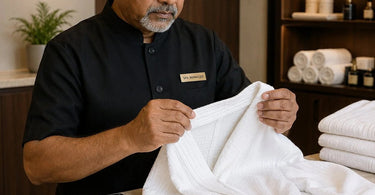
This is where the journey begins. Under good lighting, inspect the robe inside and out. Look for stains of any kind, but especially the stubborn ones: oil-based massage creams, wax drips, or color treatments. If a stain is visible, it is a no-go. There is no way around it. According to textile inspection standards, this check includes looking for color fastness, stains, and overall fabric condition . If the robe looks tired, faded, or has a weird texture, it needs to be retired. We are not in the business of making our clients feel like they are wearing a dishrag.
2. The Sniff Test (The Nose Knows)
Sometimes a robe will look clean but smell... musty. Or like a faint memory of essential oils. This means the linen was not dried properly or was stored while still damp. Linens should be washed on hot and dried until "hot to the touch" to ensure proper sanitation . A musty smell is a red flag. A robe that smells like last week's lavender and eucalyptus blend might have its own vibe, but it is not the vibe we are going for. If it doesn't smell like fresh laundry, it is out.
3. The Functionality Check (The 'Will This Robe Betray Me?' Test)
Time to get physical. Hold the robe up and give the seams a gentle tug. Are they tight? Are there any loose threads? This is where you check for the hidden damage that could unravel during use. A good seam is the difference between a robe that lasts and a robe that becomes a cape in the middle of a client's walk to the relaxation lounge. Check the belt loops and the belts themselves. A missing belt is a recipe for awkward client moments. If a belt is frayed or the loops are ripped, retire it. We are selling comfort and luxury, not a wardrobe malfunction waiting to happen.
4. The 'Last Chance' Quality Control (The Final Sanity Check)
This is the final step before the robe goes back into rotation. Is the robe perfectly folded? Does it look inviting? Is there any lint or fuzz? This is about the presentation. A robe that is tossed in a cupboard looks like you don't care. A robe that is neatly folded, perhaps with a little ribbon or a sprig of eucalyptus, screams professionalism. It shows the client you took the time to make sure everything was perfect.
The 'Separate' Part: Why It's a Game Changer
You might be thinking, "Can't I just check the robe as I am putting it away?" No. The separate inspection is about focus. When you are in the middle of a whirlwind of laundry and trying to flip a room, you are rushing. That is when mistakes happen. By having a dedicated step—or even a dedicated person—for robe inspection, you create a buffer zone. It allows for quality control without the pressure of the ticking clock. It ensures that every single robe meets a consistent standard. This is the difference between being busy and being excellent. According to guidance on linen maintenance, regular inspections for signs of wear and tear are essential for sustaining the luxury experience .
Additionally, having a separate process for inspection helps with inventory management. If you are regularly finding flaws in your robes, it might be time to upgrade your linen quality. It could also indicate that your washing process needs tweaking. For instance, if you are using harsh chemicals that are breaking down the fibers, you might need to switch to a gentler detergent. Separate inspection allows you to track these patterns and make data-driven decisions about your supplies.
The Cost of Skipping the Inspection
We know you are busy. We know the laundry pile is never-ending. But skipping the inspection is a false economy. The cost of replacing a robe that is damaged by a client is one thing, but the cost of losing a client because of a bad experience is a whole different beast. A client who remembers the time they put on a damp or stained robe will likely not come back. They will also tell their friends about their bad experience. In the age of social media, one bad review can impact your business far more than the cost of a few extra minutes of staff time for proper inspection.
Let's look at the specifics from an industry standards perspective. Professional textile testing includes evaluating for chemical safety like pH levels and formaldehyde, as well as colorfastness . While you are not running a lab in your back room, your inspection should catch the visible failures that would indicate a deeper issue. If a robe is bleeding color, it's not just a problem for your laundry; it is a sign the dye was not properly set, which could be a chemical irritant. A separate inspection catches those warning signs before they become a client problem.
The Tools of the Trade for Your Inspection Arsenal
Your team needs the right tools to do a proper inspection. A well-lit area is non-negotiable. A magnifying glass can be helpful for checking for tiny snags or loose threads, especially on delicate fabrics like microfiber. You might also want to have a dedicated bin for robes that are a 'maybe'—the ones that have a small stain you think might come out with a spot treatment, or a loose button that needs sewing. This keeps them out of circulation until they are fully repaired or cleaned. Speaking of which, a good stain remover and a sewing kit are essentials for your spa's back-of-house. Products like professional cleaners and disinfectants are your best friends in this process.
Also, consider the lifecycle of your robes. Even with impeccable care, they do not last forever. High-quality terry cotton robes, for instance, can face issues like loss of shape or reduced absorbency over time . When a robe starts to look a bit worn around the edges, it might be time to retire it to a less visible role—like a cleaning rag—and bring in some fresh faces. And if you find that your robes are wearing out too quickly, it might be worth looking at a higher quality range. For example, a microfiber robe might dry faster and resist wrinkles better than a heavy cotton one, which is a huge advantage in a busy spa environment .
Wrapping It Up (Pun Intended!)
Your spa robe is more than just a piece of clothing. It is the first hug a client gets after a treatment. It is a symbol of luxury, comfort, and cleanliness. By implementing a strict, separate inspection process, you are telling the world that you care about every single detail of the client experience. It might be tempting to skip it, but the time invested is a direct investment in your reputation. So, set up your station, train your team, and turn that inspection into a ritual of excellence. After all, a fluffy, clean robe is not just a garment; it is a promise of the experience that is yet to come. And if you are looking for more ways to enhance your client experience, remember that the little touches often make the biggest impact.
