
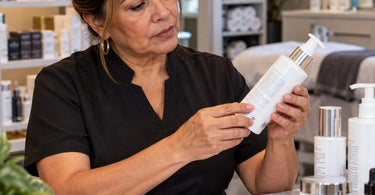
Take your results to the next level... not by buying another fancy gadget or rearranging your retail shelves (though we're all guilty of that Sunday night shelf-restock therapy session, aren't we?). The secret to transforming your team from "good enough" to absolutely unstoppable might be hiding in plain sight, right there on the back of every product bottle in your treatment room. Yes, we're talking about the humble, often-ignored, squint-worthy product label.
Here's the thing: your staff probably knows how to use products. They know the massage oils from the Massage Oils, Lotions, and Creams for Therapists collection that glide like butter. They know which wax from our Waxing Supplies for Professionals section behaves beautifully at 2 PM on a busy Saturday. But do they know why? Do they know what's actually inside those products, what those ingredients do, and how to explain it to a curious client who's been Googling things at 2 AM?
Spoiler alert: probably not. And that's a massive missed opportunity. Let's fix that together, shall we?
The Label Is Not Just Decoration (Sorry to Burst Your Bubble)
Think of the product label as the product's dating profile. The front is all glossy photos and flirty promises. "Hydrating!" "Anti-Aging!" "Professional Strength!" It's designed to make you swipe right on your credit card. But the back? The back is where the real truth lives. The ingredient list, the directions, the warnings, the manufacturer information, the shelf life, the net weight. That's the actual personality of the product, flaws and all.
For spa and salon professionals, being able to read that back panel fluently isn't just a nice bonus skill. It's the difference between being a service provider and being a trusted expert. And trust? That's the currency that builds loyal clients and increases retail sales faster than you can say "Would you like to take home the serum you loved today?"
When your staff can confidently explain that the hyaluronic acid in a facial serum is there to hold up to 1,000 times its weight in water, or that the dimethicone in a finishing product is what gives that silky, slip-slide finish, they transform from button-pushers into educators. And clients love educators. They tip them better, rebook faster, and tell their friends.
Client Safety: The Non-Negotiable Reason (Yes, We Have to Go There)
Look, we all want to have fun and keep things light. But there's a serious side to this label-reading business, and ignoring it isn't just bad for business. It's potentially dangerous.
In the professional beauty and wellness world, you're not just applying pretty-smelling lotions. You're working with chemicals that, under certain conditions or in certain combinations, can cause real harm. The hair smoothing product scandal that made headlines years ago is a perfect example. Products labeled "formaldehyde-free" were found to actually release formaldehyde when heated during treatments, exposing stylists and clients to a known carcinogen. OSHA issued citations and fines to salons that didn't know what they were working with .
That's terrifying, right? And completely avoidable with proper label education.
When your staff knows how to read labels, they know to look for chemical names that might be hiding behind innocent-sounding terms. They know that "fragrance" could mean any number of undisclosed components that might trigger a client's allergy. They know that the Professional Cleaners & Disinfectants for Salons and Spas they use on surfaces need proper dilution and ventilation, not just a glug-glug into a spray bottle.
Reading labels isn't paranoia. It's professionalism. It's protecting your team, your clients, and your livelihood.
What Your Staff Should Actually Look For (A Cheat Sheet)
Let's get practical. Here's what a label-literate staff member scans for, in order, every single time:
1. The Ingredient List: It's in Order for a Reason
Ingredients are listed in descending order of concentration. The first five ingredients make up the bulk of the formula. If your Premium Skincare Products for Spas and Salons lists water first and the fancy "active" ingredient dead last, that active is basically a garnish. It's there for the label, not for results.
Teach your team to look for the star ingredients in the top five. If they're using a Vitamin C Serum for brightening, they want to see ascorbic acid or a stable derivative like sodium ascorbyl phosphate high on the list.
2. Active vs. Functional Ingredients
Actives do the work. Functional ingredients make the product usable and pleasant. Both matter, but for different reasons. A client might ask, "Why is there alcohol in this?" Your team should know that cetyl alcohol (a fatty alcohol) is a moisturizing emollient, completely different from denatured alcohol (a drying solvent). Same word, vastly different jobs.
3. Warnings and Contraindications
Every professional product has them. "Do not use on broken skin." "Patch test before use." "Avoid contact with eyes." These aren't suggestions. They're instructions. A staff member who knows the contraindications for a chemical peel or a lash tint from our Professional Lash and Brow Tint for Spas & Salons is a staff member who won't accidentally cause a chemical burn or an allergic reaction.
4. Shelf Life and Storage
The Period After Opening (PAO) symbol looks like a tiny open jar with a number and "M" on it. That number tells you how many months the product is good for once opened. A 12M on your Massage Lotion means toss it after a year. Products stored in direct sunlight or near heat sources can degrade faster. Knowing this prevents your team from using expired or compromised products on paying clients. Nobody wants a facial with rancid oil. Trust me.
Turning Label Knowledge into Retail Gold
Here's where it gets fun. When your staff genuinely understands product labels, retail sales stop feeling like pushing product and start feeling like offering solutions.
Imagine this: A client finishes a Hydrodermabrasion treatment and their skin is glowing like they've been kissed by a benevolent angel. Your aesthetician says, "You know, the serum we used today has hyaluronic acid as the second ingredient. That's what's giving you that plump, hydrated look right now. If you want to maintain this at home, here's a retail option that has the same star ingredient."
That's not selling. That's educating. That's serving. And clients say yes to that all day long.
Contrast that with: "You should buy this moisturizer. It's great." One builds trust and authority. The other sounds like a sales pitch from someone who might not know what they're talking about.
Making Label Training Stick (Without Boring Your Team to Tears)
You don't need a three-hour seminar with a PowerPoint and stale donuts. Though, honestly, donuts help with everything.
Try these simple strategies:
Label of the Week: Pick one product from your back bar and challenge your team to find three key facts about it. What's the active ingredient? What's the shelf life? What's one contraindication? Share findings at your morning huddle. Five minutes. Done.
Client Question Role-Play: Have team members practice answering common client questions using the label as their reference. "What's the difference between this Sugar Scrub and the Salt Scrub?" "Let's look at the label together!"
New Product Breakdown: Whenever you bring in a new item, like a new line of Cuticle Oil or a Professional Sunless Tanning Product, do a quick five-minute team review of the label before it hits the floor. What are we looking at? What should we watch out for? Who is this best for?
The Bad Example Game: Find a label with a sneaky claim or a poorly disclosed ingredient and see who can spot the issue first. Turn it into a friendly competition. Bragging rights included.
It's Not Just About Products You Sell
Remember, label reading applies to everything in your space. The Professional Cleaners & Disinfectants you use to sanitize your Portable Massage Tables. The chemicals in your nail stations from the Professional Nail Care Collections. Even the storage conditions for your ItalWax - Wax matter. If the label says keep out of direct sunlight and store below 85 degrees, that's not a suggestion. That's a survival instruction for your product investment.
And let's not forget the products you use for treatments like Microdermabrasion or Dermaplaning. Knowing exactly what's in the solutions and lubricants you're applying to your client's freshly exfoliated skin is non-negotiable.
The Bottom Line (Because You're Busy and I Get It)
Staff training that includes product label reading isn't a chore. It's an investment in expertise. It protects your team and clients. It elevates your consultations. It makes retail feel natural. And it positions your salon or spa as a place where knowledge is just as important as a killer blowout or a flawless facial.
Plus, there's something deeply satisfying about watching a client's eyes light up when your team member explains, with genuine confidence, exactly why the product you're recommending will solve their problem. That moment? That's not just a sale. That's a relationship. And relationships are what keep this industry beautiful.
So go on. Grab a product from your back bar. Flip it over. Read the fine print. And then teach someone else to do the same. Your future self, your team, and your clients will thank you.
P.S. If you need some fresh labels to practice on, you know where to find us. We've got thousands of professional products waiting to spill their secrets. Happy reading, gorgeous!
)