
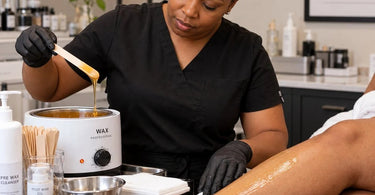
Put your best work forward... even when your wax seems determined to freeze halfway through the appointment! You load your spatula, apply a beautiful strip of professional hard wax, and suddenly it sets faster than your client can finish telling you about her weekend. Meanwhile, the exact same wax behaves perfectly on another body area. If you have ever wondered why wax cools too fast on some body areas, you are definitely not imagining things. Differences in skin temperature, body contours, room conditions, application thickness, and wax formulation can all affect how quickly wax loses heat and becomes ready for removal.
For professional estheticians and waxing specialists, understanding these differences is about more than avoiding an awkward wrestling match with a stubborn wax strip. It helps improve application control, reduce unnecessary product waste, support client comfort, and keep appointments moving smoothly. The trick is learning which variables actually matter and making small, thoughtful adjustments instead of automatically turning up the warmer.
Why Does Wax Cool Faster on Certain Body Areas?
Wax begins losing heat as soon as it leaves the warmer. Once applied, heat transfers from the wax into the skin and surrounding environment. The rate at which the wax cools depends on several factors, including the temperature difference between the wax and skin, the amount of product applied, the exposed surface area, and the formulation of the wax itself.
Here is where things get interesting. The human body does not maintain one perfectly uniform skin temperature from head to toe. Surface temperature varies with circulation, ambient conditions, clothing, recent activity, and individual physiology. Even two neighboring areas can feel noticeably different during the same appointment.
For a waxing professional, this means the same product can behave differently on a lower leg, underarm, abdomen, or bikini line. A technique that works beautifully in one location may need a slight adjustment elsewhere.
It is also important to distinguish between wax cooling and wax setting. Cooling describes a temperature change, while setting describes the wax becoming firm enough for removal. Those processes are related, but different wax formulas can reach their ideal removal consistency at different rates.
1. Skin Temperature Changes How Quickly Wax Sets
One of the biggest contributors to inconsistent wax setting is the temperature of the skin beneath the application.
Areas with cooler skin can draw heat away from freshly applied wax more rapidly because of the larger temperature difference. However, the actual result also depends on the skin and underlying tissue, wax thickness, and surrounding air. Cooler skin does not automatically guarantee the fastest setting time in every situation.
For example, a client who arrives wearing shorts on a chilly morning may have noticeably cooler lower legs than someone who has been sitting comfortably under a blanket. Applying the same hard wax to both clients may produce different working times.
Body areas that may require closer attention include:
- Lower legs and ankles: Exposed skin can feel relatively cool, particularly in air-conditioned treatment rooms.
- Forearms: Skin temperature can vary with the room environment and recent exposure.
- Abdomen: Surface temperature may differ across the treatment area, especially when clothing has recently been removed.
- Underarms: Skin folds, moisture, and local warmth can create different application conditions than flatter areas.
- Bikini area: Skin folds, surrounding clothing, and individual temperature differences may influence working time.
The professional solution is not to assume that every body part follows a universal temperature chart. Instead, observe how your chosen wax responds to the actual treatment area and adjust application size accordingly.
2. Thin Wax Applications Lose Heat Faster
Application thickness is another major reason wax appears to cool almost immediately on certain parts of the body.
A thin layer of wax contains less thermal mass than a thicker application. It can therefore lose heat and change consistency more quickly. This becomes especially noticeable when a technician stretches a small amount of hard wax over a large surface.
Imagine spreading a tiny amount of frosting across an entire birthday cake. Eventually, you have more exposed cake than frosting, and nobody is particularly happy. Hard wax can create a similar problem when applied too thinly.
For stripless hard wax, apply an even layer at the thickness recommended by the manufacturer, with a suitable removal edge or tab. Different formulations have different optimal application thicknesses, so there is no single measurement that works for every professional wax.
Soft wax requires a different approach. Soft strip wax is generally designed for a thinner application and removal with a strip. Do not apply hard wax thickness recommendations to soft wax.
If your hard wax repeatedly becomes brittle or difficult to remove before you can establish a proper lifting edge, examine your application thickness before assuming the warmer is malfunctioning.
3. Body Contours Affect Wax Application and Cooling
Flat surfaces and curved body areas present different challenges for waxing professionals.
On a relatively flat area, it may be easier to maintain consistent pressure and create an even wax layer. On curved surfaces, the spatula angle naturally changes, which can produce sections that are thicker or thinner than intended.
Consider the difference between waxing a broad section of the thigh and navigating around the ankle. The ankle has tighter curves and bony contours, making it easier to accidentally spread wax too thinly over raised areas.
The same issue can occur around knees, elbows, and other irregular surfaces.
When the application thickness varies, the thinner sections may set before the thicker sections. This can produce a strip that feels ready in one spot but remains flexible in another.
Instead of attempting one enormous application, divide complex areas into smaller sections. Use controlled spatula pressure, support the skin appropriately, and follow the wax manufacturer's application and removal directions.
Professional wax spatulas and applicators in different sizes can make navigating these contours easier. A smaller spatula may provide better control around narrow or curved areas, while a larger applicator may be more practical for broader sections.
4. Air Conditioning and Airflow Can Change Your Working Time
Your treatment room may be perfectly comfortable for clients while secretly plotting against your waxing technique.
Air conditioning, ceiling fans, portable fans, and direct airflow can increase heat loss from the surface of freshly applied wax. This is especially noticeable when a thin layer has a large surface area exposed to moving air.
Picture an esthetician waxing a client's lower legs directly beneath an air-conditioning vent. The wax may develop a firm surface sooner than expected, particularly when compared with an area sheltered from the airflow.
Before adjusting your warmer, take a look at the room itself.
- Check whether conditioned air blows directly across the treatment table.
- Notice whether wax behaves differently in certain treatment rooms.
- Avoid placing fans where they create unnecessary airflow over freshly applied wax.
- Maintain a comfortable, reasonably consistent room temperature.
- Record recurring environmental issues so the team can troubleshoot them consistently.
The goal is not to make the treatment room uncomfortably warm. It is to create stable conditions that allow both the client and the products to perform as intended.
5. Your Wax Formulation Matters More Than You Think
Not all professional waxes have the same working time, flexibility, or setting characteristics.
Hard wax formulas may use different blends of resins, synthetic polymers, waxes, and other ingredients. These differences affect application viscosity, elasticity, setting behavior, and removal characteristics.
Some hard wax formulas are designed for relatively quick setting and efficient service on smaller areas. Others offer a longer working window or remain more flexible during removal.
That means a fast-setting formula that performs wonderfully during underarm waxing might feel less forgiving when an inexperienced technician attempts an oversized application on the leg.
Professional wax collections worth comparing include ItalWax, Berodin, Cirepil, Starpil, and Waxness.
These collections provide options for professionals exploring different formulations, but individual products must be evaluated according to their own instructions. Do not assume every wax from one brand has the same setting speed or ideal temperature.
When choosing a formula, consider your preferred service areas, average application size, technician experience, and the manufacturer's recommended working conditions.
6. Warmer Temperature and Wax Consistency Can Create Confusion
When wax starts setting too quickly, the immediate temptation is to increase the warmer temperature. Resist the urge to turn that dial into a game-show buzzer.
Increasing temperature can sometimes lengthen the working time of a particular formula, but it also increases the risk of applying excessively hot wax. Warmer settings should never be used simply to overpower unsuitable application technique or environmental conditions.
Start by checking whether your professional wax warmer is maintaining the manufacturer's specified operating temperature.
A thermostat setting does not necessarily represent the precise temperature of the wax throughout the container. Temperature can vary depending on the warmer design, wax quantity, heating cycle, and whether the product has been mixed appropriately.
Follow the wax and warmer instructions, allow adequate melting time, and check for a uniform consistency. Where appropriate, use a suitable thermometer to verify the wax temperature and perform the manufacturer's recommended safety test before application.
Never rely on appearance alone to determine whether wax is safe for the skin. Wax that looks wonderfully smooth can still be dangerously hot.
If the product is already at its recommended working temperature, explore application thickness, section size, skin condition, and room airflow before changing the heat setting.
7. Moisture, Oil, and Skin Preparation Affect Wax Performance
Sometimes what appears to be an unusually fast cooling problem is actually an adhesion or removal problem.
Excess moisture, sweat, lotion residue, or inappropriate product application may prevent wax from gripping hair as expected. The wax may seem to set quickly but fail to remove hair efficiently, leaving the technician wondering whether it became too cold.
This distinction matters because a wax adhesion issue requires a different solution than a genuine temperature problem.
Prepare each treatment area according to the wax manufacturer's instructions. Appropriate pre- and post-waxing products can support a consistent service routine, but they must be compatible with the wax system being used.
For example, some hard wax systems permit a very light application of pre-wax oil, while others specify different skin preparation requirements. Adding too much oil can interfere with adhesion.
If moisture is a concern, follow the manufacturer's guidance on drying the treatment area and whether a compatible pre-wax powder is appropriate. Avoid excessive powder and unnecessary layering of products.
Clean, properly prepared skin gives the wax a more predictable surface to work with. And predictable is a beautiful word when your appointment book is completely full.
8. Application Speed and Strip Size Influence Results
Application speed matters, but working faster is not always the best answer.
If a technician spends too long repeatedly smoothing and reshaping a hard wax application, the first section may begin setting before the entire strip has been completed. Continuing to manipulate wax that is already firming can create uneven edges and inconsistent thickness.
For areas where the product has a short working window, smaller applications often provide better control. The technician can apply the wax efficiently, allow it to reach the correct removal consistency, and remove it using proper technique.
Use the following practical approach:
- Work in manageable sections: Choose a strip size appropriate for the body contour and the product's working time.
- Maintain consistent pressure: Avoid accidentally thinning the wax along the middle or edges.
- Create a proper removal edge: Follow the specific hard wax instructions for forming a lifting tab.
- Limit unnecessary passes: Repeatedly manipulating a setting strip can interfere with a clean application.
- Remove at the correct stage: Hard wax should be firm enough to lift according to the manufacturer's directions while retaining the flexibility required for safe removal.
Practice these techniques during training rather than experimenting with a rushed client appointment. A few minutes of controlled practice can prevent many frustrating service interruptions.
9. Different Body Areas May Need Different Waxing Strategies
One of the easiest ways to improve consistency is to stop treating every body area exactly the same.
Lower legs: Check for cool skin and direct air-conditioning exposure. Use applications that fit the working time of the wax and avoid spreading hard wax excessively thin.
Knees and ankles: Focus on controlled, smaller applications that accommodate curves and bony contours. Watch for uneven thickness.
Underarms: Pay attention to moisture, hair growth patterns, and skin positioning. Use appropriately sized applications and maintain proper skin support.
Bikini area: Work in carefully controlled sections, respect skin sensitivity, and select a formula intended for the service. Never compensate for difficult removal by applying unsafe heat.
Arms: Monitor application consistency on long, narrow surfaces. Cool room conditions and thin applications may shorten the working window.
Abdomen: Assess the skin condition and contour before applying wax. Smaller sections may make it easier to maintain even thickness and proper removal control.
These are practical considerations rather than rigid rules. The correct approach depends on the product, client, and service being performed.
10. How to Troubleshoot Hard Wax That Sets Too Quickly
If your hard wax consistently becomes firm before you expect it to, use a systematic troubleshooting process rather than making several changes at once.
Step 1: Verify the wax formula. Confirm that the product is appropriate for the service and that its recommended application thickness and setting characteristics match your technique.
Step 2: Check the warmer. Make sure the wax is fully melted, uniformly mixed when directed, and within the manufacturer's specified working range.
Step 3: Examine the application. Look for excessive thinning, unusually large sections, inconsistent spatula pressure, or unnecessary reworking.
Step 4: Assess the environment. Identify direct airflow, unusually cool room conditions, or significant differences between treatment stations.
Step 5: Check skin preparation. Confirm that the area is appropriately cleansed and dry and that any preparation products are compatible with the wax.
Step 6: Make one controlled adjustment. Reduce application size, improve thickness consistency, reposition the treatment setup, or select a more suitable formula.
Step 7: Evaluate the result. Determine whether the adjustment improved flexibility, hair removal, and client comfort without introducing new problems.
If the wax becomes brittle, cracks unexpectedly, or behaves differently from its usual performance, discontinue using the questionable batch until you have checked the manufacturer's instructions, storage conditions, and product integrity.
Do not attempt to repair a problematic application by repeatedly waxing irritated skin. If a removal problem occurs, prioritize skin safety and follow the appropriate professional protocol.
11. Build a Waxing Station That Supports Consistent Results
Having the right professional tools readily available can make temperature troubleshooting easier and reduce interruptions during a service.
A well-organized waxing station should include a reliable warmer, appropriately sized applicators, compatible skin preparation products, hygienic supplies, and the removal materials required for the specific wax system.
Useful categories to explore include Waxing Supplies for Professionals, Professional Wax Warmers for Salons & Spas, Professional Wax Spatulas and Applicators, and Waxing Accessories & Removers.
For spas that perform a variety of hair removal services, keeping appropriate soft strip wax and wax strips and rolls on hand may also provide additional service options when suitable.
Pure Spa Direct is a professional beauty supply distributor offering a broad selection of waxing products, equipment, and accessories from established industry brands. That makes it easier for spas, salons, and waxing studios to compare options and build a supply routine around their preferred services.
12. Train Your Team to Recognize Wax Behavior Instead of Guessing
For multi-esthetician salons and busy waxing studios, inconsistent technique can make the same wax seem completely different from one treatment room to another.
One technician may apply hard wax at an even thickness, while another creates thin sections and oversized strips. One may work beneath a strong air-conditioning vent, while another enjoys a more stable environment.
Without shared procedures, the team may blame the product when the actual problem is the process.
Develop a simple waxing reference guide that documents the manufacturer's recommended working temperature, expected consistency, typical application sizes, skin preparation requirements, and proper removal technique for each formula.
During team training, compare controlled applications on appropriate practice surfaces or supervised models. Discuss how body contours and environmental conditions influence technique. Make client safety, hygiene, and adherence to manufacturer instructions part of every demonstration.
Encourage technicians to report recurring issues and document which adjustments solved them. Over time, this creates useful operational knowledge that supports training and purchasing decisions.
It also prevents the dreaded situation in which everyone has a different theory about the wax warmer and the poor machine becomes the salon's most misunderstood employee.
13. Can Choosing a Different Wax Reduce the Problem?
Yes, selecting a formulation with a working time and elasticity better suited to your service can help reduce difficulties associated with overly rapid setting.
However, changing products should be an informed decision rather than the first response to every application problem.
Start by identifying the exact issue. Does the wax become brittle? Does it form a firm surface while remaining soft underneath? Is the application simply too large to complete comfortably? Does the product behave differently only in one treatment room?
Once you understand the problem, compare product characteristics such as recommended application thickness, setting speed, elasticity, and intended treatment areas.
Explore professional formulations through collections such as ItalWax Hard Wax and Soft Wax, Lycon, and WaxOne.
For studios evaluating several formulas, testing products under consistent conditions can be more useful than relying on vague descriptions such as fast or slow. A product that feels ideal for one technician or service may not be the best match for another.
Remember that the safest choice is always a product used according to its instructions, not a formula forced to perform outside its intended conditions.
Frequently Asked Questions About Wax Cooling Too Fast
Why does hard wax set faster on my client's legs than on the bikini area?
Differences in skin temperature, airflow, body contours, application thickness, and the technique used on each area can influence setting time. Cooler exposed legs and larger, thinner applications may contribute, but the cause should be evaluated rather than assumed.
Should I turn up my wax warmer when hard wax sets too fast?
Not automatically. First verify the manufacturer's recommended temperature and check application thickness, section size, and room conditions. Excessively hot wax can burn skin, so never increase temperature beyond safe product instructions simply to extend working time.
Does thin hard wax cool faster than thick hard wax?
Generally, a thinner application loses heat more quickly because it has less thermal mass relative to its exposed surface. Hard wax should nevertheless be applied at the thickness specified by the manufacturer rather than made unnecessarily thick.
Can air conditioning make hard wax set too quickly?
Yes. Moving cool air can increase heat loss from the wax surface and shorten its working time. Redirecting direct airflow away from the treatment area may help create more consistent conditions.
Why does my hard wax crack when I remove it?
Cracking can be associated with excessive cooling, overly thin application, insufficient flexibility, unsuitable removal timing, or formula-specific characteristics. Review the manufacturer's instructions and troubleshoot the application before continuing.
Is fast-setting wax better for professional services?
Not necessarily. Fast-setting wax may be efficient for technicians who can apply and remove it within the intended working window. Other services or techniques may benefit from a formula that provides more application time. Performance, client comfort, and safe removal are more important than setting speed alone.
The Bottom Line: Consistent Waxing Starts With Understanding the Variables
Wax cooling too fast on certain body areas is usually not one mysterious problem with one magical solution. It is often the result of several interacting factors, including skin temperature, wax thickness, body contours, airflow, product formulation, and application technique.
For estheticians, the most effective approach is to troubleshoot systematically, use the correct product for the service, follow manufacturer temperature guidelines, and adapt application size and technique to the area being treated.
Explore professional waxing supplies, hard wax formulations, and bulk wax deals through Pure Spa Direct when planning your next supply order.
Because your wax should follow your technique, not leave you racing against the clock like the final round of a reality competition. With the right formulation, consistent preparation, and well-practiced application, you can keep your services smooth, professional, and wonderfully predictable.
