
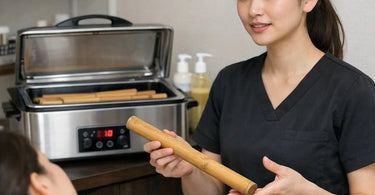
Simplify brilliance with this pro essential... Seriously, if you are still lugging around a vat of boiling water and a dozen slippery hot stones that are either scorching your client or colder than your ex's heart, let us introduce you to your new best friend: warm bamboo massage. We are talking about sleek, sustainable, and surprisingly effective Bamboo Massage Sticks that hold heat like a dream and let you roll out tension with the grace of a ninja (and the strength of a lumberjack). But here is the million-dollar question that keeps spa owners up at night (okay, maybe just us distributors): What is the absolute best way to warm these wooden wonders without turning them into kindling or giving your client a second-degree burn?
Welcome, my anxious but ambitious aestheticians, massage therapists, and spa directors! Pull up a massage table and grab your favorite spa towel, because Kelly is about to drop some thermal truth bombs. We love bamboo because it is eco-friendly, durable, and frankly, it looks way cooler on Instagram than a grey rock. But heat and humidity are bamboo's kryptonite if you are not careful. One wrong move and your perfectly straight spa tool turns into a pretzel. So, how do we get that deep, penetrating, muscle-melting warmth without ruining your investment or your client's skin? Buckle up, buttercup. We are going deep into the steamy world of thermal bamboo protocols.
Why Bamboo? (Or, Why Your Hands Deserve a Break)
Before we dive into the technical oven settings, let us talk about why you are even bothering with bamboo. First, ergonomics. Holding a hot stone for sixty minutes requires forearms of steel. Bamboo sticks are long, lightweight, and allow you to use leverage to dig into those rhomboids without destroying your thumbs. Secondly, the glide is unmatched. With a little bit of massage oil, bamboo glides over hybrid skin like a figure skater on fresh ice. Thirdly, and most importantly for this blog, the thermal retention. Bamboo heats up evenly and, when done correctly, releases that heat slowly and deeply into the fascia. It is the difference between a sunlamp and a hot cup of cocoa; one is surface level, the other warms you to the core.
The Golden Rule: Dry Heat Only (Water is the Enemy)
Alright, let us get real for a second. You know how your wooden cutting board gets all warped and weird if you leave it soaking in the sink? Bamboo is the same, but worse. It is a grass, and grass loves water, but not when it is glued together into a stick. Never, and I mean NEVER, submerge your bamboo sticks in water. Do not boil them. Do not throw them in a towel steamer. Steaming creates moisture, moisture makes the bamboo expand, and when it dries, it cracks. We want our bamboo to look like a smooth runway, not the surface of the moon. Stick to dry heat sources only.
Method #1: The Towel Warmer Tango
This is the most common method in a busy spa, mostly because you already have the equipment. A standard towel warmer (the cabinet style) works great, but it is a dry cabinet, right? Right? (Please say yes). Place your bamboo sticks inside a dry, folded towel inside the warmer. This ensures they get hot without touching any condensation drips. Set your towel warmer to low or medium. You are aiming for body temperature plus a little oomph. We want the bamboo to feel like a warm hug, not a branding iron. Check them after 15 minutes. They should be warm to the touch but not so hot you drop them. If you can't hold them comfortably in your palm for 10 seconds, they are too hot for a client.
Method #2: The Heating Pad Sandwich (The Pro Favorite)
For the solo practitioner or the therapist who wants absolute control, this is the gold standard. Grab a dry massage table warmer or a standard electric heating pad. Lay a dry towel down, arrange your bamboo sticks (maybe 6-8 of varying lengths), cover them with another dry towel, and then fold the heating pad over the top. Turn it to medium heat. The beauty of this method is that the heat is consistent, dry, and right next to your table. It takes about 20-30 minutes to fully permeate the bamboo, but once it does, that heat will last through a full 60-minute wellness treatment. Plus, you can plug it in mid-session if you need to re-warm, unlike a hot stone heater that takes forever.
Method #3: The Hot Towel Caboodle (Quick & Dirty)
Okay, so you forgot to turn on the warmer and your client is already face-down in the face cradle. We have all been there. Here is the emergency protocol: Take a thick, dry towel and put your bamboo sticks in the center. Roll the towel up tightly like a burrito. Place that burrito in your towel steamer for exactly 3-4 minutes. Because the bamboo is insulated by the towel, it won't get soaking wet, but it will get hot fast. Take it out immediately and unroll it. Use a dry hand towel to wipe off any surface moisture. This is a great hack for professional massage when you are running behind, but it is not ideal for daily use. It is like microwaving a steak; it works in a pinch, but slow and steady wins the race.
Temperature Check: The Wrist Test (Don't Be A Hero)
You have heated your hot and cold therapy tools. But are they safe? Please, for the love of all that is holy, do NOT touch the bamboo to your cheek to test it. Your cheek is numb compared to your inner wrist. Take the bamboo stick and hold it against the soft underside of your forearm for 5 seconds. If it feels "pleasantly warm" – keep it. If it feels "hot" – let it cool. If you flinch and drop it – put it back in the freezer and re-evaluate your life choices. Clients are paying you to relax them, not to brand them like cattle. Thermal massage is about deep muscle release, not searing skin. A good rule of thumb (or wrist) is 110°F to 120°F. Hot enough to melt professional hard wax? No. Hot enough to make a knot cry uncle? Yes.
The Application: Rolling, Scooping, And Chiseling (Safely)
Now that your wax strips are... wait, wrong tool. Now that your bamboo is toasty, let us use it. Always start with a base layer of massage lotion. You never put hot bamboo on dry skin. Use long, slow strokes to warm the tissue. For the back, use the stick perpendicular to the spine, rolling it up the erectors. For the shoulders, use the stick like a rolling pin over the deltoids. For the glutes (because everyone loves glute work), use your body weight to press the warm stick into the muscle and scoop upwards. The warmth is not just for comfort; the heat dilates blood vessels, bringing oxygen to sore muscles and flushing out lactic acid. You can even use two sticks at once for a "chisel" motion on the neck. It feels weird, looks cool, and your clients will think you are a wizard.
Sanitation: Don't Be Gross (The 3-Step Sani-Swish)
Bamboo is porous if you look at it under a microscope. While it is naturally antimicrobial to a degree, we are professionals, not cavemen. You cannot autoclave bamboo; it will incinerate. You cannot soak it in professional disinfectants for hours; it will absorb the chemicals and give your client a rash. Here is the protocol: Step 1: Wipe down the stick with a clean, damp cloth to remove oil and dead skin cells. Step 2: Spray with a high-level spa disinfectant (like Barbicide) that is safe for non-porous or semi-porous surfaces. Let it sit for the contact time (usually 1-2 minutes). Step 3: Wipe dry with a clean towel. Do this immediately after every single use. And please, for the sake of your reputation, do not put them back in the heating pad dirty. You are just baking the germs in. Yum.
Storage: A Cozy, Dry Home
When your bamboo is not warming muscles, it needs a home. Do not leave them in the towel warmer overnight (they will dry out and crack). Do not leave them in a soaking wet gym bag (they will mold). Store them in a cool, dry place. A drawer lined with a towel or a dedicated bamboo caddy works great. If you live in Florida (like us), humidity is your enemy. Throw a few silica gel packets (the ones that come in shoe boxes) into your storage drawer. It sounds crazy, but it keeps the moisture out and your bamboo straight and true.
Troubleshooting: When Bamboo Bites Back
Got splinters? That means your bamboo is too dry or you are dragging it sideways against the grain. Sand it down gently with fine-grit sandpaper and condition it with a TINY amount of mineral oil (just wipe it on and off, do not soak it). Does it smell like burnt toast? Your heating pad is too hot, and you are scorching the lignin (the natural glue in the wood). Turn down the heat. Is it bent like a rainbow? You stored it under a heavy weight while it was warm and damp. You cannot fix that easily. Buy new ones. Luckily, buying in bulk at Pure Spa Direct makes replacing them painless. Stock up on bamboo massage sets so you always have a backup.
Hygge, Zen, And The Bottom Line
Let's wrap this up (pun intended). Thermal bamboo massage is not just a trend; it is a legitimate modality that saves your body and impresses your clients. But the magic is in the prep. Dry heat, consistent temperature checks, and rigorous sanitation are the pillars of success. Whether you are using a basic towel steamer on a dry setting or a dedicated heating pad, the rule remains the same: slow, warm, dry.
At Pure Spa Direct, we know you are juggling waxing supplies, nail polish colors, and hair bleach allergies. Adding a new protocol feels overwhelming. But thermal bamboo is easy. It is forgiving. And when you nail that perfect temperature, the sigh of relief you hear from your client is worth every second of prep time. So go ahead, warm up those sticks, crank up the aromatherapy diffuser, and get rolling.
Now, if you excuse me, I have a date with a heating pad and a very grumpy trapezius muscle. Stay warm, stay safe, and stop boiling your tools!
)