
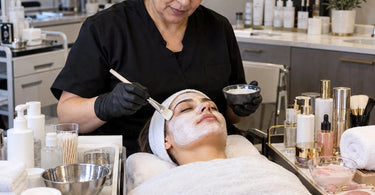
The right choice for better results starts with knowing exactly what goes into every facial treatment, right down to the last drop of serum and the final cotton pad. For spa owners and estheticians, understanding how to calculate the supply cost difference between basic and premium facial services can mean the difference between a profitable treatment menu and one that quietly eats away at your earnings. After all, a $150 facial sounds wonderful until you discover that your premium products, specialty masks, and assorted little extras have been throwing themselves a very expensive party behind your back. The good news? You do not need an accounting degree to figure out whether your facial services are earning their keep. You just need a simple system for tracking what you use, what it costs, and how those numbers change when you upgrade a treatment.
Whether your spa offers classic cleansing facials, customized hydration treatments, or advanced services featuring specialized equipment, understanding the real cost of your professional facial treatment products is essential for smart pricing, purchasing, and inventory management. Let's break down the numbers so you can give clients the experience they deserve without accidentally giving away your profit.
Why Basic and Premium Facials Need Separate Supply Budgets
At first glance, basic and premium facials may appear to have similar supply requirements. Both involve cleansing, skin preparation, treatment products, and finishing care. But once you examine the actual quantities and products used, the differences can become surprisingly significant.
A basic facial typically focuses on essential skincare steps, such as cleansing, exfoliation, masking, moisturizing, and sun protection when appropriate. A premium facial may incorporate specialized serums, professional treatment masks, additional exfoliation products, enhanced massage products, or advanced equipment with disposable treatment components.
These upgrades can change the supply cost in several ways. Premium formulations may cost more per milliliter, specialty masks may require larger portions, and advanced services may involve single-use tips or other dedicated consumables.
The key is recognizing that a premium facial does not necessarily cost twice as much to perform simply because it sells for twice the price. Some premium services have modest additional supply costs, while others require substantially more expensive products or consumables.
That is why you should calculate costs for each treatment protocol rather than applying one blanket estimate to every facial on your menu.
Step 1: List Every Product Used in Each Facial
Start by documenting your treatment protocols from beginning to end. Create one supply list for your basic facial and another for your premium facial.
Your basic facial might include:
- Professional facial cleanser
- Skin toner or preparation solution
- Standard exfoliating product
- Basic treatment mask
- Facial massage cream
- Finishing moisturizer
- Appropriate sunscreen
- Cotton pads, sponges, gloves, and other disposables
Your premium facial might use many of the same supplies, with additional products such as:
- Specialized enzyme or exfoliation treatment
- Concentrated professional treatment serum
- Premium hydration or specialty mask
- Additional treatment-specific finishing products
- Equipment-specific disposable tips or cartridges
- Extra towels, applicators, or protective supplies
Professional skincare collections, including Premium Skincare Products for Spas and Salons, can help you identify the types of products needed for different facial protocols.
Be specific when recording your supplies. Writing down facial serum is helpful, but recording the exact serum, bottle size, purchase price, and amount used is much better. Your spreadsheet cannot read your mind, no matter how many times you glare at it.
Step 2: Calculate the Cost Per Application
Once you have a product list, determine how much each product costs per treatment.
The basic formula is straightforward:
Cost per application = Total product purchase cost divided by the number of usable applications.
For products measured by volume, you can use a more detailed version:
Cost per application = (Product purchase cost / Usable product volume) x Quantity used per facial.
For example, suppose your spa purchases a professional facial cleanser for $36. The container holds 240 mL, and your esthetician uses 6 mL during a standard facial.
Your cost per milliliter is $36 divided by 240, or $0.15.
Multiply $0.15 by 6 mL, and your cleanser cost per facial is $0.90.
Now consider a premium treatment serum costing $84 for a 30 mL bottle. If your premium facial requires 1.5 mL per treatment, the calculation becomes:
$84 divided by 30 mL = $2.80 per mL.
$2.80 multiplied by 1.5 mL = $4.20 per facial.
One premium serum application costs $4.20, compared with $0.90 for the cleanser in this example. That is not necessarily a problem, but it is an important difference to understand.
Remember to include shipping, nonrecoverable taxes, and other purchasing expenses when determining your actual landed product cost. If some product remains unusable inside the container, calculate using the volume you can realistically dispense rather than assuming every last drop will reach a client's skin.
Step 3: Build a Basic Facial Supply Cost Example
Let's create a hypothetical supply budget for a basic 60-minute facial.
These figures are illustrative planning numbers, not current wholesale prices or a universal industry benchmark. Your actual costs will depend on the products, sizes, suppliers, and application quantities used in your spa.
| Basic Facial Supply | Cost Per Service |
|---|---|
| Facial cleanser | $0.90 |
| Toner or preparation solution | $0.45 |
| Basic exfoliant | $1.20 |
| Standard treatment mask | $1.75 |
| Massage cream | $0.85 |
| Moisturizer | $0.75 |
| Sunscreen | $0.90 |
| Disposable supplies | $1.60 |
Total basic facial supply cost: $8.40.
For this example, assume the spa charges $85 for its basic facial.
Divide the $8.40 supply cost by the $85 service price and multiply by 100.
Basic facial supply cost percentage = 9.88%.
This means approximately 9.9% of the service revenue goes toward the supplies counted in this example.
It does not mean the remaining 90.1% is profit. Labor, rent, laundry, utilities, equipment, payment processing, and other operating expenses still need to be paid.
Step 4: Calculate the Supply Cost of a Premium Facial
Now imagine your spa offers a premium 75-minute facial featuring enhanced exfoliation, a specialty mask, a concentrated serum, and additional finishing products.
Here is a hypothetical premium facial supply budget.
| Premium Facial Supply | Cost Per Service |
|---|---|
| Premium facial cleanser | $1.20 |
| Advanced toner or preparation solution | $0.70 |
| Specialized exfoliation treatment | $3.50 |
| Premium treatment mask | $4.75 |
| Concentrated treatment serum | $4.20 |
| Premium massage cream | $1.30 |
| Finishing moisturizer | $1.20 |
| Sunscreen | $1.10 |
| Additional hydration treatment | $2.50 |
| Disposable supplies | $2.25 |
Total premium facial supply cost: $22.70.
Suppose the spa charges $155 for this premium facial.
Divide $22.70 by $155 and multiply by 100.
Premium facial supply cost percentage = 14.65%.
The premium service uses more expensive supplies and dedicates a larger percentage of revenue to those products. However, it also generates substantially more revenue per appointment.
To determine whether the upgrade makes financial sense, we need to compare the two services directly.
Step 5: Calculate the Actual Supply Cost Difference
Here is where the numbers become especially useful for your spa menu.
Premium facial supply cost - Basic facial supply cost = Additional supply cost.
Using our examples:
$22.70 - $8.40 = $14.30.
The premium facial costs $14.30 more in supplies per service.
Now compare the selling prices:
$155 - $85 = $70.
Your premium facial generates $70 more in revenue while requiring $14.30 in additional supplies.
Subtract the incremental supply expense from the additional revenue:
$70 - $14.30 = $55.70.
That means the premium facial contributes an additional $55.70 before accounting for differences in labor, equipment, overhead, and other operating costs.
That is a much more useful number than simply noticing that the premium facial costs more to perform.
It helps you understand how much additional revenue remains available to cover the longer appointment, higher compensation, equipment usage, and desired profit.
Step 6: Account for the Extra Treatment Time
One of the biggest mistakes in facial pricing is focusing entirely on product costs while ignoring treatment duration.
A premium facial may require additional preparation, a longer massage sequence, specialty masking, equipment setup, or more cleanup time.
In our example, the basic facial takes 60 minutes and the premium facial takes 75 minutes.
Assume, for illustration, that the spa's fully loaded esthetician labor cost is $30 per hour, including applicable employer payroll costs and benefits.
The basic facial requires $30 in labor for 60 minutes.
The premium facial requires $37.50 in labor for 75 minutes.
That is an additional $7.50 in labor for the premium treatment.
Now subtract both the extra supply cost and the extra labor cost from the $70 price difference:
$70 - $14.30 - $7.50 = $48.20.
The premium facial provides $48.20 in additional contribution before differences in other expenses.
That sounds promising, but do not forget appointment turnover time, room occupancy, equipment costs, or the possibility that the longer service reduces how many appointments your spa can schedule during the day.
A treatment that creates more dollars per appointment may not necessarily create more dollars per available booking hour.
Step 7: Include the Little Supplies That Add Up
Every esthetician knows that facial services involve more than beautiful jars and expensive serums.
There are the unglamorous essentials: cotton rounds, gauze, gloves, sponges, applicators, protective coverings, and cleaning supplies.
They may not get their own glamorous display shelf, but they absolutely deserve a place in your supply calculations.
Useful categories to review include Professional Cotton, Sponges, and Wipes, Compressed Sponges, and Applicators & Spatulas.
Remember to account for the actual number of disposables used in each service rather than assuming that every treatment consumes the same amount.
For instance, a premium facial with multiple masks may require additional mixing supplies, removal sponges, or applicators.
If your basic facial uses $1.60 in disposable supplies and your premium service uses $2.25, that $0.65 difference belongs in your premium cost calculation.
It may seem tiny, but across 150 premium appointments, the extra disposable cost totals $97.50.
And that is just one category. Small amounts have a remarkable talent for becoming large totals when nobody is watching.
Step 8: Consider Equipment-Based Facial Upgrades
Premium facials sometimes involve equipment that changes the economics of a service beyond the cost of skincare products.
Examples include treatments using Hydrodermabrasion, Microdermabrasion, or Light Therapy Devices.
Different devices have different operating requirements. Some use single-use tips, specialty solutions, filters, or cartridges. Others have reusable components that require cleaning, maintenance, or periodic replacement according to manufacturer instructions.
For an equipment-based upgrade, separate your calculations into three categories.
Direct consumables: Include solutions, cartridges, disposable treatment tips, and other items consumed during the appointment.
Equipment cost per treatment: Allocate the purchase cost over a reasonable estimate of the device's useful treatment volume, along with relevant maintenance and replacement expenses.
Additional labor: Include setup, operation, cleaning, and any extra appointment time.
For example, suppose a device costs $3,000 and you expect to perform 1,500 treatments over its useful service life.
The purchase cost allocation would be $2 per treatment before accounting for maintenance, repairs, financing, or other equipment expenses.
If the treatment also requires $5 in disposable tips and $3 in specialty solution, those $8 in consumables must be included in the direct supply cost.
Keeping equipment allocation separate from disposable supply expense makes it easier to compare treatments consistently and avoid counting the same expense twice.
Also, use advanced equipment only within applicable professional licensing requirements, manufacturer instructions, and established treatment protocols.
Step 9: Factor in Product Waste and Real-World Usage
A spreadsheet built around perfect dispensing quantities is lovely in theory. In a busy treatment room, reality occasionally has other plans.
Masks may be mixed in slightly larger batches than needed. Pumps may dispense inconsistent quantities. Products may expire before every application is used, especially when premium services have lower booking volume.
Rather than guessing, compare expected usage with actual inventory consumption over several weeks.
Suppose a specialty mask costs $60 and should theoretically provide 20 applications.
The planned cost is $3 per application.
But if your team consistently gets only 17 usable treatments, the actual cost becomes approximately $3.53 per application.
That represents an additional $0.53 per facial.
The solution is not necessarily to use less product. Estheticians should always follow appropriate treatment instructions and use the quantity needed to perform the service correctly.
Instead, improve measurement, dispensing consistency, preparation methods, and inventory rotation.
For inventory organization, professional Bottles & Jars and Mixing Bowls may be useful when compatible with product instructions and sanitation requirements.
Accurate portion control helps protect product quality and financial performance without compromising the treatment experience.
Step 10: Calculate Monthly and Annual Supply Cost Differences
Individual treatment costs are important, but they become even more useful when you connect them to booking volume.
Imagine your spa performs 80 basic facials and 60 premium facials each month.
Using our hypothetical supply costs:
Basic facials: 80 appointments x $8.40 = $672 in monthly supplies.
Premium facials: 60 appointments x $22.70 = $1,362 in monthly supplies.
Total monthly facial supply expense: $2,034.
Over 12 months, assuming the same service mix and unchanged costs, that equals $24,408 in facial supply spending.
Now consider a different question: What would happen if 20 existing basic facial bookings were upgraded to premium facials each month, with the total number of appointments remaining unchanged?
Those 20 upgrades would require:
20 x $14.30 = $286 in additional monthly supply expense.
Annualized, that would be $3,432 in additional supply expense.
However, those same upgrades would generate:
20 x $70 = $1,400 in additional monthly service revenue.
After subtracting the incremental supply expense, the upgrades would provide $1,114 in additional monthly contribution before incremental labor, equipment, and overhead.
This is the type of calculation that helps spa owners evaluate menu upgrades based on financial reality rather than enthusiasm alone.
Step 11: Use Supply Cost Percentages to Monitor Your Menu
Supply cost percentages are especially helpful when comparing facial services with different selling prices.
The formula is:
Supply cost percentage = (Direct supply cost / Service selling price) x 100.
Using our examples:
Basic facial: $8.40 / $85 x 100 = 9.88%.
Premium facial: $22.70 / $155 x 100 = 14.65%.
The premium facial has a higher supply cost percentage, but that does not automatically make it less profitable.
It may generate more contribution dollars per appointment, better utilization of premium inventory, or additional opportunities for appropriate retail recommendations.
There is no single supply cost percentage that automatically makes a facial profitable for every spa. Your ideal range depends on labor expenses, pricing, service duration, treatment complexity, client demand, and overall business structure.
Instead of chasing an arbitrary percentage, establish a target based on your own financial performance and monitor it consistently.
How to Build a Simple Facial Supply Cost Spreadsheet
You do not need complicated inventory software to begin tracking facial supply costs. A basic spreadsheet can provide valuable information.
Create columns for the following:
- Service name
- Product or supply name
- Purchase price
- Usable package quantity
- Quantity used per treatment
- Cost per application
- Monthly treatment volume
- Estimated monthly supply expense
Use a separate section for each facial protocol and sum the application costs to calculate the total direct supply expense per service.
Add another summary section showing service price, treatment duration, labor expense, equipment allocation, and contribution before other overhead.
Update product prices whenever your purchasing costs change. Also review quantities when treatment protocols are revised or new products are introduced.
A practical routine is to review high-volume facial costs monthly and perform a more complete protocol-level assessment quarterly.
That way, your financial information remains useful instead of becoming another spreadsheet that quietly retires to a forgotten desktop folder.
How to Lower Facial Supply Costs Without Cheapening the Experience
Managing costs does not mean replacing every beautiful professional product with the least expensive option available.
The goal is to purchase and use products efficiently while maintaining the standards clients expect.
Compare cost per application. A larger professional container may cost more upfront but provide a lower per-treatment expense. Compare usable quantities rather than purchase prices alone.
Standardize appropriate protocol quantities. Train estheticians to follow consistent, manufacturer-appropriate application measurements while allowing for legitimate client-specific adjustments.
Consolidate overlapping products. Identify products that perform similar functions across multiple facial protocols. Where clinically and operationally appropriate, sharing a versatile professional product across services can improve inventory turnover.
Monitor low-volume premium inventory. Expensive products that are rarely used may expire before you recover their purchase cost. Match purchasing quantities to realistic appointment demand.
Review your disposable supplies. Compare professional supply options without sacrificing hygiene, appropriate single-use practices, or required sanitation standards. Collections such as Spa Essentials for Professionals can help you organize commonly needed treatment-room supplies.
Evaluate treatment upgrades separately. If you introduce a specialty mask or advanced serum, calculate its incremental cost before adding it to your premium protocol.
A few smart purchasing and usage decisions can create meaningful savings without clients noticing anything except a consistently wonderful service.
Should Every Premium Facial Have a Higher Profit Margin?
Not necessarily. A premium service should be priced to provide an appropriate financial return, but that does not mean every treatment must have the same supply percentage, gross margin, or contribution per hour.
Some premium facials justify higher prices because they require specialized training, additional labor, expensive equipment, or limited appointment capacity.
Others provide a luxurious client experience through carefully selected products and thoughtful treatment design without dramatically increasing direct supply costs.
The important distinction is between price, cost, and value.
Clients are not simply purchasing the contents of a skincare jar. They are paying for professional expertise, personalization, treatment time, comfort, and the overall experience.
For spa owners, this means your pricing decisions should reflect both the genuine value of the service and the financial resources required to deliver it.
Always evaluate a premium facial's contribution per appointment and per booking hour, not just its selling price or direct product expense.
When Should You Recalculate Your Facial Supply Costs?
Facial cost calculations should be updated whenever something meaningful changes in your treatment room.
Important triggers include introducing a new professional skincare line, changing package sizes, adjusting application quantities, modifying treatment duration, adding equipment-based services, or experiencing significant supplier price increases.
You should also review costs when seasonal facial services are added to your menu.
For example, a winter hydration facial may require richer masks or additional specialty products, while another seasonal protocol may use a different exfoliant or finishing formulation.
Even when two facials share the same service price, their actual supply costs can be different.
Keep a dated version of each treatment protocol and its corresponding supply budget so you can identify changes over time.
If your supply percentage suddenly increases, you will have the information needed to investigate whether the cause is a price change, product waste, a different service mix, or a change in application quantities.
Frequently Asked Questions About Facial Supply Costs
What is the easiest way to calculate the cost of facial products per service?
Divide each product's purchase cost by its usable quantity, then multiply by the quantity used during one treatment. Repeat for every product and disposable supply, then add the individual costs together.
Are premium facial supplies always more expensive?
No. Some premium treatments use specialized products with substantially higher per-application costs, while others rely more heavily on professional technique, personalization, or treatment time. Calculate each protocol individually.
Should laundry and cleaning supplies be included?
Yes, but use consistent accounting categories. Disposable cleaning products directly attributable to a treatment may be included in supply costs, while reusable linen laundering and broader sanitation operations can be tracked separately. Include all relevant expenses when evaluating total service profitability.
How do I compare two facials with different appointment lengths?
Calculate the direct supplies and labor for both treatments, then compare their contribution before other overhead. Divide that contribution by the total booking time to understand the financial return per occupied treatment-room hour.
Can I use the same supply cost estimate for every facial?
It is better to calculate costs by treatment type. Even services that use similar products may have different application amounts, masks, serums, disposable requirements, or equipment expenses.
How often should I update my cost calculations?
Review significant purchasing changes as they occur, monitor high-volume treatments regularly, and conduct a broader protocol review at least quarterly or whenever your menu changes substantially.
Make Every Facial Upgrade Work Harder for Your Business
A well-designed premium facial should feel special to the client and make financial sense for the spa. Understanding the exact supply cost difference between basic and premium facial services gives you the information needed to build treatment menus with confidence.
Start with accurate product measurements, account for disposables and waste, and compare incremental supply expenses against the additional revenue each upgrade creates. Then consider labor, equipment, and appointment time before deciding whether your premium pricing delivers the return your business needs.
As you review your facial protocols, explore Advanced Facial Treatment Products for Salons & Spas, Professional Skincare Supplies, and Professional Cleaners & Disinfectants at Pure Spa Direct to compare products and plan your treatment-room purchasing.
Because a fabulous facial should leave your clients glowing, your estheticians proud, and your business numbers looking just as healthy. And unlike that mysterious missing spatula, your profit should never be impossible to find.
