
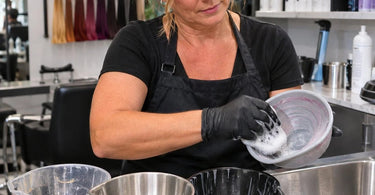
Top products, top results... and absolutely nobody dreaming of spending their afternoon scrubbing dried hair color out of a mixing bowl! In a busy salon, every minute matters, especially when your appointment book is packed and your next client is already checking her reflection in the waiting area mirror. Choosing the right hair color bowls can make a surprisingly big difference in how smoothly your color station operates. But here is the million-dollar question: does plastic, silicone, rubber, glass, or metal actually clean up faster? Understanding how to compare color bowl cleaning time across different materials can help salon professionals reduce unnecessary cleanup, maintain professional hygiene standards, and keep those beautiful color transformations moving along without missing a beat.
Color bowls may seem like small accessories, but they are hardworking members of your salon team. They hold permanent color, demi-permanent formulas, toners, developers, and lighteners throughout the day. Their materials, surface finishes, shapes, and condition all affect how easily leftover product can be removed. And while no bowl can magically clean itself (wouldn't that be fabulous?), choosing the right material and establishing a consistent cleaning process can make a noticeable difference.
Why Color Bowl Cleaning Time Matters in a Busy Salon
Imagine completing six color services in one afternoon. Each service requires at least one mixing bowl, and some techniques involve several bowls for different formulas. Between root applications, highlights, glosses, and color corrections, the number of bowls waiting for attention can multiply faster than a stylist's collection of hair clips.
Even modest differences in hands-on cleaning time can accumulate across a busy schedule. If one bowl takes 30 seconds longer to clean than another, and your team cleans 20 bowls daily, that difference represents 10 minutes of additional labor each day.
Those minutes matter because efficient cleanup supports:
- Faster preparation between color appointments.
- Less product residue accumulating on reusable tools.
- More consistent sanitation procedures.
- Reduced unnecessary scrubbing and surface wear.
- A cleaner, more organized color station.
- Improved productivity during busy salon hours.
However, faster cleaning should never mean rushing required disinfection. Cleaning removes visible residue and soil, while disinfection is a separate process that must follow applicable regulations and product label instructions. The goal is to eliminate wasted effort, not essential hygiene steps.
Plastic Color Bowls: Lightweight, Affordable, and Convenient
Plastic mixing bowls are popular in professional salons because they are lightweight, affordable, and available in numerous sizes and designs. Their practicality makes them appealing for stylists who prepare several formulas throughout the day.
A smooth, chemical-compatible plastic bowl in good condition can be relatively easy to rinse and wash immediately after use. However, not all plastics behave identically. Surface texture, chemical resistance, scratches, and prolonged exposure to color formulations can influence cleanup time.
Potential cleaning advantages:
- Lightweight construction makes handling and rinsing convenient.
- Smooth interiors can simplify removal of fresh product residue.
- Affordable replacement options help salons retire worn bowls.
- Many designs feature comfortable grips and practical pouring edges.
Potential cleaning challenges:
- Scratches can trap residue and make thorough washing more difficult.
- Certain dyes may discolor some plastic surfaces.
- Textured bottoms or molded measurement markings can require extra attention.
- Some plastics may be incompatible with particular color products or disinfectants.
For salons using plastic bowls, inspecting the interior regularly is essential. A smooth, intact bowl is generally easier to maintain than one covered in scratches and stubborn buildup.
Explore professional options in the Mixing Bowls collection at Pure Spa Direct.
Silicone and Rubber Bowls: Flexible Cleanup With a Few Trade-Offs
Flexible mixing bowls offer an interesting alternative to rigid plastic. Depending on the specific material and construction, a flexible bowl may allow dried residue to loosen when the sides are gently manipulated.
That flexibility can be particularly helpful with certain thicker formulations. However, flexibility alone does not guarantee faster cleaning, and rubber and silicone should not be treated as interchangeable materials.
Potential cleaning advantages:
- Flexible sides may help loosen certain dried residues.
- Some designs have smooth interiors that are simple to wipe.
- Lightweight construction makes handling convenient.
- Flexible materials can be useful where a non-slip grip is preferred.
Potential cleaning challenges:
- Some formulations can leave persistent stains or odors.
- Soft surfaces may be damaged by abrasive cleaning tools.
- Raised markings, seams, and textured areas can retain residue.
- Not every flexible material tolerates every coloring chemical or disinfectant.
A smooth, appropriately rated silicone bowl may outperform a heavily scratched plastic bowl during certain cleanup tasks. The reverse can also be true when comparing a simple rigid bowl against a flexible model with numerous crevices.
Always check whether the manufacturer specifically approves the bowl for the intended professional hair color formulation, particularly products involving oxidizing developers or lighteners.
Stainless Steel Bowls: Smooth Surfaces and Professional Durability
Stainless steel bowls are frequently appreciated for their durable construction and smooth, nonporous surfaces. When properly manufactured and maintained, an appropriate stainless steel bowl can be straightforward to wash without significant residue becoming trapped in the surface.
But before adding every shiny metal bowl to your color station, there is an important compatibility consideration.
Many professional hair color and lightener manufacturers specify nonmetallic mixing bowls. Metal can be unsuitable for certain formulations, and product instructions must take priority over the convenience of cleaning.
Therefore, stainless steel should only be considered for a particular mixing application when the product manufacturer explicitly permits its use.
Potential cleaning advantages:
- Nonporous, polished surfaces can be easy to wash.
- Durable construction can resist ordinary wear.
- Smooth interiors provide fewer places for residue to accumulate.
Potential cleaning challenges:
- Metal may be prohibited for certain coloring and lightening formulas.
- Scratched or damaged finishes can become more difficult to maintain.
- Some cleaning agents may be incompatible with particular metal finishes.
For hair color services, compatibility comes first. A bowl that washes beautifully but is unsuitable for the formula is not a practical salon choice.
Glass Mixing Bowls: Smooth, Nonporous, and Easy to Inspect
Glass mixing bowls offer a smooth, nonporous surface that can make residue easy to see and remove. Their transparency is especially helpful when checking whether pigment remains around the sides and bottom.
Glass may provide convenient cleanup for compatible treatments, although its weight and breakability should be considered carefully in a busy professional environment.
Potential cleaning advantages:
- Smooth interiors can simplify washing.
- Transparent walls make leftover residue easier to identify.
- Nonporous surfaces resist absorbing many substances.
- Glass does not scratch as easily as some softer plastics under ordinary handling.
Potential cleaning challenges:
- Glass is heavier than many plastic alternatives.
- Breakage and chipped edges create workplace safety concerns.
- Some glass designs have thick bases or complex shapes that require additional rinsing.
- Not every glass bowl is approved for every professional formulation.
Glass can be worth evaluating for appropriate salon applications, but a practical cleaning-time comparison should include careful handling, breakage risk, and the manufacturer's chemical compatibility guidance.
Which Color Bowl Material Cleans the Fastest?
There is no universal winner. Actual cleaning time depends on the bowl's surface condition, shape, finish, product compatibility, and the specific formulation being removed.
Consider these general characteristics before conducting your own salon comparison:
| Material | Potential Cleaning Advantage | What May Slow Cleanup |
|---|---|---|
| Plastic | Lightweight with potentially smooth interiors | Scratches, staining, textured surfaces |
| Silicone | Flexible sides may loosen some residue | Surface texture, staining, detailed shapes |
| Rubber | Flexible and convenient to handle | Material wear, residue retention, compatibility limits |
| Stainless steel | Smooth, durable, nonporous surface | Chemical compatibility restrictions, surface damage |
| Glass | Smooth, nonporous, easy-to-inspect surface | Weight, fragility, intricate designs |
This table describes potential characteristics rather than measured cleaning-time rankings. A well-designed plastic bowl may clean faster than a complicated silicone bowl, while a smooth glass bowl may be easier to inspect than an opaque bowl with a textured interior.
The best approach is a controlled comparison using the products your salon actually uses.
How to Run a Color Bowl Cleaning Time Test in Your Salon
Ready to turn your color station into a tiny efficiency laboratory? No white coats required. A stopwatch, a consistent procedure, and a few properly selected bowls are all you need.
Step 1: Select compatible bowls. Choose bowls of similar capacity and shape whenever possible. Confirm that each material is approved for the particular product being tested. Do not test incompatible material and chemical combinations simply to complete the comparison.
Step 2: Standardize the formulation. Use the same hair color or treatment formulation, prepared according to manufacturer instructions. Different product thicknesses and pigment compositions can influence residue removal.
Step 3: Standardize the residue. Measure the same amount of leftover product in each bowl. Keep the product distribution as similar as possible.
Step 4: Control the waiting period. Allow each bowl to sit for the same amount of time before cleaning. A bowl washed immediately after use is not directly comparable to one with residue that has been sitting for an hour.
Step 5: Use identical cleaning conditions. Keep water temperature, approved detergent, cleaning tools, and washing technique consistent. Follow the bowl and formulation manufacturers' instructions for removing chemical residue safely.
Step 6: Record active cleaning time. Begin timing when the cleaning process starts. Stop when the bowl is visibly clean and ready for the next required sanitation step. Record additional rinsing, stubborn stains, and any repeated cleaning.
Step 7: Complete required disinfection. Follow the applicable state board requirements and disinfectant label directions. Required wet contact time must not be reduced to produce a faster result.
Step 8: Repeat the test. Conduct at least three comparable trials for each bowl and calculate an average. More trials can provide a better picture of real salon performance.
This method produces practical information based on your salon's actual products rather than assumptions about material performance.
How to Calculate Average Cleaning Time and Labor Savings
Suppose a salon tests two compatible mixing bowl designs and records the following hypothetical active cleaning times:
Bowl A: 42 seconds, 39 seconds, and 45 seconds.
Bowl B: 68 seconds, 71 seconds, and 65 seconds.
The average for Bowl A is 42 seconds, while Bowl B averages 68 seconds.
That is a difference of 26 seconds per bowl.
If a salon cleans 30 bowls per day, the potential active labor savings would be:
26 seconds x 30 bowls = 780 seconds, or 13 minutes per day.
Over five operating days, that equals 65 minutes of active cleaning time.
These numbers are illustrative, not laboratory findings or promises about particular materials. Your actual results will depend on your workflows.
Also remember that saving labor time does not automatically shorten the required chemical disinfectant contact period. Total turnaround should be tracked separately from hands-on cleaning labor.
Don't Forget Bowl Shape, Surface Finish, and Color Brush Design
Material is important, but bowl design may matter just as much.
A bowl with a smooth interior, gently rounded corners, and an uncomplicated base may be easier to clean than one with deep grooves or narrow crevices. Raised measurement markings, textured grips, and elaborate pouring features can create places where residue collects.
Look for these practical characteristics:
- Rounded interior transitions rather than sharp corners.
- A smooth, intact surface finish.
- Minimal decorative ridges inside the bowl.
- A stable base that prevents tipping during mixing.
- A wide enough opening for convenient washing.
- Clear manufacturer guidance about chemical and disinfectant compatibility.
And remember your trusty hair color brushes. A beautifully clean bowl paired with a brush carrying old product residue is not exactly the professional dream team.
Choose brushes that can be cleaned and disinfected according to their manufacturer's instructions, paying particular attention to the bristle base and handle junction.
How to Clean Color Bowls Efficiently Without Compromising Hygiene
The fastest sustainable cleanup routine is the one your team can perform consistently and correctly.
Start by removing unused color mixture according to the product's disposal instructions and local requirements. Do not return dispensed product to its original container. Avoid pouring chemical mixtures down drains unless the manufacturer and applicable local rules permit that disposal method.
Next, wash reusable bowls with an approved cleaner and appropriate tools to remove visible residue. Do not mix cleaning chemicals, and never combine disinfectants with leftover color or developer.
After cleaning and rinsing as directed, perform any required disinfection using a product approved for the bowl material and the intended salon application. Follow the label's concentration, application method, and full contact time.
Finally, rinse if instructed, allow the bowls to dry as required, and store them in a clean location until their next use.
Keeping a dependable supply of Professional Cleaners & Disinfectants for Salons and Spas helps support a consistent routine.
Protective equipment matters, too. Use appropriate Protective Gloves & Masks according to chemical safety instructions and workplace procedures.
Common Mistakes That Make Color Bowl Cleaning Take Longer
Even the best bowl cannot rescue a cleaning routine from a few avoidable habits. Here are common issues worth watching.
Allowing product to dry unnecessarily: Some mixtures become more difficult to remove with time. Clean promptly when safe and practical, following the product's handling instructions.
Using abrasive scrubbers: Aggressive scrubbing may damage certain materials, creating scratches that make future cleaning more difficult.
Ignoring residue around rims: Pouring lips, edges, and measurement markings deserve attention during washing.
Keeping damaged bowls too long: Cracks, deep scratches, and deteriorating surfaces can interfere with effective cleaning and may justify replacement.
Confusing staining with contamination: Some surfaces retain cosmetic discoloration after thorough washing. However, visible staining should never be used as proof that a bowl is clean or disinfected. Evaluate the surface condition and follow appropriate cleaning and replacement guidance.
Using an unsuitable bowl material: A bowl that is not compatible with the selected formulation can create problems far more serious than a few extra seconds of cleanup.
How Many Color Bowls Should a Professional Salon Keep on Hand?
The right quantity depends on your color service volume, the number of stylists working simultaneously, and your sanitation workflow.
Start by estimating the maximum number of bowls needed during your busiest appointment overlap. Then consider how many additional bowls are necessary while used equipment moves through cleaning, required disinfection, drying, and storage.
For example, a stylist performing multi-formula dimensional color may need several bowls during one appointment. Multiply that demand across your team during peak service hours, and a small inventory may quickly become a bottleneck.
Maintaining an appropriate reserve of compatible bowls can reduce pressure to rush cleaning or reuse equipment before the required sanitation process is complete.
For a more organized back bar, explore Professional Hair Salon & Barber Shop Supplies, including the tools needed to support everyday color services.
Choosing the Right Bowl for Permanent Color, Toners, and Lighteners
Different color services introduce different handling requirements, so bowl selection should reflect the products you use most frequently.
Permanent hair color: Confirm the bowl material is compatible with the manufacturer's instructions and the recommended developer. Smooth, easy-to-clean interiors can be helpful for repeated services.
Demi-permanent color and toners: Consider bowls that provide convenient control for smaller mixtures while remaining easy to clean around the bottom and sides.
Bleaches and lighteners: Follow the lightener manufacturer's instructions carefully, especially restrictions on metal tools or containers. Some formulas require nonmetallic mixing equipment.
Creative color services: Multiple shades may require several bowls, making consistent bowl sizing, labeling practices, and efficient cleanup particularly valuable.
Browse Professional Hair Color and Hair Bleaches & Lighteners when organizing your professional coloring supplies.
Frequently Asked Questions About Color Bowl Cleaning
Are silicone color bowls easier to clean than plastic?
Sometimes, but not universally. A smooth silicone bowl may release certain residues easily, while a smooth plastic bowl may wash just as quickly or faster. Design, surface condition, and product compatibility determine the practical result.
Can stainless steel bowls be used for hair color?
Only when the specific hair color or treatment manufacturer permits metal mixing equipment. Many professional coloring and lightening products require nonmetallic bowls.
Does a stained color bowl need to be replaced?
Not necessarily. Cosmetic discoloration does not automatically indicate remaining soil. However, bowls with damaged surfaces, persistent residue, cracks, or conditions that prevent effective cleaning should be evaluated for replacement.
Should salons measure washing time or total sanitation time?
Ideally, measure both separately. Active washing time helps identify labor efficiency, while total turnaround includes required disinfection contact time, rinsing where directed, and drying. Never shorten mandatory sanitation steps to improve your numbers.
Is a more expensive color bowl worth buying?
It can be if it offers suitable chemical compatibility, durable construction, easier maintenance, and a longer usable lifespan. Compare replacement frequency and labor requirements rather than focusing exclusively on purchase price.
Make Your Color Station Work Smarter With Pure Spa Direct
The secret to choosing a professional color bowl is not finding one magical material that wins every cleaning contest. It is selecting a chemically compatible, easy-to-maintain bowl that performs well with your salon's actual formulas, workflows, and sanitation requirements.
Smooth surfaces, thoughtful designs, appropriate materials, and consistent cleaning procedures can all help reduce unnecessary labor. Testing multiple bowl options under controlled conditions gives you useful evidence for smarter purchasing decisions.
At Pure Spa Direct, we understand that salon professionals need supplies that support both creativity and daily efficiency. As a wholesale distributor serving beauty and wellness professionals, we offer access to a broad selection of salon essentials from professional suppliers.
Explore our professional mixing bowls, shop salon and barber supplies, and stock your stations with practical tools for your busiest days.
Because your talent belongs behind the chair creating gorgeous color, not spending unnecessary time arguing with yesterday's stubborn toner stains. Your mixing bowls should be working for you, not giving you another full-time job!

