
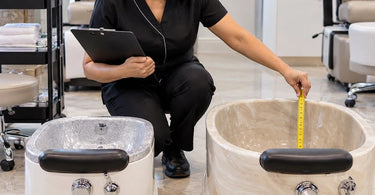
Take your services from good to great... starting with the equipment your clients put their feet into! Choosing the right pedicure bowl involves more than finding a beautiful basin that coordinates with your salon decor. Bowl capacity influences client comfort, water consumption, filling and draining time, cleaning procedures, and even how smoothly your technicians move through a busy appointment schedule. Before investing in new equipment, understanding how to compare pedicure bowl capacity can help you make a purchase that works for your services, your space, and your budget.
A gorgeous pedicure station might catch your eye, but the bowl underneath deserves just as much attention. After all, clients are coming for a relaxing foot treatment, not an unexpected lesson in how to fold their knees into a tiny basin. Let's explore the measurements, practical considerations, and purchasing questions that help salon professionals choose wisely.
Why Does Pedicure Bowl Capacity Matter?
Pedicure bowl capacity refers to the volume of water a basin is designed to hold, generally expressed in U.S. gallons or liters. However, the number on a product specification sheet does not automatically tell you how much water you should use during an actual service.
For professional salons and spas, capacity influences several important parts of the pedicure experience:
- Client comfort: The basin needs enough room for feet to rest comfortably without awkward positioning.
- Water consumption: Different operating volumes can affect water and wastewater usage throughout the day.
- Service efficiency: Filling, draining, transporting, and cleaning the bowl all take time.
- Treatment compatibility: Your soaking procedures and pedicure products need to work with the bowl's operating requirements.
- Equipment layout: Capacity should be evaluated alongside actual bowl dimensions and technician access.
Capacity is important, but it is only one piece of the purchasing decision. The ideal bowl balances usable water volume with practical design, sanitation requirements, and the type of experience your business wants to offer.
Understand the Difference Between Maximum Capacity and Working Capacity
One of the biggest mistakes salon buyers make is assuming that a bowl advertised as holding five gallons should be filled with exactly five gallons for every appointment.
Manufacturers may describe basin volume in different ways. Some specifications identify the recommended working capacity, while others describe maximum capacity or capacity to an overflow point. These measurements are not necessarily interchangeable.
Maximum capacity generally describes how much water a basin can contain at a specified upper level. Working capacity describes the volume used during normal operation according to manufacturer instructions.
Why does this distinction matter? Because inserting a client's feet displaces water. Jets, circulation systems, and required water levels can also affect how much water the bowl needs for proper operation.
A bowl filled too high may splash or overflow. A bowl filled below the required minimum may not operate correctly, particularly when it includes powered components.
Before buying, ask the supplier or manufacturer for the recommended working water level and the number of gallons required at that level. Those figures are more useful for calculating everyday operating costs than maximum capacity alone.
How Many Gallons Does a Professional Pedicure Bowl Hold?
Professional pedicure equipment comes in several configurations, and capacities vary considerably between portable units and fully installed pedicure spas.
The following categories provide a useful starting point for comparison. They are illustrative shopping ranges, not universal standards or guarantees for every model.
Compact and Portable Pedicure Bowls
Compact professional systems may hold approximately 1.5 to 2 gallons of water, depending on their design. For example, certain portable pedicure systems are specified at 1.5 gallons, while some removable-tub systems are designed for approximately 2 gallons.
These options can suit businesses that need flexible treatment areas, portable equipment, or compact service stations.
Explore portable pedicure spas and the Belava equipment collection when investigating compact professional setups.
Full-Size Pedicure Spa Basins
Many full-size professional pedicure spas have advertised basin capacities around 4.5 to 6 gallons, although individual models vary.
These systems often combine a larger basin with integrated client seating, dedicated footrests, massage features, and plumbing or drainage components.
The additional water volume does not automatically create a better treatment. Basin shape, client positioning, and service requirements remain essential.
Browse Pedicure Chairs and Spas to compare equipment configurations suited to dedicated pedicure stations.
Larger-Capacity Specialty Equipment
Some specialized pedicure systems exceed six gallons. Larger basins may provide additional space or accommodate a particular spa design, but they can also increase the amount of water that must be filled, heated, drained, and managed.
A larger basin is not automatically more luxurious. Sometimes the most luxurious feature is simply a well-designed chair that lets the client relax while the technician works comfortably.
Compare Bowl Dimensions, Not Just Gallons
Here is where pedicure equipment shopping gets interesting: two bowls can hold the same amount of water yet feel completely different to the person using them.
A wide, shallow bowl and a narrow, deep bowl might share a similar listed capacity, but their shapes influence how comfortably clients can position their feet.
Review the following dimensions whenever possible:
- Interior length: Determines available room from heel to toe.
- Interior width: Influences comfortable foot positioning.
- Interior depth: Helps determine the water level around the feet and ankles.
- Usable interior space: Accounts for sloping walls, rounded corners, jets, and other features.
- Footrest positioning: Affects the client's posture and the technician's working angle.
For salons serving a wide variety of clients, confirm the manufacturer's recommended foot-size accommodation and ask whether the bowl can comfortably support larger feet.
Remember that exterior bowl measurements may include decorative rims, cabinetry, or structural components. They should not be mistaken for usable interior dimensions.
Calculate How Bowl Capacity Affects Daily Water Consumption
Water usage becomes especially important when your salon operates multiple pedicure stations throughout the day.
Consider two hypothetical systems. Bowl A uses three gallons per service, while Bowl B uses five gallons per service.
If your business completes eight pedicures per day at one station, the comparison looks like this:
- Bowl A: 3 gallons x 8 services = 24 gallons per day.
- Bowl B: 5 gallons x 8 services = 40 gallons per day.
- Daily difference: 16 gallons.
- Monthly difference: 352 gallons across 22 operating days.
These figures represent an example, not the actual operating volume of any specific product. The calculation also excludes water used for cleaning, rinsing, and other procedures.
For a salon with several stations, multiply the difference by the number of stations to estimate potential water savings.
Water cost is only one consideration. Additional water may also affect heating demand, filling time, and drainage requirements. The operating costs of an individual system depend on its design and your local utility rates.
Factor in Filling and Draining Time
Pedicure bowls have an unusual talent: they can make a few extra minutes feel surprisingly important when your next appointment is already checking in.
A basin's capacity can influence filling and draining time, but the relationship is not always proportional. Faucet flow, water pressure, drain design, and pumping systems also matter.
For a simple illustration, a five-gallon bowl filled at an actual flow rate of two gallons per minute would take approximately two and a half minutes to fill. A three-gallon bowl at the same rate would take approximately one and a half minutes.
Those are mathematical examples, not manufacturer performance claims. Real filling times may differ substantially.
When comparing models, ask how long filling and draining typically take under the manufacturer's specified conditions.
Also consider whether the equipment requires manual water transport, a gravity drain, or a pump-assisted drainage system.
Portable basins require special attention because technicians may need to carry or roll water containers between the treatment station and a suitable sink or drain.
Consider the Weight of a Filled Pedicure Bowl
A gallon of water weighs approximately 8.34 pounds at typical room temperature. That means water volume quickly becomes a handling consideration.
For example:
- 2 gallons of water weigh approximately 16.7 pounds.
- 3 gallons weigh approximately 25 pounds.
- 5 gallons weigh approximately 41.7 pounds.
- 6 gallons weigh approximately 50 pounds.
These figures exclude the bowl itself and any additional equipment.
For permanently installed systems, water weight is generally supported by the equipment structure and its installation. For removable or portable bowls, however, lifting and transport deserve careful consideration.
A compact basin may be easier to manage, but even a relatively small water container can be uncomfortable to carry repeatedly.
Look for practical features such as accessible handles, wheeled designs, manageable removable inserts, and manufacturer-approved drainage procedures.
Your technicians' backs deserve the same thoughtful purchasing decisions as your clients' feet!
Match Bowl Capacity to Your Pedicure Service Menu
The best basin for a quick maintenance pedicure may not be the best choice for a longer spa treatment.
Start by examining the services you actually provide rather than purchasing equipment based on the most elaborate treatment you might someday add.
Express and Maintenance Pedicures
For straightforward nail grooming services with brief soaking stages, compact equipment may be sufficient when its dimensions and operating requirements suit your clients.
Evaluate your setup alongside everyday Professional Pedicure Supplies, including the products needed for consistent service preparation and aftercare.
Signature Spa Pedicures
For treatments incorporating longer relaxation stages, exfoliation, massage, and premium finishing services, the basin and seating arrangement should support the entire service comfortably.
Professional Sugar Scrubs, Salt Scrubs, and Massage Oils, Lotions, and Creams can complement your menu, but the basin itself must remain appropriate for the manufacturer's intended use.
Do not assume that a larger bowl automatically improves product performance. Follow product directions for dilution and use, and confirm that any additives are compatible with the bowl materials and equipment components.
High-Volume Nail Salons
Businesses with tightly scheduled appointments may benefit from evaluating capacity alongside filling speed, sanitation procedures, replacement components, and technician accessibility.
In a busy salon, dependable workflow can matter more than an extra gallon of capacity.
Understand How Jets and Massage Features Affect Capacity Decisions
Some professional pedicure spas include whirlpool circulation, pipeless jets, magnetic jet systems, vibration, or other massage-related features.
These technologies have different operating requirements, so shoppers should avoid assuming that every bowl works the same way.
Jet systems may require a minimum water level for proper operation. Certain designs also contain removable components that must be cleaned and disinfected according to manufacturer instructions and applicable regulations.
Ask whether the published capacity represents the water needed for the system to operate normally.
Also confirm whether the manufacturer permits liners, soaking additives, or other accessories with its specific jet configuration.
Explore equipment from Continuum Pedicure and Whale Spa when comparing professional pedicure spa configurations.
Does a Smaller Pedicure Bowl Make Cleaning Easier?
A smaller bowl may require less water to fill and drain, but reduced capacity does not automatically mean simpler sanitation.
The actual cleaning process depends on the equipment design, internal components, removable parts, approved chemicals, and applicable salon regulations.
Smooth, accessible surfaces can be easier to inspect than complicated areas with difficult-to-reach components. However, even simple basins still require proper cleaning and disinfection between clients.
For any bowl under consideration, ask:
- Can the basin surfaces be accessed easily for cleaning?
- Are jets, screens, or other components removable as required?
- Does the manufacturer provide written cleaning and disinfection instructions?
- Which disinfectants are compatible with the basin materials?
- Are replacement inserts, liners, or service parts available?
- What are the required contact times and procedures?
Choose appropriate Professional Cleaners and Disinfectants based on product labeling, equipment instructions, and applicable state and local rules.
Disposable liners, when permitted, may assist with certain aspects of service preparation, but they do not automatically replace required cleaning and disinfection.
Compare Portable Bowls With Built-In Pedicure Spas
Both portable and permanently installed pedicure equipment can make sense in a professional setting. The right choice depends on your business model.
Portable equipment may be useful for flexible treatment rooms, compact salon layouts, or businesses that need to reposition their pedicure stations. Smaller water volumes can reduce the amount of water handled per service, although transport and disposal still require planning.
Built-in pedicure spas may provide integrated seating, water connections, drainage, footrests, and optional massage features. However, installation requirements, available floor space, and service access can significantly influence the total investment.
Review Meishida Spa Equipment and Pedicure Bowls by Noel Asmar as additional equipment-shopping categories.
Always verify the current specifications and configuration of the individual model before purchasing.
Do Not Forget Plumbing and Electrical Requirements
For installed pedicure stations, water capacity should be evaluated together with plumbing requirements.
Confirm whether the model needs dedicated hot and cold water connections, a specific drain configuration, a pump-assisted drain, or specialized installation clearances.
Equipment with electrical components may also require dedicated circuits, appropriate electrical protection, or other installation provisions.
Requirements depend on the model, local codes, and manufacturer documentation. Have qualified professionals review the installation instructions before committing to equipment that might require remodeling.
A beautiful pedicure chair is exciting. Discovering that it needs plumbing your salon does not have? Considerably less exciting.
Build a Pedicure Bowl Capacity Comparison Checklist
Before making your final selection, create a simple comparison sheet for the equipment on your shortlist.
Include the following information for every model:
- Advertised basin capacity: Record gallons or liters and determine what the measurement represents.
- Recommended working volume: Confirm the manufacturer's normal operating fill level.
- Interior basin dimensions: Compare length, width, depth, and usable foot space.
- Supported client fit: Review foot-size accommodation and seating adjustments.
- Fill and drain procedures: Note whether the system is portable, gravity-drained, or pump-assisted.
- Equipment features: Document jets, heat, vibration, footrests, and other options.
- Sanitation requirements: Review the manufacturer's detailed procedures and compatible products.
- Installation needs: Check plumbing, electrical, floor space, and accessibility considerations.
- Warranty and parts: Verify replacement component availability and service support.
- Total cost: Consider purchase price, installation, consumables, cleaning supplies, water usage, and maintenance.
Comparing equipment using the same categories prevents attractive marketing photography from distracting you from essential operational details.
Calculate the True Cost of Ownership
The most affordable pedicure bowl on the initial invoice is not necessarily the least expensive choice over several years.
Suppose two suitable pieces of equipment have different purchase prices and operating volumes. Compare them using a realistic estimate of your appointment schedule.
Start with the purchase cost, then add any installation charges. Estimate water usage based on the recommended working volume rather than maximum basin capacity.
Next, include expected cleaning and disinfection supplies, permitted disposable liners, routine maintenance, and manufacturer-recommended replacement components.
Finally, consider downtime and service efficiency. Equipment that is difficult to maintain or takes longer to prepare may create indirect costs even if its water capacity is relatively small.
For high-volume businesses, small differences can become meaningful over time. But remember that comfort, durability, and reliable sanitation are essential purchasing criteria, not optional upgrades.
Common Mistakes to Avoid When Comparing Pedicure Bowls
Even experienced salon owners can overlook a few details when shopping for new equipment.
Mistake 1: Choosing the largest basin available. More capacity is not automatically better if the extra water does not improve your services.
Mistake 2: Shopping by gallons alone. A comfortable interior shape and properly positioned footrest often matter more than the advertised volume.
Mistake 3: Ignoring water handling. Portable bowls need practical filling, carrying, and emptying procedures.
Mistake 4: Forgetting sanitation requirements. Cleaning accessibility and manufacturer instructions should be reviewed before purchasing.
Mistake 5: Assuming all spa features work at any water level. Powered components may have specific minimum operating requirements.
Mistake 6: Overlooking installation costs. Built-in systems can require professional plumbing and electrical work.
Mistake 7: Buying without checking replacement parts. Availability of compatible components can affect equipment longevity and maintenance.
A little research now can prevent a much more expensive surprise after delivery.
Frequently Asked Questions About Pedicure Bowl Capacity
What is a good pedicure bowl capacity for a professional salon?
There is no single ideal capacity for every salon. Compact portable systems may use around 1.5 to 2 gallons, while many installed pedicure spas are designed with larger capacities. Choose based on client fit, service requirements, workflow, and manufacturer specifications.
Does a deeper pedicure bowl provide a better soak?
Not necessarily. A deeper bowl may allow a higher water level, but overall comfort also depends on foot positioning, interior width, seating, and footrest design. Follow the manufacturer's recommended operating water level.
Can I use less water than the stated bowl capacity?
Possibly, depending on the equipment. The minimum safe operating level is especially important for bowls with powered jets or other components. Follow the manufacturer's instructions rather than assuming that any reduced fill level is acceptable.
Are portable pedicure bowls suitable for professional services?
Portable bowls can be appropriate for professional use when they are intended for commercial service, fit the treatment menu, and can be operated and disinfected according to manufacturer directions and applicable regulations.
Will a smaller pedicure bowl save money?
It may reduce water usage if its required operating volume is lower. However, the total savings depend on appointment volume, utility rates, cleaning needs, equipment cost, and maintenance. Compare total ownership costs instead of capacity alone.
What should I ask a supplier before buying?
Ask about recommended fill volume, interior dimensions, client foot-size accommodation, cleaning procedures, compatible accessories, installation requirements, warranty coverage, and replacement parts.
Find Pedicure Equipment That Fits Your Salon's Needs
Comparing pedicure bowl capacity is really about finding the right balance between client comfort, technician efficiency, and day-to-day operating demands.
Start by identifying how much water your services actually require. Then compare interior dimensions, working volume, equipment features, sanitation procedures, and installation needs. The best choice is the bowl that fits your business, not simply the one with the biggest number on its specification sheet.
At Pure Spa Direct, we help salon and spa professionals shop for equipment and supplies from a variety of professional brands. As a distributor, we offer a convenient starting point for comparing options without limiting your search to a single manufacturer.
Explore our Pedicure Chairs and Spas, shop Professional Pedicure Supplies, or browse Spa and Salon Equipment as you plan your next upgrade.
Choose thoughtfully, verify the specifications, and invest in equipment that helps every appointment run a little more smoothly. Your clients will appreciate the comfort, your technicians will appreciate the practicality, and your schedule might even appreciate a little less drama!
