
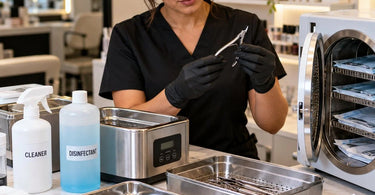
Set yourself up for success... by knowing exactly what your tool processing equipment actually does before you add it to your salon or spa. A shiny machine with a futuristic glow might look impressive on your workstation, but impressive lighting does not automatically mean impressive germ control. Cleaning, disinfection, and sterilization are three different processes, and understanding those differences can protect your clients, your staff, and your investment. Whether you run a nail salon, barber shop, waxing studio, or busy day spa, the right equipment should support your services and your sanitation requirements instead of simply looking fabulous on a countertop.
Here is the good news: comparing professional tool processing equipment becomes much easier once you stop shopping by fancy product names and start shopping by function. Let's break down what the different machines and supplies actually accomplish, which features deserve your attention, and how to build a practical processing station that works during a busy appointment schedule.
First, Understand the Three Processes Everyone Mixes Up
Before comparing equipment prices, capacity, or technology, understand the three basic steps that frequently appear in professional instrument processing.
Cleaning: Cleaning physically removes visible debris, oils, product residue, dust, and other contamination from tools. It generally involves water, an appropriate cleaning agent, and manual or mechanical action. Cleaning is essential because remaining debris can interfere with later disinfection or sterilization.
Disinfection: Disinfection uses an appropriate chemical or physical process to destroy or inactivate many disease-causing microorganisms on nonliving surfaces. Depending on the method and its intended level of disinfection, bacterial spores may survive. Disinfection does not automatically make an instrument sterile.
Sterilization: Sterilization is a validated process intended to eliminate all forms of microbial life, including bacterial spores. Proper sterilization requires equipment, operating parameters, instrument preparation, and verification procedures appropriate to the intended use.
Think of these as different jobs rather than interchangeable marketing terms. A tool can look beautifully clean without being adequately disinfected, and a disinfected tool is not necessarily sterile. That distinction matters far more than whether the machine matches your salon's blush-pink decor.
Compare Equipment by Its Actual Job, Not Its Name
Professional suppliers offer several types of tool processing equipment, but a product name alone does not establish what a device can accomplish. Manufacturers may use words such as sanitizer, cleaner, disinfecting cabinet, or sterilizer. Always check the documented function, operating instructions, validated performance claims, and applicable regulatory requirements.
Here is a practical comparison of common equipment categories.
| Equipment | Primary Purpose | Important Limitation |
|---|---|---|
| Manual cleaning supplies | Remove debris and residue | Cleaning alone does not establish disinfection or sterility |
| Ultrasonic cleaner | Assist mechanical cleaning through ultrasonic action | Does not automatically disinfect or sterilize |
| Disinfectant immersion container | Hold compatible tools in an appropriate disinfectant | Effectiveness depends on the disinfectant label, full contact, and required exposure time |
| UV cabinet | Potentially provide a manufacturer-specified UV treatment or protected storage function | Do not assume it replaces required chemical disinfection or validated sterilization |
| Steam sterilizer or autoclave | Sterilize compatible instruments using validated steam cycles | Requires proper preparation, loading, cycle selection, monitoring, and maintenance |
| Dry heat sterilizer | Sterilize compatible instruments using validated high-temperature cycles | Heat compatibility and validated exposure parameters are essential |
This comparison reveals something important: equipment categories are not automatically substitutes for one another. An ultrasonic cleaner and a steam sterilizer perform fundamentally different functions. Buying one when your workflow requires both is like ordering shampoo when you actually need hair color. Related industry, completely different appointment!
Ultrasonic Cleaners: Excellent Cleaning Assistance, Not Automatic Sterilization
An ultrasonic cleaner can be a useful investment for professional environments that process compatible reusable metal implements. These machines use high-frequency sound waves in a liquid cleaning solution to create cavitation, which helps loosen contamination from certain surfaces and difficult-to-reach areas.
For nail professionals working with compatible cuticle nippers, pushers, and other reusable implements, ultrasonic cleaning may reduce the amount of manual scrubbing required. However, instruments still need to be prepared according to their manufacturers' instructions, and tools must be inspected after cleaning.
When comparing ultrasonic cleaners, consider tank capacity, operating frequency, cycle controls, compatible cleaning solutions, basket design, maintenance requirements, and manufacturer instructions for tool placement.
Most importantly, remember that ultrasonic cleaning is primarily a cleaning step. Unless a complete system has specifically validated additional capabilities, do not treat an ultrasonic cycle as proof that instruments have been disinfected or sterilized.
Disinfectant Containers: Simple Equipment With Serious Responsibilities
Not every sanitation upgrade needs a touchscreen and a power cord. Sometimes the most useful equipment is a properly sized, covered disinfectant jar or immersion container.
For reusable, nonporous tools that can safely be immersed, these containers support chemical disinfection with an appropriate product. Their effectiveness depends on correct procedures, however, rather than the appearance of the container.
Start by choosing suitable Professional Cleaners & Disinfectants for Salons and Spas. Verify the product's EPA registration, permitted use sites, organism claims, dilution instructions, and required contact time. Also confirm that it meets your state board's specific requirements.
When comparing containers, consider whether the tools fit without crowding, whether the lid closes securely, whether the interior can be cleaned, and whether the material is compatible with the chemical solution.
Tools generally need to be cleaned first and then exposed to the disinfectant according to its label. For an immersion procedure, the solution must contact all required surfaces for the full specified time. Follow the product instructions for rinsing, drying, solution replacement, and disposal.
And no, a quick dip while your next client chooses between two nearly identical shades of pink does not count as completing a required contact time.
UV Cabinets: Understand the Claims Before Trusting the Glow
UV cabinets are probably one of the most confusing categories in professional beauty equipment. A cabinet may look high-tech, and a manufacturer may describe it using terms such as UV sanitizer or UV sterilizer.
However, ultraviolet light treatment depends on several factors, including wavelength, dose, exposure duration, surface geometry, cleanliness, and whether the light actually reaches contaminated surfaces. Hinges, tool overlaps, shadows, and internal recesses can limit exposure.
When comparing products in the UV Sterilizers category, treat the collection name as a shopping category, not proof that every product provides validated sterilization.
Ask the manufacturer what specific microbial reduction claims are supported, what testing establishes those claims, which tools are suitable, and whether the device is permitted for the intended function under applicable rules.
In many salon settings, UV cabinets should not be considered substitutes for required cleaning and EPA-registered chemical disinfection. A cabinet may have a useful secondary function when allowed by local regulations and supported by its instructions, but a glowing bulb is not a universal sanitation shortcut.
Autoclaves: Understanding True Steam Sterilization
A steam sterilizer, commonly called an autoclave, uses saturated steam under pressure within validated operating cycles to sterilize compatible instruments. This is a very different process from placing tools in hot water or a warm cabinet.
For businesses whose services, instruments, or local regulations require sterilization, choosing an appropriate autoclave involves several considerations.
Instrument compatibility: Confirm that every instrument you plan to process is approved for the sterilization method and cycle.
Cycle validation: Verify the manufacturer's documented cycle parameters, including temperature, exposure time, drying requirements, and any specific loading restrictions.
Capacity: Evaluate how many properly arranged instruments the unit can process per load without interfering with steam circulation.
Monitoring: Determine the requirements for mechanical monitoring, chemical indicators, biological monitoring, recordkeeping, and corrective action when a cycle fails.
Maintenance: Consider water requirements, cleaning schedules, replacement components, service support, and staff training.
Look for appropriate regulatory authorization or clearance where applicable, rather than relying exclusively on broad advertising claims. Sterilization is a process that must be performed correctly and verified, not simply a button labeled START.
Dry Heat Sterilizers: Not the Same as Ordinary Heated Cabinets
Some professional environments use validated dry heat sterilization equipment for appropriate heat-resistant tools. These devices rely on carefully controlled temperatures and exposure periods to achieve sterilization.
However, not every heated cabinet or towel warmer qualifies as a sterilizer. A towel steamer, for example, is designed for a different purpose and should not be assumed to sterilize metal implements.
When comparing dry heat equipment, request documented sterilization performance, approved cycle parameters, instrument compatibility information, monitoring procedures, and operating instructions.
Check whether the specific device and method are accepted by your licensing authority for your intended services. Do not attempt to improvise sterilization with household ovens, cosmetic warming equipment, or unvalidated heating devices.
Match Your Equipment to the Services You Actually Perform
The right processing station for a nail salon may look different from the right setup for a barber shop, waxing studio, or facial treatment room.
Nail salons: Reusable cuticle nippers, metal pushers, drill bits, and other implements require procedures appropriate to the instrument, its material, and applicable board rules. Start by identifying which items can be safely reused and how each must be processed. Explore Manicure Essentials and Nail Brushes & Tools when organizing compatible professional implements.
Barber shops: Clippers, trimmers, shears, guards, and detachable blades present different cleaning and disinfection challenges. Electrical components generally cannot be immersed, so suitable surface disinfection methods and manufacturer instructions become especially important. Review Professional Shears, Clippers, & Trimmers for Barbers while planning your processing procedures.
Waxing studios: Proper handling of disposable applicators is essential. A single-use applicator does not become reusable because someone wipes it off. Stock appropriate Professional Wax Spatulas and Applicators and establish clear disposal procedures.
Facial treatment rooms: Reusable facial tools and attachments should be processed based on their intended use, material compatibility, and equipment manufacturer instructions. For specialized instruments or services that penetrate the skin, additional requirements may apply beyond ordinary salon disinfection. Browse Spa Tools & Implements for Professionals when assessing your tool inventory.
No single device automatically solves every department's processing needs. The smartest purchasing decision begins with a complete list of instruments and the required treatment for each one.
Seven Questions to Ask Before Buying Any Processing Machine
Before spending money on new equipment, use this practical buying checklist.
- What exact process does the device perform? Is it cleaning, disinfection, sterilization, or a separately documented combination of processes?
- What evidence supports its claims? Request relevant test information, instructions, and regulatory documentation rather than relying on marketing descriptions.
- Which materials and instruments are compatible? Metal, plastic, rubber, adhesive components, and electrical assemblies may have different restrictions.
- What processing steps must happen first? Determine whether manual cleaning, disassembly, rinsing, drying, or specialized preparation is necessary.
- How long is the complete turnaround? Account for preparation, cleaning, disinfection or sterilization, required contact or exposure time, drying, and proper storage.
- What are the operating costs? Include consumables, disinfectants, monitoring supplies, utilities, maintenance, replacement parts, and staff time.
- Does it satisfy applicable rules? Check your state cosmetology or barbering board, health authority, and any additional requirements for specialized services.
A device that costs less initially may become more expensive if its small capacity creates constant delays or its operating supplies are costly. Meanwhile, a sophisticated machine that performs the wrong process is not an upgrade. It is an expensive lesson with a very attractive control panel.
Calculate Capacity Based on Real Appointment Volume
Processing capacity should match your busiest realistic service period, not just your average Tuesday morning.
Imagine a nail salon with four technicians. Each technician performs multiple appointments daily and uses several reusable metal implements per service. If the salon owns too few complete instrument sets, technicians may feel pressured to rush required processing steps between clients.
Instead of assuming faster equipment always solves the problem, calculate how many clean, ready-to-use sets are necessary during peak appointment overlap.
Consider the total time for collecting used tools, removing debris, running any mechanical cleaning process, completing required disinfection or sterilization, drying, inspection, and storage.
Then compare that total turnaround with your booking schedule. Sometimes purchasing additional compatible tool sets is a more practical solution than purchasing a bigger machine.
For example, if a processing workflow occupies a set for 45 minutes and appointments begin every 30 minutes, one set cannot continuously support that schedule. Your business needs enough spare sets to prevent a bottleneck while every required step is completed correctly.
Design a Processing Station That Prevents Mix-Ups
Equipment works best when it sits inside an organized workflow. Even premium machines cannot compensate for dirty and clean instruments being casually mixed together.
Where space allows, organize a tool processing area into clearly identified stages: used-tool collection, cleaning, disinfection or sterilization, inspection and drying, and protected clean storage.
Use appropriate containers for used instruments, maintain sufficient workspace, and separate processed tools from contaminated items. Choose storage products that protect clean instruments from recontamination and comply with your state's requirements.
Keep Protective Gloves & Masks for Salon and Spa Professionals accessible wherever the selected procedures require protective equipment.
Also make instructions easy to follow. A laminated processing checklist, clearly marked containers, and consistent staff training can prevent the classic salon mystery of whether the tools in that tray are finished, waiting, or somehow both.
Do Not Forget the Ongoing Cost of Processing
A machine's sticker price is only one part of its total cost.
Ultrasonic cleaners may require suitable cleaning solutions and periodic tank maintenance. Chemical disinfection requires properly selected products, monitoring of usable solution life where applicable, appropriate containers, and safe disposal. Sterilizers may require indicators, recordkeeping materials, routine testing, servicing, and consumable components.
Estimate your monthly expense using the number of instrument sets processed, the labor involved, consumables per cycle, equipment maintenance, and staff training requirements.
For growing businesses, build these costs into service pricing instead of treating sanitation supplies as an unexpected expense. Reliable processing is a basic operating requirement, not an optional luxury add-on.
Common Equipment Shopping Mistakes to Avoid
Mistake one: Assuming cleaning means disinfection. A visibly clean instrument can still require an approved disinfection process.
Mistake two: Treating all UV cabinets as sterilizers. Product-specific validation and applicable regulations determine what a device can legitimately accomplish.
Mistake three: Ignoring chemical contact time. Disinfectant effectiveness depends on following the product label, including the required exposure period.
Mistake four: Buying equipment that cannot handle your tools. Material compatibility, instrument design, and manufacturer instructions should guide equipment selection.
Mistake five: Forgetting workflow capacity. Even a properly selected system can create delays if the business has too few tool sets or insufficient processing capacity.
Mistake six: Overlooking local regulations. State and local authorities may establish specific requirements for disinfectants, processing methods, storage, and specialized services.
Mistake seven: Assuming disposable items can always be reprocessed. Single-use products must be discarded after their intended use unless the manufacturer and applicable regulations explicitly permit otherwise.
Frequently Asked Questions About Salon Tool Processing Equipment
Does an ultrasonic cleaner sterilize nail tools?
No. An ordinary ultrasonic cleaner is designed to assist with removing debris. Additional disinfection or sterilization may be required depending on the instrument and applicable regulations.
Is a UV cabinet better than chemical disinfectant?
They should not be treated as interchangeable. A UV cabinet does not automatically fulfill the chemical disinfection requirements imposed by salon licensing authorities. Evaluate its validated claims and your local rules before choosing it for any processing function.
Do all salon tools need an autoclave?
No universal answer applies to every service or jurisdiction. Requirements depend on instrument use, whether the item contacts intact skin or penetrates tissue, manufacturer instructions, and relevant laws. Sterilization may be required for certain instruments and procedures, while appropriate disinfection may be permitted for others.
Can disinfectant be used without cleaning first?
Reusable tools generally need thorough cleaning before disinfection because debris can interfere with effectiveness. Follow both the instrument manufacturer's instructions and the disinfectant label.
What matters more, equipment price or processing time?
Neither should outweigh safety and compliance. First confirm that the system performs the required process. Then compare capacity, turnaround time, compatibility, operating expenses, and service support.
Build a Smarter Salon Sanitation Setup With Pure Spa Direct
Choosing the right tool processing equipment is not about collecting the most machines or finding the product with the fanciest description. It is about understanding what your instruments need, selecting equipment with appropriate documented capabilities, following manufacturer instructions, and building a reliable routine your entire team can maintain.
At Pure Spa Direct, we help spa, salon, barber, waxing, and nail professionals shop for the supplies and equipment that support efficient daily operations. As a professional distributor, we offer access to a broad selection of products from established industry manufacturers rather than manufacturing the equipment ourselves.
Explore our Professional Cleaners & Disinfectants, browse Spa Tools & Implements, or shop Top-Quality Equipment & Furniture for Spas & Salons as you refine your processing station.
Remember, a clean tool, a disinfected tool, and a sterile tool are not necessarily the same thing. Once your team understands that distinction, comparing equipment becomes easier, purchasing decisions become smarter, and your sanitation workflow becomes far more dependable. Now that is the kind of professional upgrade worth celebrating!
