
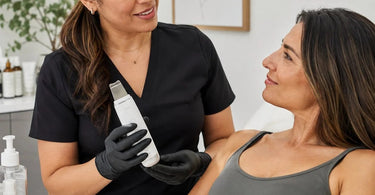
Clients rave about this pro essential... but let's be real, nothing kills the vibe of a luxurious spa day faster than the sinking feeling that you're about to become a human guinea pig for the latest shiny gadget. We've all been there, right? You're excited to show off that new ultrasonic skin scrubber you've been dying to use, but the moment your client eyes it with suspicion, the energy shifts. The goal is to transform that skepticism into excitement, making your client feel like they're getting VIP access to the future of beauty, not a lab experiment. It's a delicate dance, but with the right approach, you can introduce any new tool and have them literally begging to be your first test subject. From the latest high-tech High Frequency Machines to the precision of Dermaplaning tools, the key is in the presentation, not just the product.
Think about it. Introducing a new Facial Steamer or a Microcurrent Machine should be a moment of shared discovery, not a one-sided performance. It's about building a bridge between your professional expertise and their personal comfort. They trust you with their skin, their hair, their overall well-being, so that trust should be the foundation of every new service you offer. When you approach the introduction with the right mix of professionalism, education, and a little bit of humor, you're not just selling a service; you're enhancing the relationship. This post is your guide to mastering that introduction, ensuring you look like a genius and your client leaves feeling like they just discovered a new secret to self-care, all while keeping your business at the cutting edge.
Why "Surprise!" is a Four-Letter Word in the Treatment Room
Let's be honest: no one likes unexpected surprises during a service, especially if it involves something sharp, scary, or making weird noises. That is the fastest way to send your client's relaxation level from a 10 to a negative 100. People come to your spa or salon to relax and trust your expertise. The moment you whip out a device they've never seen and start explaining its functions with a manic gleam in your eye, their brain goes into fight-or-flight mode. Their comfort is the most important thing, and feeling like a test subject is the opposite of comfortable.
This is especially true in high-trust services like waxing. Imagine you're about to start a service with a new Professional Wax Warmer or a new type of ItalWax. If you simply start using it without a word, your client might be bracing for something completely different (and painful!). The secret is to make them a part of the process. An article on the TEDDEE blog nails this by suggesting that when introducing new processes, "the root of resistance often isn't the tech itself—it's the fear of the unknown or the perceived threat to their routine" . Your client's brain works the same way. They know the drill; they trust the drill. A new tool is a disruption unless you guide them through it.
A great way to build this trust is to establish a sense of control and personalization from the very beginning of the appointment. Pure Spa Direct suggests using a simple pre-appointment strategy, like letting a client choose their playlist, to hand them the "remote control to their own mood" before you even start the treatment . This tiny act of giving them a choice signals that their preferences matter, setting a collaborative tone for the entire session. If you've already established that dynamic, the introduction of a new tool feels less like a unilateral decision and more like a continuation of that partnership.
Becoming the Director of Your Client's Experience
Instead of a scary surprise, think of the introduction as a scene in a movie where you are the director. You're setting the stage for an amazing experience, not a horror flick. A recent Pure Spa Direct blog perfectly captures this by emphasizing the importance of "strategically decoding the spec sheet to build a service menu that flows like a dream" . The same principle applies to the tools you use for those services. You need to frame the tool as the key to delivering a better, more comfortable, or more effective experience.
When you introduce something like Ultrasonic Skin Scrubbers for a facial, or a new Wax Spatulas and Applicators for a brow wax, the first step is to build credibility. Don't just say, "Look what I got!" Say something like, "I've been seeing incredible results with this new tool for removing peach fuzz; it gives such a smooth canvas for makeup, and I think you're going to love the glow it creates." This immediately pivots the conversation from the "what" to the "why for them." It's not about your new toy; it's about their new glow.
For estheticians considering advanced tools, this approach is critical. The Skin Inc. article on the Dermaflash Pro highlights that its "no-touch exfoliation and peach fuzz removal system... mitigates the risks that come with ye ol' dermaplaning" . This kind of language—focusing on safety, comfort, and a superior result—is exactly what you should be echoing to your client. You are their expert guide, helping them navigate to the best possible outcome. By framing the tool as a safer, more advanced, and results-driven option, you're not experimenting; you're upgrading their experience.
How to Introduce a New Tool: A Step-by-Step Guide
Alright, let's get down to business. Here's your foolproof method for turning a potential "test subject" moment into a "where have you been all my life?" moment.
Step 1: The Warm-Up (Pre-Appointment)
This is all about planting the seed. If you know you're going to be using a new tool on a client, especially a regular, a little heads-up can work wonders. You can say something casual like, "I'm so excited for your appointment next week! I just got in a new Galvanic Machine that is amazing for deep cleansing—I can't wait for you to try it if you're comfortable." This gives them time to process the idea and, more importantly, it makes them feel like they're getting special treatment. It's an exclusive sneak peek.
For lash and brow services, this is a great way to introduce something new like a Brow Lamination treatment. You can send a quick text: "Hey! I just finished a training on the new brow lamination technique, and the results are incredible! If you're interested in a little brow lift and fluff, we could try it at your appointment next week." It makes them feel like they're getting insider access to the next big thing, which is a powerful motivator. This pre-work builds anticipation and consent, which is the opposite of a surprise.
Step 2: The On-Table Consultation (The "Why" Before the "What")
When your client is on the table and you're about to begin, your consultation is where the magic happens. This is where you dive into the specifics of their needs. If you're doing a facial, you might say, "I'm noticing a little congestion here on your T-zone. I have a new Vacuum and Spray Machine that I think would work wonders to gently clear that out. It uses water and gentle suction, so it's much more comfortable than manual extractions." This isn't an announcement; it's a tailored recommendation based on a problem you've identified together.
This approach is the antidote to the "test subject" fear. A blog from The Beauty Cult emphasizes that you should "shift your mindset: stop selling. Start recommending. You're not pushing products—you're offering solutions" . This is the golden rule of introducing any new service. You're not "trying out" a new tool on them; you're solving a problem they have. For a waxing client, you could say, "I've been using a new Efficient Roll-On Wax Cartridge system that applies wax more evenly and reduces the need for strips in some areas. I think it would make this much faster and cleaner for you." You're painting a picture of a better, more comfortable experience.
Step 3: The Demonstration (Show, Don't Just Tell)
Before you even bring the new Professional Sunless Tanning Equipment or Advanced Spa Equipment near their face, show it to them. Pick it up, turn it on (if it's safe to do so away from them), and explain what they might feel or hear. You can say, "Okay, this tool is very gentle. It uses ultrasonic vibrations, so you might feel a slight tingle or hear a low buzz, but it shouldn't be uncomfortable at all. Let me just try it on my hand first so you can see." By demonstrating it on yourself or a mannequin first, you're providing a visual and aural preview.
This desensitizes them to the unknown. The article about user onboarding for service businesses talks about the importance of "contextual in-app help" and "smart tooltips" to prevent user frustration . Your demonstration is the ultimate smart tooltip. You're helping them, the "user," understand the new tool in a low-stakes, no-pressure environment. This builds a huge amount of trust. You're essentially giving them a backstage tour of the new gadget, and it makes them feel like a collaborator, not a recipient.
Step 4: Start on Low-Stakes Territory
If a client is still a little nervous, don't dive right into the deep end. For example, if you're introducing a new Microdermabrasion tool, start on a less sensitive area like the chin or the forehead. Say, "I'm going to start here on your jawline with a lower setting so you can get a feel for the sensation. Just let me know if it's too much." This gives them agency and an "escape route," which is a massive comfort booster. It turns the experience into a collaborative test drive, not a one-way street. It’s not about being careful; it's about being respectful.
This builds their confidence in your skill and the tool. If they see that you're being cautious and attentive, they will relax. And when they relax, the tool can work more effectively. This is particularly true for services like dermaplaning, where precision and trust are everything. The recent Dermaflash Pro launch article emphasizes that the device was designed to empower estheticians "to work with confidence," and that confidence is contagious . When you handle the tool with confidence and start on a safe area, your client will mirror that confidence.
Step 5: The Play-by-Play (Talk Them Through It)
As you're using the tool, narrate the experience. "Okay, you're going to feel a slight cool sensation from this Hydrodermabrasion wand now as I focus on your cheeks. It feels like a gentle suction, almost like a vacuum cleaner for your pores, but in a good way!" This constant, reassuring commentary removes the mystery and turns the experience into a story. It's like the director's commentary on a DVD, and it makes the client feel more engaged and less passive.
A podcast discussion on AI for massage therapists highlights the idea of having "scripts that sound client-focused" . This is the same principle. You're not just using a tool; you're guiding them through a curated experience. Provide descriptive feedback on what you're seeing: "Look at the glow coming up on your skin right here already!" This immediate, positive reinforcement connects the tool directly to a visible benefit, which is incredibly reassuring and often quite exciting for the client.
Building Confidence in Your Skills and Your Gear
Your confidence in the tool is everything. If you're shaky, they'll be terrified. You need to be an expert. This means you must practice before you ever bring it into the service room. You need to be so familiar with the device that you can operate it while holding a conversation and reading your client's comfort level. It's the only way to look like a pro.
This is where your choice of equipment matters. Investing in reputable brands from Pure Spa Direct, like Silhouet-Tone, Oakworks, or Earthlite, gives you a foundation of reliability. You can also source top-tier brands for specific services, such as ItalWax for waxing or CND for nails, knowing that the quality will support your professional presentation. The tools are an extension of your expertise, and when your confidence is solid, your clients will sense that you are in complete control. The specific spec sheets and features of these high-end products give you ample material for your "play-by-play" narration, from the quiet motor of a Facial Steamer to the precision engineering of a Professional Shear.
To make sure your team is just as confident, consider incorporating quick practice sessions. According to a blog about closing the spa retail training gap, "a few minutes weekly is usually enough" for training to build confidence . The same applies to equipment. Have a 5-minute weekly huddle where you practice using a new tool. You can even do a role-reversal where one team member plays the client on the table while the other introduces the tool. This kind of practice makes the script feel natural and will ensure every team member is comfortable with the new service . Practice builds the muscle memory and the narrative, so when a client says "Oh, what's that?" you don't freeze.
Aftercare: Capping Off the Experience
The introduction doesn't end when the tool is turned off. The final step is to reinforce the client's wise decision to trust you. Highlight the immediate results. "Feel how smooth your skin is! That new Rotary Brush Exfoliator Machine really worked to get rid of that dull top layer." Hand them a mirror and point out the glow. You are validating their comfort and bravery, and you're creating a powerful testimonial for future use.
And don't stop there! This is the perfect time to suggest the right retail products to extend the results at home. Their skin is primed and receptive, and they're more likely to trust your recommendation than ever before. A blog from Universal Companies points out that "staff need tools that make conversations feel supportive, not sales-y" . Now is that golden moment. You can say, "To maintain this amazing glow, I recommend this Premium Skincare serum from our collection. It's the perfect follow-up to the treatment we just did." This completes the circle, moving the client from potential test subject to a loyal advocate for your new, cutting-edge services. By walking them through the process, you're not just introducing a new tool; you're introducing a new level of service and care they'll keep coming back for.
