
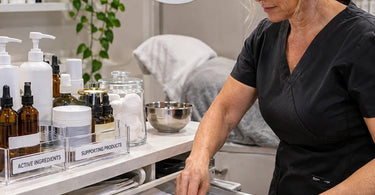
Efficiency drives profits with this tool... and in the professional treatment room, that tool is a thoughtfully organized backbar that keeps every active ingredient, supporting formula, and essential supply exactly where it belongs. If you have ever searched three drawers for a serum while your client relaxes beneath a warm towel, you already know that beautiful shelving does not automatically equal an efficient workspace. Organizing professional skincare products by treatment function, application sequence, and frequency of use can transform a hectic service setup into a smooth, repeatable routine. The goal is not simply to make your shelves look gorgeous, although we certainly appreciate a good matching-container moment. It is to help estheticians work confidently, protect product integrity, control inventory, and spend more time delivering exceptional services instead of playing hide-and-seek with the hyaluronic acid.
Active ingredients are the hardworking stars of many professional facial protocols, but they rarely perform their entire routine alone. Cleansers, application tools, neutralizing products when required, soothing masks, moisturizers, and finishing formulas all support the treatment experience. Creating a logical storage system for these different categories helps professionals prepare efficiently while maintaining the flexibility needed to customize services for individual clients.
Start by Separating Active Ingredients From Supporting Products
The first step toward an organized treatment room is understanding which products serve as targeted treatment formulas and which products support preparation, application, comfort, and finishing.
Active treatment products may include exfoliating acids, enzymes, vitamin C formulas, retinoid-containing products, niacinamide serums, and other concentrated skincare preparations. Depending on their formulation, these ingredients can address concerns such as uneven-looking tone, surface texture, dryness, or the appearance of fine lines. Their professional application requirements vary, making clear identification especially important.
Supporting products include cleansers, toners, hydrating solutions, barrier-supporting moisturizers, calming masks, and finishing products. These items may contain active ingredients themselves, so the distinction is organizational rather than scientific. Think of the categories as treatment roles instead of absolute ingredient classifications.
A practical backbar might contain separate areas for preparation and cleansing, targeted treatment formulas, calming and hydrating products, finishing products, and disposable application supplies. Within these areas, products can be grouped by compatible protocols or specific treatment concerns.
Browse Advanced Facial Treatment Products for Salons & Spas when building a professional assortment that supports several service types without requiring an endless collection of nearly identical bottles.
Organize Products in the Order They Are Actually Used
One of the easiest ways to improve treatment setup is to arrange frequently used products according to the sequence of a service. A product can be perfectly organized alphabetically and still be terribly inconvenient if the cleanser lives beside the finishing moisturizer while the treatment mask is hiding on another shelf.
For a typical customized facial, the organization might follow a simple workflow:
- Preparation: Cleansing products, makeup-removing supplies, and skin assessment essentials.
- Primary treatment: Professionally appropriate exfoliants, enzymes, or targeted treatment formulas.
- Supporting care: Hydrating products, soothing masks, and other formulas selected for the specific protocol.
- Finishing: Moisturizer, sunscreen when indicated, and appropriate finishing products.
- Application essentials: Bowls, spatulas, cotton supplies, gloves, and other necessary implements.
This layout allows an esthetician to follow the service sequence without repeatedly crossing the room. Products requiring special storage, controlled access, or additional safety precautions should remain in their designated locations rather than being moved simply for convenience.
For treatment providers offering different facial modalities, organize separate protocol-specific kits that contain approved supporting supplies and clearly identify any specialized products that must be retrieved separately.
Create Dedicated Zones for Different Categories of Active Ingredients
Not every active ingredient belongs in the same storage bin. Different formulas have different stability requirements, potential incompatibilities, and application instructions.
Establish clearly labeled locations for categories such as professional exfoliants, enzyme preparations, antioxidant serums, hydration-focused formulas, and barrier-supporting treatments. Organizing by function makes products easier to locate, while individual labels preserve the information needed for correct selection.
For example, an exfoliation section could contain approved enzyme masks and professional exfoliating solutions, with each product retained in its original packaging. Products should be separated further according to manufacturer requirements and treatment protocols. Acids and other strong professional treatments should not be treated as interchangeable simply because they share a shelf.
Antioxidant preparations may require particular protection from heat, light, or air exposure, depending on the formulation. Other products may require refrigeration or specific temperature ranges. Always follow the manufacturer's storage instructions rather than assuming that every serum benefits from the same conditions.
Keeping professional formulas in their original, properly labeled containers also helps preserve access to ingredient information, expiration dates, lot numbers, and usage directions.
Give Supporting Products Their Own Organized Space
Supporting products deserve just as much attention as the headline ingredients. After all, a treatment protocol that calls for a soothing mask is not particularly efficient if the mask is missing and the client is already on the table.
Create a supporting-products area that includes frequently used cleansers, hydrating masks, moisturizers, and appropriate finishing formulas. Consider subdividing this area by treatment purpose, such as soothing care, hydration, or post-treatment finishing.
For services involving masks and preparations that require dispensing or mixing, keep clean, appropriate Mixing Bowls and Applicators & Spatulas available in a protected storage area.
Professionals should dispense products hygienically, avoid placing used applicators back into shared containers, and discard unused portions that have been dispensed for an individual client rather than returning them to bulk packaging.
It is also helpful to distinguish universal supporting products from protocol-specific products. A gentle cleanser might be appropriate for several services, while a specialized finishing formula might belong with one particular treatment system.
Build Treatment Kits That Make Setup Faster
One of the most practical organizational strategies for busy spas is creating service-specific treatment kits. These kits function as organized collections of approved supplies, allowing estheticians to prepare efficiently without repeatedly gathering the same items.
A hydrating facial kit might include designated cleansing supplies, approved application implements, a hydrating mask, and the supporting formulas required by that service. A professional exfoliation setup could include protocol instructions, clean applicators, timing equipment, and designated pre-treatment and post-treatment products.
The objective is not to pre-mix active formulas or prepare unstable products in advance. Many professional preparations must be mixed or dispensed immediately before use, and some should never be combined unless the manufacturer explicitly instructs otherwise.
Instead, organize the unopened products, clean equipment, and supporting supplies so the provider can complete the appropriate preparation at the proper time.
Stackable bins, clearly identified trays, and covered storage containers can make this system easier to maintain. For smaller treatment rooms, a designated cart may provide convenient access without overwhelming counter space.
Explore Spa Essentials for Professionals when developing a practical setup that accommodates daily treatment supplies.
Use Labels That Tell Your Team More Than Just a Product Name
Clear labeling is essential when multiple estheticians share a backbar. While everyone may recognize the signature cleanser, specialized treatment formulas deserve more detailed identification.
Useful shelf or bin labels can identify the product category, designated protocol, storage requirements, and whether the products are intended for general treatment use or restricted professional applications.
For individual products, retain manufacturer labels and establish a separate inventory record that tracks opening dates when applicable, expiration information, lot numbers, and any required use-after-opening period.
Color-coded labels can make categories easier to recognize. For example, one color could identify preparation products, another targeted treatment formulas, and another finishing products. However, colors should supplement written identification, not replace it.
Keep the system simple enough that a new team member can understand it without needing an elaborate treasure map. If your organizational system requires a thirty-minute explanation and a decoder ring, it might be time to simplify.
Keep Tools and Disposable Supplies Within Easy Reach
Even a perfectly arranged collection of skincare products cannot prevent interruptions if the provider must leave the treatment area to find cotton rounds, a clean brush, or a fresh pair of gloves.
Create a dedicated supply zone for frequently used disposable and reusable implements. This might include Professional Cotton, Sponges, and Wipes for Salons & Spas, Compressed Sponges, clean application brushes, and Protective Gloves & Masks for Salon and Spa Professionals.
Store clean implements separately from used tools and maintain clearly defined procedures for cleaning, disinfection, and disposal. Single-use items should never be reprocessed for another client. Reusable implements must be cleaned and disinfected according to applicable regulations and manufacturer directions before being returned to clean storage.
Frequently used supplies should be accessible without exposing unused inventory to contamination. Closed drawers, covered containers, and appropriately designed dispensers can support a more controlled setup.
When the treatment station is properly stocked, the esthetician can maintain the natural rhythm of the service instead of interrupting a relaxing facial to conduct an emergency cotton-round expedition.
Design a Treatment Cart Around Movement and Accessibility
The physical placement of products matters almost as much as their category. A beautiful backbar that forces constant reaching, bending, and turning may create unnecessary fatigue throughout a busy day.
Arrange your treatment cart or workstation according to how frequently different items are used. Keep the most frequently accessed supplies at comfortable working heights, while less commonly needed items can occupy designated secondary storage.
Place stable, heavier equipment where it can be safely supported. Avoid overcrowding shelves with fragile glass containers, and keep liquids away from electrical components unless the equipment and workspace are designed for that arrangement.
Separate clean preparation surfaces from areas used for contaminated items or waste. A dedicated space for dispensing products should be easy to clean and large enough to accommodate the supplies needed for the procedure.
If your treatment room includes equipment such as Facial Steamers or Magnifying Lights, plan the surrounding product placement so cords, heat, moisture, and equipment movement do not interfere with safe access to skincare formulas.
Separate Everyday Backbar Products From Specialized Treatment Supplies
Not every item needs to occupy prime treatment-room real estate. Specialized formulas used occasionally can take up valuable space when stored alongside products needed for almost every appointment.
Consider a two-level inventory system. The treatment-room backbar holds an appropriate working quantity of frequently used products, while a separate stockroom contains additional inventory and less frequently requested supplies.
Specialized products can be retrieved according to scheduled services and manufacturer handling requirements. This arrangement can help keep workstations uncluttered while supporting a wider service menu.
For example, a spa offering traditional facials alongside Dermaplaning or Hydrodermabrasion might maintain separate supplies and preparation checklists for each modality.
Specialized procedures should only be performed by appropriately trained professionals operating within applicable licensing rules, using products and equipment as directed by their manufacturers.
The ideal organization makes standard services easy to prepare without compromising the specific requirements of advanced treatments.
Build Inventory Management Into Your Organization System
Organized shelves are wonderful, but they are even more valuable when they help prevent product shortages, waste, and surprise purchasing emergencies.
Start by identifying which active ingredients and supporting products are used most frequently. Track typical consumption per service, the number of appointments performed, supplier lead times, and any manufacturer-established shelf-life limitations.
Establish minimum stock quantities for essential supplies. When inventory reaches the designated reorder point, the purchasing team knows it is time to replenish the product before the next busy week begins.
Rotate eligible inventory according to expiration dates, using earlier-expiring products first when they remain suitable for use. Check packaging integrity and required storage conditions during routine inventory reviews. Discard expired, compromised, or improperly stored products according to manufacturer instructions and applicable requirements.
Products that are expensive, unstable, or used infrequently may require smaller working quantities. Ordering oversized containers is not necessarily economical if the contents cannot be used within their permitted lifespan.
Professional Bottles & Jars can be useful for appropriate dispensing and storage applications, but active formulas should not be transferred into alternate packaging unless the manufacturer permits it and all labeling, compatibility, and sanitation requirements can be maintained.
Efficiency is about reducing waste as well as reducing search time. The goal is to stock what the business actually uses, not to create a miniature skincare warehouse with mood lighting.
Establish a Consistent Setup Checklist for Every Treatment
Once your products are organized, maintain that efficiency with a standardized treatment preparation checklist. A checklist supports consistency while allowing the provider to select appropriate formulas for each client's needs.
Before an appointment, the esthetician can verify the scheduled service, review relevant consultation information, confirm that the planned protocol is appropriate, and check that required products and supplies are available.
The provider should also confirm that active products are within their usable dates, required equipment is functioning properly, and clean implements are ready for use.
For professional exfoliants and other specialized formulas, verify required instructions, contraindications, timing, and any prescribed supporting products before treatment begins. Ingredient familiarity alone is not enough to establish that two formulas can safely be combined or layered.
A simple checklist can include treatment identification, product selection, clean implement availability, equipment readiness, sanitation verification, and post-service replenishment.
This process becomes especially valuable when multiple employees share treatment rooms or when a business offers a broad range of customized facial services.
Make Sanitation Part of the Storage Design
Efficient treatment setup and professional sanitation should work together. Storage solutions that are difficult to clean or require frequent contact with shared product contents can create unnecessary risks.
Choose storage surfaces that can be cleaned and disinfected appropriately. Keep clean linens protected from used materials, maintain separate locations for disinfected implements, and provide designated disposal containers for contaminated single-use items.
Use Professional Cleaners & Disinfectants for Salons and Spas appropriate for the surfaces and equipment being treated, following their label directions for dilution, application, compatibility, and required contact time.
Disinfectants should remain in their properly identified containers and be stored separately from skincare preparations according to label requirements. Never mix cleaning chemicals or substitute them for cosmetic treatment products.
Keep commonly touched dispensing surfaces and workstations within the cleaning schedule. Whenever a product container or implement becomes contaminated, follow the appropriate handling or disposal procedure before the next client.
An organized setup should make correct hygiene practices easier to perform consistently, not create shortcuts that compromise them.
Train Every Esthetician to Follow the Same Organization System
Even the most thoughtfully designed backbar can become chaotic if each team member has a different idea of where products belong.
Create straightforward written procedures for returning products to their assigned locations, replenishing disposable supplies, recording inventory usage, and identifying damaged or expired stock.
New employees should learn the treatment-room layout as part of their onboarding process. Demonstrate where everyday products are stored, which areas contain specialized formulas, and how to access approved protocols and manufacturer instructions.
Consider including a simple shelf diagram or laminated workstation checklist in the treatment room. These small reference tools are especially helpful in businesses where providers rotate between different rooms.
Encourage employees to report recurring setup problems. If three estheticians continually reach across the room for the same moisturizer, that is useful information about your current layout.
The system should support the people using it. A little team feedback can prevent your perfectly labeled shelves from becoming a beautifully organized inconvenience.
Review Your Treatment Setup as Your Service Menu Changes
Backbar organization should evolve with the business. Introducing new treatments, changing product lines, or increasing appointment volume can alter which formulas and supporting products deserve the most accessible locations.
Schedule periodic reviews to evaluate product usage, staff feedback, inventory turnover, and service preparation routines. Identify products that are rarely used, duplicate similar functions, or no longer belong to an active treatment protocol.
For example, adding a more comprehensive hydration-focused service may increase the demand for certain masks, serums, and application supplies. Expanding advanced facial offerings may require additional dedicated storage, more specialized implements, or revised handling procedures.
When adjusting the assortment, explore Must-Have Supplies for Salon & Spa Business Success alongside the professional treatment categories relevant to your service menu.
Reviewing your setup regularly helps ensure the organization system continues to reflect actual daily operations instead of the business you operated two years ago.
A More Organized Backbar Creates a Better Treatment Experience
Learning how to organize active ingredients and supporting products for efficient treatment setup is about much more than attractive shelves and matching labels. It is about building a treatment environment where professional skincare products are easy to locate, appropriate protocols are easier to follow, and employees can prepare services with greater consistency.
Separating targeted formulas from supporting products, arranging supplies according to workflow, creating dedicated treatment kits, and establishing clear inventory procedures can help reduce unnecessary movement and interruptions. Thoughtful sanitation practices and manufacturer-directed storage remain essential parts of the process.
For spa owners and estheticians, these improvements can support better use of staff time, more predictable product consumption, and a calmer treatment experience. Clients may never notice that your cleansers, serums, masks, and implements have designated locations, but they can certainly appreciate an appointment that feels organized and professionally delivered.
Pure Spa Direct helps spa and salon professionals source the skincare products, application tools, treatment supplies, and equipment needed to build practical treatment-room setups. As a professional distributor, we offer access to products and supplies across a wide range of service categories, making it easier to assemble the essentials that fit your business.
Explore our professional facial treatment products and Spa Tools & Implements for Professionals to create a backbar that works as efficiently as your team does. Because the most relaxing moment in a facial should belong to your client, not to the esthetician finally discovering where someone put the serum.
