
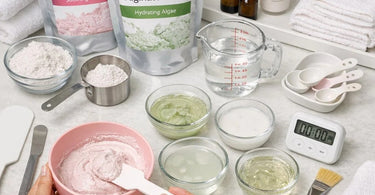
Efficiency drives profits with this tool, but let's be real, nothing kills the vibe of a luxurious facial faster than a lumpy, watery, or rock-hard alginate mask disaster. We have all been there—you turn your back for two seconds to grab a spatula, and suddenly the bowl contains what looks like chunky oatmeal instead of the smooth, creamy rubber mask your client was expecting. Or worse, you pour it on, and it drips everywhere like a sad, seaweed-scented waterfall. But fear not, my fabulous friend! Mastering the art of the alginate mask is easier than convincing a client to buy the retail skincare products you just used. It is all about precision, speed, and a little bit of science.
At Pure Spa Direct, we are your wholesale BFFs. We supply the gear, and you supply the magic hands. Whether you run a high-end day spa, a bustling salon, or a wellness center, alginate masks are a non-negotiable tool for hydration, lifting, and delivering those delicious active ingredients deep into the skin. But because these masks are divas (they set fast and demand respect), you need to know how to handle them.
Today, we are ditching the beauty school flashbacks and diving deep into the gooey, glorious world of professional facial treatments. Grab your mixing bowls and your sense of humor—it is time to get mixing.
Why Bother With Alginate? (Besides Looking Cool)
First things first, why are we even using this stuff? If you are still slapping on basic cream masks and calling it a day, you are missing out. Alginate masks, derived from seaweed, are the shape-shifters of the spa body treatment world. When mixed correctly, they form a rubberized, occlusive seal over the skin . This does two amazing things: it drives those expensive serums deeper into the epidermis, and it provides a gentle lifting effect as it peels off. Plus, the cooling sensation is basically a nap for the skin. It is the closest we can get to a time machine for a tired complexion, and frankly, peeling it off in one satisfying piece is deeply, deeply satisfying.
The Non-Negotiable Tool Kit
Before you even look at the powder, you need your weapons ready. Alginate waits for no one. Do not be the girl scrambling for a spatula while the clock ticks. You will need:
- The Right Bowl: Metal is a no-no (it can react with the mix) and flimsy plastic is annoying. Grab a flexible silicone or smooth glass bowl. It makes cleanup infinitely easier .
- The Spatula: A sturdy medical-grade spatula or a silicone whisk. We want smooth blending, not aerated paraffin.
- The Water: Tap water is the enemy. Minerals in tap water can accelerate setting or cause uneven gelling . You need cool, distilled or purified water. Keep it in the fridge.
- The Scale/Scoop: Eyeballing it is for guacamole, not professional salon equipment techniques. Use the scoop provided or a digital scale.
Pro tip: Wear protective gloves if you have a lot of back-to-back brow lamination and facial clients. While the ingredients are generally safe, keeping the goop off your manicure is always a win.
The Secret Sauce: Ratios and Temperatures
Here is where most spa professionals go off the rails. They read the bag once and think they have it memorized. They do not. Different brands have different densities . Some bulk wax deals come with specific instructions, but so do these masks. Generally, you are looking at a ratio of roughly 1 part powder to 1.5 or 2 parts water, but always check the manufacturer's label .
Temperature control is your secret weapon. If you use warm water, that mask is going to turn into a brick in about 30 seconds . You will be scraping it out of the bowl with a chisel. Use cool water (around 50-60°F / 10-15°C). This slows down the chemical reaction just enough to give you a solid 60 to 90 seconds of working time . That is plenty of time to slap it on, even if you are clumsy (we love you anyway).
Step-by-Step: The Perfect Mix
Alright, let's save that facial. Follow these steps exactly, and you will never serve a lumpy mask again.
Step 1: Add Water First - Pour your cool distilled water into your clean mixing bowl. Why? Because if you put powder first, half of it gets stuck in the bottom corners of the bowl and refuses to blend. Water first, then powder on top ensures a smooth mix .
Step 2: Sprinkle, Don't Dump - Slowly sprinkle the alginate powder evenly over the surface of the water. Let it sit for about 10 seconds to hydrate. This is called "blooming" in the chemistry world, but we call it "not having lumps." .
Step 3: The 30-Second Whisk - Using your spatula, stir rapidly in a circular or figure-eight motion. Do not whip it like you are beating eggs for a meringue. You want no air bubbles. Air bubbles create craters in the mask. Stir until it looks like thick, glossy pancake batter or Greek yogurt .
Step 4: Apply Immediately - Seriously, drop the spatula and pick up your application brush. As soon as it looks smooth, get it on the face. Start from the forehead and work down to the chin, making sure the layer is thick enough to peel (about 3-5mm).
Application: The Art of the Slather
Now that your mix is perfect, let's talk about the landing. You have a client lying there, hopefully not looking up your nose. You have applied your premium skincare products or serums underneath. As you apply the alginate, use a brush or a spatula to smooth it out. Be careful around the lash and brow service area (unless you want to wax their eyebrows off—spoiler: you don't).
Many professionals like to apply a thin layer of Hyaluronic Acid or a hydrogel mask underneath the alginate to make removal even easier and boost hydration . The alginate locks in all that moisture, creating a "sauna" effect for the skin. Leave it on for about 15 to 20 minutes. Do not let it sit for 45 minutes unless you want it to absorb the souls of the living (it gets really hard to remove).
Oops! Fixing Common Disasters
Even the best of us mess up sometimes. Here is how to troubleshoot:
- The "Too Runny" Disaster: This usually means your water was too warm or you added too much liquid. If it is dripping off the chin, unfortunately, there is no saving it. Apologize to the client, wipe it off, and start over with cooler water and less liquid.
- The "Lumpy Oatmeal" Mess: You added the powder all at once. This happens. If lumps are already forming, mixing harder won't fix it. Chalk it up to a learning experience and remix. Wasting product is cheaper than a bad review.
- The "Rock Hard" Bowl: You let the leftover mix dry in your mixing bowls. For the love of all that is holy, rinse it out immediately with cold water. Hot water makes alginate stickier. Cold water allows it to release and wash away easily .
Stock Up at Pure Spa Direct
You cannot perfect a craft without the right supplies for salon and spa business success. At Pure Spa Direct, we have everything you need to elevate your facial game. From high-quality facial steamers to open the pores, to the mixing bowls that make cleanup a breeze, we keep your back bar looking sharp.
Looking to expand your menu? Try pairing your fresh alginate mask with tools like high frequency machines or ultrasonic skin scrubbers before application. The conductivity and occlusion work wonders together. And do not forget the professional cotton products for salons and spas to clean up the edges.
Now go forth and mix with confidence! Your clients are waiting for that perfect, peel-off moment.
Ready to upgrade your treatment room? Shop our full Advanced Facial Treatment collection or browse brands like Tuel Skincare and Murad for the perfect layering products under your alginate. Don't forget to check out our Boca Terry linens for the ultimate plush experience while the mask sets!
