
Upgrade your offerings with this now... because honestly, nothing kills the Zen vibe of a Hydrodermabrasion facial quite like an accidental inferno in the back room. Look, we love the smell of Premium Nail Polish in the morning as much as the next esthetician, but let's talk about the unglamorous hero of the nail world: Acetone. You buy it in bulk to save those precious pennies (and to ensure you never run out during a Saturday rush), but that giant metal tin can be a bit of a drama queen. It is highly flammable, emits fumes that can make you loopy, and frankly, it doesn't like to be treated like an old bottle of water.
Whether you run a high-volume Pedicure Chairs/Spas paradise or a bustling Nail Tables and Manicure Stations hub, storing large volumes of acetone requires respect, know-how, and a dash of paranoia (the healthy kind). We aren't just trying to keep your Professional Nail Care Collections looking pretty; we are trying to keep your insurance agent happy and your eyebrows un-singed. At Pure Spa Direct, we supply the pros, which means we also believe in keeping those pros safe. So, grab a Cuticle Oil and a coffee, and lets get into the explosive (pun intended) details of acetone storage.
Why Your Bulk Acetone Needs Its Own VIP Section
First things first: Acetone is not a guest at the party; it is the guest who arrives in a leather jacket, starts a mosh pit, and tries to steal the spotlight. In chemical terms, it is a Class IB Flammable Liquid . That flashpoint? A terrifyingly low 0°F (-18°C) . Translation? At room temperature, acetone is basically begging to catch fire if it sees a spark. You cannot just shove a 5-gallon drum under the sink next to your Towel Steamers (which generate heat). That is a recipe for disaster.
Before we dive into the nerdy rules, know this: Your local fire marshal or state cosmetology board probably has specific codes. For instance, some state regulations, like in Mississippi, strictly limit salons to no more than two (2) gallons of acetone stored or in use at any one time . We know, we know—you love the Bulk Wax Deals and want the same for your liquids, but safety codes often dictate quantity. If you need massive amounts, you need a specific game plan. Let's break down how to store that liquid courage safely.
The Golden Rules Of Acetone Real Estate
If you are storing more than a few small bottles for Acrylic Nail Supplies or Dipping Powder Systems for Salons, you need a dedicated Flammable Storage Cabinet. Yes, your metal tool cabinet from the hardware store wont cut it. These cabinets are specifically engineered with double walls, air gaps for fire resistance, and leak-proof sumps at the bottom .
Think of it as a bomb shelter for your Professional Nail Care Collections. OSHA regulations (specifically 29 CFR 1910.106) dictate that you cannot store more than 60 gallons of a Class I flammable liquid in a single storage cabinet, and you are limited to three cabinets per building . So, unless you are running a factory, stick to one cabinet and keep your inventory lean and mean. Also, never store acetone near oxidizers or acids . Acetone can form explosive peroxides when it oxidizes. Yes, explosive. Keep your acetone far, far away from your Hair Bleaches and Lighteners if they are powdered oxidizers.
Containers: Ditch The Plastic Party Cup
We see it all the time: A technician transfers a gallon of acetone into a random plastic water bottle or a cheap squeeze bottle that looks cute on the Nail Art Supplies shelf. Stop it. Right now. Acetone is a solvent. It eats through certain plastics. Over time, that bottle will weaken, crack, and leak thousands of dollars of product (and highly flammable fumes) all over your floor.
Your acetone must live in approved containers. For large volumes, we recommend Type I or Type II Safety Cans . These are usually bright red (to indicate flammability) and come with spring-closing lids, flame arresters, and leak-tight seals. If you are decanting into smaller bottles for your Manicure Essentials station, use high-density polyethylene (HDPE) or metal containers specifically rated for acetone, and make sure they have a self-closing lid. And for the love of all that is holy, label it. A generic spray bottle should never hide the fact that it contains a Class IB liquid .
Location, Location, Extinguisher
Where you put your storage cabinet matters as much as the cabinet itself. You need a cool, dry, and well-ventilated area . Vapors are the real enemy here. Acetone vapors are heavier than air, meaning they sink to the floor and travel. They can travel across the room to a pilot light, a spark from a Hair Styling Tools & Appliances motor, or a static shock and then rush back to the source.
Do not store acetone near exits (it blocks evacuation routes), in a boiler room, or directly next to your electrical panel. Ideally, your Bottles & Jars full of acetone should live in a room with an exhaust fan or a dedicated ventilation system. Also, ensure you have a Class B fire extinguisher (for flammable liquids) within easy reach. Water won't put out an acetone fire; in fact, it might just spread it.
Handling & Housekeeping (The Boring But Vital Stuff)
Okay, so the tank is safe in the magic red box. But what about during service? When you are pouring acetone for a Gelish soak-off or refilling your station, you need PPE (Personal Protective Equipment). Acetone is a degreaser, which sounds nice until it strips the natural oils from your skin, leaving you with cracked, bleeding cuticles . It also absorbs through the skin—yuck. Wear Protective Gloves & Masks for Salon and Spa Professionals. Specifically, gloves made of Butyl rubber or Viton; standard latex gloves dissolve in acetone.
Here is a funny (read: annoying) truth: Acetone evaporates faster than your willpower to clean the wax pot. But that evaporation is a fire hazard. Always keep the lid on your storage containers and your safety cans . If you spill acetone (and you will), do not just leave it to evaporate while you grab a paper towel. Ventilate the area immediately. Soak up the spill with Professional Cotton, Sponges, and Wipes for Salons & Spas and dispose of those waste materials in a covered, flame-resistant trash can. Do not just throw soaking wet rags in a closed bin; they can create vapors or, if contaminated with other products, spontaneously combust .
Training Your Team (Make It Fun, Or Else)
Lets face it, staff meetings are boring. But telling the story of the salon that burned down because someone dropped an e-file onto an open acetone cup? That gets attention. Your Waxing Supplies for Professionals might be harmless, but your solvents are spicy.
Create a rule: No open acetone containers near charging stations or electrical outlets. Keep the Nail Art Rhinestones away from the spill zone. Train your technicians on the SDS (Safety Data Sheet). Yes, it is a snooze-fest, but it tells you exactly what to do if someone inhales too many fumes (dizzy, headaches, nausea) or gets it in their eyes (flush for 15 minutes!).
At Pure Spa Direct, we are your partners in profit and safety. Whether you need new Safety Containers (search our site for safety cans) or you are restocking on Cuccio polishes and ItalWax, we ship it fast so you don't have to hoard dangerously large quantities. Keep your stock lean, your storage red, and your sense of humor intact.
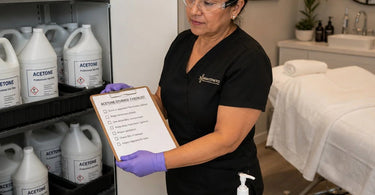
Quick Checklist: Is Your Acetone Storage Lit? (Hopefully Not Literally)
- [ ] The Cabinet: Is it a yellow or red flammable cabinet with a self-closing door?
- [ ] The Quantity: Are you under the 60-gallon per cabinet limit (or state-specific 2-gallon limit)?
- [ ] The Vent: Is the room free of vapor accumulation and ignition sources?
- [ ] The Gloves: Are you wearing chemical-resistant gloves when handling bulk fills?
- [ ] The Spill Kit: Do you have absorbents and a plan?
Now go forth and conquer those Professional Gel Polish services, safe in the knowledge that your back room won't explode. Happy (and safe) selling!
)