
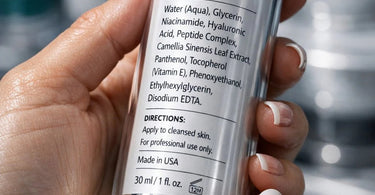
Stay ready for anything... especially a client squinting at the tiny print on the back of your luxury serum and asking, "So, what does dimethicone actually DO?" Don't sweat it! Reading a professional cosmetic label isn't about having a chemistry degree; it's about knowing where to look and what the key sections really mean. For spa and salon professionals, this skill is pure gold. It builds immense trust, elevates your consultations, and turns random product recommendations into authoritative, educational moments that boost retail sales. Think of yourself as a label detective, and this guide is your magnifying glass. Let's decode those bottles, jars, and tubes together, so you can confidently explain it all to your clients. First stop on our investigative tour? The front panel, where marketing meets reality.
The front of the bottle is the flirtatious first date—all promises and pretty pictures. It's designed to seduce, but your job is to read between the lines. Words like "clinical," "dermatologist-tested," or "luxury" are vibe descriptors, not regulated guarantees. Pay closer attention to claims like "hypoallergenic" or "non-comedogenic." While not strictly defined by the FDA, they generally indicate the product is formulated to be less likely to cause allergic reactions or clog pores. The product name and brand, like those from our Tuel Skincare Collection or Murad, give you a sense of the line's philosophy. But the real truth serum? That's on the back and sides.
The INCI List: Your Ingredient Roadmap (It's Not as Scary as It Looks)
Flip the bottle. That block of scientific-sounding names is the International Nomenclature of Cosmetic Ingredients (INCI) list. Here's the #1 rule to share with clients: Ingredients are listed in descending order of concentration. The first five ingredients typically make up the bulk of the formula. So, if your Hyaluronic Acid Serum lists "Aqua (Water)" first and "Sodium Hyaluronate" third, that's a good sign of potency. Ingredients present at 1% or less can be listed in any order after the major players. A common marker for this 1% threshold is preservatives like Phenoxyethanol. See it? Everything after it is likely in that smaller-dose category.
Active Ingredients vs. Functional Ingredients: The Dream Team
This is a crucial distinction for explaining product efficacy. Active Ingredients are the "stars" that directly address a specific concern—like retinol for aging, salicylic acid for acne, or titanium dioxide for sun protection. In some products (like OTC drugs for acne or sunscreen), these actives will be called out separately. Functional Ingredients are the essential "supporting cast" that make the product workable, stable, and pleasant to use. This includes emulsifiers, preservatives, fragrances, and texture enhancers. A client might ask, "Why is there silicone in this?" You can explain that dimethicone (a silicone) is a functional ingredient that creates a silky, spreadable feel and can help lock in moisture—it's not necessarily a "bad" thing!
Decoding Common Label Claims & Certifications
Clients love these buzzwords, and you should know what's behind them.
Cruelty-Free/Leaping Bunny: The product wasn't tested on animals. This is different from "Vegan," which means it contains no animal-derived ingredients.
Organic: Look for a certification seal (like USDA). The term alone isn't regulated for cosmetics. Brands like Organic Fiji often highlight their certified ingredients.
Paraben-Free, Sulfate-Free: These indicate the formula excludes these specific, commonly debated ingredients. It's a formulation choice, not an automatic indicator of safety or efficacy.
Fragrance-Free vs. Unscented: A big one! "Fragrance-Free" means no smell-masking ingredients were added. "Unscented" often means a masking fragrance was used to neutralize the natural smell of the ingredients. For sensitive skin, fragrance-free is usually the better bet.
The Practical Info: Net Weight, Shelf Life & How to Use
Don't ignore the bottom! The net weight (e.g., 1.7 oz / 50 mL) tells you exactly what you're paying for. The Period After Opening (PAO) symbol—an open jar icon with a number like "12M"—tells you how many months the product is good for after it's first opened. This is gold for encouraging clients to actually use their products and for maintaining treatment room hygiene. Directions for use ("Apply to clean face morning and night") are also there for a reason—following them ensures the product works as intended. This is especially important for professional-grade products used alongside your services, like Post-Waxing Products or Advanced Facial Treatments.
Putting It Into Practice: A Sample Client Conversation
Let's role-play. Your client holds up a bottle of professional-grade brightening serum.
Client: "This is so expensive! What makes it special?"
You (The Expert): "Great question! Let's look together. See here? 'Glycolic Acid' is listed second, which means it's a high concentration of the active ingredient that exfoliates dull skin. Then we have 'Licorice Root Extract' and 'Vitamin C' further down—these are brightening agents that work in synergy. It's also formulated without synthetic fragrance, which I recommend for your skin type. The packaging is airtight to keep the vitamin C stable. So, you're paying for a potent, thoughtful formula that will deliver real results."
Boom. You just turned a price tag into a value proposition using the label as your evidence.
Equipping Your Space & Your Knowledge
Having the right tools makes label reading easier. A good Magnifying Light at your consultation station is a pro move. Stock your retail shelves with brands that prioritize transparent labeling and education, like our Ayur-Medic or June Jacobs lines. And remember, the best resource is often the brand's professional educator or detailed website. We at Pure Spa Direct are here to connect you with that information for the thousands of products we carry, from Professional Hair Color to Spa Body Treatments.
Final Pro-Tip: When in Doubt, Patch Test!
No matter how well you read a label, individual skin is unpredictable. Always recommend a patch test for new products, especially those with active ingredients. This final step of care reinforces your expertise and protects your client's skin—and your reputation. It shows you've moved beyond just selling a product to providing a complete, responsible skincare prescription.
Mastering the art of the label transforms you from a service provider to a trusted skincare authority. It demystifies the products you use in treatments like Dermaplaning or Hydrodermabrasion, and it empowers your clients to make smarter choices long after they leave your chair. So grab a few bottles from your shelf, practice your detective work, and get ready to build deeper trust—one ingredient list at a time.
%20-%20Your%20Ultimate%20Guide%20to%20Transparency%20%26%20Trust)