
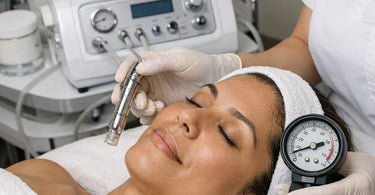
Pros pick this product because they know that flawless skin doesn't happen by accident, and neither does a flawless microdermabrasion treatment. If you have ever found yourself staring at your Microdermabrasion machine wondering if it is working as hard as you are, you are not alone. That little humming box of magic relies heavily on one tiny but mighty hero: suction power. Without the perfect amount of vacuum pressure, you are either gently tickling the client's face (resulting in zero glow) or pulling so hard you risk leaving little red souvenirs called petechiae . Neither scenario is great for your books or your tips. So, grab your favorite lukewarm coffee (because we know you never get to drink it hot) and lets dive into the surprisingly funny world of vacuum gauges, tissue paper, and why your Hydrodermabrasion machine needs a check-up.
Before you roll your eyes and think, "Kelly, I went to school. I know how to turn a dial," hear me out. Testing suction isn't just about flipping a switch. It is about calibration, client comfort, and ensuring that the expensive machine you bought from us isn't just acting as a very noisy paperweight. We have seen it all: the machine that sounds like a jet engine but pulls like a hamster drinking a smoothie, and the one that looks gentle but could suck the chrome off a trailer hitch. Today, we are going to fix that.
Why Bother Testing? Isn't New Stuff Always Perfect?
Oh, honey. If I had a dollar for every time a brand new Advanced Facial Treatment Product came out of the box acting diva-ish, I could retire to a beach in Aruba with a lifetime supply of ItalWax. Shipping vibrations, manufacturing quirks, and just general bad juju can affect the internal pump pressure. Furthermore, as you use your machine, those little filters get clogged with the dead skin cells of a thousand clients. That build-up is the enemy of performance. Regular suction testing ensures you aren't charging $150 for a "luxury treatment" that is performing at a dollar-store level.
The "Hand Test" vs. The Real Deal
Let me tell you a secret. Sticking your finger over the handpiece hose and saying, "Yep, feels like it's sucking," is not a valid diagnostic technique. Yet, we see estheticians do this daily. Our fingers have nerve endings, sure, but they cannot tell you the difference between 40 kPa and 60 kPa. You need objective data. Clinical studies have shown that therapeutic effects occur at varying pressures, but complete stratum corneum removal happens effectively around that -40 to -60 kPa range . Too low, and you are just giving a weird wind massage. Too high, and you are heading into "ouch" territory.
Method One: The Classic Water Test (Fun With Liquids!)
This is my favorite trick because it involves water, and water spills are basically a rite of passage in a Spa. Grab a small cup of water and your microdermabrasion handpiece. Submerge the tip just below the surface. Turn the machine on to your standard operating setting. Does the water shoot up the tube like a geyser? Or does it gurgle sadly and give up? A strong, steady draw of liquid indicates that the vacuum pathway is clear and the pump is generating significant lift. If it can suck water, it can definitely suck dead skin cells. Just remember to clean the tube immediately after, or you will end up with a science experiment growing in your hose. Yuck.
Method Two: The Suction Gauge (For the Nerds Among Us)
Honestly, if you run a high-volume Professional Salon, buy a vacuum gauge. They are cheap, and they save your reputation. Most professional units, like those from Spa Masters or Prosana, should hit between 30 to 70 kPa depending on the setting . You connect the gauge to the hose, block the tip, and read the number. If the gauge says 20 but the dial says 60, your machine is lying to you. Machines lie. Its a fact of life, right up there with "I'll be done in five minutes" and "I won't cry during this movie."
The Tissue Test (Low Tech, High Reward)
Okay, you don't have a gauge and you don't want to get water inside your pretty Top-Quality Equipment. I get it. Grab a standard tissue (the cheap scratchy salon kind, not the fluffy luxury kind). Place it flat over the handpiece tip. Turn on the suction. Can you lift the tissue? Good. Does the tissue crumple violently into a tight little ball? Better. Does the tissue just sit there mocking you? Houston, we have a problem. This test checks the "lift" capacity. For crystal-free machines that rely on friction, that lift is what pulls the skin taut against the diamond tip. No lift = No exfoliation. Its that simple.
The Sound of Silence (And Squealing)
Listen to your machine. Yes, really. Put your ear close (but not too close, we like our eardrums). A healthy Ultrasonic Facial Machine or microderm unit has a consistent, smooth motor sound. If you hear a high-pitched squeal, the bearings might be dying. If it sounds like a clogged straw sucking the last bit of a milkshake, your filter is dirty. If it sounds like a lawnmower fighting a badger, please turn it off and call a repair tech. Your clients will appreciate the lack of industrial noise pollution during their "relaxing" facial.
Checking the Entire Airflow Path
Sometimes the suction is fine, but the airflow is blocked. This is like trying to breathe through a snorkel full of pudding. Check your Professional Cotton, Sponges, and Wipes—are you using too much cotton between the tip and the filter? Check the filter itself. Is it grey and furry? Swap it out. Check the connection points. Loose hoses bleed suction pressure. Think of it like a Vacuum and Spray Machine; if there is a leak anywhere, your power drops to zero.
Calibrating for Different Skin Types
Here is where the "art" of suction meets the "science." You might have a machine that hits 80 kPa at max power, but should you use that on a 65-year-old with fragile skin? Absolutely not. This is why variable speed is key. Testing the maximum suction tells you the machine's ceiling. Your skill tells you how low to go. For thin eye areas or Dermaplaning prep, you want whisper-light suction. For thick, oily backs (bacne treatments are our bread and butter, ladies), you can crank that dial up to 11 and really go to town. Testing ensures that when you set the dial to "3," it actually means 3, not 8. We want glowing reviews, not bruise-covered complaints.
The "M&M" Test (Not For Eating, Sadly)
I saw a Tik Tok about this once, and while I don't condone wasting candy, it is genius. Place an M&M (or a similar small, hard candy) on a table. Hold the handpiece just above it. Turn the suction on full blast. If the candy jumps up into the tube, your vacuum is ferocious and ready for battle. If the candy just wobbles, you need to service your Advanced Spa Equipment. Just don't let your clients see you eating candy off the floor later. Hygiene first, ladies.
Regular Maintenance Schedules
I know you are busy. Between booking appointments, folding High-Quality Towels, and scrubbing wax pots, who has time to test a machine? You do. Because fixing a pump costs $500. Testing it takes 30 seconds. Add it to your monthly deep clean checklist. Right after "clean the Facial Steamers" and right before "hide the snacks from the front desk."
Upgrading Your Tech
If you have done all the tests—the water, the gauge, the M&M—and your machine still feels like it's breathing through a pillow, it might be time to say goodbye. We know breakups are hard, but trust us, the new Microdermabrasion Advanced Exfoliation machines on the market today are quieter, stronger, and frankly, way sexier. We carry top-tier brands that come with warranties and actual customer support, because we know that your time is money, and dead machines don't pay the rent.
So, go forth and test. Get your hands dirty (metaphorically, please wear gloves). Make sure your suction is scary-good (in a safe, professional way). Your clients will leave looking like polished diamonds, and they will book their next appointment before they even reach the front desk. And that, my friends, is the sound of success. Now, go drink that coffee before it gets cold.
)