
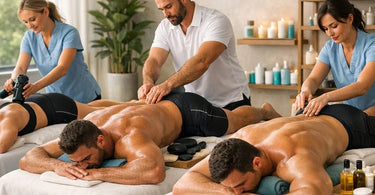
Excellence is always within reach... especially when you're trying to knead it out of a quad that feels like concrete. If your massage table has recently seen more spandex than silk robes, you're in the right place. The athletic crowd isn't just looking for relaxation—they're on a mission for performance and recovery, and their bodies tell wildly different stories depending on their sport. Understanding the narrative written in their overworked muscles is your ticket to becoming their MVP (Most Valuable Practitioner). Let's decode the unique needs of runners, cyclists, and swimmers, so you can offer targeted, effective treatments that keep them coming back and referring all their equally sore friends.
Building a sports massage niche is brilliant business. These clients are dedicated, often on regular schedules, and understand the value of maintenance. But treat a cyclist like a runner, and you might as well be using a wrench to do a hot stone massage. The demands are that specific. So, grab your favorite massage lotion, adjust your portable massage table, and let's dive into the fascinating world of athletic aches.
The Runner: A Symphony of Impact and Repetition
Ah, the runner. They chase endorphins with a passion usually reserved for black Friday sales. Their mantra is "just one more mile," and their bodies pay the price in sheer, repetitive impact. Gravity is not their friend. Every stride sends a shockwave up the kinetic chain, from the soles of the feet to the base of the skull.
Primary Trouble Zones: It's all about the lower body. Calves, shins, quads, hamstrings, hip flexors, IT bands, glutes, and the plantar fascia form their personal pain parade. Upper body issues often stem from compensation or poor form, manifesting as tight shoulders and neck.
The Massage Prescription: Deep, focused work is non-negotiable. Think of it as digging for treasure, where the treasure is a functional muscle fiber. Myofascial release techniques are golden for the IT band and plantar fascia. Compression and cross-fiber friction help break up adhesions in the quads and calves. Don't forget the feet! A detailed foot massage with a good cuticle oil for neatness? Okay, maybe not, but definitely with focused attention on the arches. Tools like TheraTools can be lifesavers for your hands. Since runners are prone to inflammation, incorporating hot and cold therapy can enhance recovery. A towel steamer provides wonderfully warm towels for pre-warming muscles, while cold gel packs can follow intense work.
The Cyclist: Frozen in Flexion, A Study in Power
Cyclists live in a world of perpetual contraction. For hours, they're bent over, legs pumping in a perfect circle. This creates incredible power but also some of the most spectacular muscular imbalances you'll ever see. Their posture off the bike often looks like they're still trying to reach handlebars.
Primary Trouble Zones: The quadriceps become mighty but extremely tight. The hip flexors are in a constant state of shortening. The glutes, while powerful, can become inhibited. The lower back screams from sustained flexion. The neck and shoulders (trapezius and levator scapulae) are locked in extension to see the road, and let's not forget the hands, forearms, and psoas.
The Massage Prescription: The goal here is length and release for the overworked, and activation for the sleeping giants. Intensive work on the quads and hip flexors is crucial. The lower back needs gentle, sustained release. The neck and upper traps beg for myofascial and trigger point work. But the secret weapon? Working on the anterior (front) of the body—chest (pectorals), shoulders, and even the abdominal muscles, which are often tight from crunching. This helps open up that rounded posture. Cupping therapy can be fantastic for the broad back muscles, creating space and blood flow. Using a high-quality massage cream from brands like Biotone or Soothing Touch allows for the deep, gliding strokes needed.
The Swimmer: The Overhead Orchestra of Rotator Cuff Woes
Swimmers glide through water like effortless poetry. Their bodies, however, are engaged in a brutal tug-of-war. They develop incredible back and shoulder strength, but the repetitive overhead motion places insane demands on the shoulder girdle. Their issues are less about impact and more about overuse and instability in a hyper-mobile joint.
Primary Trouble Zones: The shoulder complex is ground zero—rotator cuff muscles (supraspinatus, infraspinatus, teres minor, subscapularis), deltoids, and latissimus dorsi. The upper back (rhomboids, mid-traps) works overtime. Neck strain is common from breathing technique. Interestingly, swimmers can also have surprisingly tight hips and ankles, which act as rudders.
The Massage Prescription: Precision is key. This isn't about brute force; it's about finding the small, overworked stabilizers. Deep tissue work around the scapula (shoulder blade) is essential. Focus on releasing the lats, pecs, and deltoids to take tension off the rotator cuff. Trigger point therapy for the infraspinatus and teres minor is often a game-changer. Don't neglect the neck and the often-tight forearms. Swimmers benefit greatly from massage that enhances circulation and reduces inflammation in these critical joints. Integrating aromatherapy with invigorating or anti-inflammatory scents can elevate the experience. Having supportive massage bolsters to position their arms for optimal shoulder access is a pro move.
Gear Up for Athletic Success
To truly cater to this market, your space and supplies need to match your expertise. Investing in a top-tier massage table from Earthlite or Oakworks ensures stability and client comfort. A massage table warmer is a luxurious touch for pre-warming muscles. Have a variety of professional cleaners on hand—athletes sweat, it's their thing.
Consider adding complementary services. A pressotherapy session post-massage can accelerate a cyclist's leg recovery. A swimmer might adore a spa body treatment with a salt scrub to exfoliate chlorine-dried skin. And every athlete can benefit from retail recommendations like premium skincare for sun and wind exposure or a good percussion massager for home use.
The Finish Line: Building Your Sports Massage Empire
By tailoring your approach, you move from being a generic massage option to a sought-after recovery specialist. Market these specific services on your social media. Create packages: "The Marathon Prep Series," "The Century Ride Recovery," or "The Swimmer's Shoulder Saver." Partner with local running clubs, bike shops, and swim teams.
Remember, the athlete's goal is to return to their sport stronger. Your role is to facilitate that. When you solve their specific pain points, you become an indispensable part of their training regimen. And that, dear practitioner, is how you turn a hobbyist's passion into your thriving, fully-booked business reality. Now, go stock up on must-have supplies, because those runners are already lacing up.
)