
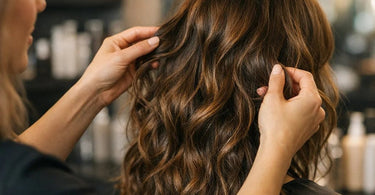
Make the most of every opportunity to listen–not just to your client's words, but to their hair. Every head that settles into your chair comes with a story written in its strands, a unique pattern of curls, waves, coarseness, and flow that's begging to be understood. As a stylist, your most powerful tool isn't the pair of Professional Shears, Clippers, & Trimmers for Barbers in your hand (though a sharp pair certainly helps). It's your ability to read that story and let it dictate your every move. This philosophy–of following the hair's lead rather than forcing a predetermined style–is what transforms a good haircut into a great, personalized experience that clients will rave about and rebook for. So, let's ditch the one-size-fits-all approach and learn how to become a fluent translator of texture and flow.
Think of it this way: you wouldn't use the same technique to sculpt marble as you would to shape clay. Hair is no different. The dense, robust nature of thick, coarse hair demands a different conversation than fine, silky strands that whisper rather than shout. Mastering this isn't just artistic; it's business-smart. When you give a client a cut that works with their natural texture, you're giving them a style that's easy to manage, looks fantastic day after day, and builds unshakable trust. They stop seeing you as just a stylist and start seeing you as their hair's personal guru.
The First Chapter: The Consultation & The Feel Test
Every great story begins with a careful introduction. Your consultation is where you start "reading the hair." Go beyond asking for a Pinterest photo. Before they even finish describing their dream lob, run your fingers through their hair. Feel it. Is it fine and slippery, thick and resistant, or dry and spongy? Look at the natural pattern. Is it bone-straight (Type 1), waving gently (Type 2), forming defined curls (Type 3), or coiled tightly (Type 4)? These are the foundational letters of your hair alphabet.
Now, let's get scientific for a second with a quick porosity check. This tells you how well the hair absorbs and holds moisture, which is crucial for predicting how it will behave during and after the cut. Spritz a small, product-free section with water. Does it bead up on the surface like rain on a waxed car? That's low porosity–the cuticle is tight. Does it soak in instantly? That's high porosity–the cuticle is open and possibly damaged. The ideal is a happy medium where it absorbs after a moment. This little test informs everything from what Premium Hair Care Products you'll recommend to how you might apply tension during the cut. High-porosity hair, often more fragile, needs a gentler touch.
Speaking the Language of Texture: Techniques as Dialects
Once you've assessed the hair's native language, you can choose your cutting dialect–the technique that will best communicate the desired style while honoring the hair's inherent properties.
For fine, straight hair that lacks volume, your goal is to create the illusion of body without making it look wispy or thin. Here, blunt cutting can be a friend, adding a clean, weighted line that gives the appearance of fullness. But use caution with over-layering, which can make fine hair look sparse. Instead, consider subtle point cutting into the ends to remove weight and create soft movement without sacrificing density. The right Professional Hair Brushes & Combs for Stylists are also key for smoothing and building volume at the root.
When working with thick, coarse, or dense hair, the challenge is often managing bulk and encouraging movement. Slide cutting, where you glide open shears down the hair shaft, is a beautiful way to remove internal weight and create fluidity. Thinning or using texturizing shears can also help, but beware the "over-texturizing" trap that leads to frizz. For a softer, more diffused edge on these hair types, a razor cut can create feathered, wearable texture.
Curly and coily hair (Types 3 & 4) have their own glorious grammar. Cutting curly hair dry or in its natural state is often the gold standard. This allows you to see the exact shape of each curl cluster and how the hair shrinks up, so you can shape it precisely where it lives, not where it stretches. Techniques like twist cutting–where you twist a section and snip into it–can add beautiful, hidden dimension to longer curly hair. The primary goal is to shape and define the curl pattern, often removing bulk from the interior to let the curls spring freely. Every cut should end with a lesson for your client using defining products from your retail shelf, ensuring your masterpiece lasts.
The Grammar of the Cut: Foundation is Everything
No matter the dialect (technique), every sentence needs proper grammar. In haircutting, this is your foundational system: sectioning, elevation, and over-direction.
Sectioning with precision is your first step to control. Clean, organized partings are your roadmap. Elevation–lifting the hair away from the head–controls where weight is built or removed. Lift to 90 degrees or higher to build weight away from the perimeter; keep it low for weight at the ends. Over-direction is your secret weapon for creating volume and shape. Combing a section away from its natural falling position before cutting allows you to place weight and length exactly where you want it. For example, over-directing crown sections forward can create gorgeous face-framing layers that fall perfectly.
And let's talk about the "Morning After" test. The true sign of a grammatically perfect cut is how it behaves on day two, three, and four. Are the layers still falling nicely? Is the client able to refresh it with a bit of Dry Shampoo and scrunching? A cut that passes this test is a cut that follows the hair's natural flow, making it inherently easier for the client to maintain. This is where your role as an educator, armed with the right retail products like Texturizing Spray or Professional Hair Color protectants, cements loyalty.
Equipping Your Literary Salon: Tools & The Full Experience
You can't write a novel with a broken pencil. Reading and sculpting hair requires the right tools. Invest in high-quality, sharp shears that become an extension of your hand. Different textures may call for different blades. Ensure you have a full arsenal, from sturdy shears for blunt cuts to texturizing and thinning shears for detail work, all available in our Must-Have Supplies for Salon & Spa Business Success collection.
But the story doesn't end at the styling chair. The entire client experience contributes to the narrative of your expertise. The comfort of your Portable Massage Tables during a facial, the luxury of a warm towel from a Towel Steamer, even the ambiance–it all tells the client you care about mastery in every detail. When you pair a technically perfect, texture-led haircut with this level of holistic service, you're not just providing a trim; you're authoring an experience they will want to reread again and again.
So, the next time a client sits in your chair, take a moment. Listen. Read. Let their hair tell you its story, and then use your skill to help it tell an even better one. That's the art of letting the texture and flow guide the cut. And that's how you build a book of clients who are truly devoted to the author.
