
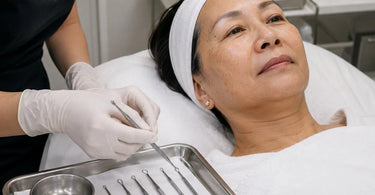
Maximize results with this smart tool... but only if you grab the correct one first! Let's be real, friends. I have seen more well-intentioned facials go south faster than a tourist without sunscreen in July simply because someone grabbed the wrong end of a Extraction Tool. One minute you are gently clearing congestion, the next minute your client looks like they lost a fight with a bee. We have all been there (don't lie, you know you have). The difference between a flawless finish and a red, angry mess isn't just pressure; it is geometry. You wouldn't use a hammer to fix a watch, so why are you using a giant loop on a tiny pearl of milia? Today, we are going to play Match Game with those shiny metal wands in your drawer. By the time we are done, you will be the swift, silent, and painless extraction wizard your clients have been dreaming of.
That little metal tool sitting by your Facial Steamer is actually a highly technical instrument. It is not just a pimple popper; it is a precision device. But just like you would not use a stripping Professional Stripless Hard Wax on a sensitive lip if you wanted to avoid tears, you should not use a lancet where a simple loop will do. Let us break down the rogue's gallery of facial blemishes and arm you with the exact weapon (tool!) you need to send them packing .
The Classic Blackhead (Open Comedone): Your Bread and Butter
Ah, the blackhead. The bane of the T-zone and the source of oddly satisfying viral videos. These little guys are open to the air, meaning the top has oxidized and turned dark. They look like sesame seeds are trying to escape the nose. The good news? They are generally the easiest to evict if you have the right gear. Because they are open, you do not need to puncture the skin. You just need to evict the tenant.
Your weapon of choice here is the standard Comedone Extractor with a small, circular loop . You want a loop that is slightly larger than the blackhead itself. Place the opening directly over the offender, center it, and roll gently. Do not scrape! Scraping is how you get those lovely vertical red lines that make your client look like they have windshield wipers on their nose. Use a gentle rocking or rolling motion. If it doesn't come out on the first try, do not force it. That is your sign to go back to the steamer or use a Hydrodermabrasion machine to loosen things up. The Tweezerman knurled handle tools are specifically great here because they offer a non-slip grip, ensuring you apply pressure exactly where you want it, not skidding across the cheek .
The Sneaky Whitehead (Closed Comedone): Handle with Care
Whiteheads are the introverts of the blemish world. They are closed over with a thin layer of skin, meaning the pore is totally blocked. Trying to squeeze a whitehead without breaking that skin barrier is like trying to pop a balloon with your mind; it just results in a lot of huffing and puffing and eventually, an explosion that traumatizes everyone involved. Do not be that esthetician.
For whiteheads, you need a Lancet or a needle-point tool . I know, it sounds scary, but it is actually gentler. You are going to hold the lancet parallel to the skin (sideways!) and gently nick the very top layer of the whitehead. Do not stab straight down like you are sewing a button. After that tiny nick, you can switch back to your loop extractor or use sterile cotton swabs to apply gentle pressure from the sides. Out will pop the little pearl. This method prevents bruising and tearing. Remember, lancets are typically single-use and must be disposed of in a sharps container—safety first, bestie .
The Hard Little Kernels (Milia): The Stubborn Guests
Milia are not technically acne. They are tiny keratin-filled cysts that live just under the surface of the skin, usually around the eyes or cheeks. They are hard, white, and feel like little grains of sand under your fingertip. And they will not budge. Squeezing milia is like trying to squeeze a marble out of a couch cushion. You will just hurt your thumbs and make the client red.
Milia require a precise approach. Because they are so hard and deep, the extraction tool needs to be sharp to create an opening . Use a Milia Lancet or a very fine-tipped needle. You need to create a tiny opening on the side of the milia (again, parallel to the skin). Then, you take a Milia Spoon or a comedone extractor with a very small, cup-like loop (often the size of a pinhead) and press down around the edge. The keratin plug should pop out whole. It is wildly satisfying when it works. If you do a lot of these, keep a dedicated Spa Tools & Implements set that includes a specific milia spoon, as the deeper cup gives you better leverage without crushing the surrounding tissue .
The Angry Bully (Inflamed Acne/Pustules): Hands Off!
Stop. Put the metal down. I know it is tempting. I know it is right there. But if the blemish is red, inflamed, or has a white head surrounded by angry red skin, you are looking at active inflammation or infection. Extracting this with a metal tool is a recipe for spreading bacteria, causing hyperpigmentation, and potentially scarring. Leave these ones for the High Frequency Machines and antibacterial serums.
If you absolutely must (and check your local state board regulations first), a pustule can be drained with a sterile lancet . However, in a modern Spa Body Treatment setting, the trend is toward non-extraction or gentle Ultrasonic Skin Scrubbers that vibrate the debris out without the trauma. Save your strength (and your client's skin) for the non-inflamed stuff.
The Deep, Dark Secrets (Sebaceous Filaments): Leave Them Alone
This is the most common mistake I see. You look at a client's nose and see tiny little dots. You grab your tool. You squeeze. And... they fill right back up tomorrow. Those are not blackheads, darling. Those are sebaceous filaments. They are normal, healthy oil flow lines. Everyone has them. If you extract them, you just get a waxy noodle, and your client will be back next week with the same nose because their pores are working as intended.
Do not extract these. Instead, use a chemical exfoliant or a Hydrodermabrasion treatment. This keeps them clean and small without the trauma of extraction. Save your extraction tool energy for the actual comedones.
The Pro Routine: Steamer, Light, and Follow-Up
Before you even pick up a tool, your setup matters. You should have a Facial Steamer running to soften the impaction. You should also have a Magnifying Light or LED Bright Lamps so you can actually see what you are doing without going cross-eyed. Trying to extract under dim lighting is how accidents happen.
After you have successfully evicted the gunk, you cannot just send them on their way. You need to soothe the skin. Reach for a calming serum or a cold gemstone roller. I love following extractions with a Cold and Hot Hammer Machine to reduce inflammation instantly. Then, apply a Premium Skincare Product designed to shrink the appearance of pores. And for the love of hygiene, please clean your tools immediately! A Professional Cleaner & Disinfectant is a must .
Why Brand Matters (Even for Metal)
I know, metal is metal, right? Wrong. Cheap extraction tools have seams, rough edges, and poor balance. A rough edge can cut a client's skin. Bad balance means you use too much pressure. Brands like Tweezerman and Fromm International polish their tools so they glide, not drag . Investing in a high-quality set from our Must-Have Supplies collection ensures that the only thing your client feels is relief, not the tool itself.
Level Up with Tech
If you are still doing all your extractions manually, you are working too hard. While manual tools are essential for precision, you can save your wrists by incorporating technology. A Vacuum and Spray Machine uses suction to pull debris from pores without the pinching motion . It is a game changer for back facials or clients with lots of clogged pores. Just remember, you still need the manual tool for the stubborn, deep ones that the vacuum cannot dislodge.
Ultimately, selecting the right tool comes down to knowing your enemy. Is it open? Closed? Hard? Angry? Match the tool to the terrain, prep the skin properly, and always, always sanitize. You have got this. Now go forth and unclog those pores with confidence
