
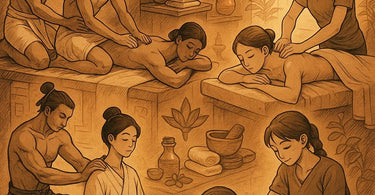
It’s the little things that matter... especially when those little things involve ancient emperors getting their feet rubbed by powerful generals, which apparently caused quite the political scandal! The history of massage is far stranger and more fascinating than you might imagine. While today we might debate which massage oil works best, ancient civilizations were busy using massage to treat everything from epilepsy to battlefield injuries. Let’s take a hilarious trip through time to explore the weird and wonderful origins of the treatments you provide every day. Your clients will love these stories almost as much as they love your magic hands.
From ancient Egyptian tomb paintings to Roman emperors and Japanese monks, massage has been healing bodies and causing drama for over 5,000 years. Understanding this rich history isn’t just fascinating—it adds depth to your professional practice and gives you amazing conversation starters during sessions. Plus, knowing that Julius Caesar needed daily pinching somehow makes our modern need for a good deep tissue massage feel completely justified.
When Rubbing Was Revolutionary: Ancient Massage Origins
Long before online booking and portable massage tables, ancient healers were developing massage techniques that still influence our work today. These early practitioners took their rubbing very seriously, and for good reason—they believed it could balance the body’s energy and cure diseases.
In India around 3,000 B.C.E., massage was considered a sacred healing practice within Ayurvedic medicine. The earliest written records of massage therapy in Ayurveda date between 1,500 and 500 B.C.E., but the practice likely existed many centuries before. Can you imagine trying to explain CE hours to those ancient practitioners? They were too busy combining massage with meditation and aromatherapy—making them the original holistic healers.
Meanwhile, in China around 2,700 B.C.E., physicians were using massage therapy to correct energy imbalances in the body. The famous Chinese medical text The Yellow Emperor’s Classic Book of Internal Medicine, written around 400 B.C.E., contains over thirty chapters referencing massage techniques. These ancient Chinese methods eventually evolved into practices we still use today, like acupressure.
But the real showstoppers were the Egyptians, who around 2,500 B.C.E. decided that the feet were the key to everything. Egyptian tomb paintings actually show people receiving hand and foot massages, and they’re credited with developing reflexology. They believed that applying pressure to one area of the body could treat another area entirely—a concept that modern reflexologists would definitely appreciate.
Celebrity Clients of the Ancient World: The First Spa-Goers
Think your A-list clients are impressive? Ancient massage had some truly legendary enthusiasts who took their treatments very, very seriously.
Let’s start with Julius Caesar, who apparently had more than just a Roman Empire to manage. Historical accounts describe Caesar being “pinched all over” daily to relieve neuralgia and prevent epileptic seizures. That’s right—the most powerful man in Rome submitted to daily pinching sessions. It makes our modern hot and cold therapy seem pretty tame by comparison.
Then there was the ancient love triangle that would make any modern soap opera jealous. Roman Emperor Octavian (later known as Augustus) reportedly complained about Mark Antony’s very public displays of affection toward Cleopatra—specifically, his habit of massaging her feet in front of company. Apparently, political power wasn’t the only thing these ancient rulers were fighting over. Who knew foot rubs could cause international incidents?
But the ancient Greeks were perhaps the most practical about their massage needs. Between 800 and 700 B.C.E., Greek athletes used massage to condition their bodies before competitions and recover afterward. Hippocrates himself, the father of modern medicine, prescribed massage treatments and called it “anatripsis” (which means “to rub up”). He specifically recommended upward strokes to increase circulation toward the heart—a technique that still informs many modern modalities.
From Battlefields to Bathhouses: Massage Gets Practical
Ancient civilizations didn’t just use massage for celebrity pampering—they put it to work in some surprisingly practical situations that would make any modern massage professional proud.
Consider the poor Egyptian soldiers after the Battle of Kadesh around 1274 B.C.E.—an engagement involving over 6,000 chariots. An ancient Egyptian pictograph shows a healer tending to the weary feet of soldiers after this massive battle. With that many chariots involved, you can bet their legs and feet needed some serious attention. This might be the earliest recorded instance of what we’d now call sports massage.
The Greeks took athletic massage to the next level by having skilled attendants massage their Olympic athletes after training. These practitioners developed advanced knowledge of muscular recovery, making them the great-great-grandparents of today’s sports massage therapists. They probably didn’t have modern massage tables, but they definitely understood the principles.
Then there were the Romans, who inherited massage traditions from the Greeks and added their own twist—the bathhouse experience. Wealthy Romans would have massages in their homes, while the general public flocked to Roman baths for “spa” treatments that included full-body massages to stimulate circulation and loosen joints. Sounds familiar, doesn’t it? The more things change, the more they stay the same.
The Great Migration: How Massage Traveled the World
Massage didn’t just stay put in one civilization—it packed its bags and traveled across continents, picking up new techniques and philosophies along the way.
When Japanese Buddhist monks trained in China around 1,000 B.C.E., they observed Chinese massage methods and developed their own style called Anma, which later evolved into Shiatsu. The Japanese approach focused on regulating and strengthening organs by rebalancing energy levels through pressure point stimulation. Today, you can find Shiatsu on service menus at modern clinics worldwide.
The big breakthrough for Western massage came in 1776 when French missionaries translated Chinese medical texts and introduced Asian massage techniques to Europe. This exchange gave us French terms we still use today, like effleurage (light strokes), petrissage (kneading), and friction (deep tissue technique). Merci beaucoup, French missionaries!
But the real game-changer came from Swedish doctor Per Henrik Ling, who in the early 1800s created the Swedish Movement Cure to help relieve chronic pain. His method was as much medical gymnastics as massage therapy, but it formed the basis for what we now know as Swedish massage. Then Dutchman Johan George Mezger defined the basic hand strokes that became the foundation of Swedish massage as we know it today.
Massage in America: From “Rubbers” to Respected Therapy
The journey of massage to America is filled with colorful characters and evolving professional identities that eventually led to the respected field we know today.
In colonial times, forerunners of today’s massage therapists were called “rubbers”—and no, that’s not a joke. These were typically women hired by surgeons to treat orthopedic problems with manual rubbing and friction. Rubbers had little formal education but possessed a knack for hands-on therapy. Before medical licensing laws limited their practices, some rubbers worked independently in competition with regular doctors, building successful practices through word of mouth.
By the 1850s, “medical gymnasts” brought Ling’s Swedish movement methods to America, elevating hands-on treatment with their two-year education program that included anatomy, physiology, and clinical work. These practitioners laid the groundwork for highly skilled hands-on specialists outside conventional medicine.
The late 1800s saw the rise of the terms “masseuse” and “masseur,” referring to therapists trained in the soft tissue manipulations defined by Mezger. But by the 1960s, these terms had fallen into disrepute, and the profession needed a rebrand. In 1958, the American Association of Masseuses and Masseurs changed its name to the American Massage & Therapy Association, encouraging the use of “massage therapy” and “massage therapist” instead. The new titles helped give the field legitimacy as a health profession.
Weird Historical Facts That Will Amaze Your Clients
Ready to impress your clients with some truly bizarre historical tidbits during their next session? These strange facts are guaranteed to make your treatments more memorable.
Did you know that the earliest archaeological evidence of massage comes from the Tomb of Akmanthor (also known as “The Tomb of the Physician”) in Egypt dating to 2330 B.C.E.? The carvings show two men having their feet and hands worked on—proof that even ancient Egyptians needed their pedicures.
Here’s one for your sports-minded clients: Hippocrates, the father of modern medicine, didn’t just endorse massage—he specifically wrote that “the physician must be experienced in many things, but assuredly in rubbing.” He recognized that “rubbing can bind a joint which is too loose and loosen a joint which is too hard.” Pretty advanced thinking for 2,400 years ago!
And my personal favorite: The full-body massage as we know it today actually originated as part of the “Rest Cure” for a condition called neurasthenia—a kind of debilitating melancholy common among wealthy society ladies in the late 19th century. The most extreme form involved forced bed rest, liberal feeding, and full-body general massage to stimulate circulation and increase the patient’s appetite. The Rest Cure eventually fell out of favor, but it introduced generations to full-body massage for convalescence and rejuvenation.
Bringing Ancient Wisdom into Your Modern Practice
Today’s massage therapists stand on the shoulders of thousands of years of healing tradition. From ancient Indian Ayurvedic practitioners to Egyptian reflexologists, Greek athletic trainers to Japanese Shiatsu masters, the core principles of healing touch have remained remarkably consistent.
What’s changed is our understanding of anatomy and physiology, and the incredible tools at our disposal. While ancient practitioners had to make do with whatever was available, today’s professionals have access to everything from specialized massage creams to state-of-the-art massage chairs and hot stone warmers.
The next time you’re stocking up on supplies at Pure Spa Direct, remember that you’re participating in a tradition that spans millennia and continents. Those Egyptian tomb paintings, Roman bathhouse attendants, and Ayurvedic healers are all part of your professional lineage. Now that’s something to think about during your next session—right after you finish being grateful you don’t have to pinch Julius Caesar all over.
