
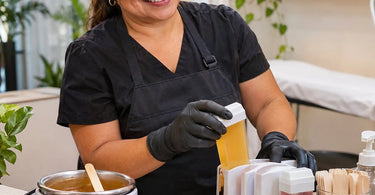
Small steps lead to big success... especially when those steps involve examining what your waxing services actually cost. A few dollars saved on supplies, a few minutes trimmed from appointments, and a smarter equipment purchase can make a surprisingly meaningful difference to your salon's bottom line. But deciding between waxing roll-ons and traditional pot wax isn't quite as simple as comparing the prices on two boxes. Both systems have their advantages, both require ongoing supplies, and both can be profitable when matched to the right services. The real question is which system delivers the best combination of efficiency, professional results, and cost control for your particular business.
For estheticians, waxing specialists, salon owners, and spa managers, understanding the complete cost of a waxing system is essential. Let's break down equipment investments, wax consumption, disposable supplies, appointment efficiency, and those sneaky little operating expenses that somehow multiply when nobody is watching.
Understanding the Two Professional Waxing Systems
Before comparing costs, it helps to understand exactly what you're purchasing and how each application method works.
Roll-on waxing systems use specially designed cartridges containing soft wax. The cartridges fit into compatible electric heaters, and an integrated roller distributes a thin layer of warmed wax directly onto the treatment area. The wax is then removed using appropriate waxing strips. These systems are particularly useful for larger areas such as legs, arms, backs, and chests.
Traditional pot waxing systems use electric warmers that heat wax in cans, inserts, or removable pots. Professionals apply the wax using spatulas, giving them considerable control over application size, thickness, and placement. Depending on the formulation, pot systems can accommodate soft strip wax or stripless hard wax.
That distinction matters. Comparing a roll-on cartridge with a pot of soft wax is a more direct comparison than comparing roll-on wax with hard wax because the removal methods and suitable treatment areas differ.
Pure Spa Direct carries a range of professional waxing supplies that allow businesses to build either type of service setup without treating every treatment room like an expensive science experiment.
Initial Equipment Costs: What Does Each System Require?
Every waxing station begins with equipment, and initial purchasing decisions determine how easily the station can accommodate future services.
Roll-on equipment: A basic system requires a compatible cartridge heater, wax cartridges, and waxing strips. Single-cartridge heaters can be practical for individual estheticians, mobile professionals, or businesses introducing roll-on services. Multiple-cartridge heaters allow several cartridges to remain ready during busy treatment schedules.
For example, a professional Nacach Aloe Roll-On Waxing Kit combines a single-cartridge heater, three wax cartridges, and nonwoven strips. A larger Nacach Professional Roll-On Waxing Kit includes a triple-cartridge warmer, ten cartridges, waxing strips, and pre- and post-wax products. These bundles illustrate how startup costs can vary according to heater capacity and included supplies.
Traditional pot equipment: A pot-based setup requires a compatible wax warmer, appropriate wax containers or inserts, and applicator spatulas. Soft wax also requires removal strips, while hard wax is generally removed without strips once properly set.
Single-pot warmers may be sufficient for a limited service menu. Dual-pot systems offer more flexibility when a professional needs different wax formulations available during the same appointment.
Explore Professional Wax Warmers for Salons & Spas to compare equipment configurations.
The business takeaway: Neither system automatically wins on startup price. Compare the total cost of a functioning workstation, including accessories, rather than looking at the heater alone.
Wax Consumption: Where the Real Cost Differences Begin
Equipment is purchased occasionally. Wax is purchased repeatedly. That makes product consumption one of the most important factors in long-term profitability.
Roll-on cartridges typically dispense wax in a relatively uniform layer. This can help technicians control application thickness and reduce excessive product usage, particularly across broad treatment areas.
Traditional pot wax gives experienced professionals greater freedom to adjust application size and thickness. A skilled esthetician using the correct amount of product can also achieve excellent efficiency.
However, traditional soft wax application requires careful technique. Excessively thick layers, product left on spatulas, and unnecessary repeated applications can increase consumption.
Cartridges introduce a different consideration: usable product remaining in a container when it must be discarded. Depending on the manufacturer's directions and applicable hygiene requirements, partially used cartridges may create additional product waste.
That means a cartridge's purchase price alone does not establish its true cost.
To calculate wax cost per appointment, use this simple formula:
Wax cost per service = Total wax purchase cost divided by the number of completed services supported by the purchased quantity.
For example, imagine a salon purchases $60 worth of cartridges and completes 20 appropriate services using that inventory. Its wax cost averages $3 per service. If $60 of pot wax produces 25 comparable services, the average becomes $2.40 per service.
These are hypothetical figures, not actual product prices or guaranteed yields. Your results will depend on the treatment area, formula, technician technique, product waste, and sanitation requirements.
Reviewing Efficient Roll-On Wax Cartridges alongside Soft Strip Wax provides a useful starting point for comparing product formats.
Consumable Costs: Strips, Spatulas, and Everything Else
Let's talk about the supplies that quietly disappear between appointments. You know the ones. Somehow, the waxing strips were fully stocked on Monday, and by Wednesday they have apparently joined the missing-sock dimension.
Both roll-on waxing and traditional soft strip waxing generally require removal strips. That makes strip consumption an important shared expense.
Roll-on systems usually eliminate the need for separate spatulas during the roll-on application itself. Traditional pot waxing requires clean, appropriate applicators, and proper infection-control procedures may mean using numerous disposable spatulas during a single service.
For a salon performing many appointments daily, spatula consumption can become a measurable recurring expense.
But don't forget that roll-on cartridges and roller components introduce their own material costs. A complete comparison must consider the disposable elements of each system.
Here is a practical breakdown:
- Roll-on soft wax: Cartridges, waxing strips, appropriate gloves, skin preparation products, and post-wax care.
- Pot-based soft wax: Bulk or canned wax, waxing strips, disposable spatulas, appropriate gloves, preparation products, and post-wax care.
- Pot-based hard wax: Hard wax, disposable applicators, appropriate gloves, preparation products, and post-wax care, generally without removal strips.
Additional shared expenses can include treatment table coverings, cleaning supplies, laundry, and waste disposal.
Pure Spa Direct offers Quality Wax Strips & Rolls, Professional Wax Spatulas and Applicators, and Pre & Post-Waxing Products to help professionals account for their complete service supply needs.
Appointment Speed: The Hidden Profitability Factor
Consumable costs matter, but treatment time can have an equally important effect on revenue.
Roll-on waxing can be especially efficient for larger treatment areas. A compatible roller distributes wax across broad sections without repeated spatula dipping, potentially reducing application time.
Traditional pot waxing may require more individual application movements, although an experienced professional can still work very quickly.
Consider a hypothetical scenario in which a technician saves five minutes during each of six daily appointments.
That's 30 minutes of potential scheduling capacity per day. Across 20 working days, the savings total 10 hours.
However, saved time only becomes additional revenue when the business can use that capacity productively. A salon with a waiting list may benefit considerably, while a salon with unfilled appointment slots may see less immediate financial impact.
Also consider preparation, heating, changing cartridges, cleaning equipment, and resetting the workstation. Faster application doesn't necessarily mean a faster overall service.
Smart salon strategy: Time complete appointments from preparation through cleanup rather than measuring wax application alone. The stopwatch has no interest in your preferred technique, which makes it surprisingly useful.
Sanitation and Product Waste: Costs You Cannot Ignore
Professional waxing decisions must account for hygiene protocols, manufacturer instructions, and applicable state and local regulations.
Traditional pot waxing requires careful applicator management. Used spatulas must not be reintroduced into shared wax when prohibited by sanitation requirements. Disposable applicators should be handled according to the applicable rules and your establishment's infection-control procedures.
Roll-on waxing presents different considerations because the roller contacts the client's skin directly. A cartridge or applicator that touches one client must not automatically be used on another. Some jurisdictions require single-use cartridges to be discarded immediately after the service, and restrictions on roll-on systems vary.
Never assume that a cartridge system is automatically more hygienic simply because the wax is enclosed.
Both systems require appropriate equipment cleaning, temperature management, and safe handling.
These requirements affect operating costs in several ways:
- Single-client cartridge disposal may increase wax consumption.
- Disposable spatula requirements affect pot-based consumable costs.
- Cleaning and disinfection procedures require staff time and supplies.
- Improper storage or temperature management can result in wasted product.
- Equipment maintenance and replacement should be included in long-term budgeting.
Before choosing a system, verify local requirements and product-specific directions. Compliance is not an optional upgrade, regardless of how attractive a bulk discount looks.
Large-Area Waxing: Where Roll-Ons Often Shine
For salons offering frequent leg, arm, chest, or back waxing, roll-on systems deserve serious consideration.
These treatment areas provide relatively broad surfaces where a consistent application width can improve workflow.
A roll-on heater can also offer a compact setup, which may appeal to mobile estheticians or treatment rooms with limited counter space.
For businesses with multiple technicians, a standardized cartridge format can help simplify purchasing and training when everyone uses compatible equipment and follows the same approved procedures.
That said, not every roll-on cartridge works with every heater. Check cartridge dimensions, compatible heater models, operating requirements, and manufacturer instructions before purchasing inventory.
Buying 48 cartridges that don't fit your warmers is not a cost-saving strategy. It is an expensive lesson in measuring things first.
Detail Work and Sensitive Areas: Why Pot Wax Remains Valuable
Traditional pot waxing continues to offer important advantages for precision services.
Eyebrow shaping, upper-lip waxing, and other smaller areas often require careful control over exactly where the product is placed.
Spatula application allows the professional to customize the size and shape of each wax section. This flexibility can make traditional pot systems useful for detailed work.
Additionally, stripless hard wax is commonly selected for certain sensitive areas because its formulation and removal process differ from traditional soft wax.
Hard wax is not simply soft wax in a different container. It has its own equipment considerations, application techniques, melting characteristics, and consumable requirements.
Explore Professional Stripless Hard Wax to evaluate formulations appropriate to your treatment menu.
The most economical choice may be to keep a pot system available for precision and sensitive-area services while using roll-ons for suitable larger areas.
Bulk Buying: Does Purchasing More Automatically Save Money?
Wholesale purchasing can improve product economics, but only when the quantities and formats match actual demand.
For example, buying wax in larger quantities may reduce the purchase cost per ounce. Yet a product with poor turnover can become expensive if inventory expires, deteriorates, or is no longer suitable for service use.
Roll-on cartridges can be convenient to count and reorder because each sealed unit represents a defined quantity. Pot wax may offer purchasing flexibility through different can sizes, refill formats, and bulk packaging.
When comparing wholesale options, consider:
- Net wax quantity rather than container size alone.
- Unit price after any volume discounts.
- Shipping charges and minimum order requirements.
- Expected usable yield per service.
- Storage space, shelf life, and inventory turnover.
- Compatibility with existing equipment.
- Potential waste from partially used containers.
Browse Bulk Wax Deals when planning repeat purchases for a busy waxing department.
Remember, buying more inventory isn't automatically better inventory management. Your storage closet does not need an impressive wax collection that never gets used.
Calculating the True Cost Per Waxing Service
To compare these systems fairly, build a simple cost worksheet for each major treatment category.
Include the following expenses:
- Wax: Actual quantity consumed or allocated to each appointment.
- Application supplies: Spatulas, cartridges, roller components, and other disposable items.
- Removal supplies: Waxing strips where applicable.
- Preparation and aftercare: Cleansers, powders or oils when appropriate, and post-wax products.
- Sanitation: Cleaning materials, protective supplies, and disposal requirements.
- Labor: Total paid staff time associated with the appointment.
- Equipment: An appropriate allocation for heater purchases, maintenance, and replacement.
Consider this hypothetical comparison for a single large-area waxing appointment:
Roll-on service: $3.00 in wax and cartridge allocation, $0.80 in strips, $1.20 in other consumables, and $12.00 in allocated labor produces a direct operating cost of $17.00 before equipment allocation and overhead.
Traditional soft wax service: $2.40 in wax, $0.80 in strips, $0.70 in spatulas, $1.20 in other consumables, and $14.00 in allocated labor produces a direct operating cost of $19.10 before equipment allocation and overhead.
In this illustrative scenario, the roll-on method costs $2.10 less per appointment despite its higher wax allocation, primarily because of the assumed labor difference.
But reverse the labor assumptions or increase cartridge waste, and the result could change.
These figures are examples only. They are not actual quoted salon costs, verified product yields, or expected industry averages.
For a fuller picture, calculate contribution per appointment by subtracting variable service costs from service revenue. Then account for equipment depreciation, fixed overhead, and unused scheduling capacity separately.
That approach helps prevent double-counting labor or confusing gross service revenue with actual profit.
Should a Salon Invest in Both Systems?
For many established waxing businesses, the answer may be yes.
A hybrid setup gives estheticians flexibility to select the application method that best fits the treatment area, client needs, and approved service protocol.
A salon might use roll-on cartridges for full-leg waxing, traditional soft wax for selected smaller body areas, and hard wax for services that benefit from stripless application.
This arrangement does require more inventory categories and equipment planning. However, it can also reduce the need to force every appointment into a single technique.
The Nacach Professional Multi-Combine Waxing System is an example of equipment designed to support roll-on, soft wax, and hard wax services within one broader setup.
Businesses considering a mixed approach can also review Complete Waxing Kits for Salons & Spas to compare starter and multi-format equipment options.
How to Choose the Most Cost-Effective System for Your Business
Instead of selecting equipment based solely on promotional pricing, examine your actual service menu and appointment volume.
Choose roll-on systems for closer evaluation if: Your business performs frequent large-area soft wax services, has technicians who benefit from standardized application, or needs compact cartridge-based equipment.
Choose traditional pot systems for closer evaluation if: Your service menu requires flexible application shapes, includes hard wax treatments, or relies heavily on detailed waxing services.
Consider both if: Your waxing department performs a broad variety of treatments and has enough consistent demand to justify maintaining multiple product formats.
Before committing to a major purchase, conduct a controlled trial. Compare several representative appointments using the same treatment categories, similarly experienced technicians, and consistent sanitation standards.
Record service time, product quantity, disposable supply use, cleanup time, product waste, and any client comfort or service-quality issues.
A trial period provides information that a price tag cannot.
Frequently Asked Questions About Roll-On and Pot Wax Costs
Is roll-on waxing cheaper than traditional pot waxing?
Not necessarily. Roll-ons may reduce application time and eliminate separate spatulas for certain services, but cartridges can cost more per usable quantity and may create additional disposal-related waste. The lower-cost method depends on actual service conditions.
Do roll-on wax cartridges require waxing strips?
Most professional roll-on systems use soft wax that requires compatible removal strips. Always follow the specific product instructions.
Can a salon use the same heater for roll-on cartridges and pot wax?
Only if the equipment is expressly designed for both applications. Standard cartridge heaters and traditional pot warmers are not automatically interchangeable.
Does hard wax cost more than soft wax?
The purchase price alone cannot answer that question. Hard wax generally eliminates removal-strip expenses but requires applicators, and its application thickness, yield, and suitable service areas differ from soft wax.
Are roll-on systems better for high-volume salons?
They can be useful for high-volume, large-area services, particularly when consistent application and efficient workstation organization matter. However, sanitation rules, cartridge usage, and equipment capacity must be considered.
How often should a salon review waxing supply costs?
Monthly reviews are practical for businesses with regular waxing volume. Track supply usage against appointments and revisit purchasing decisions whenever prices, formulas, services, or staffing patterns change.
The Bottom Line: Make Every Waxing Appointment Count
The best waxing system isn't necessarily the one with the lowest equipment price or the cheapest container of wax. It's the one that supports consistent professional services while controlling total costs and making effective use of your team's time.
Roll-on systems can offer appealing efficiency for larger treatment areas, while traditional pot systems provide versatility and precise application options. For many salons and spas, maintaining both methods may be the most practical long-term approach.
Pure Spa Direct helps salon owners and licensed beauty professionals compare and source equipment, consumables, and accessories from established professional brands. As a distributor, Pure Spa Direct provides access to multiple waxing product lines rather than limiting businesses to a single manufacturer or technique.
Explore our professional waxing collection to build a supply strategy around your actual appointment volume, treatment menu, and purchasing priorities.
Because a profitable waxing business isn't built on guessing what each service costs. It's built on knowing your numbers, choosing supplies intelligently, and making sure your bottom line stays as smooth as your clients' freshly waxed legs.
