
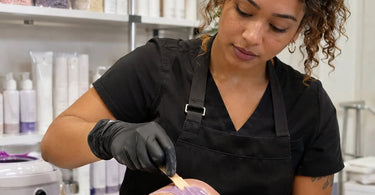
Because your work matters, even the smallest details of a professional waxing service deserve attention, including that surprisingly tricky little landscape known as the knee. If you have ever applied professional hard wax across a client's kneecap and watched one section turn into a thick little mountain while another barely coated the skin, you are definitely not alone. Uneven hard wax thickness around the knee is a common application challenge, even for experienced estheticians, because curved anatomy, changing skin tension, wax consistency, and applicator technique all influence how the wax spreads. The good news? Once you understand why the thickness changes, you can make small adjustments that create smoother applications, cleaner removals, and a more comfortable experience for your clients.
The knee may be a small part of a full-leg waxing appointment, but it certainly knows how to demand attention. Unlike the relatively flat surface of the shin, the knee features curves, folds, prominent bone, and skin that shifts with every little movement. Understanding these differences is the secret to preventing uneven wax buildup and keeping your waxing technique beautifully consistent.
Why Is Hard Wax Thickness So Difficult to Control Around the Knee?
The primary reason hard wax spreads unevenly around the knee is its irregular surface. The rounded kneecap creates a raised area, while the surrounding skin transitions into softer contours and flexible creases. A spatula that glides smoothly along the shin may suddenly change its angle or pressure as it moves across the knee.
As the applicator travels over the raised kneecap, wax can be deposited more heavily along the sides or at the beginning and end of a stroke. If the esthetician does not adjust the applicator angle, the wax may become too thin over the highest point and excessively thick near the edges.
Skin movement adds another challenge. When a client straightens or bends the leg, the skin around the knee changes shape. A surface that appeared smooth during application can develop folds or tension differences when the position changes.
This combination of anatomy and movement makes knee waxing a technique-sensitive service rather than simply a smaller version of waxing the shin.
1. Curved Knee Anatomy Creates Uneven Wax Distribution
The kneecap is not flat, and your applicator should not behave as though it is. When a broad spatula passes over a rounded surface, its contact with the skin changes throughout the stroke.
Several patterns can develop:
- Thick wax along the sides: Excess product collects as the spatula moves away from the central curve.
- Thin patches over the kneecap: Increased applicator pressure may remove too much wax from the raised surface.
- Heavy application at the lower edge: The esthetician may unintentionally deposit the remaining wax while finishing the stroke.
- Uneven borders: Changes in wrist angle can create ridges and thin areas within the same application.
The solution is to work with the shape of the knee rather than trying to force one large application across every contour.
Smaller, controlled sections allow the applicator to maintain more consistent contact with the skin. They also make it easier to establish an appropriate removal tab without creating an unnecessarily bulky strip.
2. Incorrect Wax Temperature Changes How the Product Spreads
Temperature is one of the biggest factors affecting hard wax thickness. Wax that is too hot becomes more fluid, while wax that is too cool becomes thicker and harder to spread evenly.
When hard wax is excessively fluid, it may move away from the elevated center of the knee and collect in lower areas. The result can be a thin coating over the kneecap surrounded by thicker edges.
When the wax is too cool, the opposite problem often occurs. The applicator may drag or skip across the skin, leaving ridges, clumps, and irregular thickness.
Neither situation is ideal for a smooth professional application.
Using reliable professional wax warmers helps estheticians maintain a more consistent working temperature throughout the appointment.
Remember that different wax formulas have different ideal operating temperatures. Always follow the manufacturer's directions rather than relying on one universal temperature setting.
Professional tip: Check the wax consistency before beginning the knee area. The product should spread smoothly with controlled movement without dripping excessively or dragging across the skin. Test the temperature safely before application to the client.
3. Inconsistent Spatula Pressure Produces Thick and Thin Areas
Your spatula is doing more than moving wax from the warmer to the skin. It determines how the wax is distributed, how firmly it surrounds the hair, and how consistently the application sets.
Too much pressure can scrape wax away from the center of the application. Too little pressure can leave heavy deposits that take longer to set.
A common knee-waxing mistake occurs when the esthetician maintains the same wrist position while moving over the kneecap. Because the surface curves, the pressure changes even if the hand feels steady.
To improve consistency, keep the movement deliberate and adjust the applicator angle as you follow the contour. Avoid pressing so firmly that the spatula leaves exposed skin behind.
The choice of applicator also matters. Explore professional wax spatulas and applicators in different sizes for better control around smaller treatment areas.
A narrower applicator may be easier to maneuver around the kneecap than a wide spatula intended for larger leg sections.
Think precision rather than speed. The knee is not the place to audition your fastest windshield-wiper impression.
4. Poor Client Positioning Creates Skin Folds and Uneven Tension
Client positioning can dramatically influence hard wax application around the knee.
If the leg is positioned awkwardly, the skin may bunch along one side while stretching tightly over another. This uneven surface makes it difficult to maintain a uniform wax layer.
For many knee-waxing techniques, a slightly bent knee helps create a more manageable surface over the kneecap. However, the ideal position depends on the exact area being treated, the client's mobility, and the manufacturer's application method.
Position the leg comfortably with appropriate support, then gently stabilize the surrounding skin before applying wax.
Professional massage bolsters can help maintain comfortable positioning when appropriate for the treatment setup.
Ask the client to remain still during application and removal. Even a small movement can change the surface enough to create an uneven application or interfere with a controlled removal.
5. Applying Too Much Wax in One Stroke Causes Buildup
More wax does not automatically mean better hair removal.
Loading an applicator with excessive product often creates a thick deposit at the beginning of the stroke. As the spatula moves forward, less wax remains available, producing a progressively thinner application.
On a curved knee, that imbalance becomes even more noticeable.
Instead of attempting to cover the entire kneecap with one oversized application, divide the area into manageable sections. Load the spatula with an appropriate amount of product for each section and spread it deliberately.
Maintain the thickness recommended for the specific hard wax formula. Thin-film hard waxes are designed for different application thicknesses than some traditional hard waxes, so the correct layer is product-dependent.
Extremely thick applications can take longer to set and may feel unnecessarily warm. Applications that are too thin can become fragile, break during removal, or fail to grip hair effectively.
The objective is not to create the thinnest possible layer. It is to achieve a consistent, functional layer suited to the product.
6. Inadequate Skin Preparation Interferes With Smooth Application
Even beautifully controlled spatula work can struggle when the skin has not been prepared correctly.
Excess oil, lotion, perspiration, and cosmetic residue can interfere with how wax contacts the skin and hair. Around the knee, naturally dry or rough areas may also make application feel less smooth.
Begin with a thorough assessment of the treatment area. Look for irritation, abrasions, sunburn, compromised skin, or other conditions that would make waxing inappropriate.
Next, use a compatible pre-wax cleanser and allow the skin to dry completely. Depending on the wax system, the manufacturer may recommend a very light application of a specific pre-wax oil or powder.
Never assume that preparation products are interchangeable. A product intended for one wax formula may not produce the same results with another.
Explore professional pre- and post-waxing products to build a preparation routine compatible with the wax used in your treatment room.
Important: Do not aggressively exfoliate immediately before waxing to compensate for rough knees. Excessive exfoliation can increase skin sensitivity and the risk of irritation.
7. Using the Wrong Hard Wax Formula Can Make Knee Waxing More Difficult
Not every hard wax behaves the same way.
Some professional formulas are designed to spread in relatively thin, flexible layers. Others require a more substantial application to remain intact during removal.
Flexibility becomes particularly important around the knee because the application must accommodate a curved surface without cracking or breaking prematurely.
A wax that becomes overly brittle may fracture when lifted, especially if the layer is too thin or the product has been allowed to cool beyond its recommended removal stage.
Professionals can compare options from collections such as ItalWax, Berodin, and Cirepil.
Each formula has its own instructions for temperature, application, setting, and removal. Select a wax appropriate for the treatment area and your preferred professional technique.
How to Apply Hard Wax More Evenly Around the Knee
Improving knee waxing does not require reinventing your entire service. A few technique adjustments can make a noticeable difference.
- Prepare the area: Examine the skin, cleanse it with a suitable product, and follow the wax manufacturer's preparation instructions.
- Position the knee: Support the leg comfortably and adjust the bend until the treatment section is accessible and the skin can be stabilized.
- Check the wax: Confirm that the product is fully melted, evenly mixed when appropriate, and at its recommended working consistency. Test its temperature safely.
- Select the applicator: Choose a spatula that offers adequate control over the curved surface.
- Work in small sections: Avoid attempting to bridge multiple dramatic contours with one oversized patch.
- Maintain controlled pressure: Adjust your wrist and applicator angle to follow the shape of the knee.
- Create a removal tab: Form an accessible edge according to the wax manufacturer's directions without leaving an excessively heavy ridge.
- Allow proper setting: Check the wax for readiness using the product's recommended indicators rather than relying on a fixed number of seconds.
- Remove correctly: Hold the skin taut and remove the wax quickly, close and parallel to the skin, following the specified removal direction.
- Assess the result: Check for remaining hair, irritation, and residual wax before continuing with other sections.
When using professional waxing supplies, consistency comes from combining the right products with a repeatable application method.
Common Knee Waxing Problems and What They Mean
Problem: The wax is thick around the edges but thin in the center.
Possible causes include excessive wax loading, inconsistent spatula pressure, a changing applicator angle, or wax that is too fluid. Use smaller sections, adjust the angle over the kneecap, and confirm the working consistency.
Problem: The wax forms ridges or clumps.
The wax may be too cool or the applicator may be dragging across the surface. Check the formula's recommended temperature and evaluate the pressure used during application.
Problem: The wax breaks during removal.
The layer may be too thin, the wax may have become overly brittle, or the removal technique may not suit the product. Follow the manufacturer's instructions for application thickness and setting time.
Problem: The wax stays soft in certain areas.
Thicker sections can require additional setting time. Excessive working temperature, warm skin, or room conditions may also contribute. Never pull wax before it is ready.
Problem: Hair remains after removal.
The application may not have surrounded the hair adequately, or the hair may be too short for effective removal. Examine hair length, direction, and application pressure. Avoid repeatedly waxing sensitized skin.
Does Hair Growth Direction Affect Wax Thickness Around the Knee?
Hair growth direction does not directly determine the thickness of the wax, but it can influence how an esthetician applies the product.
Hair around the knee may grow in different directions, encouraging the professional to change application strokes or divide the area into smaller sections.
Some hard wax systems permit application against or regardless of hair growth, while others specify a particular direction. Removal directions can also differ by formula.
Always follow the instructions for the product being used.
Mapping the hair growth before application can help you plan manageable sections and avoid awkward changes in direction halfway through a stroke.
How to Prevent Uneven Thickness During Busy Salon Appointments
Maintaining consistent technique becomes especially important during a fully booked waxing schedule.
When appointments are running behind, it can be tempting to increase application size, skip repositioning, or rush the wax preparation process.
Unfortunately, those shortcuts may create the very problems that slow a service down: broken wax, missed hair, repeated applications, and difficult removals.
A reliable setup can help. Keep your wax warmer, fresh applicators, cleansing products, disposable supplies, and aftercare products conveniently organized.
Consider purchasing frequently used items through bulk wax deals to support consistent product availability without changing formulas unexpectedly during a busy period.
Keep your preferred application technique consistent across the team, and train new estheticians to recognize signs of wax that is too hot, too cool, too thick, or too thin.
A little extra attention during application can save time during removal. Your schedule, your supplies, and your clients will appreciate it.
When Should You Stop Instead of Correcting the Wax?
Not every waxing problem should be corrected with another application.
If the client reports excessive heat or burning, stop immediately and assess the situation. Never apply wax that feels excessively hot, and follow appropriate first-aid and salon safety procedures if a burn is suspected.
Do not continue waxing over skin that has lifted, become abraded, or developed significant irritation. Repeated applications can increase the risk of skin injury, particularly when the skin barrier is already compromised.
Review relevant contraindications, including recent exfoliating treatments, medications affecting skin fragility, and existing skin conditions, before beginning the service.
If isolated hairs remain after removal, professional tweezing may be preferable to another wax application, depending on skin condition and treatment protocols.
Excellent waxing is not about removing every last hair at any cost. Protecting the client's skin is always the priority.
Professional Supplies That Help Improve Knee Waxing Technique
Consistent knee waxing begins with quality equipment and dependable supplies.
For an efficient professional setup, consider the following essentials:
- Reliable hard wax: Choose a formula suitable for curved areas and the intended application technique.
- Temperature-controlled equipment: A dependable professional warmer helps maintain a consistent working texture.
- Appropriately sized spatulas: Different widths provide greater control when transitioning between large leg sections and smaller knee contours.
- Compatible skin preparation products: Cleansers and manufacturer-approved preparation products help establish proper application conditions.
- Comfortable client support: Proper treatment-table positioning and supportive accessories can make the knee easier to access.
- Gentle aftercare: Suitable post-wax products help complete the treatment while supporting client comfort.
Pure Spa Direct supplies professional estheticians, spas, salons, and waxing studios with products from established industry brands. As a professional distributor rather than a wax manufacturer, Pure Spa Direct offers access to multiple product lines so businesses can select equipment and supplies that match their preferred service methods.
Browse complete professional waxing kits or explore waxing accessories and removers to build a treatment station that supports efficient, controlled applications.
Frequently Asked Questions About Uneven Hard Wax Around the Knee
Why does hard wax become thicker on the sides of the kneecap?
The curved shape of the knee changes how the applicator contacts the skin. Excess wax can collect along the sides when the angle or pressure is not adjusted during application. Wax that is too fluid may also contribute to pooling.
Should hard wax be applied thinner around the knee?
Not necessarily. The correct thickness depends on the formula. The goal is a consistent layer that grips hair effectively and remains intact during removal. Follow the manufacturer's instructions rather than automatically applying less product.
Is it better to wax the knee bent or straight?
A slightly bent knee often provides a useful surface for waxing the kneecap, but positioning should be adjusted for the particular section, client comfort, and product technique. The surrounding skin must remain properly supported and taut during removal.
Can wax temperature cause uneven thickness?
Yes. Overheated wax can become excessively fluid and difficult to control, while wax that is too cool may drag or form ridges. Maintaining the recommended working temperature and consistency helps improve application.
Why does hard wax crack on the knee?
Cracking may occur when the application is too thin, the wax is unsuitable for the technique, or the product has cooled beyond its ideal removal stage. Follow the formula's instructions and avoid allowing the wax to become excessively brittle.
Can uneven wax thickness affect hair removal results?
Absolutely. Thin sections may fail to grip hair adequately or break during removal, while thick sections may take longer to set and complicate removal. A consistent application supports more predictable results.
The Bottom Line: Smooth Knee Waxing Starts With Better Control
Uneven hard wax thickness around the knee usually comes down to a combination of curved anatomy, changing skin tension, inconsistent spatula pressure, incorrect wax consistency, and oversized applications. Once you recognize those factors, correcting your technique becomes much easier.
Focus on comfortable positioning, careful preparation, controlled product temperature, smaller sections, and consistent applicator movement. Most importantly, work with the specific instructions for your chosen hard wax rather than treating every formula the same way.
With a little practice, the knee can go from the most frustrating part of a leg wax to just another smooth step in your professional routine. And frankly, that tiny kneecap has been getting far too much attention already.
Ready to fine-tune your waxing setup? Explore Pure Spa Direct's selection of professional waxing supplies, stripless hard wax, and wax applicators to support beautifully consistent services from the thighs all the way down to those wonderfully challenging knees.

