
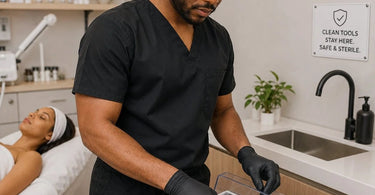
Clients notice quality first, but they trust cleanliness forever. We joke about the 'spa eyes' where they notice a single dust bunny from across the room, but when it comes to the implements you use on their skin, that level of scrutiny is entirely justified. In our world of facials, waxing, massages, and nail art, the trust between a professional and a client is sacred, and that trust is physically manifested in the tools we use. You wouldn't eat a meal prepared with utensils pulled from a kitchen junk drawer, would you? In the same way, no client's skin should ever come into contact with implements stored right next to the sink, where moisture lurks and chaos reigns. Think of your spa tools and implements like surgical instruments; they require a clean, dry, and predictable environment to remain safe and effective.
It happens to the best of us, right? You finish a flawless brow wax, clean your tweezers and spatulas with the expertise of a surgeon, and then... you just pop them in a jar beside the sink. It's convenient, it's a reflex, and it's one of the most common hygiene missteps in the industry. But here's the million-dollar question: If your 'clean' implements are stored beside the sink, are they truly clean? The short, resounding, and slightly dramatic answer is no. That convenient spot is a breeding ground for bacteria, a magnet for cross-contamination, and a silent credibility killer for your business. We're going to break down why this habit is a no-go and give you the blueprint for a storage strategy that ensures your clients only get the best.
The Science of a Splash Zone: Why the Sink is Not Your Storage Unit
Let's talk about the 'splash zone'. When you think about the sink in your treatment room or salon, it's primarily a place for washing hands, rinsing bowls, and maybe cleaning up a spill. But while you're not doing a cannonball in it, the activity around the sink creates a micro-climate that is the arch-nemesis of sterile implements.
The Germ Factory That is a Wet Sink
We're not just talking about a drop of water here. We're talking about the invisible cloud of water droplets that becomes aerosolized every time you turn on the tap. It's not a massive splash; it's a fine mist, a constant, subtle shower of moisture that lands on everything nearby. This moisture, combined with the warm, often dark environment of a countertop, creates the perfect storm for bacterial growth. This is a basic concept of infection control, so relevant that the Virginia Administrative Code specifies that "sinks, bowls, tubs... shall be maintained in accordance with manufacturer's recommendations" and cleaned to prevent contamination. Even a small puddle can have big consequences.
When you store your professional nail care tools or waxing supplies next to the sink, you're essentially parking them in a petri dish. Those seemingly harmless water droplets can carry bacteria, leftover product residue, and other contaminants that you've just washed down the drain. It’s a classic case of cross-connection hazard, where a source of contamination is too close to a clean area .
It's Not Just Water; It's Product Soup
If you're like most professionals, you're not just washing hands at the sink. You're rinsing out wax residue from applicators, cleaning mixing bowls, and maybe even washing out a few body brushes. This means the water hitting your sink is what I like to call 'product soup'. It's a delightful mixture of water, wax, oils, exfoliants, and whatever else was on your tools. The splatter from this concoction is even more dangerous than plain water. It's a nutrient-rich medium that invites bacteria to not just survive, but to throw a party on your clean tools.
Rules and Regulations: What the Board Says
You don't have to take my word for it. Your state board has very clear, very strict rules about this, and they are there for a reason. The rules and regulations from state boards are all strikingly similar on this point. Georgia's rules, for instance, explicitly state that all disinfected tools and implements must be stored in a "sanitary manner in a covered container" and that "soiled and dirty tools and implements must be stored in a separate and properly labeled covered container" . Notice how the key is separate and covered. A jar next to the sink that is open to the elements doesn't fit that bill.
Iowa's administrative code is even more direct, stating that "disinfected implements shall be stored in a disinfected, dry, covered container and shall be isolated from contaminants" . The term 'isolated from contaminants' is crucial. The sink area, by its very nature, is a source of contaminants. It's a high-traffic, high-moisture zone that cannot be considered a clean, isolated environment.
Even the gold-standard textbooks like Milady are clear on this principle. In the standard protocols for sanitation and infection control, the final step is always to "store disinfected implements in a clean, covered container until needed" . It's the last step in the process, and it's the most important one. You've done the hard work of cleaning and disinfecting; don't undo it all with a poor storage choice. So, basically, if you're leaving your clean implements out in the open by the sink, you're not just flirting with a bad inspection; you're inviting a potential health hazard for your clients, which can lead to infections and seriously unhappy customers. A good UV sterilizer can be part of the solution, but it starts with proper storage.
The Unseen Enemies: Cross-Contamination and the Risk of Rust
We've talked about bacteria, but let's talk about two other silent assassins that live by the sink: cross-contamination and rust. The sink is where dirty items are placed. You might have a designated basket or area for used implements, but the proximity to clean ones creates a massive risk for cross-contamination. You or a team member could inadvertently grab a dirty item instead of a clean one, or splashing water from a dirty bowl could land on your clean tools. It's a game of Russian roulette with your clients' safety. There's a reason the Virginia Board dictates that "soiled implements must be removed from the tops of work stations immediately after use" .
This is why many state regulations, like those in Virginia and Indiana, emphasize having a wet disinfection unit with a cover at each station, along with separate, labeled containers for clean and soiled implements . Indiana law, in particular, requires all instruments including forceps, tweezers, and brushes to be sterilized prior to use, often requiring an autoclave or dry heat sterilizer . This level of detail highlights the seriousness of proper handling from start to finish.
Then, of course, there's the issue of rust. Most of our high-quality implements are made of metal. Metal and constant moisture are not friends. The humidity from the sink can cause even the best stainless steel to corrode over time. It's a slow process, but it's relentless. A rusty tool is not only unsightly and unprofessional, but it's also more likely to harbor bacteria and can be less effective and more likely to break. And if you’re storing your professional hair salon and barber shop supplies near the sink, you risk damaging your shears and clippers, which can be a costly mistake.
Time for a Change: Real-World, Sink-Free Storage Solutions
So, if we can't store things by the sink, where in the world do we put them? I'm glad you asked. This is where we get to organize our way to a better, more professional, and frankly, more efficient spa or salon.
The Covered Container is Your Best Friend
First and foremost, get a good, covered container for your clean implements. Whether it's a beautiful glass jar with a lid, a professional UV sterilizer box, or a simple, sanitized plastic container with a snap-on top, the lid is non-negotiable. The rules from Georgia, Iowa, and Virginia all stress the importance of a "covered container" . This isn't a suggestion; it's a standard. It ensures that airborne particles, dust, and, yes, those nasty splatters from the sink, stay off your clean tools. Label it clearly as 'Clean Tools' so there is no confusion.
Separate and Conquer: Designated 'Clean' and 'Dirty' Zones
Think like a commercial kitchen. They have separate prep areas, cooking areas, and cleaning areas. Your spa or salon should be the same. Create a designated 'clean' station that is a reasonable distance from any source of contamination, especially the sink. This area should be dry and ideally have a different countertop or a shelf that is specifically reserved for clean, packaged supplies. This is where you keep your professional cotton and other disposable items. Conversely, your 'dirty' area should be right by the sink. This is where you pre-clean, scrub, and prepare items for the disinfectant bath. Never the twain shall meet.
This concept of separation is so fundamental that it's mentioned in the regulations from Iowa, where they talk about storing "disinfected implements" isolated from contaminants . By creating physical distance, you're building a wall of safety.
Implement Storage: Think Like a Pro
Don't just toss your tools into a drawer. Professional storage is about organization and safety. Consider using implements caddies, magnetic strips on the wall (away from water!), or individual cases for your most precious tools. This not only protects them from damage but makes your workflow smoother. You're also less likely to accidentally grab a dirty tool if your clean ones are meticulously organized in a separate location.
In a stylish and functional nail salon, this might look like a designated drawer with compartmentalized inserts, far from the pedicure bowls. Or for a lash and brow enhancement station, keeping your tweezers in a sealed UV sterilizer on the shelf above your workstation. This demonstrates to your clients that you take their safety seriously.
Conclusion: Cleanliness is Not Just a Policy, It's Your Best Ad
At the end of the day, changing where you store your tools is one of the easiest, most cost-effective things you can do to elevate your professional game. You wouldn't use a towel that's been sitting in a puddle of water, so why would you use a tool that's been marinating in a splash zone? When you treat your implements with the respect they deserve and store them safely, you are sending a powerful, silent message to every client who walks through your door. It says, "I know what I'm doing, and I care about your well-being." And that kind of trust is what builds empires.
So, the next time you go to place a freshly cleaned pair of tweezers or a shiny new spatula on that counter by the sink, stop yourself. Take a breath, open a clean drawer, place it in a labeled container, or tuck it safely into your UV sterilizer. Your clients will notice, your state board inspector will smile, and your business will shine just a little bit brighter. You've got this!
)