
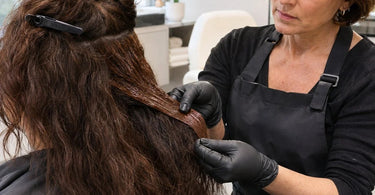
Your time matters - make it count... especially when you are working with a client whose hair seems to multiply every time you lift another section! Understanding why color saturation can vary along extremely dense hair sections is essential for achieving consistent, beautiful results in professional salon services. Hair density can make even a familiar color application surprisingly challenging, creating hidden pockets of untreated strands, uneven pigment distribution, and frustrating differences in the final shade. Fortunately, mastering a few strategic application techniques can help you deliver gorgeous color without turning an ordinary appointment into an all-day adventure.
For professional colorists, extremely dense hair presents a unique combination of challenges involving product distribution, section thickness, hair movement, and processing consistency. Understanding how these factors interact allows you to make informed adjustments before uneven color becomes a problem. Whether you are performing a permanent color service, gray coverage, dimensional highlights, or a complete color transformation, controlling saturation is one of the most important steps toward predictable results.
What Does Hair Color Saturation Actually Mean?
In professional hair coloring, saturation describes how thoroughly the coloring product coats the intended hair strands. Proper saturation means the formula reaches the necessary surfaces throughout each subsection rather than sitting primarily on the visible outer layer.
Imagine spreading frosting across a beautifully layered cake. Covering only the top might look fantastic from above, but the layers underneath would remain completely untouched. Dense hair behaves similarly. A section can appear thoroughly coated while dozens of hidden strands remain insufficiently covered.
This distinction becomes especially important when using Professional Hair Color or Hair Bleaches and Lighteners, because inadequate product coverage can affect pigment deposit, lifting consistency, and the overall appearance of the finished service.
Hair Density and Hair Thickness Are Not the Same Thing
Before adjusting your coloring technique, it helps to distinguish between hair density and individual strand thickness. Density refers to the number of hairs growing within a particular area of the scalp. Strand thickness, sometimes called diameter, describes how fine or coarse each individual hair is.
A client can have extremely dense hair composed of fine strands, while another client may have relatively sparse hair with very coarse individual strands. Both situations can present coloring challenges, but they require different considerations.
Extremely dense hair contains many closely packed strands. This concentration can make it difficult for color to reach the interior of a subsection, particularly when the hair naturally clumps together or has significant curl and texture.
Coarse strands, meanwhile, may behave differently during chemical processing because of their individual structure and resistance. Understanding whether the primary challenge involves density, strand diameter, porosity, or a combination of these factors helps determine the most effective application strategy.
Why the Outer Layers Receive More Color
One of the most common saturation problems occurs when the visible surface of a dense section receives generous product coverage while the interior strands receive substantially less.
This can happen because a color brush primarily contacts the outer hair fibers during application. When the subsection is thick, the product does not automatically travel through every internal layer. The stylist may see an impressive coating on the surface and reasonably assume the section is completely saturated.
Unfortunately, hair color is not a mind reader. It cannot locate the untouched strands hiding underneath simply because the stylist has an excellent attitude.
As the hair processes, thoroughly coated strands may develop the intended color while less-saturated strands retain more of their original pigment. The difference may become particularly noticeable after rinsing, drying, and separating the hair.
For services requiring uniform coverage, working with thinner subsections and applying product to both accessible surfaces can substantially improve consistency.
Why Section Thickness Changes Everything
Sectioning is one of the most powerful tools available to professional colorists working with high-density hair. The thicker the subsection, the more difficult it becomes to distribute product evenly throughout its interior.
For extremely dense hair, subsections around one-quarter inch or thinner may be useful, depending on the hair texture, formula, and application technique. The correct subsection is one that allows the stylist to see and thoroughly coat the intended strands without leaving hidden layers untreated.
Instead of selecting a fixed section thickness for the entire head, adjust subsection size according to the amount of hair actually contained within each parting. A narrow section near the hairline may contain far fewer strands than an equally wide section near the crown.
Professional Hair Brushes and Combs can help create precise partings, while dependable hair sectioning clips keep untreated areas organized and prevent surrounding hair from interfering with application.
Remember that speed should come from an efficient technique, not from making sections unnecessarily large. A few extra minutes spent sectioning correctly can prevent a much longer color correction appointment.
Hair Texture Creates Additional Saturation Challenges
Dense curly, coily, and highly textured hair can create additional application challenges because strands naturally group together and follow complex growth patterns.
Curls and coils may conceal interior surfaces or cause adjacent strands to overlap. Even after a stylist separates the hair, those strands can naturally move back together unless the subsection is properly controlled.
The goal is not to aggressively straighten or stretch the hair during application. Instead, use appropriate tension, careful separation, and manageable subsection sizes to expose the surfaces requiring product.
Hair that is densely packed near the scalp may require particularly close attention during root applications. Gently lifting the subsection and positioning the brush to access the intended growth area can improve coverage without excessive pulling.
When working with delicate or previously processed hair, avoid unnecessary mechanical stress. Consistent saturation should never come at the expense of protecting the hair and maintaining client comfort.
Porosity Can Make Saturation Differences More Visible
Even when product distribution appears uniform, differences in hair porosity can affect the final result. Porosity describes how readily hair absorbs and releases moisture and how its condition influences cosmetic product behavior.
Hair that has experienced previous chemical treatments, environmental exposure, or mechanical damage may respond differently from healthier virgin hair. These differences can occur along a single strand or between separate regions of the head.
For example, a client may have relatively resistant new growth, previously colored mid-lengths, and highly porous ends. Applying one formula uniformly from scalp to ends may not produce an equally uniform result.
Dense hair can make these differences harder to detect during the initial consultation because multiple layers conceal the condition of underlying strands.
Evaluate porosity throughout the head before choosing formulas and application sequences. Where appropriate, consider a compatible porosity equalizer according to its manufacturer instructions.
Remember that porosity products do not replace proper saturation. They address a different variable and should support, rather than substitute for, accurate application.
Why Product Quantity Matters More Than Stylists Expect
Extremely dense hair frequently requires more coloring product than hair of similar length with lower density. Two clients with shoulder-length hair may have dramatically different product requirements simply because one has substantially more individual strands.
Running short on formula halfway through a service creates an obvious temptation to stretch the remaining mixture across increasingly large sections. Unfortunately, thinly spreading product over too many strands can compromise coverage.
During the consultation, evaluate hair density, length, texture, and the specific service to estimate product requirements. Keep additional supplies available so the application can continue without unnecessary interruption.
Quality Mixing Bowls, professional hair color brushes, and precise digital color scales support an organized mixing process.
Always maintain the manufacturer-specified mixing ratio. Adding extra developer or otherwise diluting a formula to make it cover more hair can change its performance and produce unpredictable results.
For lengthy applications, preparing fresh batches when appropriate can help maintain product performance while reducing unnecessary waste. Follow the specific product directions for mixing, working time, and disposal.
Application Pressure and Brush Placement Make a Difference
Color brushes are not simply tools for moving product from a bowl to the hair. Brush angle, pressure, stroke direction, and product loading can all influence saturation.
Using insufficient product on the brush may create a thin surface coating rather than complete coverage. Conversely, excessively aggressive brushing can move product away from the area being treated or disturb previously arranged sections.
For uniform applications, load the brush adequately and work systematically through the subsection. Apply product where needed, then inspect the opposite side when appropriate to confirm coverage.
In very dense areas, separating a subsection into smaller working layers is often more effective than repeatedly pressing additional product onto its outer surface.
When performing lightening services, use the application method required by the chosen technique. Maximum saturation is essential for many foil-lightening applications, while certain balayage techniques intentionally use controlled surface saturation to create softer transitions.
The key is distinguishing intentional artistic placement from accidental underapplication.
Why Roots, Mid-Lengths, and Ends Can Develop Differently
Colorists must also consider how hair behaves in different regions along its length. Natural scalp warmth, previous color history, porosity, and formula placement can all influence processing.
During certain lightening services, warmth near the scalp can accelerate development compared with cooler lengths. Previously processed ends may also react differently from untreated roots.
These factors become particularly important on extremely dense hair because large sections can make it difficult to monitor the entire application consistently.
Follow the manufacturer-recommended application sequence for the specific color system and service. Virgin lightening, root retouches, gray coverage, and color refreshing may require different methods.
Avoid assuming that applying the same formula everywhere at exactly the same moment will always create uniform results. Professional color formulation often requires considering different zones separately.
Processing Time Starts With the Product Instructions
Hair density can extend the amount of time required to complete an application. However, simply leaving color on longer is not a reliable solution to inadequate saturation.
Hair that never received sufficient product cannot be expected to develop properly through additional waiting alone.
During lengthy services, organize the application to minimize unnecessary variation between the first and last treated sections. If the selected color system requires specific timing procedures or fresh mixtures, plan accordingly.
Some professional formulas specify processing time from the completion of application, while other techniques involve carefully staged processing. Always follow the manufacturer instructions rather than applying a universal timing rule.
Do not add heat unless the product specifically permits it. Unapproved heat or excessive processing can compromise the result and increase the risk of hair or scalp damage.
Check the development visually where appropriate and perform strand testing when the service or hair history calls for it.
How to Recognize Incomplete Saturation Before Rinsing
One of the best habits a stylist can develop is performing a saturation check before moving on to the next major section.
Carefully separate treated strands and inspect the interior. Look for areas where the hair appears substantially less coated than the surrounding fibers.
Pay particular attention to the crown, occipital region, behind the ears, and areas where exceptionally dense growth makes clean partings difficult.
Avoid assuming that a generous coating on the exterior guarantees product distribution throughout the section.
For foil applications, inspect whether the intended strands are adequately coated within the foil. For root color, make sure the product reaches the intended regrowth without leaving narrow untreated bands.
This inspection should occur during application, not after the processing period has already ended. Discovering an untouched subsection before the service progresses is far easier to manage than finding a surprise dark patch during the final blowout.
A Practical Salon Workflow for Extremely Dense Hair
Creating a repeatable process helps colorists maintain consistent results while managing appointment time.
Step 1: Evaluate the hair. Examine density, strand diameter, texture, previous chemical services, porosity, scalp condition, and the desired result. Identify areas likely to require extra attention.
Step 2: Plan product requirements. Estimate the quantity of professional color or lightener needed and prepare the appropriate tools. Keep additional product available without mixing excessive quantities too early.
Step 3: Create organized sections. Divide the hair into manageable quadrants or another layout appropriate to the service. Secure untreated sections with professional clips.
Step 4: Work with fine subsections. Adjust subsection thickness based on the number of strands present. Extremely dense areas generally require thinner partings than less-dense regions.
Step 5: Apply product deliberately. Use adequate formula and controlled brush strokes. Inspect both accessible surfaces where appropriate and ensure interior strands receive the required coverage.
Step 6: Maintain consistent processing. Follow product-specific instructions for timing, formula preparation, and any staged application.
Step 7: Rinse and evaluate thoroughly. Dense hair can retain product within interior layers, so follow the manufacturer instructions for complete rinsing and post-color care.
This structured method helps reduce missed areas, improve appointment predictability, and create a more consistent client experience.
Essential Professional Supplies for Better Color Control
Successful dense-hair coloring depends heavily on skill, but having the right supplies can make the process considerably more manageable.
A well-equipped color station should include dependable tint brushes, tail combs, sectioning clips, mixing bowls, measuring equipment, protective gloves, and sufficient professional color products.
Explore Professional Hair Salon & Barber Shop Supplies for tools that support efficient daily salon services.
For color formulations and product selection, professional collections from Wella and Clairol Professional offer options worth exploring according to the services your salon performs.
Professional High-Quality Towels and Protective Gloves & Masks also support an organized, comfortable, and hygienic coloring environment.
Pure Spa Direct supplies professional salon products from established manufacturers, helping beauty professionals find the tools and materials needed for their services. Selecting suitable supplies and following the individual manufacturers' directions remain essential parts of the process.
Common Mistakes That Lead to Patchy Results
Even experienced colorists can encounter saturation problems when working with exceptionally dense hair. Several mistakes are especially common.
Using subsections that are too thick: The surface looks coated while internal strands remain untreated.
Underestimating product needs: Insufficient formula encourages uneven distribution and rushed application.
Relying on combing alone: Combing may help distribute certain products when directed, but it cannot reliably compensate for inadequate initial application. Excessive combing can also disturb placement or stress fragile hair.
Ignoring regional density differences: The crown and back of the head may require different subsection sizes from the hairline.
Overlooking porosity variations: Previously processed hair may absorb or develop color differently from new growth.
Trying to fix missed coverage with extra processing time: Additional time cannot reliably correct areas that received insufficient product.
Recognizing these mistakes early helps prevent avoidable corrections and supports more consistent service quality.
What to Do When Uneven Saturation Has Already Occurred
If a completed service reveals uneven color, resist the temptation to immediately apply another full-head formula.
First, identify the actual cause of the unevenness. Was the product insufficiently applied? Did the hair have different porosity levels? Was the formulation unsuitable for certain areas? Did processing or previous chemical history contribute?
Examine the hair in good lighting and assess its current condition before planning a correction. Isolated missed areas may require a targeted approach, while uneven lift or excessive porosity can demand a more detailed correction strategy.
Perform strand testing when appropriate, particularly after lightening or when the hair has an uncertain chemical history.
Never assume that additional bleach or developer will safely correct every saturation problem. Hair condition, prior processing, and the intended result should determine whether further chemical treatment is appropriate.
When the hair cannot safely tolerate additional processing, discuss realistic alternatives and a gradual correction plan with the client.
How Better Saturation Improves Salon Efficiency
Thinner sections and more deliberate application may initially seem slower, particularly when the appointment schedule already resembles a competitive sporting event.
However, efficiency should be evaluated across the complete service rather than simply measuring how quickly the color reaches the hair.
Accurate application can reduce the likelihood of missed sections, avoidable reprocessing, unexpected color adjustments, and lengthy finishing corrections.
Consistent results also strengthen client confidence. A client who knows their stylist can handle exceptionally dense hair is more likely to feel comfortable booking future color services and discussing additional transformations.
For salons, documenting successful formulas, application sequences, product quantities, and processing observations can improve consistency between appointments. These notes are especially valuable when several stylists share responsibility for a client's services.
Beautiful Color Starts With Complete Coverage
Understanding why color saturation can vary along extremely dense hair sections allows professional stylists to address one of the most overlooked causes of uneven hair color.
The solution is rarely a single miracle product or an aggressive processing adjustment. More often, it involves accurate consultation, carefully controlled section sizes, appropriate product quantities, thorough application, and consistent adherence to manufacturer instructions.
Dense hair offers wonderful opportunities for dimensional color, rich coverage, and dramatic transformations. With the right technique, those abundant strands become a creative advantage rather than an application obstacle.
Stock your salon with dependable professional hair color, explore practical hair color application tools, and keep your color station ready for clients with every imaginable hair density.
Because the only surprise your client should experience after a color appointment is how fabulous their hair looks, not the mysterious uncolored section hiding underneath!

