
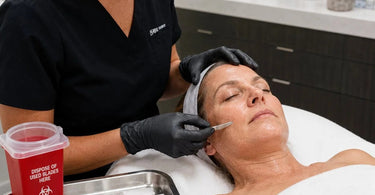
Your path to success begins here... and let's be honest, it rarely includes a surprise trip to the emergency room or a frantic call to your insurance agent. In the bustling world of spas, salons, and barbershops, we wield a lot of power—the power to make people look and feel fantastic. But with great power comes great responsibility, and sometimes that responsibility comes in a tiny, incredibly sharp package: the humble facial razor. We're not just talking about a quick swipe to tidy up some brow hairs. We're talking about the workhorses of dermaplaning, the precision tools for shaping, and the unsung heroes of a smooth, flawless finish. However, the moment that blade has done its job, a magical transformation occurs: it turns from a tool of beauty into a potential biohazard. A clear, foolproof disposal procedure isn't just a good idea; it's the invisible shield that protects your team, your clients, and your business reputation. So, grab a cup of coffee (or something stronger, we don't judge), and let's dive into the sharp world of facial razor disposal—where safety meets sanity and a little bit of humor.
Let's face it—no one gets into the beauty industry because they have a passion for sorting through trash. But here's the reality: the non-medical sharps like facial razors, dermaplaning tools, and even those tiny wax applicators have a dark side. In a world where blood-borne pathogens are a concern, these items are classified as 'sharps' for a reason. From a regulatory standpoint, many states have clear-cut rules. For instance, guidelines from Georgia emphasize that sharps like razor blades should be disposed of in a proper container, and they must be stored upright with the right labels . We're not just trying to make your life difficult; we're trying to make sure a client's accidental nick doesn't become your biggest headache.
The 'Ouch' Factor: Why This Isn't Just About Throwing Things Away
Imagine this: you've just finished a flawless dermaplaning session. Your client is glowing, you're feeling proud, and you casually toss that used blade into the trash can under your station. Simple, right? Wrong. That little blade is now a ticking time bomb. According to public health guidance, a single-use razor is considered high-risk after a single use because it has the potential to transmit skin infections or blood-borne viruses . The moment a razor touches a client's skin, even without visible blood, it's contaminated. Treating it like regular garbage is a gamble no one should take.
Think about the logistics. That used razor is now sitting in a bag with coffee cups and paper towels. A staff member reaches in to pull out the trash, and *slice*—a needlestick injury occurs. Suddenly, that 'harmless' piece of trash has become a significant health scare, requiring medical testing, potential post-exposure treatment, and a mountain of paperwork. As one source bluntly puts it, you don't have to see blood on instruments to get an infection . Plus, the financial cost of a single sharps injury can be estimated at around $3,000 per victim, leading to an industry burden of over $1 billion annually . Yikes! That's a lot of retail products you'd have to sell to cover that.
The Legal Lowdown: Navigating the Regulatory Red Tape
Okay, so we know it's dangerous. But you might be thinking, 'Doug, what's the worst that could happen legally?' Well, that's where things get really interesting. Let's take a quick tour around the regulatory landscape, shall we? In Iowa, for example, administrative code clearly states that establishments must maintain a biohazard sharps container for disposing of used razor blades and other sharp instruments. These need to be placed close to where you use them and disposed of properly when full . They're not just suggestions; these are rules backed by state law.
Heading over to New Jersey, they have a specific take on shaving and preparation of the skin. Their rule says a single-use disposable razor shall be used and can be disposed of as general garbage only if the client's skin has not been broken . However—and this is a big 'however'—if the skin has been broken, it must be disposed of as regulated medical waste . That's a critical distinction that many professionals might miss. Are you checking the skin for micro-tears before deciding which bin to toss it in? Probably not. That's why it's just safer to treat all facial razors as medical waste. As one industry resource notes, even if your state doesn't specifically regulate med spa waste, collecting and managing sharps properly will help keep your employees and clients safe .
In South Dakota, the rule is refreshingly simple: razors must be disposable single-use only and discarded after one patron . While it doesn't specify the exact disposal method, it underscores the principle of single-use. In a nutshell, authorities are very serious about how you handle used blades. It's a compliance issue that touches on OSHA standards for bloodborne pathogens, and it's one of the fastest ways to get on a regulator's radar if you're caught cutting corners .
The Tools of the Trade: Your Sharps Disposal Arsenal
So, you're convinced. You need a proper disposal system. But what does that actually look like in a treatment room? It doesn't have to be a massive, industrial-looking bin that scares your clients. The market offers a variety of sleek, functional, and discreet options. You can find containers specifically designed for the beauty industry that are not only compliant but also aesthetically pleasing. For instance, there are blade removal boxes that hold up to 100 used blades, designed to be small and discreet, perfect for tucking away in a drawer without sacrificing compliance . These boxes are also a safer way to remove blades from handles than using forceps, reducing the risk of a cut during the disposal process itself .
Other products like the 'Disposable Blade Remover' are designed to prevent cuts, scrapes, and possible infection when removing and disposing of blades—no direct contact required . They are round, palm-sized, and can store not only scalpel blades but also dermaplaning razors and other small sharps . These products are often made of durable, rigid polypropylene and are engineered to be a simple yet efficient part of your workflow.
But the options don't stop there. If you're looking for a more comprehensive solution, mail-back programs are a fantastic option. These kits include a sharps container, step-by-step instructions, a pre-addressed, postage-paid return shipping label, and a barcoded return shipping container . You fill it, you ship it, and it's taken care of. No muss, no fuss, and complete peace of mind. It's a cost-effective and convenient way to manage waste, especially if you're a smaller studio or med spa that doesn't generate massive volumes of medical waste .
Dermaplaning and Disposal: A Match Made in Hygiene Heaven
Let's talk about the elephant in the room (or rather, the elephant on the treatment table): dermaplaning. This service is exploding in popularity, and for good reason. It's incredible for exfoliation and creating a glowing complexion. But it relies on a very sharp blade. The importance of clear disposal procedures becomes magnified in this context. If you are offering Dermaplaning services, you are handling surgical-grade scalpels. These aren't just 'razors' in the traditional sense; they are medical-grade sharps.
When you use a Dermaplaning Blade, the manufacturer's instructions typically tell you to never try to re-sheath the scalpel and to dispose of it immediately in a puncture-resistant container according to local guidelines . This isn't negotiable. It's a life-or-death (or at least a career-or-lawsuit) scenario. You need to have a clear procedure in place for your estheticians that is drilled into their muscle memory: use the blade, finish the service, and immediately place it in the designated sharps container. No setting it down on the counter. No tossing it in the regular trash. It's a one-way trip from your hand to the disposal box.
Furthermore, if you are using products like Pre & Post-Waxing Products to prep the skin, a facial razor might be used to remove fine vellus hair. Even if you don't draw blood, the risk is still there. The simple act of micro-exfoliation creates tiny, invisible micro-abrasions that could potentially be a vector for infection . So, treat every single razor, whether it's for a full dermaplane or just a quick tidy-up, with the exact same level of caution.
The Human Element: Training Your Team
Let's be real. Having the best sharps container in the world is useless if your team doesn't use it. A clear disposal procedure is only effective if it's communicated, demonstrated, and enforced. In today's fast-paced environment, it's easy to get sloppy. That's why training should be continuous and engaging. Make it part of your onboarding process. Make it a topic of discussion at monthly team meetings. Maybe even create a funny 'Worst Disposal Practices' poster for the break room (humor helps!).
Your staff needs to know the 'why' behind the 'what.' When they understand that a simple cut can lead to serious health risks and potential legal liability, they'll be more inclined to take it seriously. We're talking about protecting their own health, the health of their beloved clients, and the reputation of the business that signs their paychecks. As the CDC advises, all staff should be trained and prepared to respond appropriately to incidents involving accidental cuts or exposure to blood or bodily fluids . This includes knowing exactly where the sharps containers are, how to change them, and who to call if there is a spill. The goal is to create a culture where safety isn't just a policy on a dusty shelf but a deeply ingrained habit.
What Happens Inside the Container: It's Not Just a Box
You've got your sharps container. It's on the counter, it's got the biohazard label, and your team is using it. But what happens when it's three-quarters full? You don't just duct-tape it and toss it in the dumpster, right? Right. You shouldn't. The container itself has specific handling requirements. Many regulations state that sharps containers must be properly disposed of when they reach three-quarters (3/4) full . They often require a Hygienic Table Paper or other containment within the box to absorb any leaks.
This is where a partnership with a medical waste disposal company becomes invaluable. They handle the pickup, the transportation, and the treatment of the waste, usually through incineration or other sterilization methods. It's not the most glamorous part of the beauty industry, but it's one of the most critical. It ensures that those tiny blades don't end up in a landfill where they could injure sanitation workers or potentially harm the environment. Many services provide a complete waste management program, offering online training, certificates for staff education, and easy-to-understand guides on waste segregation and safety . It's about having a system that starts the moment you open a new blade and ends with it being safely destroyed.
The Bottom Line: Protecting Your Business and Reputation
Let's talk about money and reputation. A negative online review about a client getting cut is one thing. A lawsuit because a staff member was exposed to a bloodborne pathogen due to improper disposal is a whole different beast. Medical spas, for instance, generate regulated medical waste including sharps and biohazards that pose serious health and environmental risks if not disposed of properly . Your compliance isn't just about avoiding penalties from OSHA, the EPA, or your state's Department of Health; it's about demonstrating to your clients that you are a professional establishment that takes their safety seriously.
When a client sees a biohazard container in your treatment room, they might not know exactly what it is, but it sends a subconscious signal that you are hygienic and compliant. It builds trust. It shows that you care about the details. And let's be honest, in the age of social media, trust is currency. A clear disposal procedure isn't just about sharp objects; it's about the overall perception of your brand. It's about sending the message that you are a premium, safety-first destination.
Bringing It All Home: The Pure Spa Direct Perspective
At Pure Spa Direct, we're not just distributors; we're your partners in building a successful, safe, and profitable business. We understand the challenges of running a bustling spa or salon. There are a million things to juggle, from client appointments to inventory management. That's why we want to make safety as easy and streamlined as possible. You shouldn't have to dig through a thousand products to find the right Professional Cleaners & Disinfectants for Salons and Spas for your surfaces or the perfect Professional Cotton, Sponges, and Wipes for your services.
We source products from the top brands like thermaBliss, Earthlite, and Gigi to ensure you have everything you need. But beyond the products, we believe in empowering you with knowledge. A well-informed professional is a successful one. And a safe one is a successful one. By implementing clear disposal procedures for facial razors, you're not just checking a box. You're building a legacy of excellence, one that protects your team, your clients, and your bottom line.
So, the next time you finish a service and you're about to carelessly toss that blade, stop. Take a second. Walk it to the sharps container. Drop it in. And give yourself a little pat on the back. You just made your spa safer, your staff happier, and your business that much more robust. Now, let's get back to the fun stuff—making people look and feel beautiful.
